


TL;DR:
- Successful mechanical contractors recognize that leadership involves high emotional intelligence and strong communication skills. They identify potential leaders early through mentoring behaviors, ownership, and adaptability, using stretch assignments to assess readiness. External hiring requires behavioral interviews focusing on past influence, with continuous development and clear career paths boosting retention.
Sourcing mechanical leadership talent means identifying and recruiting professionals who combine technical credibility with the people skills to run crews, manage projects, and grow a contracting business. In HVAC and plumbing, this is harder than it sounds. Emotional intelligence accounts for nearly 90% of the factors that separate leaders from high performers with equal technical ability. That gap explains why so many contractors promote their best technician and then watch their best team fall apart.
What leadership skills should mechanical contractors look for?
The right leader in a mechanical contracting business does more than read blueprints and pull permits. Successful leadership requires trading deep technical problem-solving for communication, trade-off management, and decision-making at an organizational level. That shift is not natural for most field technicians, and contractors who ignore it pay for it in turnover and missed deadlines.
Research identifying 103 distinct leadership practices across engineering environments grouped them into five categories: people management and development, processes and execution, professional growth, communication, and strategic vision. The same research flagged micromanagement and counterproductive communication as the most damaging leadership behaviors. For HVAC and plumbing contractors, those findings translate directly to the field.
The leadership qualities worth prioritizing include:
- Emotional intelligence: The ability to read a crew, manage conflict, and stay composed under pressure
- Communication: Clear direction-giving, active listening, and honest feedback without drama
- Delegation: Trusting technicians to own tasks rather than hovering over every job
- Strategic vision: Understanding how field decisions affect project margins and client relationships
- Accountability: Holding teams to standards without creating a culture of fear
Pro Tip: When screening candidates, ask how they handled a situation where a crew member underperformed. The answer reveals more about leadership style than any technical question.
How to identify emerging leaders in your mechanical workforce
Leadership potential shows up long before someone is ready for a title. Signals like natural mentorship and handling ambiguity predict future leaders years before any formal promotion. Contractors who wait until a role opens to start looking will always be behind.
The behavioral signals worth tracking in your current workforce include:
- Mentoring without being asked. The technician who walks a junior crew member through a repair without prompting is already leading.
- Ownership beyond their scope. They flag problems outside their job description because they care about the outcome.
- Business curiosity. They ask about project margins, scheduling logic, or client expectations.
- Adaptability under pressure. They adjust when a job changes mid-day without complaining or freezing.
- Conflict resolution. They de-escalate tension between crew members before it reaches a supervisor.
Stretch assignments are the most reliable way to test these signals before committing to a promotion. Giving a senior technician responsibility for a small crew on a contained project reveals how they perform under real conditions. Stretch assignments two to three years before promotion significantly reduce the risk of a failed leadership transition.
Pro Tip: Build a simple observation log for each high-potential employee. Note specific behaviors monthly. Patterns become clear fast, and you will have evidence to support promotion decisions when the time comes.

How to recruit mechanical leadership talent from outside your company
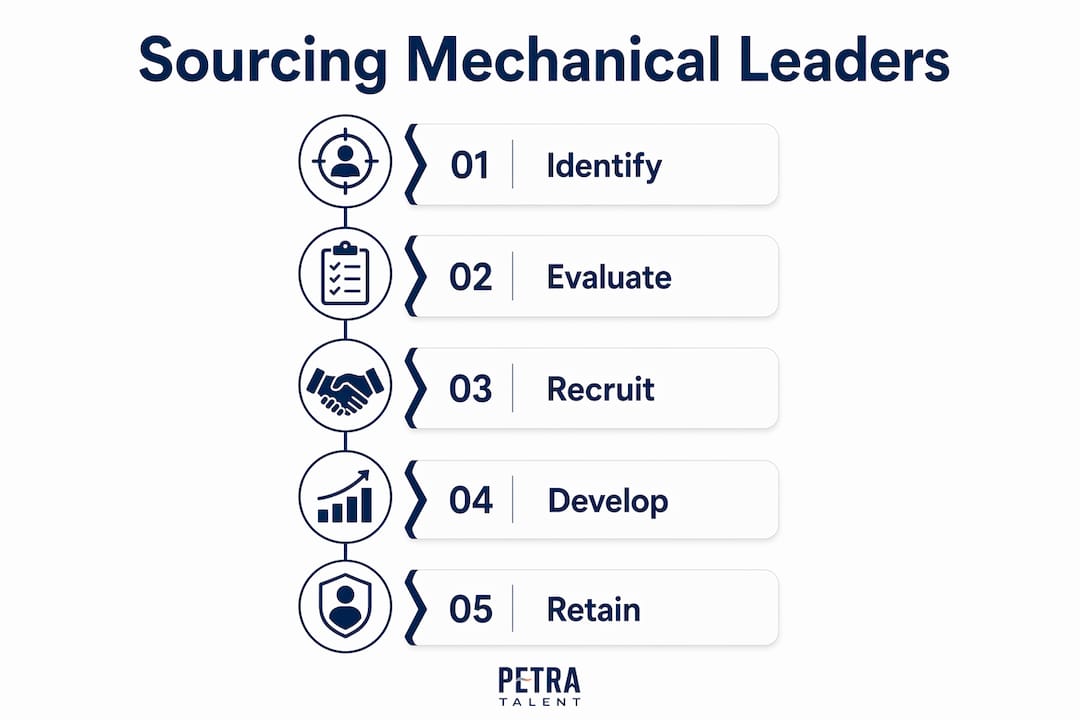
Internal development is the preferred path, but not every contractor has a ready pipeline. When sourcing talent externally, the interview process needs to shift away from technical tests and toward behavioral evidence.
Interviewing for leadership should focus on past behaviors and real incident retrospectives rather than hypothetical scenarios or code-style questions. Ask candidates to walk through a specific project where they influenced an outcome without formal authority. Ask for examples of mentoring someone who struggled. Those answers reveal judgment in a way that a resume never will.
The hiring bar for engineering managers should match the bar for senior engineers. A manager who cannot command technical respect from licensed plumbers or HVAC journeymen creates more problems than the vacancy did. Promoting the wrong person damages the team and often costs the company a good technician at the same time.
| Sourcing method | Strengths | Limitations |
|---|---|---|
| Internal promotion with stretch assignments | Cultural fit, lower risk | Requires long lead time |
| Trade association networks | Industry-specific candidates | Smaller candidate pool |
| Specialty recruitment partners | Vetted, faster placement | Requires clear role definition |
| General job boards | Wide reach | Low signal-to-noise ratio |
For contractors hiring plumbing leadership roles, the vetting process should include direct questions about crew size managed, project delivery outcomes, and how the candidate handled a failed inspection or a client dispute.
How to develop and retain mechanical leaders after hiring
Hiring a leader is the beginning, not the end. Continuous leadership development and objective KPIs improve both leadership quality and retention over time. Without a structured development plan, even strong hires plateau or leave.
The most effective retention and development practices for mechanical leadership roles include:
- Track leadership KPIs. Measure team retention rates, crew engagement, and project delivery consistency. These numbers tell you whether a leader is actually performing.
- Assign a mentor. Pair new leaders with experienced project managers or superintendents who can provide skip-level perspective.
- Run regular feedback loops. Monthly one-on-ones focused on leadership challenges, not just project status, build self-awareness faster than annual reviews.
- Communicate career paths clearly. Leaders who see a defined path to senior management or ownership stay longer than those who feel capped.
- Reinforce leadership culture. Recognize leaders publicly when their crews perform well. Culture is built through repeated, visible behavior.
Contractors who treat leadership development as a one-time onboarding event consistently lose their best people to companies that invest in them. The mechanical trades have a well-documented skilled trades gap that makes retention a competitive advantage, not just a nice-to-have.
Key Takeaways
Sourcing mechanical leadership talent requires a structured approach that combines early identification, behavioral interviewing, and continuous development rather than reactive promotion decisions.
| Point | Details |
|---|---|
| Emotional intelligence is the top predictor | EI accounts for nearly 90% of leadership success factors in technical fields. |
| Identify leaders before they are ready | Behavioral signals like mentoring and ownership appear years before formal readiness. |
| Raise the hiring bar for managers | A poor leadership hire damages teams and costs the company a skilled technician. |
| Use behavioral interviews externally | Ask for real incident examples and evidence of influence without formal authority. |
| Track leadership KPIs consistently | Retention rates, engagement scores, and delivery predictability measure leadership quality objectively. |
What I have learned about sourcing mechanical leaders
The most common mistake I see mechanical contractors make is treating a leadership hire as a technical promotion with a pay raise attached. The skills that make someone an outstanding HVAC technician or master plumber are not the same skills that make them an effective crew leader or project manager. Transitioning to a leadership role is a career change, and contractors who treat it as anything less set their best people up to fail.
The contractors who get this right share one habit: they build their leadership pipeline before they need it. They observe their workforce continuously, assign stretch responsibilities early, and use emotional intelligence as a genuine screening criterion, not an afterthought. They also know when to look outside their own company and how to vet candidates who have the right instincts but come from a different trade context.
Reactive hiring, where a foreman leaves on a Friday and a contractor scrambles to fill the gap by Monday, almost always produces a bad outcome. Proactive pipeline building, even informal, changes the entire equation. The contractors I have seen grow fastest are the ones who treat leadership development as part of their business model, not a human resources problem.
— David
Petratalent’s approach to mechanical leadership recruitment
Finding the right leader for an HVAC or plumbing operation takes more than posting a job listing. Petratalent specializes in leadership sourcing and vetting for mechanical contractors across the United States, with a process built around behavioral screening, technical credibility checks, and market wage benchmarking.
Contractors working with Petratalent get access to a candidate pool that has already been filtered for the leadership qualities that matter in field operations: communication, crew management experience, and the ability to hold teams accountable without losing them. Petratalent also provides workforce consultation to help contractors define what a leadership role actually requires before the search begins. For contractors ready to build a stronger leadership bench, HVAC recruiting services from Petratalent offer a structured path from open role to placed leader.
FAQ
What is mechanical leadership talent?
Mechanical leadership talent refers to professionals in HVAC, plumbing, or related trades who combine technical credibility with the people management, communication, and decision-making skills needed to lead crews and projects effectively.
Why is emotional intelligence important for mechanical leaders?
Emotional intelligence accounts for nearly 90% of the factors that separate leaders from peers with equal technical skills. In high-pressure field environments, EI directly affects crew retention and project outcomes.
How do you identify leadership potential in field technicians?
Look for technicians who mentor others without being asked, take ownership beyond their assigned scope, and stay composed when job conditions change. These behaviors predict leadership readiness years before a formal promotion.
What interview questions work best for mechanical leadership roles?
Ask candidates to describe a specific situation where they influenced a team outcome without formal authority. Behavioral interview questions focused on real incidents reveal judgment and leadership instinct better than hypothetical scenarios.
How should contractors retain mechanical leaders once hired?
Track objective KPIs like team retention and project delivery rates, assign mentors, and communicate clear career paths. Leaders who see growth opportunities and receive consistent feedback stay significantly longer than those who do not.
Recommended
Post a comment
Related Posts
July 13, 2026
Performance-Based Screening for HVAC and Plumbing Hiring
Discover what is performance-based screening and how it enhances HVAC and plumbing hiring. Improve candidate…
July 12, 2026
Types of Plumbing Trade Certifications: A Career Guide
Explore the types of plumbing trade certifications to enhance your career. Learn how these credentials…
July 11, 2026
Why Plumbing Certifications Affect Hiring Decisions
Discover why plumbing certifications affect hiring decisions. Learn how these credentials impact wages, legal authority,…

July 10, 2026
What Contractors Miss When Hiring Plumbers Without Recruitment Agencies
Hiring plumbers might seem straightforward at first. Many contractors believe that posting a job and…