



TL;DR:
- Performance-based screening evaluates candidates through job-relevant tasks to better predict success. It significantly reduces turnover and shortens hiring cycles by focusing on demonstrated skills. Contractors who use structured, validated evaluations gain a competitive hiring advantage.
Performance-based screening is defined as the evaluation of candidates through job-relevant tasks and assessments that mirror actual work demands, rather than relying on resumes or unstructured interviews alone. For hiring managers and HR professionals in HVAC and plumbing, this method is the clearest path to predicting whether a technician or plumber will succeed on the job. Research from SHRM and industrial psychologists like Schmidt and Hunter confirms that structured, task-based evaluation outperforms traditional credential reviews in both predictive accuracy and retention outcomes. Petratalent applies these principles specifically to skilled trades recruitment across the United States.
What is performance-based screening and why does it matter?
Performance-based screening is a structured hiring method that asks candidates to demonstrate skills through tasks that reflect real job responsibilities. The industry term for this approach is “performance-based evaluation,” and it sits within the broader category of evidence-based hiring. Traditional interviews ask candidates what they would do. Performance-based evaluation asks them to show it.

The difference matters because confidence does not equal capability. A technician who interviews well may still struggle with refrigerant recovery procedures or reading load calculations under pressure. Structured task-based screening separates those two things cleanly. For HVAC and plumbing contractors managing tight crews and demanding service schedules, that separation is the difference between a reliable hire and a costly replacement.
Performance-based recruiting focuses on measurable outcomes, not credentials, which also improves diversity and the overall quality of hire. That means contractors stop filtering on certifications alone and start filtering on demonstrated ability.
How does performance-based screening work in skilled trades?
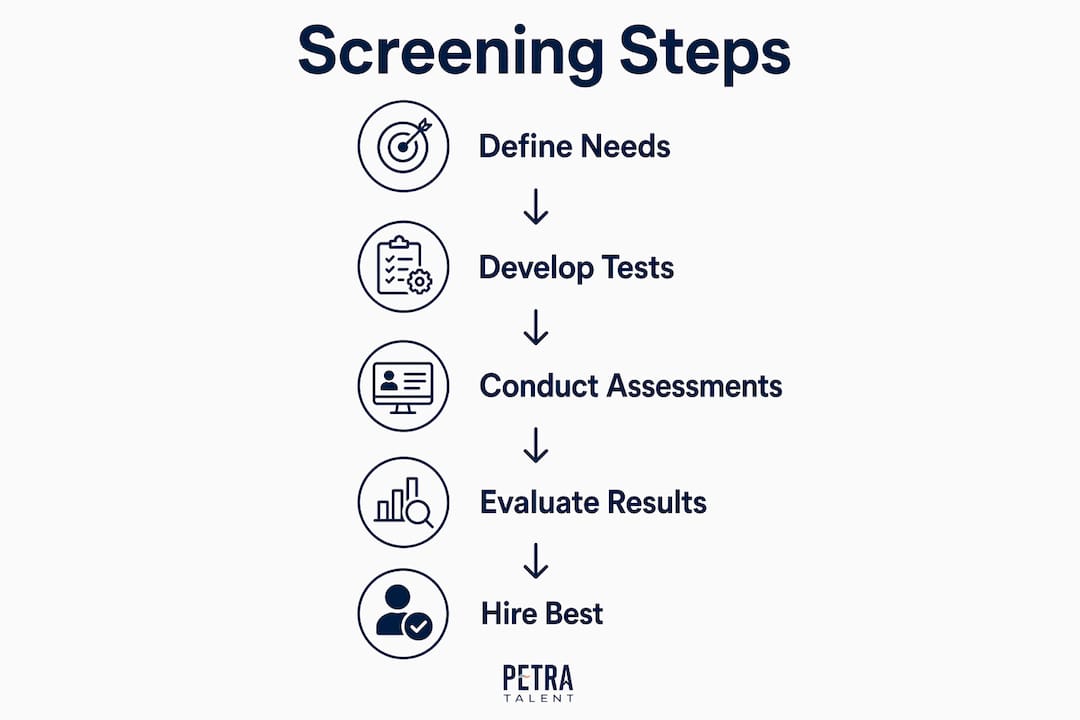
The process follows a defined sequence. Each step adds a layer of evidence before a hiring decision is made.
- Knockout questions. Short, pass/fail questions filter out candidates who lack non-negotiable qualifications, such as a valid EPA 608 certification or a journeyman plumbing license. These take minutes and protect the rest of the process from wasted time.
- Cognitive and situational judgment tests. Candidates respond to realistic scenarios drawn from the job. An HVAC example: “A customer reports a system that short-cycles every 20 minutes. What are your first three diagnostic steps?” Situational Judgment Tests correlate at 0.34 with job performance and predict customer service behaviors effectively, making them well-suited for hourly field roles.
- Work sample tasks. Candidates complete a task that mirrors actual job duties. For plumbing roles, this might involve reading a pipe schematic or identifying a code violation in a diagram. For HVAC, it could mean interpreting a refrigerant pressure chart.
- Structured interviews. Interviewers use a fixed question set and a scoring rubric. Every candidate answers the same questions, and responses are scored against defined criteria.
Pro Tip: Build your knockout questions around your three most common reasons for early termination. If new hires consistently fail because they cannot read wiring diagrams, make diagram interpretation a knockout criterion.
Automation supports this process by handling initial screening at scale. Optimized screening processes produce a 55% faster time-to-fill and save managers 4–5 hours per week per 100 applications. That time savings compounds quickly during peak hiring seasons.
What are the benefits of performance screening over traditional hiring?
The case for performance-based evaluation rests on measurable outcomes, not theory.
- Higher predictive accuracy. Structured screening reaches a predictive validity of 0.51, compared to 0.20 for unstructured interviews. An unstructured interview is barely better than a coin flip at predicting job performance.
- Lower turnover. Validated pre-employment assessments reduce staff turnover by an average of 65%. For HVAC and plumbing contractors, where replacing a journeyman technician can cost tens of thousands of dollars in lost productivity and recruiting fees, that reduction is significant.
- Faster hiring cycles. The 55% improvement in time-to-fill means open positions get filled before they drain your existing crew.
- Reduced subjective bias. Structured rubrics evaluate observable behaviors, not gut feelings. That consistency protects contractors from both bad hires and legal exposure.
- Better onboarding data. Screening results reveal where a new hire needs support before their first day. That information makes onboarding more targeted and effective.
The importance of performance screening becomes especially clear in high-volume hiring periods, when the pressure to fill seats fast leads to shortcuts that hurt retention later.
Common performance assessment techniques for HVAC and plumbing roles
Different techniques serve different hiring goals. The table below outlines the most common performance assessment methods used in skilled trades recruitment.
| Technique | Best used for | Key strength |
|---|---|---|
| Situational Judgment Tests (SJTs) | Field technicians, customer-facing roles | Predicts judgment and service behavior |
| Work sample tests | Hands-on trade tasks | Directly measures job-relevant skill |
| Behavioral structured interviews | All roles, especially senior | Surfaces past performance patterns |
| Automated phone or video screening | High-volume initial screening | Scales efficiently, reduces scheduling load |
Situational Judgment Tests are particularly effective for HVAC and plumbing because they assess how a candidate thinks through a problem, not just whether they know the answer. A question like “A homeowner is upset because their new system is louder than expected. How do you respond?” tests both technical knowledge and customer communication at once.
Work sample tests for plumbing roles might include identifying a code violation in a residential drain layout or calculating pipe sizing for a given fixture count. For HVAC, interpreting a psychrometric chart or diagnosing a fault from a set of pressure readings works well. These tasks require candidates to apply skills under real-world pressure, not just recall information.
Pro Tip: Pair every work sample test with a brief verbal debrief. Ask the candidate to walk you through their reasoning. That conversation reveals problem-solving depth that the task result alone cannot show.
For plumbing workforce vetting, combining SJTs with a structured behavioral interview produces the most complete picture of a candidate’s readiness.
How to implement performance-based screening in your hiring process
Effective implementation follows a clear sequence. Skipping steps produces inconsistent results.
- Define measurable performance objectives first. Identify the three to five behaviors that separate your top performers from average ones. These become your screening criteria. For an HVAC service technician, that might include diagnostic speed, first-call resolution rate, and customer communication quality.
- Select or build validated screening tools. Match each tool to a specific performance objective. A work sample test for diagnostic speed. An SJT for customer communication. A structured interview for past resolution patterns.
- Use a consistent scoring rubric. Consistency in screening questions and scoring criteria is more impactful than speed or expensive tools without structure. The SCORE framework (Specific, Consistent, Observable, Recorded, and Equitable) provides a practical standard for building rubrics.
- Integrate screening data into onboarding. Pre-hire screening data informs onboarding, coaching, and early performance management. A candidate who scored low on customer communication scenarios needs structured coaching in week one, not week twelve.
- Protect the candidate experience. Long, poorly explained screening processes drive strong candidates away. Keep each stage under 30 minutes and communicate clearly about what comes next.
Pro Tip: Run your screening process on a current top performer before using it on candidates. If your best technician would struggle with a task, the task is measuring the wrong thing.
For guidance on structuring your HVAC hiring process around these principles, Petratalent provides frameworks built specifically for mechanical contractors.
Key Takeaways
Performance-based screening outperforms traditional hiring methods in predictive accuracy, turnover reduction, and hiring speed, making it the most reliable evaluation approach for HVAC and plumbing contractors.
| Point | Details |
|---|---|
| Definition | Performance-based screening evaluates candidates through job-relevant tasks, not resumes alone. |
| Predictive accuracy | Structured screening reaches 0.51 predictive validity versus 0.20 for unstructured interviews. |
| Turnover impact | Validated assessments reduce turnover by an average of 65%, cutting replacement costs significantly. |
| Key techniques | SJTs, work sample tests, and structured behavioral interviews are the most effective methods for trades roles. |
| Implementation anchor | Consistent scoring rubrics matter more than expensive tools without defined criteria. |
What I’ve learned from watching trades hiring go wrong
The most common mistake I see in HVAC and plumbing hiring is treating speed as the primary goal. Contractors fill a seat fast, skip the structured evaluation, and then spend three months managing a poor fit before starting over. The total cost of that cycle is always higher than the time a proper screening process would have taken.
The second mistake is treating screening as a gate rather than a data source. The information gathered during a structured assessment tells you exactly where a new hire needs support. Contractors who use that data in onboarding see faster ramp-up times and stronger early retention. Those who ignore it repeat the same coaching conversations every quarter.
Hiring teams also face a real tension between speed, quality, and candidate experience. Structured rubrics resolve that tension better than any single tool. They make the process faster because evaluators spend less time debating subjective impressions. They improve quality because every candidate is measured against the same standard. And they protect the candidate experience because the process feels fair and organized.
The contractors I respect most treat their screening process as a competitive advantage. When your evaluation is more accurate than your competitors’, you hire better people and keep them longer. That compounds over time.
— David
Petratalent’s approach to performance-based hiring
Hiring managers and HR professionals in HVAC and plumbing do not need a generic recruiting agency. They need a partner who understands the difference between a journeyman and a master plumber, and who can evaluate candidates against the specific demands of field service, construction, and leadership roles.

Petratalent provides technical vetting and workforce solutions built specifically for mechanical contractors. The screening process covers role-specific candidate sourcing, structured performance evaluation, and market wage benchmarking. For contractors managing common HVAC recruitment challenges, Petratalent offers workforce consultation that connects screening data to long-term hiring strategy. Contact Petratalent to discuss how structured, validated screening can improve your next hire.
FAQ
What is performance-based screening in simple terms?
Performance-based screening evaluates candidates by having them complete tasks that reflect actual job duties, rather than relying on resumes or unstructured interviews. The goal is to measure what a candidate can do, not just what they claim.
How does performance-based evaluation reduce turnover?
Validated assessments match candidates to roles based on demonstrated ability, which reduces the mismatch that causes early exits. Research shows validated pre-employment assessments reduce turnover by an average of 65%.
What performance screening techniques work best for HVAC roles?
Situational Judgment Tests and work sample tasks are the most effective techniques for HVAC hiring. SJTs assess field judgment and customer communication, while work samples test hands-on diagnostic and technical skills directly.
How long does a performance-based screening process take?
A well-structured process typically runs across two to three stages and takes candidates under two hours total. Automated initial screening reduces manager time by 4–5 hours per week per 100 applications.
Can small HVAC or plumbing contractors use performance-based screening?
Yes. Small contractors can start with two tools: a structured interview rubric and one job-relevant work sample task. Consistency in scoring matters more than the number of assessment stages.
Recommended
Post a comment
Related Posts

July 14, 2026
How to Source Mechanical Leadership Talent Effectively
Learn how to source mechanical leadership talent effectively. Discover key skills needed for success in…

July 12, 2026
Types of Plumbing Trade Certifications: A Career Guide
Explore the types of plumbing trade certifications to enhance your career. Learn how these credentials…

July 11, 2026
Why Plumbing Certifications Affect Hiring Decisions
Discover why plumbing certifications affect hiring decisions. Learn how these credentials impact wages, legal authority,…

July 10, 2026
What Contractors Miss When Hiring Plumbers Without Recruitment Agencies
Hiring plumbers might seem straightforward at first. Many contractors believe that posting a job and…