




TL;DR:
- Plumbing workforce vetting involves layered background checks, license verification, and practical skill assessments to ensure safety and compliance. Tiered screening assigns check intensity based on access level and risk, incorporating continuous criminal monitoring for high-risk roles. Properly following legal and procedural standards reduces liability, enhances quality, and improves hiring outcomes.
Plumbing workforce vetting is the structured process of verifying a candidate’s identity, criminal history, license status, driving record, and technical skills before placing them on a job site or inside a client’s home. The industry term for this process is “contractor screening,” and it covers everything from a basic SSN trace to hands-on skills assessments scored against a standardized rubric. Contractors who skip or compress this process expose themselves to liability, rework costs, and reputational damage that a single bad hire can cause. The Fair Credit Reporting Act (FCRA), state licensing boards, and FMCSA driving record requirements all shape how this process must be structured to remain legally defensible.
How plumbing workforce vetting works: the background check layers
Background checks for plumbing candidates follow a specific sequence, and the order matters as much as the checks themselves. Multi-layer identity verification anchors the entire process: without a confirmed identity, every subsequent check is unreliable. A standard New Jersey-style safety screening sequence runs SSN trace, national and multi-state criminal search, sex offender registry check, motor vehicle record (MVR) review, license verification, and a 5 to 10 panel drug screen. Each layer catches a different category of risk that the others miss.
- SSN trace and identity verification. This step confirms the candidate is who they claim to be and surfaces all addresses and name variations associated with that Social Security Number. It defines the geographic scope for criminal record searches.
- Criminal record searches. National, state, and county-level searches must all run independently. A national database search alone misses records that have not been indexed at the federal level.
- Sex offender registry check. Plumbers work inside occupied homes. This check is non-negotiable for any technician with residential access.
- MVR review. FMCSA guidelines require pulling driving history across all states where a candidate held a license in the past three years, plus drug and alcohol clearinghouse queries for safety-sensitive roles. Plumbing technicians operating company vehicles fall into this category.
- Drug testing. A 5 to 10 panel screen conducted at a certified collection site provides a defensible record. Urine-based testing remains the most common method for pre-employment screening in the trades.
Pro Tip: Tier your background checks based on access level, not just job title. A technician doing exterior work needs fewer checks than one entering an occupied home unsupervised.
How to verify plumbing licenses and credentials properly

License verification is not a single database lookup. Confirming active license status means checking that the license is current, in good standing, and matches the specific scope of work the candidate will perform. A general plumbing license does not authorize gas fitting work in most states. Contractors who miss this distinction face code violations, failed inspections, and potential liability for unpermitted work.
A thorough license verification process covers the following:
- License status. Confirm the license is active and not expired, suspended, or revoked through the relevant state licensing board portal.
- License type match. Verify the license category aligns with the job scope. Gas fitting, medical gas, and backflow prevention each require separate endorsements in many jurisdictions.
- Complaint and disciplinary history. State boards maintain records of formal complaints and disciplinary actions. Disciplinary history checks reveal patterns that a resume will never show.
- Insurance and workers’ compensation. Request current certificates of insurance directly from the carrier, not from the candidate. Expired or fraudulent certificates are a common red flag.
- Permit-pulling willingness. A licensed plumber who resists pulling permits is a liability. This behavior often signals unlicensed work history or an attempt to avoid inspection.
Document every verification result with a date stamp and the source used. This creates an audit trail that protects the contractor if a dispute arises later.
What role does skill-based vetting play in plumbing workforce selection?
Credentials confirm legal authorization to work. They do not confirm whether a candidate can diagnose a slab leak under pressure or replace a water heater without creating a callback. Structured practical evaluations predict long-term job quality better than resumes or interviews alone. The standard process runs in three stages:
- Pre-screen call (10 minutes). Confirm license status, availability, valid driver’s license, and basic tool familiarity. This filters out unqualified candidates before investing more time.
- Hands-on or video skills test (30 to 60 minutes). Candidates complete common plumbing tasks such as leak diagnosis, fixture replacement, or pipe fitting. Rubric-scored work samples reduce evaluator bias and create a consistent standard across all candidates.
- Behavioral interview. Questions focus on customer interaction scenarios, safety decision-making, and how the candidate handles callbacks. Structured behavioral interviews combined with practical tests outperform resumes alone for predicting on-the-job reliability.
Pro Tip: Order skill assessments before background checks when possible. Fair chance hiring practices recommend this sequence to avoid disqualifying candidates prematurely on record alone before confirming they have the technical ability the role requires.
Skill vetting also serves as a quality signal to candidates. A contractor who runs a structured assessment process signals to top-tier technicians that the company operates at a professional level. That perception affects offer acceptance rates.
How do legal compliance requirements shape plumbing workforce vetting?
The FCRA governs how contractors and their third-party screening vendors collect and use background check information. FCRA-compliant screening requires two separate steps before any report is ordered: a standalone written disclosure and a prior written authorization from the candidate. Mixing the disclosure form with the employment application is one of the most common FCRA violations contractors commit.
The adverse action process follows a strict sequence:
- Pre-adverse action notice. Before making a final denial decision, the contractor must send the candidate a copy of the background report and a summary of their FCRA rights.
- Waiting period. The candidate must receive a reasonable amount of time to dispute inaccurate information. Industry practice treats five business days as the minimum.
- Final adverse action notice. Only after the waiting period can the contractor issue a formal denial with the required disclosures.
Contractors who skip the pre-adverse action step face FCRA litigation exposure. Class action suits in this area have resulted in settlements exceeding millions of dollars for large employers.
FCRA compliance violations most often stem from process failures, not intentional misconduct. Treating disclosure and authorization as separate workflow artifacts, and documenting each background check transaction, creates the audit trail needed to withstand legal scrutiny.
What tiered vetting frameworks best serve plumbing contractors?
Verification frameworks based on access level produce more defensible hiring programs than screening by job title alone. A tiered model assigns check intensity based on the risk profile of the work, not the label on the role.
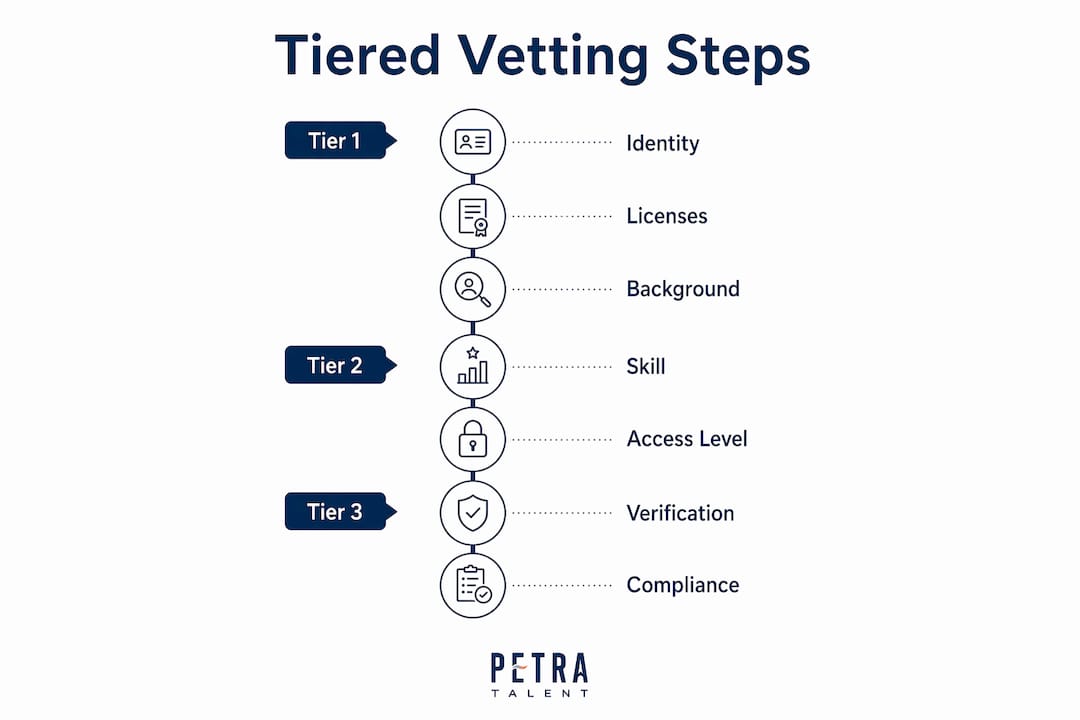
| Access tier | Work context | Verification stack |
|---|---|---|
| Tier 1: Exterior/supervised | Outdoor or commercial work with supervision present | SSN trace, national criminal search, MVR |
| Tier 2: Interior/client present | Residential work with homeowner on-site | Adds county-level records, document authentication, license verification |
| Tier 3: Unsupervised/vulnerable access | Occupied home with no client present, elderly or vulnerable residents | Adds federal criminal check, biometric ID matching, continuous criminal monitoring |
Tier 3 represents the highest-risk deployment scenario in residential plumbing. Biometric identity matching closes the credential-sharing gap where one technician passes a background check and another shows up to the job. Continuous criminal monitoring alerts the contractor to new legal issues during employment, not just at the point of hire. Continuous monitoring is the single most underused tool in plumbing workforce risk management.
Key takeaways
Effective plumbing workforce vetting requires layered background checks, verified credentials, practical skill assessment, and FCRA-compliant documentation to produce defensible and quality-focused hiring decisions.
| Point | Details |
|---|---|
| Layer background checks | Run SSN trace, criminal, MVR, drug, and license checks in sequence for complete coverage. |
| Verify license scope | Confirm the license type matches the specific work scope, including gas fitting or backflow endorsements. |
| Use rubric-scored skills tests | Hands-on assessments scored by rubric reduce bias and predict on-the-job performance better than interviews alone. |
| Follow FCRA sequence | Keep disclosure and authorization as separate documents and complete the pre-adverse action process before any denial. |
| Apply tiered vetting | Match check intensity to access level, with biometric matching and continuous monitoring for unsupervised residential work. |
What contractors often get wrong about vetting
Most contractors I work with understand that background checks matter. Where they consistently fall short is in treating vetting as a single event rather than a structured workflow with distinct legal obligations at each step. The FCRA sequence alone trips up experienced hiring managers who have been doing this for years. Mixing the disclosure form with the application is not a minor paperwork error. It is a litigation trigger.
The other gap I see regularly is the disconnect between background screening and skill assessment. A clean background check on a technician who cannot properly diagnose a pressure drop issue does not protect your business. It just means you hired someone honest who cannot do the job. The plumbing trade recruitment process needs both tracks running in parallel, not sequentially.
Tiered vetting is the framework I recommend to every contractor who asks where to start. It forces you to think about risk in terms of what the technician will actually be doing and who they will be around, rather than defaulting to the same check for every hire. That shift in thinking alone changes the quality of your hiring program.
— David
How Petratalent supports plumbing contractors with workforce vetting
Petratalent specializes in plumbing recruiting services for mechanical contractors across the United States, combining role-specific candidate sourcing with technical vetting that covers license verification, skills assessment, and compliance support. Contractors who partner with Petratalent reduce time-to-fill while maintaining the screening standards their clients and insurers expect.

The full range of services at Petratalent includes direct hire placements, leadership searches, market wage benchmarking, and workforce compliance consultation. For contractors who need to scale their plumbing crews without compromising on quality or legal adherence, Petratalent provides the structured process and industry expertise to make that possible. Contact Petratalent to discuss your current hiring needs and vetting requirements.
FAQ
What does plumbing workforce vetting include?
Plumbing workforce vetting covers identity verification, criminal background checks, MVR review, drug testing, license validation, and technical skills assessment. The full process also includes FCRA-compliant documentation and, for high-risk access roles, continuous criminal monitoring.
How do plumbing background checks work?
A standard plumbing background check runs an SSN trace first to confirm identity, then layers national, state, and county criminal searches, a sex offender registry check, and an MVR review. Drug testing and license verification complete the sequence before a hire decision is made.
What are the FCRA requirements for plumbing hiring?
The FCRA requires a standalone written disclosure and prior written authorization before ordering any background report. If a report leads to a denial, contractors must send a pre-adverse action notice, allow a dispute period, and then issue a final adverse action notice.
How should contractors verify a plumber’s license?
Contractors should check the license status directly through the state licensing board, confirm the license type matches the job scope, review complaint and disciplinary history, and request current insurance certificates from the issuing carrier rather than from the candidate.
What is tiered contractor screening?
Tiered contractor screening assigns background check intensity based on the access level of the role. Exterior supervised work requires fewer checks, while unsupervised interior access to occupied homes requires federal criminal checks, biometric identity matching, and continuous monitoring throughout employment.
Recommended
Related Posts
October 13, 2026
Recruiting Contract Terms: 10 Checks and Ready to Use Clauses
Define fee triggers, candidate ownership, guarantees, and compliance terms. Get a master agreement, short schedule,…
October 12, 2026
Offer Acceptance Rates: Segment Benchmarks, HVAC’s 3–5 Day SLA
See why a 78% to 82% offer acceptance benchmark can mislead, how role and source…
October 11, 2026
Bad Hires Can Cost Construction Firms 30% to 200% of Salary
Bad hires can cost construction firms 30% to 200% of annual salary. Calculate recruiting, rework,…

October 10, 2026
Construction Labor Forecasting for PMs: 7 Steps to Time Hiring
Learn when construction project managers should use WBS or simulation, track labor KPIs, and turn…