


TL;DR:
- Effective plumbing leadership hiring focuses on qualities like emotional intelligence, mentoring, and communication rather than just technical skill.
- Structured assessment, proactive talent pipelines, and comprehensive onboarding are essential for developing strong frontline leaders and improving jobsite culture and safety.
Most plumbing contractors make the same mistake when a foreman spot opens up. They promote the best installer on the crew. It feels logical, but what is plumbing leadership hiring really about? At its core, leadership recruitment in the trades means identifying and placing individuals who can manage people, drive accountability, and align field work with business goals, not just someone who can sweat copper faster than anyone else. This guide breaks down the qualities to look for, the hiring strategies that actually work, and how to set new leaders up for success from day one.
Table of Contents
- Key takeaways
- What plumbing leadership hiring really means
- Plumbing leadership qualities worth screening for
- Smarter hiring strategies for plumbing leadership roles
- Integrating new plumbing leaders effectively
- My perspective on plumbing leadership hiring
- How Petratalent supports plumbing leadership hiring
- FAQ
Key takeaways
| Point | Details |
|---|---|
| Technical skill doesn’t equal leadership | The best installer often lacks the mentoring and communication skills needed to lead a crew effectively. |
| Leadership qualities are specific and screenable | Emotional intelligence, planning behavior, and accountability can be evaluated through structured interviews. |
| Traditional job boards fall short | Building talent pipelines through apprenticeships and proactive outreach produces better leadership candidates. |
| Onboarding determines early success | A structured 30/60/90 day plan with mentor-led shadowing cuts the ramp-up time significantly. |
| Leadership gaps show up on the jobsite | Rework, safety issues, and crew turnover are often symptoms of weak frontline leadership, not individual worker problems. |
What plumbing leadership hiring really means
The term “plumbing leadership hiring” is widely used in workforce planning discussions, but the more recognized industry term for this practice is frontline leadership recruitment. Understanding the distinction matters because it changes how you write job descriptions, screen candidates, and define success in the role.
Modern plumbing foremen and supervisors are the first line of management between your field crews and the company’s goals. Their job is not just to install correctly. It is to plan daily work, communicate with project managers, document progress, and keep the crew moving safely and efficiently. The foreman role has evolved to incorporate technology and AI tools for aligning jobsite activities with company goals and improving accountability.
What separates high-performing plumbing operations from struggling ones is often the quality of frontline leadership rather than the skill of individual technicians. Here is what modern plumbing leaders are actually responsible for:
- Translating project plans into daily crew assignments
- Identifying and removing obstacles before they cause delays
- Mentoring apprentices and junior plumbers
- Maintaining documentation for billing, compliance, and safety
- Communicating schedule changes, material needs, and issues to the office
- Modeling the culture and behavior the company expects
Pro Tip: When writing a job description for a foreman role, focus the requirements on planning, communication, and accountability behaviors. Avoid describing the role as simply “lead installer with supervisory duties.”
Frontline plumbing leaders directly shape daily culture and retention on the jobsite. In tight labor markets, that influence is worth more than an extra tool truck.
Plumbing leadership qualities worth screening for
Identifying true leadership potential requires looking beyond certifications and years in the trade. The PHCC’s 2026 Super Foremen workshop made the case clearly: servant leadership behaviors like mentoring, emotional intelligence, and removing obstacles matter more than being the most technically skilled person in the room.
When evaluating candidates for plumbing leadership roles, screen for these specific qualities in this order of priority:
- Servant leadership orientation. Does the candidate describe their role as removing obstacles for their crew, or do they frame everything as personal heroics? Ask: “Tell me about a time a crew member was struggling. What did you do?” The answer reveals whether they mentor or just take over.
- Emotional intelligence and communication. Can the candidate explain a conflict with a project manager or a difficult conversation with an apprentice? Behavior-based interview scoring on communication, planning, and accountability separates leadership-ready candidates from technically strong ones who have not developed these skills.
- Planning and documentation habits. Ask candidates to walk you through how they start their day on a job site. Leaders who plan ahead, document proactively, and track materials describe structured routines. Candidates who say “I just show up and figure it out” are not ready for a leadership role regardless of their skill level.
- Accountability without micromanagement. Good leaders hold crews to standards without standing over them all day. Ask about how they handle a crew member who repeatedly makes the same mistake. This reveals how they balance enforcement with coaching.
- Comfort with technology. Modern foremen use project management apps, safety reporting tools, and sometimes AI-assisted scheduling platforms. A candidate who is resistant to digital tools will struggle as these become standard.
Pro Tip: Use a short work-sample test during screening. Give candidates a basic project scenario and ask them to outline their first two days on the job. The response tells you more than a resume ever will.
Leadership gaps manifest as jobsite friction, including rework and safety failures, rather than abstract HR problems. Hiring for these specific qualities reduces that friction before it starts.
Smarter hiring strategies for plumbing leadership roles
Posting a foreman job on a general job board and waiting is rarely a winning approach. Traditional job boards fall short for skilled trades leadership roles, and contractors who rely on them exclusively face longer vacancies and weaker candidate pools.
Here is how effective hiring strategies in plumbing differ from standard approaches:
| Standard Approach | Strategic Approach |
|---|---|
| Post on general job boards and wait | Build a candidate pipeline before the role is vacant |
| Promote the best installer automatically | Assess leadership readiness separately from technical skill |
| One-round interview with no structure | Behavioral interview with scored rubric and work-sample test |
| Start the new hire and hope for the best | Structured 30/60/90 day onboarding with mentor shadowing |
| No formal feedback until annual review | Monthly check-ins tied to productivity and safety metrics |
Apprenticeships remain a strong long-term strategy for building leadership talent from within. Apprentices hired and trained by your company know your systems, culture, and standards already. When they reach journeyman level, leadership potential is far easier to evaluate because you have years of observed behavior to draw on.
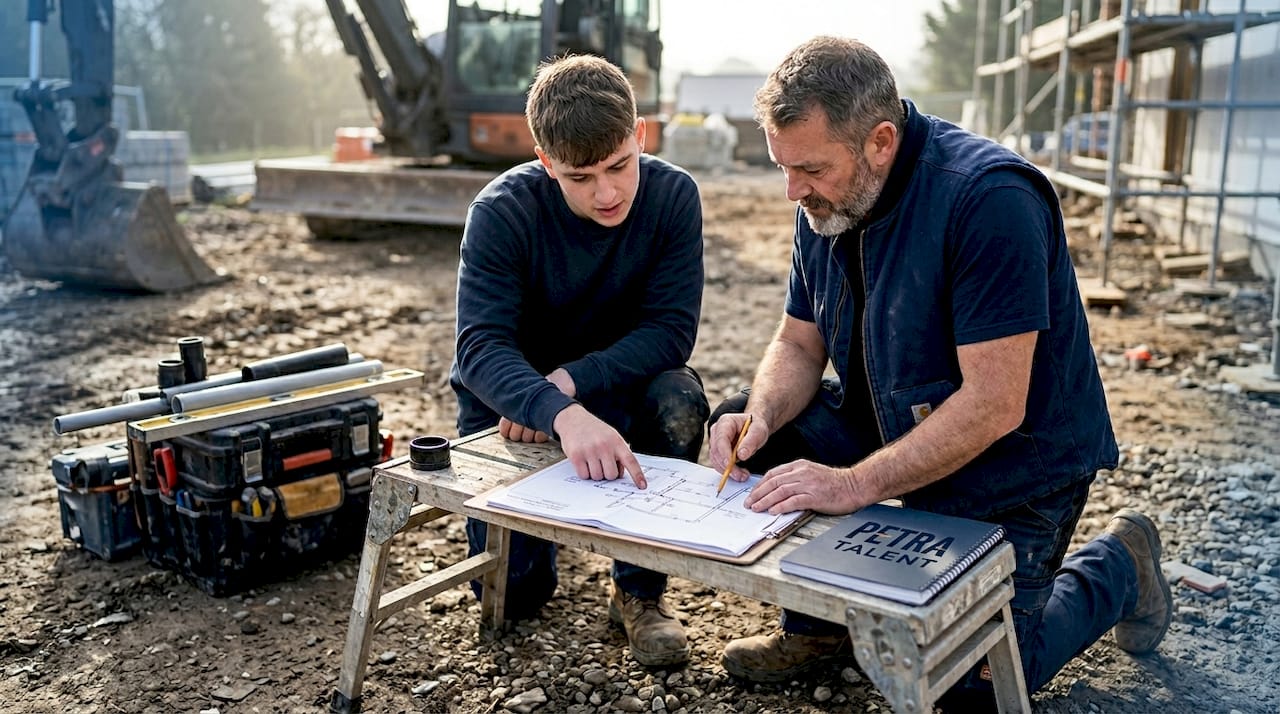
For external hires, pre-screening calls focused on behavioral questions should precede in-person interviews. Master plumbers within the organization can participate in technical validation while hiring managers assess leadership behaviors separately. This division of roles prevents the common trap of letting technical skill dominate the evaluation.
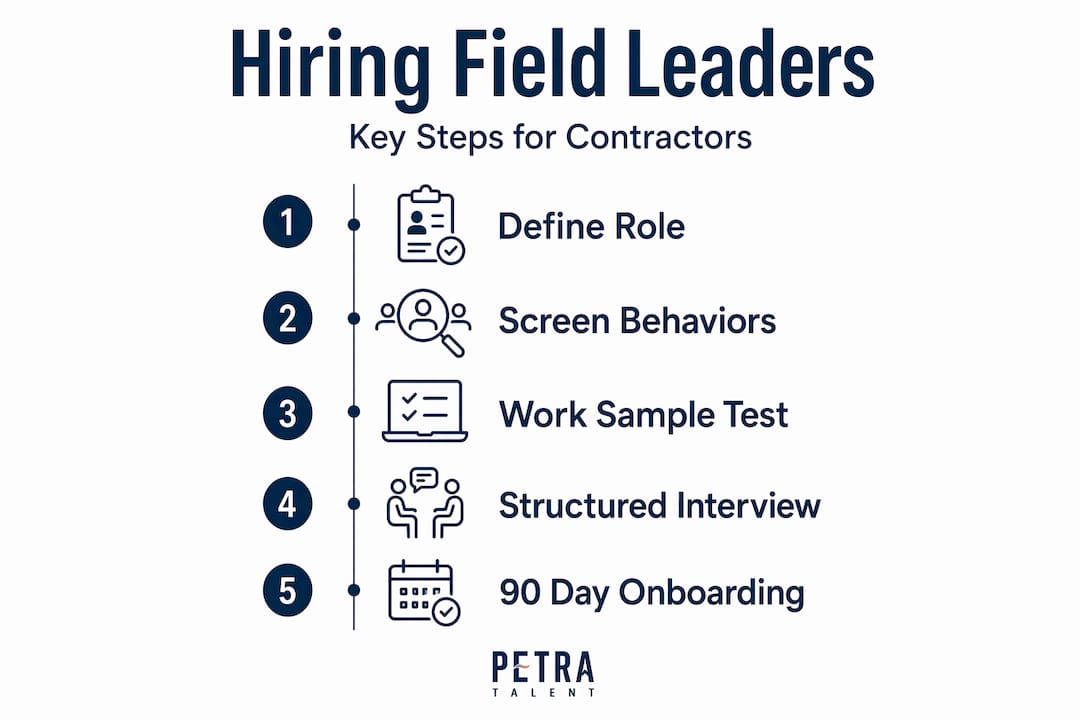
Developing field leaders proactively is one of the highest-leverage retention strategies available to plumbing contractors during labor shortages. When crew members see a defined path to leadership, turnover drops.
For a broader look at how plumbing trade recruitment connects to leadership development, the fundamentals apply at every level of the org chart.
Integrating new plumbing leaders effectively
Hiring the right person is only half the work. How a company onboards a new leader determines how quickly they contribute and whether they stay past the first year.
Structured onboarding with mentor-led shadowing reduces time to full productivity from months to weeks. The approach mirrors what high-performing companies do with technician onboarding, just applied to management responsibilities. Effective integration for new plumbing leaders includes:
- A defined 30/60/90 day plan with specific learning milestones at each stage
- Assigned mentor from existing senior leadership for the first 60 days
- Weekly check-ins with the direct supervisor to surface issues early
- Access to technology tools with guided training during the first two weeks
- Clear metrics for what success looks like at 30, 60, and 90 days
- Culture alignment sessions that explain how field operations connect to business goals
The 90-day window is not just about getting the new leader up to speed. It is the period where you assess whether your hiring decision was correct. If check-ins reveal repeated communication gaps or resistance to documentation practices, those issues rarely improve on their own. Address them early with direct coaching or structured support.
Ongoing leadership development matters beyond onboarding. Monthly evaluations using productivity data and safety metrics give leaders clear feedback and give business owners a defendable record of performance. Using metrics for problem diagnosis rather than relying on gut feel is a hallmark of well-managed plumbing operations.
My perspective on plumbing leadership hiring
I have seen contractors struggle with this issue repeatedly, and the root cause is almost always the same. The business owner promotes based on technical skill and then wonders why the team starts underperforming. What I have learned is that technical mastery and leadership readiness are two separate traits, and they only overlap in a minority of candidates.
The mistake I see most often is skipping a structured evaluation process because the owner already “knows” the person. Familiarity biases the decision. I have watched excellent plumbers become miserable and ineffective foremen because no one asked whether they actually wanted to manage people or had the communication skills to do it.
What genuinely works is treating the foreman role as a distinct career path with a defined entry criteria, not just the next step for the best wrench-turner. Servant leadership, as PHCC’s research reinforces, produces better crew outcomes than technical authority. And structured onboarding, even a basic version, changes retention and early performance more than most contractors expect.
Measure the impact of your leaders with real data. If safety incidents or rework rates are high on one foreman’s jobs and low on another’s, that is information. Act on it.
— David
How Petratalent supports plumbing leadership hiring
Petratalent specializes in leadership and management searches for plumbing and HVAC contractors across the United States. If finding qualified foremen, supervisors, and project managers is slowing your business down, Petratalent’s sourcing and vetting process is built specifically for this. From behavioral screening to technical validation, the team handles the steps that most internal hiring processes skip. Explore Petratalent’s plumbing recruiting services to see how a specialized recruitment partner can improve the quality and speed of your next leadership hire.
FAQ
What is plumbing leadership hiring?
Plumbing leadership hiring, or frontline leadership recruitment, is the process of identifying, evaluating, and placing foremen, supervisors, and project managers in plumbing companies. It focuses on leadership behaviors and management skills rather than technical installation ability alone.
Why shouldn’t contractors just promote the best installer?
The most skilled installer is not always the most effective plumbing leader. PHCC’s foremen research shows that servant leadership traits like mentoring and communication drive crew performance, and those traits are separate from technical expertise.
What qualities matter most in a plumbing foreman?
The most important plumbing leadership qualities include emotional intelligence, planning and documentation habits, accountability, communication skills, and comfort with technology. These traits can be assessed through behavioral interview questions and work-sample tests.
How long does it take to onboard a new plumbing leader?
A structured 30/60/90 day onboarding plan with mentor-led shadowing can reduce full productivity ramp-up from several months to a few weeks, according to 2026 workforce guidance for plumbing contractors.
Where should contractors look for plumbing leadership candidates?
Beyond job boards, contractors should build talent pipelines through apprenticeship programs, proactive outreach, and internal development tracks. Rethinking recruiting strategies to include apprenticeship pathways and digital outreach consistently produces stronger leadership candidates.
Recommended
- What is plumbing trade recruitment? A guide for contractors
- Blog Modern 01 – PetraTalent
- Blog – PetraTalent
Related Posts
October 13, 2026
Recruiting Contract Terms: 10 Checks and Ready to Use Clauses
Define fee triggers, candidate ownership, guarantees, and compliance terms. Get a master agreement, short schedule,…
October 12, 2026
Offer Acceptance Rates: Segment Benchmarks, HVAC’s 3–5 Day SLA
See why a 78% to 82% offer acceptance benchmark can mislead, how role and source…
October 11, 2026
Bad Hires Can Cost Construction Firms 30% to 200% of Salary
Bad hires can cost construction firms 30% to 200% of annual salary. Calculate recruiting, rework,…
October 10, 2026
Construction Labor Forecasting for PMs: 7 Steps to Time Hiring
Learn when construction project managers should use WBS or simulation, track labor KPIs, and turn…