



TL;DR:
- Pre-screened candidates meet minimum qualification requirements before any interview takes place. Automated and manual screening methods work together to filter applicants quickly and fairly. Proper pre-screening saves time, reduces bias, and helps contractors find qualified tradespeople efficiently.
A pre-screened candidate is defined as an applicant who has passed an initial evaluation against must-have qualifications before advancing to a formal interview. In HVAC and plumbing recruiting, that means verifying licenses, certifications, salary expectations, and work authorization before a hiring manager ever picks up the phone. Understanding what does pre-screened candidate mean gives recruiters a clear framework for filtering unqualified applicants early and protecting their most limited resource: time. This article explains how the process works, which criteria matter most in skilled trades, and how to build a pre-screening stage that holds up under real hiring pressure.
What does pre-screened candidate mean in recruitment?
A pre-screened candidate has cleared a defined set of minimum qualifications before the formal interview stage begins. The industry term for this stage is “candidate pre-screening,” and it functions as a gatekeeping exercise, not an interview. Pre-screening verifies binary must-haves such as whether a candidate holds a valid EPA 608 certification or is legally authorized to work in the United States. It does not assess culture fit, communication style, or long-term potential. Those questions belong in the interview.
The distinction matters because mixing the two stages creates serious inefficiencies. Recruiters who treat a pre-screen like a full interview waste 30–45 minutes per candidate on questions that should take 10 minutes to resolve. Pre-screening answers one question: “Does this candidate qualify?” The interview answers a different one: “Is this candidate the right fit?” Keeping those stages separate is the foundation of an efficient hiring pipeline.
How does the pre-screening process work in recruitment?
Pre-screening follows a defined sequence that filters applicants before any interview is scheduled. The process typically starts with a resume review against knockout criteria, moves to a short screening call or automated questionnaire, and ends with a pass or fail decision. Traditional manual phone screens take 30–45 minutes, while AI-driven pre-screens complete the same evaluation in 5–15 minutes. That time difference compounds quickly when a contractor posts a plumbing foreman role and receives 200 applications in a week.
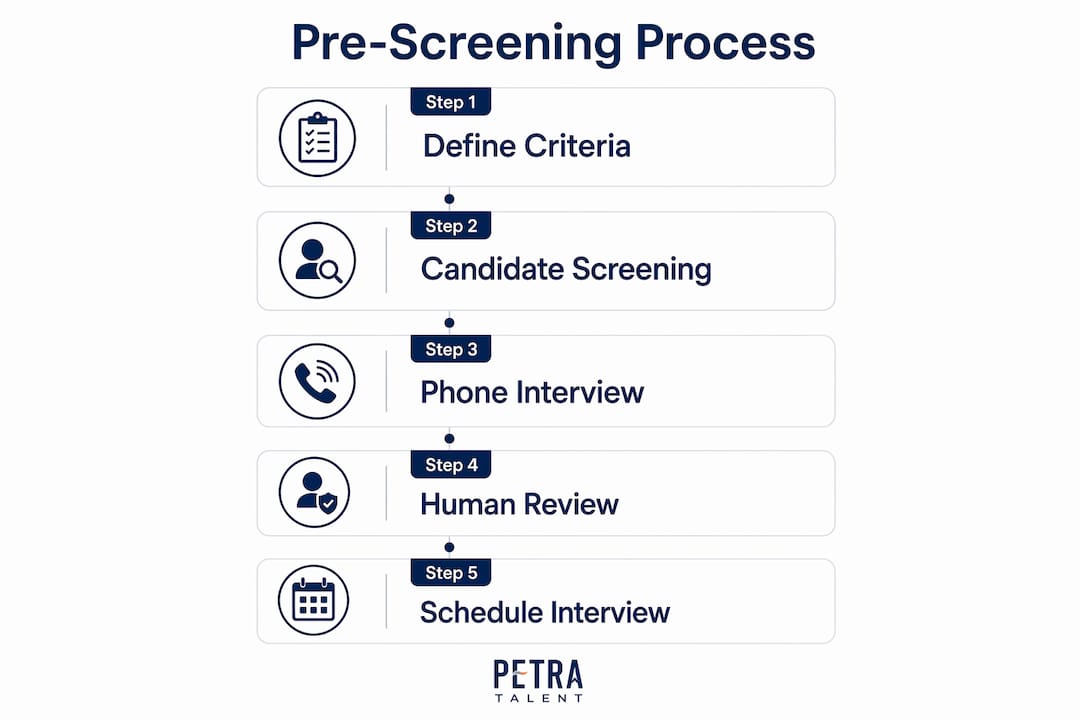
Automated tools have changed the volume equation significantly. AI tools can screen 500 resumes in under 2 minutes, scoring each applicant on a 0–100 match scale. That capability reduces unqualified resumes by 80–90%, letting recruiters focus on the top 10–20% of applicants. The speed is real, but it comes with a tradeoff: automated scoring can miss context that a recruiter would catch in a 5-minute call.
The two approaches each have a place in a well-built process:
- Manual screening: Allows nuanced judgment, catches red flags in tone or communication, and builds early rapport with strong candidates. Best for senior or leadership roles.
- Automated screening: Processes high application volumes quickly, applies criteria consistently, and removes early-stage bias. Best for high-volume technician or field roles.
- Hybrid approach: Automated tools handle the first filter; recruiters review the top-scored applicants before scheduling calls. This is the most efficient model for most HVAC and plumbing contractors.
Pro Tip: Never let automation make the final pre-screen decision alone. Recruiters should personally review the top-scored applicants before any candidate advances. A score of 78 out of 100 means nothing if the candidate listed a license they do not actually hold.
What qualifications define a pre-screened candidate in HVAC and plumbing?
Skilled trades pre-screening focuses on eight core eligibility areas. Standardizing these criteria ensures full compliance before any lengthy interview is scheduled. Each criterion serves a specific purpose in HVAC and plumbing hiring, where a missing license or an unworkable commute can disqualify an otherwise strong candidate on day one.
For technical must-haves in HVAC and plumbing, licenses and certifications are the most critical filter. An HVAC technician without EPA 608 certification cannot legally handle refrigerants. A plumber without a state journeyman or master license cannot pull permits. Checking these credentials at the pre-screen stage prevents wasted interview time on candidates who cannot legally perform the job.
| Eligibility criterion | Why it matters in trades hiring |
|---|---|
| Work authorization | Legal requirement; must be confirmed before any offer |
| Certifications and licenses | EPA 608, journeyman license, master plumber; role-specific and non-negotiable |
| Salary expectations | Misalignment here ends offers at the final stage; resolve it early |
| Location and commute | Service territory coverage depends on where the technician lives |
| Availability | Start date and schedule flexibility affect project timelines directly |
| Physical accommodations | Trades roles involve physical demands; accommodations must be addressed upfront |
| Travel willingness | Some commercial HVAC roles require regional or overnight travel |
| Role-specific technical skills | Equipment experience, software proficiency, and specialty certifications |
Hiring managers who vet plumbing candidates early on these eight points consistently report fewer late-stage offer failures. Skipping even one criterion, particularly salary expectations, is a common source of wasted interview cycles in skilled trades recruiting.
What are the key benefits of pre-screening candidates for hiring managers?
Pre-screening creates a clear minimum quality floor for every candidate who advances. Mixing pre-screening with full interviews causes recruiter burnout and delays. When the stages are kept separate and the criteria are set correctly, hiring managers spend their time only on candidates who already meet the baseline. That shift alone reduces the average time-to-fill for HVAC technician roles.
The benefits extend beyond time savings:
- Reduced recruiter burnout: Recruiters spend less time on unqualified applicants and more time building relationships with strong candidates.
- Standardized evaluation: Every applicant is measured against the same criteria, which reduces the influence of unconscious bias. AI-powered pre-screening enforces fairness by applying objective standards like certifications and license status consistently across all applicants.
- Stronger employer brand: Candidates who do not pass the pre-screen still form an opinion of the company. Prompt, polite rejection communication keeps that impression positive and preserves the employer’s reputation in a tight labor market.
- Better interview quality: Hiring managers who only meet pre-screened job applicants report more productive conversations and faster decisions.
Pre-screening is not a filter for finding the best candidate. It is a filter for removing candidates who cannot do the job at all. That distinction keeps the process fair, fast, and legally defensible.
Contractors who skip this stage often discover the cost later. A common HVAC hiring mistake is advancing candidates to panel interviews before confirming basic eligibility, which wastes the time of multiple senior staff members at once.
How should HVAC and plumbing recruiters implement effective pre-screening?
Effective implementation starts with defining knockout criteria before the job is posted. A knockout criterion is a requirement that disqualifies a candidate automatically if not met. For a residential HVAC service technician role, that list might include EPA 608 certification, a valid driver’s license, and a commute within 30 miles of the service area. Every criterion on the list must be genuinely non-negotiable. If a recruiter would consider waiving it, it is not a knockout criterion.

Recruiters should also configure screening questions to match both technical and soft skill needs. For a plumbing foreman role, a technical question might ask which pipe materials the candidate has worked with on commercial projects. A soft skill question might ask how the candidate handles a situation where a crew member is not meeting daily production targets. Both types of questions belong in the pre-screen only if the answer is a clear pass or fail. Open-ended questions that require interpretation belong in the interview.
Candidate communication during pre-screening is often overlooked. Candidates who fail the pre-screen should be informed promptly and courteously. A 48-hour response window is a reasonable standard. Candidates who pass should receive a clear next step within the same timeframe. Silence after a pre-screen is one of the fastest ways to lose a qualified technician to another offer.
Human oversight on AI screening prevents automation bias from filtering out candidates who score slightly below a threshold due to resume formatting rather than actual qualifications. The best process combines AI prioritization with a recruiter reviewing the top-scored applicants before any scheduling decision is made.
Pro Tip: Build a short candidate experience survey into the pre-screening stage. Ask applicants two questions: how clear was the process, and how long did it take? The answers reveal friction points that cost you qualified candidates before they ever reach an interview.
Key takeaways
Pre-screened candidates are applicants who have cleared defined minimum qualifications before the interview stage, and this gatekeeping process is the single most effective way to protect recruiter time and improve hiring quality in HVAC and plumbing trades.
| Point | Details |
|---|---|
| Definition of pre-screening | A pre-screened candidate has passed minimum qualification checks before any interview is scheduled. |
| Eight core eligibility areas | Work authorization, licenses, salary, location, availability, accommodations, travel, and role-specific skills are the standard criteria. |
| AI screening volume | Automated tools can process 500 resumes in under 2 minutes, cutting unqualified applicants by 80–90%. |
| Human oversight is required | Recruiters must review top-scored applicants before advancing anyone; automation alone is not sufficient. |
| Prompt rejection protects brand | Candidates who fail pre-screening should receive a polite response within 48 hours to preserve employer reputation. |
Pre-screening is a tool, not a shortcut
The most common mistake I see in HVAC and plumbing recruiting is treating pre-screening as a formality rather than a deliberate stage with its own criteria and standards. Recruiters set up a quick phone call, ask a few general questions, and call it a pre-screen. Then they wonder why they are still losing candidates at the offer stage over salary mismatches or missing licenses.
Pre-screening only works when the knockout criteria are set before the first application arrives, not after. I have seen contractors post a journeyman plumber role, receive 150 applications, and then spend two weeks interviewing candidates before discovering that fewer than 20 held the required state license. That is a pre-screening failure, not a candidate quality problem.
The shift to AI-assisted screening has genuinely helped high-volume hiring teams. But the recruiters who get the most out of it are the ones who treat the AI output as a starting point, not a final answer. The best hires I have seen come from teams that use automation to narrow the field and then apply real judgment to the top candidates. That combination is faster than manual screening and more accurate than automation alone.
The other thing worth saying directly: pre-screening is not a place to cut corners on candidate experience. A technician who gets a polite, clear rejection in 24 hours will remember that company positively. One who hears nothing for two weeks will tell every colleague in their network.
— David
Petratalent’s approach to pre-screening in skilled trades
Petratalent works exclusively with HVAC and plumbing contractors across the United States, and pre-screening is built into every placement process from the start.
Every candidate Petratalent presents has already been evaluated against role-specific knockout criteria: licenses, certifications, salary alignment, location, and technical experience. Hiring managers receive only applicants who meet the minimum bar, which means fewer wasted interviews and faster decisions. Petratalent’s technical vetting and workforce solutions are designed specifically for mechanical contractors who need qualified technicians, foremen, and project managers without the overhead of building a full internal screening process. Contractors who want to see how the full service works can review Petratalent’s recruitment services to find the right fit for their hiring needs.
FAQ
What does pre-screened candidate mean in simple terms?
A pre-screened candidate is an applicant who has already been checked against minimum job requirements, such as licenses and salary expectations, before a formal interview is scheduled. The pre-screen confirms basic eligibility, not overall fit.
How does pre-screening differ from a job interview?
Pre-screening verifies binary must-haves and takes 5–15 minutes with automated tools or 30–45 minutes by phone. A formal interview assesses qualitative fit, culture alignment, and role-specific judgment, which requires significantly more time and preparation.
What licenses are typically checked during HVAC pre-screening?
EPA 608 certification and a valid state HVAC contractor or technician license are the most common technical requirements verified at the pre-screen stage. Specific requirements vary by state and role type.
Can automated tools fully replace human pre-screening?
Automated tools can process high volumes quickly and apply criteria consistently, but human review of top-scored applicants remains necessary to catch resume formatting errors and context that algorithms miss.
Why does prompt rejection after pre-screening matter?
Candidates who receive a polite, timely rejection maintain a positive impression of the employer, which protects the company’s reputation in a tight skilled trades labor market where word-of-mouth travels fast.
Recommended
Related Posts

October 13, 2026
Recruiting Contract Terms: 10 Checks and Ready to Use Clauses
Define fee triggers, candidate ownership, guarantees, and compliance terms. Get a master agreement, short schedule,…
October 12, 2026
Offer Acceptance Rates: Segment Benchmarks, HVAC’s 3–5 Day SLA
See why a 78% to 82% offer acceptance benchmark can mislead, how role and source…
October 11, 2026
Bad Hires Can Cost Construction Firms 30% to 200% of Salary
Bad hires can cost construction firms 30% to 200% of annual salary. Calculate recruiting, rework,…
October 10, 2026
Construction Labor Forecasting for PMs: 7 Steps to Time Hiring
Learn when construction project managers should use WBS or simulation, track labor KPIs, and turn…