


TL;DR:
- Structured onboarding improves HVAC technician retention and productivity significantly. Contractors should implement a 30-day plan with clear milestones and leverage digital tools for consistent training. Proper documentation, mentor selection, and early system access are critical for successful integration.
Onboarding new HVAC hires is the process of systematically integrating and training new technicians so they become confident, productive team members quickly and safely. The industry term for this process is “new employee onboarding,” and it covers far more than paperwork. Structured onboarding improves new hire retention by 82% and productivity by over 70%. That means contractors who skip a formal process are not just losing time. They are losing people. A well-built onboarding framework covers documentation, hands-on training milestones, mentorship, and digital tools that keep every technician on the same page from day one.
What does onboarding new HVAC hires actually require?
Effective new HVAC technician onboarding starts before the first job site visit. Contractors who get this right treat the first day as a setup day, not a training day. Every document and system access must be ready before hands-on work begins.
Required paperwork
Essential onboarding paperwork includes the following forms and agreements:
- I-9 (Employment Eligibility Verification)
- W-4 (Federal Tax Withholding)
- State tax withholding forms
- Non-disclosure agreements (NDAs)
- Direct deposit authorization
- Company policy acknowledgments
Completing these before the first field day removes legal risk and lets the technician focus entirely on learning the job.
Technology and system access
New hires also need access to the digital tools your team uses daily. Set up the following before or on day one:
| Tool Category | Purpose |
|---|---|
| CRM platform | Customer records, job history, scheduling |
| Communication platform | Team messaging, dispatch updates |
| Digital training library | SOPs, safety checklists, diagnostic guides |
| Time tracking software | Hours logging, payroll accuracy |
Contractors who hire certified HVAC technicians know that compliance documentation and system access are non-negotiable from the start. Skipping either one creates confusion that slows down the entire first week.
How to build a 30-day onboarding roadmap for new technicians
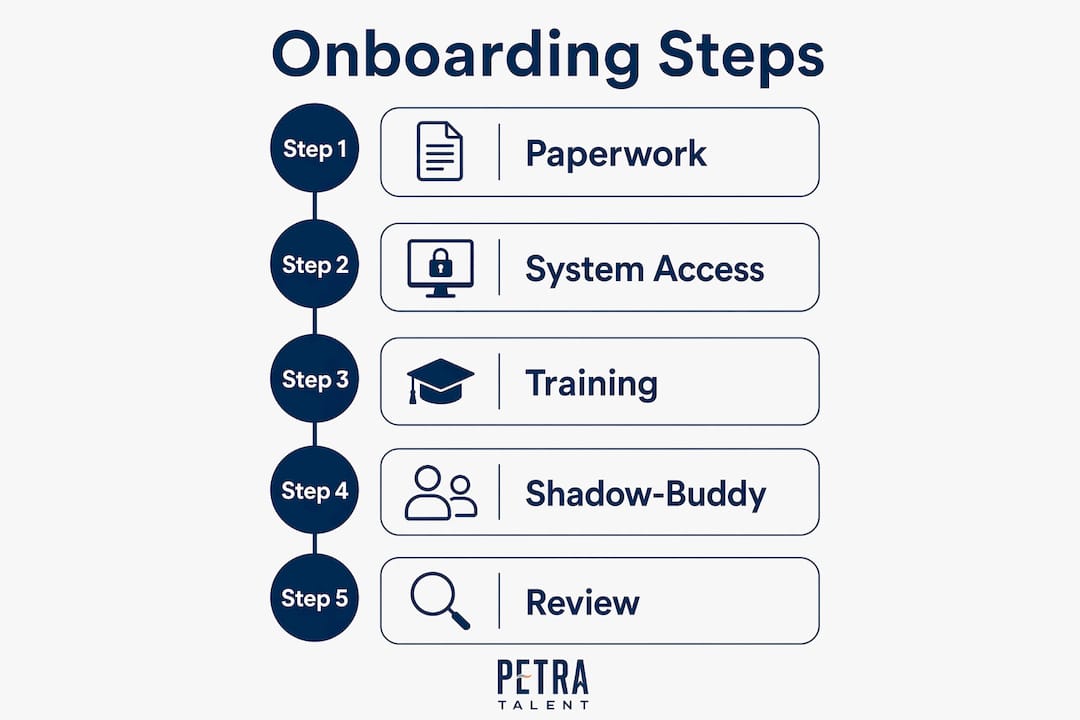
A structured 30-day onboarding plan with weekly milestones helps new hires progress safely from observation to independence. Without a defined timeline, contractors default to informal training that varies by supervisor and produces inconsistent results.
-
Week 1: Shadow and orient. The new technician rides along with an experienced team member on every call. The focus is observation, not action. Cover company culture, safety protocols, customer communication standards, and how the team operates day to day.
-
Week 2: Assisted tasks. The new hire begins performing job tasks under direct supervision. The experienced technician guides each step and provides real-time feedback. This is where hands-on skills get tested in a low-risk environment.
-
Week 3: Supervised independence. The technician handles calls with the supervisor available but not directing every move. This builds confidence while keeping a safety net in place. Feedback sessions at the end of each day are critical here.
-
Week 4: Review and calibrate. Conduct a formal check-in to assess readiness, address gaps, and set expectations for the next 60 days. Document what the technician has mastered and what still needs work.
Setting clear milestones at each stage removes ambiguity for both the technician and the manager. Contractors who want to grow their HVAC field workforce consistently use this kind of structured progression to reduce early turnover.
Pro Tip: Write down the milestones for each week and share them with the new hire on day one. When technicians know exactly what success looks like at each stage, they perform better and ask better questions.
What makes a shadow-buddy system work for HVAC teams?
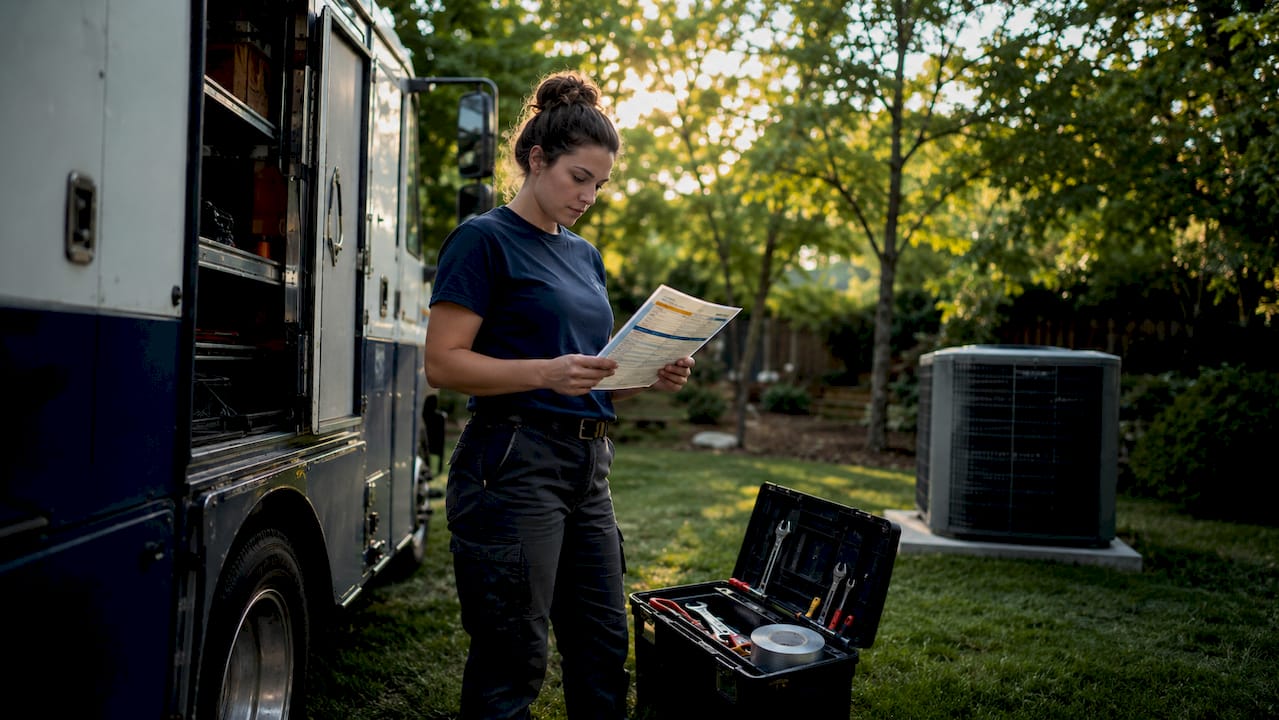
The shadow-buddy system is one of the most effective tools in HVAC employee training, but only when the right person fills the role. Most contractors make the mistake of assigning their best technician as the trainer. Technical skill alone does not make someone a good teacher.
Effective shadow-buddies share three core traits:
- Patient communication. They explain procedures clearly without frustration, even when a new hire asks the same question twice.
- Honest, constructive feedback. They correct mistakes in the moment without embarrassing the new hire in front of customers.
- Company buy-in. They represent the business positively and do not vent about management or internal issues to new hires.
Avoid assigning shadow-buddies who are overloaded with their own work or who show indifference to training. A disengaged trainer sends a clear message to the new hire: this company does not invest in its people. That message drives early exits.
Pro Tip: Rotate shadow-buddy assignments across two or three qualified technicians. This prevents burnout in your best trainers and exposes new hires to different working styles.
For managers overseeing HVAC technician integration, the shadow-buddy selection process deserves as much attention as the training content itself.
How do digital tools improve HVAC training outcomes?
Cloud-based training platforms centralize SOPs, safety checklists, and diagnostic guides so every technician accesses the same information. This eliminates the inconsistency that comes from verbal-only training, where details change depending on who is teaching.
Microlearning modules of 10–15 minutes reduce overwhelm and allow technicians to review procedures between service calls. Short, focused segments fit the pace of field work far better than full-day classroom sessions.
| Training Method | Disruption to Job Site | Consistency | Retention Support |
|---|---|---|---|
| Verbal-only instruction | Low | Poor | Weak |
| Printed manuals | Low | Moderate | Moderate |
| Cloud-based microlearning | Very low | High | Strong |
| Full-day classroom sessions | High | High | Moderate |
Tracking completion through quizzes or digital checklists gives managers a clear picture of where each technician stands. This data replaces guesswork with evidence when deciding whether a hire is ready to work independently.
Common onboarding mistakes HVAC contractors make
Most onboarding failures trace back to a handful of predictable errors. Recognizing them early saves contractors significant time and money.
- The owner as the only trainer. Owner-directed onboarding creates bottlenecks that slow every new hire and pull the owner away from running the business. Documented SOPs and a shadow-buddy system fix this by distributing the training load.
- Relying on tribal knowledge. Informal, undocumented training produces inconsistent service quality and creates safety risks. Formal checklists and written SOPs replace memory-based instruction with repeatable processes.
- Information overload in week one. Dumping every policy, procedure, and tool on a new hire in the first two days guarantees poor retention. Spread content across the 30-day roadmap and use microlearning to pace delivery.
- No feedback loop. Onboarding without scheduled check-ins leaves problems unaddressed until they become serious. Weekly one-on-ones during the first month catch issues early.
Contractors who structure their HVAC hiring process from recruitment through the first 90 days see measurably lower turnover than those who treat onboarding as an afterthought.
Key Takeaways
Structured onboarding is the single most effective way to improve HVAC technician retention and productivity from the first day on the job.
| Point | Details |
|---|---|
| Complete paperwork first | Finish I-9, W-4, NDAs, and system access before any field work begins. |
| Use a 30-day roadmap | Progress new hires from shadowing to supervised independence with weekly milestones. |
| Choose buddies for communication | Select shadow-buddies based on patience and feedback skills, not just technical ability. |
| Adopt microlearning | Use 10–15 minute digital modules to train consistently without disrupting job sites. |
| Document everything | Replace tribal knowledge with written SOPs and checklists to reduce training inconsistency. |
What I’ve learned about building onboarding that actually scales
Most contractors I talk to know their onboarding is broken. They just do not know where to start fixing it. The honest answer is: start with documentation. You cannot delegate a process that only exists in someone’s head.
The second thing I would tell any contractor is to stop treating the shadow-buddy role as a favor you ask of your best tech. It is a defined position with defined responsibilities. When you treat it that way, your trainers show up differently and your new hires get a better experience.
Digital tools matter, but they are not the foundation. The foundation is a written process. Once that exists, microlearning and cloud platforms make it faster and more consistent. Without the written process, technology just speeds up the chaos.
The contractors who build scalable teams do one thing consistently: they set expectations on day one and then follow through at every weekly milestone. New hires who know what is expected of them in week one, week two, and week three perform better and stay longer. That is not a theory. That is what the data on structured onboarding shows, and it matches what I see in practice.
— David
How Petratalent helps HVAC contractors build stronger teams
Bringing the right technician through the door is the first step. Getting them to stay and perform is the second. Petratalent works with HVAC contractors across the United States to source, vet, and place skilled technicians, project managers, and leadership talent who are ready to integrate into a structured onboarding process.
Petratalent’s HVAC recruiting services go beyond resume screening. The team provides technical vetting, market wage insights, and workforce compliance support so contractors hire with confidence. If your onboarding process is solid but your pipeline is not, Petratalent fills that gap with candidates who are pre-qualified for the role and the team culture. Contractors dealing with HVAC recruitment challenges can connect with Petratalent to build a hiring and retention strategy that holds.
FAQ
What does onboarding new HVAC hires include?
New HVAC technician onboarding covers employment paperwork (I-9, W-4, NDAs), system access setup, a structured 30-day training roadmap, shadow-buddy mentorship, and digital training tools. The goal is to move a new hire from observation to confident independent work within the first month.
How long should HVAC onboarding take?
A structured 30-day onboarding plan is the standard for new HVAC technicians, with weekly milestones that progress from shadowing to supervised independence. Some roles with greater technical complexity may extend the supervised phase into a 60 or 90-day program.
What is a shadow-buddy system in HVAC training?
A shadow-buddy system pairs a new hire with an experienced technician who provides real-time guidance, feedback, and cultural orientation during the first weeks on the job. The best shadow-buddies are selected for communication skills and patience, not just technical expertise.
Why do HVAC contractors struggle with onboarding?
The most common failures are owner bottlenecks, reliance on tribal knowledge instead of documented SOPs, and information overload in the first week. Contractors who avoid common hiring mistakes and build formal onboarding systems see significantly better retention.
How do digital tools help with HVAC employee training?
Cloud-based platforms centralize SOPs, checklists, and training modules so every technician accesses consistent information. Microlearning segments of 10–15 minutes allow field technicians to complete training between calls without disrupting active job sites.
Recommended
Related Posts

October 13, 2026
Recruiting Contract Terms: 10 Checks and Ready to Use Clauses
Define fee triggers, candidate ownership, guarantees, and compliance terms. Get a master agreement, short schedule,…
October 12, 2026
Offer Acceptance Rates: Segment Benchmarks, HVAC’s 3–5 Day SLA
See why a 78% to 82% offer acceptance benchmark can mislead, how role and source…
October 11, 2026
Bad Hires Can Cost Construction Firms 30% to 200% of Salary
Bad hires can cost construction firms 30% to 200% of annual salary. Calculate recruiting, rework,…
October 10, 2026
Construction Labor Forecasting for PMs: 7 Steps to Time Hiring
Learn when construction project managers should use WBS or simulation, track labor KPIs, and turn…