



TL;DR:
- Plumbing certifications verify a plumber’s legal authority, technical competence, and professionalism. Certified plumbers earn significantly higher wages and are more likely to advance to supervisory roles, benefiting employers through better quality work and reduced liability. Licensing complexities, delays, and distinctions between individual and business licenses affect hiring, requiring careful verification and strategic workforce planning.
Plumbing certifications are the primary credential employers use to verify a candidate’s technical competency, legal eligibility, and commitment to professional standards. The three core licensing tiers — apprentice, journeyman, and master — each carry distinct legal rights and responsibilities that directly shape what a hire can do on day one. Certified plumbers earn a median wage of $72,170 annually, compared to $59,910 for non-certified peers. That 20.5% wage premium reflects real market demand. Understanding why plumbing certifications affect hiring means understanding how credentials translate into legal authority, reduced liability, and workforce stability.
Why plumbing certifications affect hiring quality and outcomes
Certifications do more than confirm training hours. They verify that a plumber understands code compliance, system design, and safety protocols well enough to protect both the employer and the client.

Licensed plumbers reduce installation errors and improve code compliance, which directly lowers liability exposure for contractors. A non-certified hire who causes a code violation can trigger failed inspections, project shutdowns, and legal costs that far exceed any short-term savings on wages. The importance of plumbing credentials becomes clearest when something goes wrong on a job site.
The distinction between licensing tiers matters operationally. A journeyman can execute work under supervision, but only a master plumber holds the authority to design systems, pull permits, and lead commercial bids. Master licensing grants permit authority that journeymen cannot legally exercise. For contractors pursuing commercial work, a master plumber on staff is not optional.
Key competencies that certified plumbers bring to a team:
- Code compliance knowledge across residential and commercial systems
- Permit-ready authority at the master level
- Documented training hours that meet state licensing board standards
- Reduced rework rates due to standardized installation practices
- Professional accountability tied to a license that can be revoked
“Licensed plumbers command higher service rates justified by years of training and reduce costly rework and liabilities for employers. That combination makes certification status one of the clearest indicators of long-term value in a hire.”
Pro Tip: When screening candidates, request the license number and verify it directly with the state licensing board. A license number that does not match the candidate’s name is a compliance risk, not a paperwork issue.
What legal and licensing challenges do employers face?
Licensing in the plumbing trades is not uniform. Each state sets its own requirements, and many municipalities add a second layer of local licensing on top of state credentials. This creates real friction in hiring, especially for contractors who operate across multiple jurisdictions.
Journeyman exam pass rates in Texas sit between 60% and 65%, and similar rates apply in other major states. That means a meaningful share of candidates fail on the first attempt. The practical result is onboarding delays of 4–8 months for out-of-state hires who need to pass local exams before working independently.
Reciprocity agreements between states are limited. Licensed journeymen who relocate often face months of supervised work before they can operate independently in a new jurisdiction. Employers who assume a licensed hire can start unsupervised immediately are taking on a compliance risk they may not see until an inspection fails.
The licensing structure also separates individual credentials from business credentials. Most states require a master plumber attached to the company and a separate plumbing contractor license for the business entity to pull permits. Confusing these two license types creates compliance failures that can shut down operations. For a deeper look at plumbing compliance in hiring, the distinctions matter at every stage of onboarding.
| Licensing tier | Who holds it | Key authority |
|---|---|---|
| Apprentice | Individual | Works under journeyman supervision only |
| Journeyman | Individual | Executes permitted work under master oversight |
| Master | Individual | Designs systems, pulls permits, leads bids |
| Contractor | Business entity | Operates legally as a plumbing company |
How do certifications influence wages, promotions, and retention?
Certification status accelerates career advancement at a rate that directly affects workforce planning. 78% of certified plumbers reach supervisory roles within five years, compared to 42% of non-certified plumbers. That gap means certified workers move into leadership positions faster, freeing employers to build a more stable supervisory pipeline.
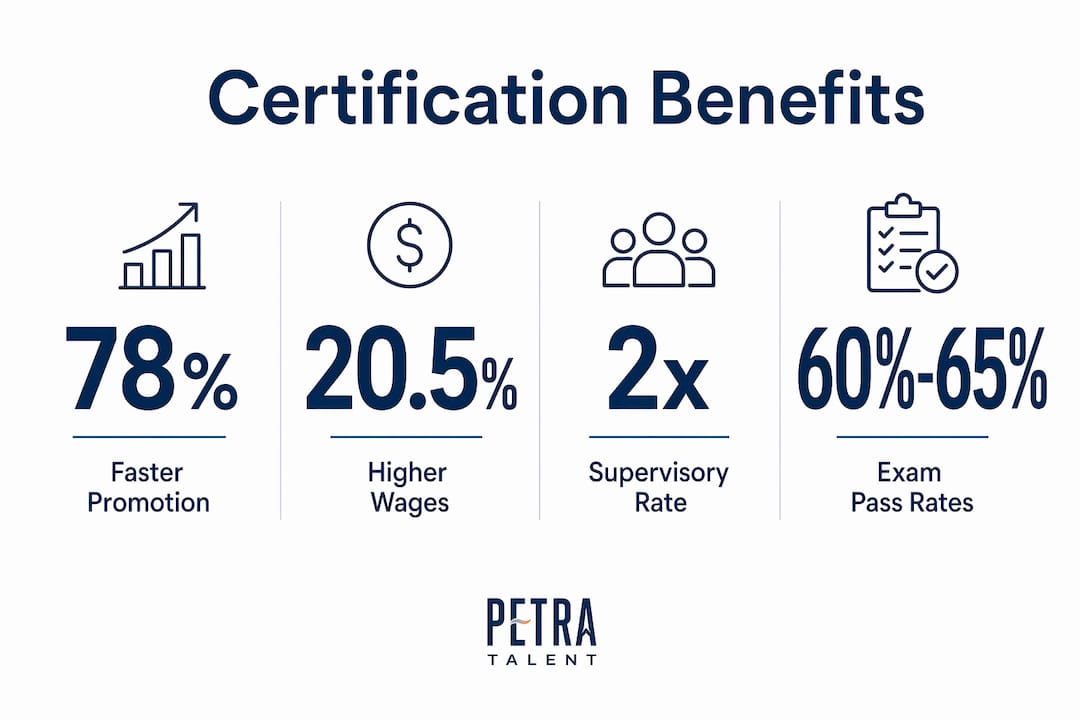
The wage data reinforces this. Certified plumbers earn a 20.5% higher median annual wage, and that premium reflects market recognition of their legal authority and reduced error rates. Employers who pay competitive wages to certified workers see lower turnover. Replacing a skilled plumber costs significantly more than the wage difference between certified and non-certified hires, when accounting for recruiting, onboarding, and lost productivity.
Continuous education tied to license renewal also keeps certified plumbers current on code changes and new materials. That ongoing learning reduces the risk of outdated practices causing compliance failures on newer projects. Contractors who invest in plumbing service technician specializations see this return in both quality and retention.
Three workforce stability benefits of hiring certified plumbers:
- Lower voluntary turnover, because certified workers have more to lose by leaving without a strong offer
- Faster promotion into supervisory roles, reducing the need to hire externally for leadership positions
- Higher bid eligibility on commercial projects that require a licensed master plumber on record
How can employers build certification into their hiring strategy?
Credential verification is the starting point, and it requires more precision than most employers apply. Distinguishing between individual licenses and business contractor licenses is the first step. Verifying both through the relevant state licensing board before extending an offer protects the company from compliance gaps that surface during inspections.
Employers operating in markets with low journeyman pass rates need a longer hiring horizon. Building relationships with local apprenticeship programs creates a pipeline of candidates who will earn their journeyman license within the market’s specific requirements. That approach reduces dependence on out-of-state hires who face reciprocity delays. For context on how HVAC certifications shape hiring in a related trade, the same licensing complexity applies across mechanical contracting.
Practical steps for incorporating certification into hiring:
- Verify license numbers directly with state boards before making offers
- Clarify the supervision requirements for out-of-state hires during onboarding planning
- Build apprenticeship partnerships in markets where journeyman supply is tight
- Include certification status in compensation bands to reward credential advancement
- Track license renewal dates for current staff to avoid lapses that affect permit authority
Pro Tip: Structure compensation tiers around licensing levels. A clear pay increase tied to passing the journeyman or master exam gives current employees a financial reason to pursue certification, reducing external hiring pressure.
Understanding workforce vetting for contractors as a structured process, rather than a checklist, is what separates contractors who consistently hire well from those who repeat the same onboarding mistakes.
Key Takeaways
Plumbing certifications directly determine a candidate’s legal authority, wage tier, and long-term value to a contracting business, making credential verification a non-negotiable step in every hiring decision.
| Point | Details |
|---|---|
| Wage premium is real | Certified plumbers earn $72,170 vs. $59,910 for non-certified peers, a 20.5% difference. |
| Master license unlocks business capacity | Only master plumbers can pull permits and lead commercial bids legally. |
| Licensing delays are predictable | Out-of-state hires face 4–8 months of supervised work before independent licensing. |
| Promotion rates favor certified workers | 78% of certified plumbers reach supervisory roles within five years, vs. 42% non-certified. |
| Business and individual licenses are separate | Confusing contractor licenses with individual plumber licenses creates compliance failures. |
What I’ve learned about certifications that most employers miss
Contractors consistently underestimate how much licensing complexity affects their actual hiring timeline. The assumption that a licensed plumber from another state can start working independently on Monday is one of the most common and costly mistakes I see. The reciprocity gap is real, and it turns a strong hire into a supervised liability for months.
The second thing most employers overlook is the business value of a master plumber beyond the individual’s skill set. A master license is a revenue-enabling asset for the company. Without one on staff, a contractor cannot legally pull permits or bid certain commercial projects. That is not a credential detail. That is a business constraint.
Certification status also signals something harder to measure: professional commitment. Plumbers who pursue master licensing invest years of additional training and pass rigorous exams. That investment correlates with lower turnover and higher performance. Employers who treat certification as a checkbox miss the behavioral signal it carries.
— David
Petratalent’s approach to certified plumbing recruitment
Hiring certified plumbers efficiently requires more than posting a job and reviewing resumes. Petratalent specializes in sourcing and vetting licensed plumbing professionals across the United States, with a process built around credential verification, local licensing compliance, and role-specific technical screening.

Petratalent’s plumbing recruiting services are designed for mechanical contractors who need verified, license-ready candidates without the delays that come from unvetted pipelines. The team confirms individual license status, identifies reciprocity gaps before offers are extended, and matches candidates to the specific licensing requirements of each market. Contractors who work with Petratalent reduce time-to-fill and avoid the compliance risks that come from skipping credential verification. For a broader view of available services, the Petratalent services overview covers the full scope of workforce solutions for plumbing and HVAC contractors.
FAQ
Why do plumbing certifications matter in hiring decisions?
Plumbing certifications verify a candidate’s legal authority to perform and supervise work, reducing liability and code compliance risks for employers. Certified plumbers also earn a 20.5% higher median wage, reflecting their market value and reduced error rates.
What is the difference between a journeyman and a master plumber license?
A journeyman license allows a plumber to execute work under a master’s oversight, while a master license grants authority to design systems, pull permits, and lead commercial bids independently.
How do licensing delays affect plumbing hiring timelines?
Out-of-state hires with journeyman licenses often require 4–8 months of supervised work before passing local exams, due to limited reciprocity agreements between states.
Do certifications reduce turnover in plumbing teams?
Certified plumbers reach supervisory roles at nearly double the rate of non-certified peers, and their higher wages and career advancement opportunities correlate with lower voluntary turnover.
What is the difference between a plumbing contractor license and an individual plumber license?
A contractor license is held by the business entity and authorizes the company to operate and pull permits, while individual licenses (journeyman or master) are held by the plumber personally. Confusing the two creates compliance failures during inspections.
Recommended
Post a comment
Related Posts

July 10, 2026
What Contractors Miss When Hiring Plumbers Without Recruitment Agencies
Hiring plumbers might seem straightforward at first. Many contractors believe that posting a job and…

July 10, 2026
Plumbing Staffing Agencies That Help You Hire Skilled Workers Fast
Finding qualified plumbing professionals has become increasingly challenging for contractors. Many businesses rely on plumbing…

July 10, 2026
HVAC Project Manager Hiring That Improves Workflow and Budget Control
Project success often depends on more than technical expertise and field execution. Strong leadership behind…

July 10, 2026
How to Choose the Right HVAC Staffing Agency for Your Business
Finding qualified professionals has become one of the biggest challenges for mechanical contractors. Many businesses…