



TL;DR:
- HVAC certifications are essential for hiring certified technicians, reducing callbacks, and improving compliance. Supporting credentials like EPA 608 and NATE enhances workforce quality and retention, saving costs over time. Verifying individual certifications through official sources ensures workforce reliability and legal compliance.
HVAC certifications are the most reliable proof that a technician can do the job safely, legally, and to a standard that protects your business. Understanding why HVAC certifications matter in hiring is not an academic exercise. It is a practical decision that affects callback rates, compliance exposure, and whether your best candidates accept your offer before a competitor does. The two credentials that define the field are EPA 608, which is federally mandated for anyone handling refrigerants, and NATE (North American Technician Excellence), the leading voluntary quality credential recognized across the industry.
Why HVAC certifications matter in hiring decisions
Certifications in the HVAC trade fall into two categories: legal requirements and quality signals. EPA 608 is the legal floor. Any technician who handles refrigerants without it exposes your company to federal penalties. NATE certification sits above that floor as the industry’s primary performance benchmark. Contractors who understand this distinction make better screening decisions from the first call.
The productivity data behind NATE is specific. NATE-certified technicians complete about 20.5% more work on average and earn 12.2% more than non-certified peers. That wage premium is not a cost. It is a signal that certified technicians are more productive and more likely to stay. Learning how to hire certified HVAC technicians starts with recognizing which credentials carry real weight and which are just company claims.
Beyond EPA 608 and NATE, two other credentials add value in specific contexts:
- OSHA 10: A safety training credential that reduces worksite incidents and is increasingly required on commercial projects.
- State licenses: Required in most states for HVAC work above a certain scope. Requirements vary by state, so contractors must confirm local rules before screening candidates.
Stacking credentials pays off at the senior level. Combining EPA 608, NATE, and a state license can raise a senior technician’s salary ceiling by $10,000 to $15,000 annually. That range reflects the market’s recognition that multi-certified technicians carry less risk and deliver more value.
How certifications reduce callbacks and improve workforce quality
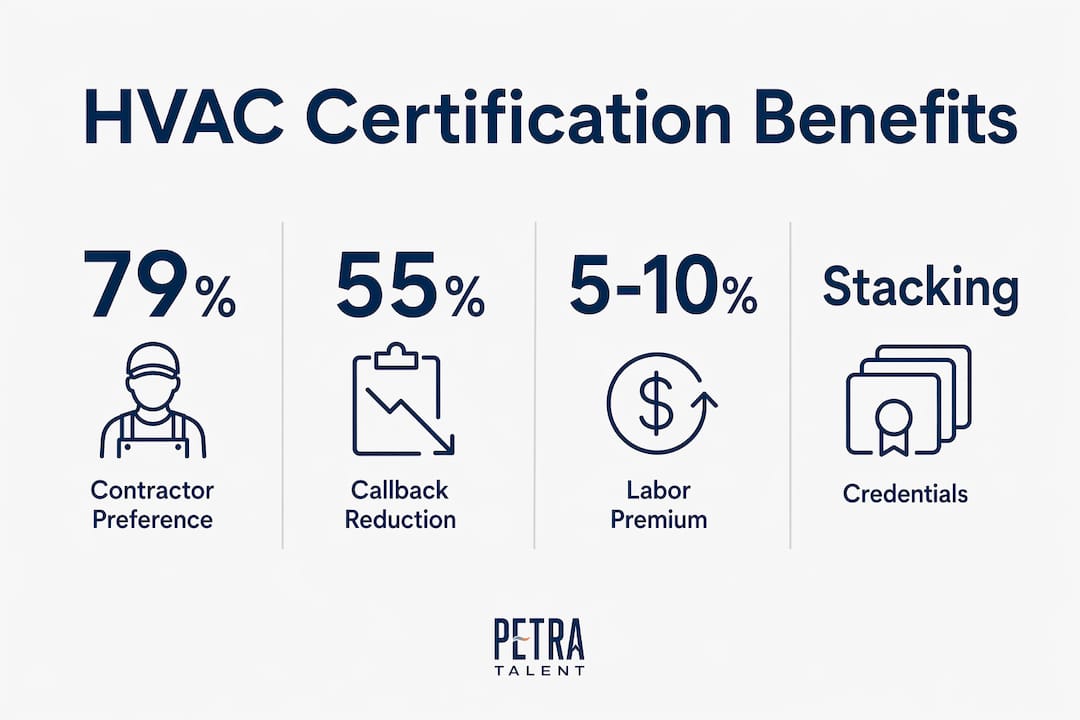
Callbacks are one of the most direct costs a mechanical contractor absorbs. They consume labor hours, damage customer relationships, and signal a quality problem to the market. Certification status is one of the strongest predictors of callback frequency. 55% of callbacks involve technicians without NATE certification. That figure alone justifies treating NATE as a serious screening criterion.
The contractor community has noticed. Surveys show 79% of contractors prefer NATE-certified technicians, and 76% say certified technicians perform better in the field. Those numbers reflect years of direct experience with the difference certification makes on real jobs.
Pro Tip: A 5–10% labor premium for a NATE-certified technician is cost-effective when you consider that poor installations from uncertified workers can generate 15–40% losses in rework, warranty claims, and customer churn.
Certification also acts as a filter against transient or opportunistic workers. Ongoing certification maintenance signals that a technician is invested in the trade as a career, not a temporary income source. That distinction matters when you are building a workforce meant to last.
Best practices for verifying certifications during hiring
Verification is where many contractors make a critical mistake. A company can claim its workforce is NATE-certified without every individual technician holding a current credential. Verification must be done at the individual level through official registries like natex.org. Relying on a company’s word exposes you to compliance gaps and workmanship failures.
A structured approach to certification verification works as follows:
- Gate on EPA 608 first. No candidate who handles refrigerants should advance past the initial screen without a confirmed EPA 608 credential. This is a legal requirement, not a preference.
- Check NATE status through natex.org. Confirm the specific technician’s name and certification specialty. NATE certifications are specialty-specific, so a technician certified in air conditioning may not hold a heating credential.
- Confirm state license status. Most state licensing boards maintain public lookup tools. Run the check yourself rather than accepting a copy of a certificate.
- Sequence NATE for experienced candidates. EPA 608 should be the initial gate; NATE certification is best pursued after 1–2 years of field experience. Pushing new hires toward NATE too early creates burnout and disrupts shop culture.
- Move fast on certified candidates. In a tight labor market, a two-day callback rule keeps certified candidates engaged. Firms that run four-week hiring loops lose qualified technicians to faster-moving competitors.
Pro Tip: When posting roles, list EPA 608 as a hard requirement and NATE as a preferred credential. This filters your applicant pool before the first interview and signals to serious technicians that you run a professional operation.
Avoiding common HVAC hiring mistakes during the screening phase saves significant time and reduces the risk of placing an unqualified technician in a role that demands precision.
How funding certifications improves retention and career growth
Retention in the HVAC trades is directly tied to whether technicians see a future with their employer. Certification funding is one of the clearest signals a contractor can send. When a company pays for a technician’s NATE exam or state license renewal, it communicates investment in that person’s career. That investment reduces turnover.
The financial case for technicians is clear. Stacking EPA 608, NATE, and a state license can add $10,000 to $15,000 to a senior technician’s annual salary ceiling. Technicians who understand this progression are more motivated to stay with employers who support it. Contractors who fund certification also benefit from a workforce that is continuously improving its skills.
Key retention benefits of supporting certification include:
- Lower turnover costs. Replacing a skilled technician costs far more than funding a certification exam.
- Higher engagement. Technicians enrolled in certification programs report stronger connection to their employer’s goals.
- Career pathway clarity. Structured certification progression gives technicians a reason to stay through the early years of employment.
- Wage competitiveness. Employers who fund certifications can attract candidates from career-focused job markets where credential support is a deciding factor.
Contractors who treat certification as a one-time hiring filter miss the larger opportunity. Certification is a career development tool that pays dividends in workforce stability over time.
Key Takeaways
HVAC certifications are the most reliable hiring filter available to mechanical contractors, directly reducing callbacks, improving compliance, and supporting long-term retention.
| Point | Details |
|---|---|
| EPA 608 is the legal floor | No technician handling refrigerants should be hired without a confirmed EPA 608 credential. |
| NATE reduces callbacks | 55% of callbacks involve non-NATE-certified technicians, making NATE a critical quality screen. |
| Verify at the individual level | Confirm credentials through natex.org for each technician, not through company-wide claims. |
| Sequence certifications correctly | Gate on EPA 608 first; encourage NATE after 1–2 years of field experience to avoid burnout. |
| Fund certifications to retain talent | Supporting credential costs signals career investment and reduces costly technician turnover. |
Certifications are a hiring asset, not just a compliance checkbox
From where I sit, the biggest mistake contractors make is treating certifications as a paperwork requirement rather than a strategic hiring tool. I have seen companies hire technicians based on a company’s claim of a certified workforce, only to discover that the individual on the job site had no current credentials. That gap is not just a compliance risk. It is a direct path to callbacks, warranty disputes, and customer loss.
The sequencing point matters more than most hiring managers realize. Pushing a new technician toward NATE certification before they have real field experience often backfires. The credential loses meaning when it is not backed by practical competence. The smarter approach is to gate hard on EPA 608, let technicians build field skills for one to two years, and then support NATE as a career milestone.
Speed is the other factor that separates contractors who consistently hire certified talent from those who settle. Certified technicians have options. A slow hiring process is not just inefficient. It is a competitive disadvantage. The contractors who move in two days, not two weeks, are the ones who build the strongest certified workforces.
— David
Petratalent’s approach to sourcing certified HVAC technicians
Mechanical contractors who need certified HVAC technicians and cannot afford a slow or uncertain hiring process work with Petratalent for exactly this reason.

Petratalent’s HVAC recruiting services focus on sourcing technicians with verified credentials, including EPA 608 and NATE, before candidates reach the interview stage. The team applies technical vetting to confirm individual certification status, not company-level claims. Contractors get faster access to qualified candidates and spend less time filtering unqualified applicants. For contractors managing workforce compliance and quality at scale, Petratalent’s full recruiting and vetting solutions provide a structured path to a stronger, more reliable field team.
FAQ
What is EPA 608 and why is it required for HVAC hiring?
EPA 608 is a federally mandated certification for any technician who handles refrigerants. Hiring a technician without it exposes your company to federal penalties and compliance failures.
How does NATE certification affect callback rates?
55% of callbacks involve technicians without NATE certification. Prioritizing NATE-certified candidates directly reduces rework costs and protects your company’s reputation.
How do I verify a technician’s NATE certification?
Check the individual technician’s credentials through natex.org. Never rely on a company’s claim that its workforce is certified without confirming each technician’s status directly.
When should a technician pursue NATE certification?
NATE certification is most effective after 1–2 years of field experience. Requiring it from new hires before they have practical skills often leads to burnout and poor retention.
How much can stacking certifications increase a technician’s salary?
Combining EPA 608, NATE, and a state license can raise a senior technician’s annual salary ceiling by $10,000 to $15,000, making certification support a strong retention tool for contractors.
Recommended
Related Posts

October 13, 2026
Recruiting Contract Terms: 10 Checks and Ready to Use Clauses
Define fee triggers, candidate ownership, guarantees, and compliance terms. Get a master agreement, short schedule,…

October 12, 2026
Offer Acceptance Rates: Segment Benchmarks, HVAC’s 3–5 Day SLA
See why a 78% to 82% offer acceptance benchmark can mislead, how role and source…

October 11, 2026
Bad Hires Can Cost Construction Firms 30% to 200% of Salary
Bad hires can cost construction firms 30% to 200% of annual salary. Calculate recruiting, rework,…

October 10, 2026
Construction Labor Forecasting for PMs: 7 Steps to Time Hiring
Learn when construction project managers should use WBS or simulation, track labor KPIs, and turn…