



TL;DR:
- The skilled trades gap is a growing shortage of qualified workers in essential technical roles. It results from retirements, reduced training, and higher skill demands, leading to significant economic losses. Addressing the shortage requires expanding training programs, building industry-school partnerships, and improving workforce retention strategies.
The skilled trades gap is defined as the growing disparity between demand for qualified tradespeople and the number of workers actually available to fill those roles. Electricians, plumbers, HVAC technicians, pipefitters, and welders sit at the center of this shortage. The U.S. faces a projection of 2.1 million unfilled skilled trades positions by 2030, according to JLL. That figure represents a structural deficit, not a temporary dip in hiring. Understanding what the skilled trades gap means requires looking at demographics, education policy, and economic forces together.
What does the skilled trades gap mean for the workforce?
The skilled trades gap, also called the skilled labor gap in workforce economics, describes a structural mismatch between job openings and qualified candidates in technical occupations. This is not simply a matter of not enough people applying. The gap reflects a pipeline that has been shrinking for decades while demand has accelerated.
The causes fall into four clear categories:
- Retirement outpacing replacement. The trades sector faces a 5-to-2 retirement-to-replacement ratio, meaning five workers retire for every two who enter. That math compounds quickly across a decade.
- Collapsed vocational training. Career and technical education programs were cut significantly in public schools from the 1980s onward. The result is a generation with no exposure to trades as a career path.
- Weak apprenticeship throughput. Only about 150,000 new workers enter the trades annually through apprenticeships, against roughly 600,000 open job postings. The pipeline produces less than a quarter of what the market needs.
- Rising skill complexity. Modern HVAC systems, smart building controls, and energy management platforms require digital fluency alongside traditional mechanical skills. That raises the bar for entry and slows the pace at which new workers become fully productive.
Pro Tip: When analyzing the skilled trades workforce issues at your organization, distinguish between a true skills gap, a wage gap, and a geographic mismatch. Each requires a different fix. Treating a wage problem as a training problem wastes time and money.
How does the skilled trades gap affect labor markets and the economy?

The economic consequences of the skilled labor gap are measurable and severe. Economic losses could reach $1 trillion annually from project delays, cost overruns, and deferred infrastructure work. That figure comes from JLL’s analysis of unfilled roles across construction, manufacturing, and facilities management.
The impact spreads across four layers:
- Project delays and cost inflation. Construction timelines stretch when crews are understaffed. Contractors bid higher to account for labor scarcity, pushing up costs for developers, municipalities, and homeowners.
- Business continuity risk. Facilities that cannot find qualified HVAC or electrical technicians face equipment failures, compliance violations, and unplanned downtime.
- Community and tax revenue losses. Closing the gap could unlock $325.6 billion in GDP and $71.3 billion in tax revenue nationally by 2030. Those numbers show what the shortage costs governments and communities every year it persists.
- Intensified competition for talent. Construction alone needs 349,000 net new workers in 2026. That demand forces employers into bidding wars for the same small pool of experienced workers, which raises wages but does not solve the underlying supply problem.
The labor market tightening is not uniform. Urban markets with major data center or infrastructure projects feel the pressure most acutely. Rural markets face geographic mismatches where workers exist but are not located near the work.
How is the skilled trades gap evolving with technology and workforce trends?
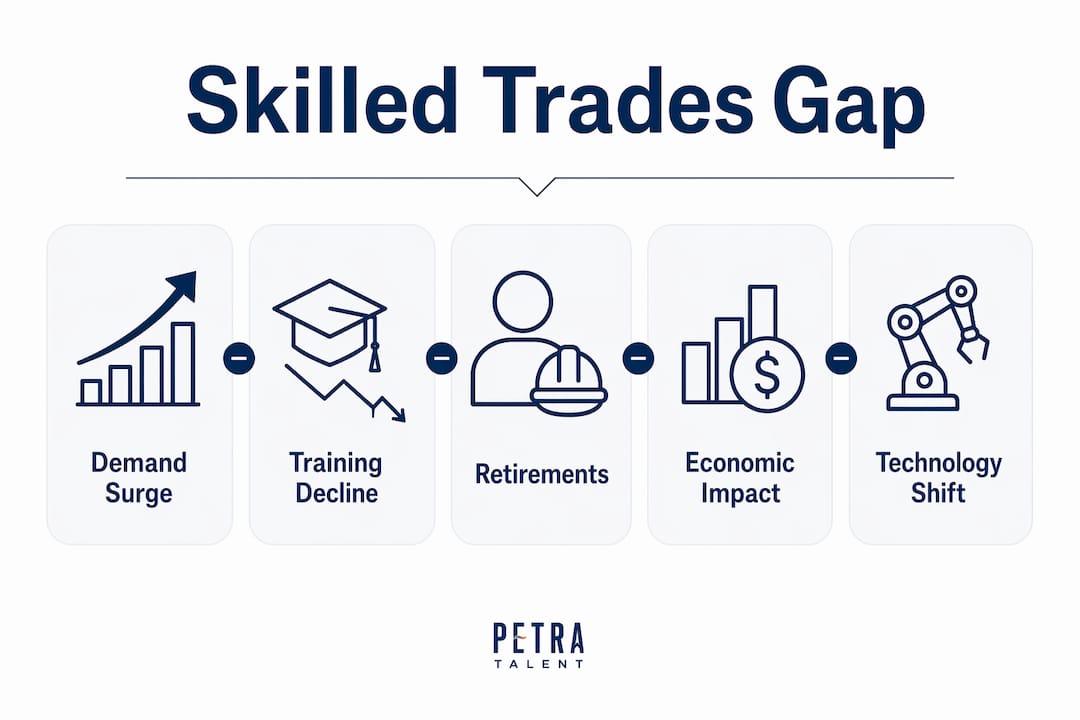
Demand for skilled tradespeople is not static. It is accelerating in specific sectors. AI data centers, renewable energy installations, and aging building infrastructure all require licensed electricians, HVAC technicians, and plumbers at a scale the current workforce cannot meet.
The skill requirements within trades are also shifting. Demand for high-tech skills in data center construction and energy systems is growing faster than the general trades market. A technician who can commission a building automation system is worth significantly more than one who cannot, and there are far fewer of them.
| Demand driver | Trades most affected | Skill requirement shift |
|---|---|---|
| AI data centers | Electricians, HVAC techs | High-voltage systems, precision cooling |
| Energy efficiency retrofits | HVAC, plumbers | Heat pump systems, controls integration |
| Aging infrastructure | All trades | Code compliance, systems diagnostics |
| Residential construction growth | Plumbers, electricians | Speed, licensing, project management |
One countervailing force is worth noting. College tuition has increased 900% since 1983, and uncertain job markets for four-year degree holders are pushing more young people to reconsider trades careers. That renewed interest is real, but it has not yet translated into enough new workers to close the gap.
Pro Tip: Employers who build direct school-to-employer pipelines with community colleges and vocational programs fill roles faster than those relying on open job postings. The HVAC technician shortage is most acute for contractors without a structured pipeline.
What strategies are effective to close the skilled trades gap?
Closing the skilled trades shortage requires action on multiple fronts simultaneously. Training more candidates is necessary but not sufficient on its own.
- Expand apprenticeship capacity. The bottleneck is not just candidate interest. Instructor availability and apprenticeship slots limit how many workers can enter the pipeline each year. Funding more training seats and qualified instructors is the highest-leverage investment.
- Build school-to-employer programs. Partnerships between mechanical contractors and high schools or community colleges create a direct path from classroom to job site. Hiring plumbing apprentices strategically through these programs reduces time-to-productivity and improves retention.
- Address wage competitiveness. Geographic mismatches and below-market wages keep qualified workers from taking available roles. Compensation tied to asset outcomes and career growth is the most effective retention tool for modern trades professionals managing complex systems.
- Use trade-specific recruitment. General job boards do not reach experienced tradespeople effectively. Specialized recruiting that targets licensed technicians and vets candidates for technical competency fills roles faster and with better outcomes.
- Invest in career development. Workers who see a clear path from apprentice to journeyman to foreman to project manager stay longer. Retention is cheaper than replacement, and career ladders are a proven tool for reducing turnover in skilled trades.
Key takeaways
The skilled trades gap is a structural workforce crisis driven by demographic imbalance, collapsed training pipelines, and rising skill complexity, and it will cost the U.S. economy up to $1 trillion annually until it is addressed.
| Point | Details |
|---|---|
| Definition of the gap | Demand for qualified tradespeople far exceeds supply, with 2.1 million unfilled roles projected by 2030. |
| Primary cause | A 5-to-2 retirement-to-replacement ratio compounds the shortage faster than training programs can offset. |
| Economic stakes | Unfilled roles cost up to $1 trillion annually and suppress $325.6 billion in potential GDP growth. |
| Evolving demand | AI infrastructure, energy retrofits, and aging buildings are accelerating demand for high-skill tradespeople. |
| Closing the gap | Expanding apprenticeship capacity, building school-to-employer pipelines, and tying pay to career growth are the most effective interventions. |
The gap is bigger than a hiring problem
I have spent years working inside the HVAC and plumbing recruitment space, and the most common mistake I see is treating the skilled trades gap as a short-term staffing problem. It is not. It is a systemic failure that took decades to build and will take coordinated effort across education, industry, and policy to reverse.
What frustrates me most is how often employers focus entirely on recruitment while ignoring retention. You can fill a role in 60 days and lose the worker in 90 if the compensation structure and career path are not right. The trades professionals entering the workforce today have options. They know their value. Contractors who treat hiring as a transaction rather than a relationship will keep losing ground.
The good news is that the fundamentals are shifting. High college costs and uncertain degree returns are sending more young people toward trades. That window will not stay open forever. The employers and policymakers who build real pipelines now will be the ones with stable workforces in 2030.
— David
How Petratalent addresses skilled trades workforce challenges
The skilled trades shortage hits HVAC and plumbing contractors hardest because the technical vetting requirements are high and the candidate pool is thin. Petratalent specializes in sourcing and screening licensed technicians, project managers, and leadership talent specifically for mechanical contractors across the United States.

Petratalent’s recruitment and workforce solutions cover direct hire placements, technical vetting, market wage analysis, and workforce consultation. Contractors working with Petratalent get candidates who are pre-screened for licensure, technical competency, and role fit, not just resume matches. For contractors dealing with HVAC recruitment challenges or struggling to build a reliable plumbing team, Petratalent provides the industry-specific expertise that general staffing firms cannot.
FAQ
What does the skilled trades gap mean?
The skilled trades gap is the disparity between the number of qualified tradespeople available and the number needed to fill open roles. The U.S. faces a projected 2.1 million unfilled skilled trades positions by 2030.
What trades are most affected by the shortage?
Electricians, HVAC technicians, plumbers, pipefitters, and welders face the most severe shortages. Construction alone needs 349,000 net new workers in 2026 to meet current demand.
Why is the skilled trades gap getting worse?
Five workers retire for every two who enter the trades, and only about 150,000 new workers enter annually through apprenticeships against 600,000 open job postings. That gap widens each year without major investment in training capacity.
What is the economic impact of the skilled labor gap?
Unfilled skilled trades roles cost the U.S. economy up to $1 trillion annually in project delays and lost productivity. Closing the gap could unlock $325.6 billion in GDP and $71.3 billion in tax revenue by 2030.
How can contractors address the skilled trades shortage?
Contractors close the gap fastest by building school-to-employer pipelines, expanding apprenticeship programs, and using trade-specific recruiting to find pre-vetted candidates. Linking compensation to career development also significantly improves retention.
Recommended
Related Posts

October 14, 2026
HVAC Recruiter Fees: Contractors Weigh $10,000 Against Vacancy Costs
See how HVAC recruiter fees work for contractors, from 15% to 25% placement costs to…

October 13, 2026
Recruiting Contract Terms: 10 Checks and Ready to Use Clauses
Define fee triggers, candidate ownership, guarantees, and compliance terms. Get a master agreement, short schedule,…

October 12, 2026
Offer Acceptance Rates: Segment Benchmarks, HVAC’s 3–5 Day SLA
See why a 78% to 82% offer acceptance benchmark can mislead, how role and source…
October 11, 2026
Bad Hires Can Cost Construction Firms 30% to 200% of Salary
Bad hires can cost construction firms 30% to 200% of annual salary. Calculate recruiting, rework,…