



TL;DR:
- Mechanical contractors often face lengthy, inconsistent hiring processes that hinder project timelines and operational efficiency. Structured recruitment workflows, including standardized scoring and automation, significantly reduce time-to-hire and improve candidate quality. Embracing AI-driven tools and redefining role requirements ensure contractors stay competitive in a transforming workforce landscape.
Mechanical contractors across the United States frequently run into the same wall: a hiring process that takes too long, produces inconsistent candidates, and stalls projects before they even begin. The need to structure your mechanical direct hire process is not a matter of preference. It is a matter of operational survival. When a skilled HVAC technician or plumbing superintendent position sits open for 60 to 90 days, schedules slip and crews get stretched thin. This guide walks through every stage of the mechanical hiring workflow, from preparation and execution to validation and continuous improvement, so contractors can hire better and faster.
Table of Contents
- Why structuring your direct hire process matters for mechanical contractors
- Preparing for a successful direct hire: requirements and tools checklist
- Executing the mechanical direct hire process step by step
- Verifying and improving your direct hire hiring outcomes
- Rethinking mechanical direct hiring in the age of AI and workforce transformation
- Streamline your mechanical hiring with PetraTalent’s expert services
- Frequently asked questions
Key Takeaways
| Point | Details |
|---|---|
| Audit and structure process | Review hiring workflows and implement standardized rubrics to reduce hiring time and improve quality. |
| Prioritize certifications | Replace rigid degree requirements with relevant certifications like NATE and PE to widen your talent pool. |
| Leverage AI and specialists | Use specialized recruiters and AI tools to shorten sourcing time and streamline candidate evaluation. |
| Automate hiring steps | Incorporate ATS automation for scheduling, scoring, and approvals maintaining transparency and consistency. |
| Monitor and improve | Track key metrics and use guarantee periods to manage risk and refine your direct hire process continuously. |
Why structuring your direct hire process matters for mechanical contractors
To create a reliable hiring system, it is crucial first to understand why current processes often fail and how structuring can make a meaningful difference.
Most mechanical contractors do not have a broken hiring process. They have no process at all. Requisitions get passed by word of mouth, screening criteria shift from hire to hire, and interview panels ask different questions to different candidates. The result is inconsistent quality and unpredictable timelines.
Using industry-focused recruiters reveals a consistent pattern: contractors who audit their hiring workflows and eliminate bottlenecks cut their time significantly. In fact, mechanical contractors can reduce their time-to-hire from 90 days to 45 days by auditing hiring workflows and implementing standardized scoring rubrics. That is not a small efficiency gain. It translates directly to project readiness.
Structuring the direct hire process also eliminates one of the most costly screening errors in mechanical engineering hiring: overweighting degrees. A four-year engineering degree does not tell you whether a technician can troubleshoot a chiller under pressure or safely commission a hydronic system. Certifications do.
Here is what a well-structured direct hire process delivers:
- Faster time-to-hire through defined stages, timelines, and ownership at each step
- Consistent candidate quality by applying standardized scoring weighted on technical accuracy (40%), safety knowledge (30%), and operational efficiency (30%)
- Reduced bias because every candidate moves through the same structured evaluation
- Better retention since candidates are evaluated against the actual demands of the role, not a generic job description
A structured hiring process is not about slowing down to fill out paperwork. It is about removing the parts of your current process that waste time without adding value.
Exploring mechanical staffing services built specifically for the trades makes this clearer. The structure of recruitment matters as much as the quality of candidates sourced.
Preparing for a successful direct hire: requirements and tools checklist
Once you understand the importance of structuring, the next step is thorough preparation to ensure your hiring process runs without unnecessary delays.
Before posting a single job listing, contractors need to define exactly what they are hiring for. That means going beyond job titles and listing the specific certifications, hands-on skills, and project experience required. Replacing degree requirements with certifications like NATE for HVAC and PE for power systems increases the qualified talent pool and better reflects real-world skills.
Technical assessments are another preparation essential. The most effective assessments simulate real project challenges, such as diagnosing a refrigerant leak under time pressure or sizing a plumbing system for a multi-unit build. When designed well, these assessments predict job performance with 80 to 90% accuracy compared to unstructured interviews. Leveraging specialized recruiting advantages in mechanical talent sourcing can also significantly reduce the time it takes to get qualified candidates in front of your hiring team. Specialized engineering recruiting firms provide shortlists in 2 to 3 weeks, shortening time-to-hire compared to generalist models.
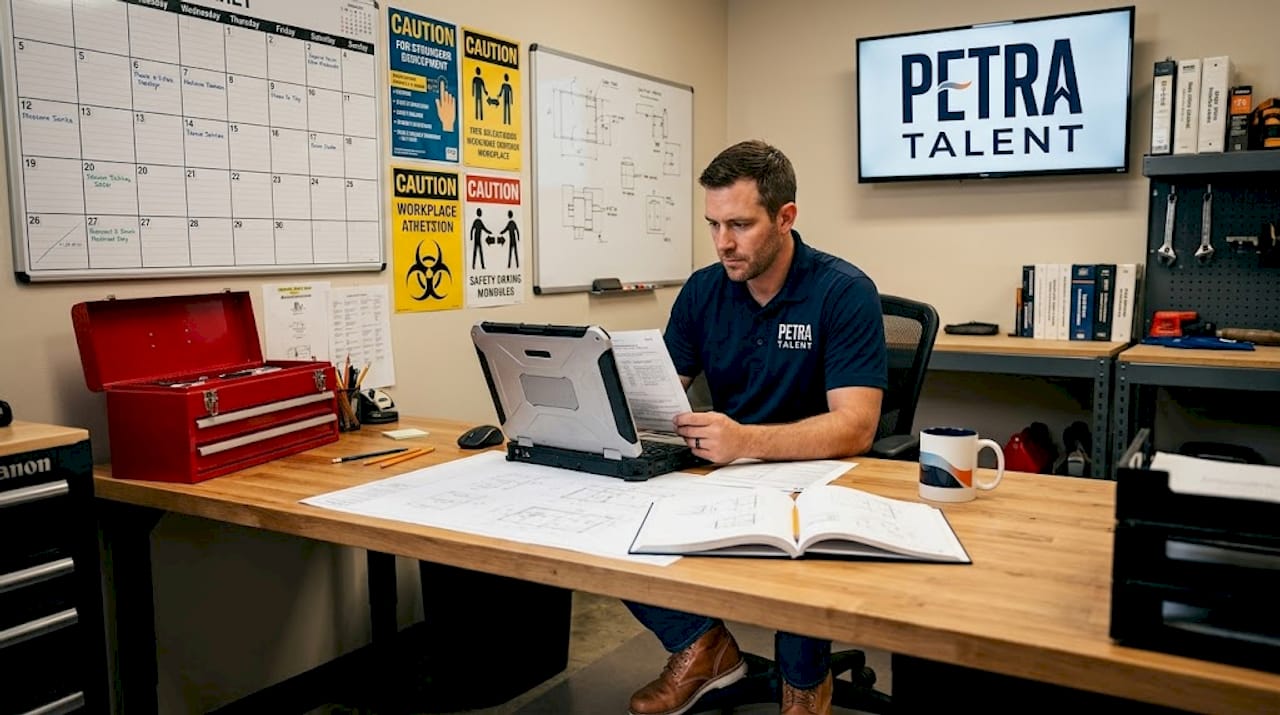
Preparation checklist for a structured direct hire:
| Preparation item | Details |
|---|---|
| Role requirements document | Certifications, years of experience, project type, tools proficiency |
| Technical assessment | Scenario-based, role-specific, scored with a rubric |
| ATS configuration | Screening stages, rubrics, status tracking, evidence capture |
| Sourcing strategy | Specialized recruiter, AI tool, or industry job boards |
| Compensation benchmark | Current market rates for region and role |
| Interview panel alignment | Agreed criteria, scoring weights, and feedback format |
Pro Tip: Before your first outreach goes out, confirm that your ATS (applicant tracking system, the software that manages candidates through hiring stages) is configured with knockout questions specific to each role. A question like “Do you hold a current NATE certification?” instantly filters unqualified applicants without requiring a recruiter to review every resume.
Executing the mechanical direct hire process step by step
With preparation complete, you can execute the direct hire process with confidence, ensuring consistency at every stage.
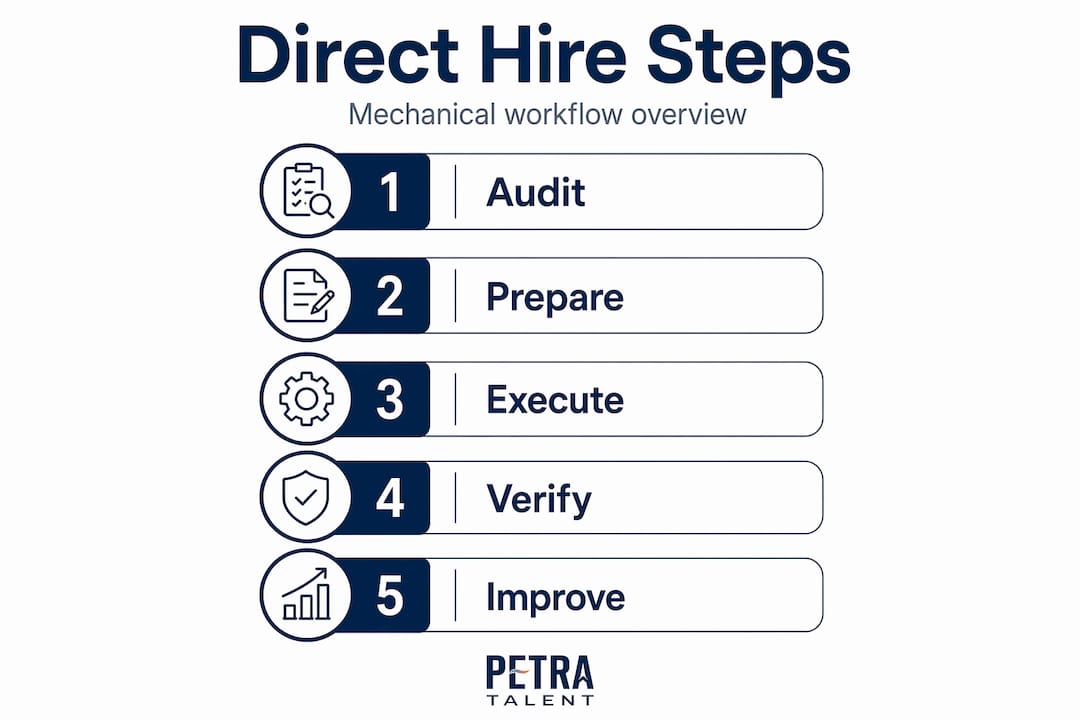
The direct hire process steps below apply to both field technician roles and leadership positions like project managers and superintendents. The weight given to certain criteria will shift, but the structure stays the same.
- Launch targeted outreach. Use specialized recruiters or AI-powered sourcing tools to reach passive candidates who are not actively job hunting but are open to the right opportunity. AI-powered recruiting tools can reduce manual sourcing time by up to 90% while enabling faster candidate screening and scheduling.
- Apply knockout screening with structured rubrics. Every candidate answers the same set of knockout questions. Rubrics weighted on technical accuracy, safety knowledge, and efficiency criteria score responses consistently. No subjective gut calls at this stage.
- Automate interview scheduling. Manual scheduling is one of the most common sources of delay in the mechanical hiring workflow. Automated scheduling tools send calendar invites and reminders, cutting no-shows and phone-tag delays significantly.
- Collect structured interviewer feedback. Each panel member submits evidence notes tied to specific criteria, not general impressions. Recruitment automation workflows standardize screening and scheduling, ensuring transparency with outputs like status, next action, evidence notes, and approval logs.
- Manage the offer with automated approval workflows. Electronic signatures and automated approval routing eliminate the two-to-three-day lag that often kills offers when candidates are fielding multiple options.
Transparency at every stage is not optional in how to hire mechanical professionals. Candidates who understand where they stand in the process are far more likely to stay engaged through to offer acceptance.
Reviewing automated recruiting workflows and structured hiring processes gives contractors a clearer picture of how these steps translate into real tools and timelines.
Manual vs. structured process comparison:
| Hiring stage | Unstructured approach | Structured approach |
|---|---|---|
| Candidate sourcing | Job boards only, weeks of waiting | Specialized sourcing, shortlist in 2 to 3 weeks |
| Screening | Resume review, inconsistent criteria | Knockout questions, scored rubrics |
| Interview scheduling | Manual emails, high no-show rate | Automated scheduling, reminders sent |
| Feedback collection | Verbal debrief, no documentation | Evidence notes, scored criteria |
| Offer management | Verbal offer, manual paperwork | Automated approval, electronic signature |
Verifying and improving your direct hire hiring outcomes
After executing your hire, validating outcomes and iterating on your process ensures you maintain quality over time, not just on the first placement.
Tracking the right metrics is the starting point. Contractors who monitor time-to-hire, offer acceptance rates, and 90-day retention have the data they need to identify exactly where their process is losing momentum or producing poor fits.
Key performance indicators to track after every direct hire:
- Time-to-hire: Days from requisition open to accepted offer
- Offer acceptance rate: Percentage of offers that result in a signed acceptance
- 90-day retention rate: Whether new hires remain and perform through the initial period
- Hiring manager satisfaction score: Collected via a brief post-hire survey
Direct hire agreements provide an added layer of protection during this verification period. Direct hire agreements often include a 90-day guarantee period with free replacement or refund if the candidate leaves or is terminated. Use that window intentionally. Onboarding quality and early check-ins during those 90 days are as important as the hiring process itself.
Pro Tip: Set a monthly 30-minute review with your hiring manager and recruiter to go through the ATS dashboard together. Reviewing improving hiring outcomes data in a shared session surfaces problems faster than waiting for an annual audit.
Key metrics tracking table:
| Metric | Target benchmark | Review frequency |
|---|---|---|
| Time-to-hire | 30 to 45 days | Monthly |
| Offer acceptance rate | 85% or higher | Per hire cycle |
| 90-day retention | 90% or higher | Quarterly |
| Hiring manager satisfaction | 4 out of 5 or higher | Per hire |
Rethinking mechanical direct hiring in the age of AI and workforce transformation
The advice in this guide reflects current best practices. But mechanical contractors who want a lasting edge need to look at where the mechanical hiring paradigm is actually heading.
Hiring is shifting from manual task execution to AI-orchestrated workflows where human recruiters focus on judgment and candidate relationships. That is not a distant prediction. AI tools are already automating resume scoring, interview scheduling, and feedback analysis inside mechanical engineering hiring workflows today.
The implications go beyond speed. The more important shift is in how job descriptions get written and how candidates get evaluated. A field technician today who can validate AI diagnostics, catch errors in automated system outputs, and adapt their workflow when conditions change is more valuable than one who simply executes the same tasks reliably. Organizations must redesign roles and hiring systems to prioritize AI fluency, judgment, adaptability, and process thinking.
Contractors who update their job descriptions and screening criteria now to reflect these capabilities will find their talent pool improving while their competitors struggle with mismatched hires. The contractors who wait will face the cost of re-hiring in two to three years when the mismatch becomes impossible to ignore. Modern workforce design thinking pushes this point clearly: hiring for what a role requires today is necessary. Hiring for what it will require in three years is the actual competitive move.
Streamline your mechanical hiring with PetraTalent’s expert services
Now that you understand the structured direct hire process, PetraTalent offers the expertise to put these principles into action across your HVAC and plumbing operations.
PetraTalent specializes in direct hire recruiting for mechanical contractors nationwide, with services built specifically for the trades. From HVAC recruiting services to plumbing recruiting services, the focus is always on qualified, vetted candidates who match your role requirements from day one. The technical vetting solutions go beyond resume review to assess real-world competency. Whether you need a field technician or a superintendent, explore the full range of PetraTalent services to find the right fit for your team and your timeline.
Frequently asked questions
What is a direct hire process in mechanical contracting?
A direct hire process involves permanently recruiting technicians or leaders who join your payroll immediately, typically with a one-time placement fee and no temporary contract period. Direct hire placements are permanent, with the hire joining your company’s payroll from day one.
How can I reduce time-to-hire in my mechanical direct hiring process?
You can reduce time-to-hire by auditing workflows for bottlenecks, using standardized scoring rubrics, and automating interview scheduling and feedback collection. Mechanical contractors can reduce time-to-hire from 90 to 45 days by auditing hiring workflows and using standardized evaluation criteria.
What certifications should I prioritize over degree requirements?
Prioritize NATE certification for HVAC roles and PE for power systems, as both better represent real-world competency and expand your qualified candidate pool. Replacing degree requirements with certifications like NATE or PE increases the talent pool by better reflecting practical skills.
What guarantees are typical with direct hire agreements?
Most direct hire agreements include a 90-day guarantee period in which the agency will provide a free replacement search or refund part of the placement fee if the new hire departs early. Direct hire agreements commonly include a 90-day guarantee with free replacement or payment refund if the candidate leaves.
How is AI changing mechanical hiring processes?
AI is automating resume scoring, interview scheduling, and feedback collection so human recruiters can focus on candidate relationships and key decisions. AI orchestrates recruiting tasks end-to-end, shifting focus from manual execution to judgment and candidate engagement.
Recommended
- PetraTalent – Building the Future of HVAC Talent.
- Our Services – PetraTalent
- Blog – PetraTalent
- Blog Modern 01 – PetraTalent
Related Posts

October 13, 2026
Recruiting Contract Terms: 10 Checks and Ready to Use Clauses
Define fee triggers, candidate ownership, guarantees, and compliance terms. Get a master agreement, short schedule,…
October 12, 2026
Offer Acceptance Rates: Segment Benchmarks, HVAC’s 3–5 Day SLA
See why a 78% to 82% offer acceptance benchmark can mislead, how role and source…
October 11, 2026
Bad Hires Can Cost Construction Firms 30% to 200% of Salary
Bad hires can cost construction firms 30% to 200% of annual salary. Calculate recruiting, rework,…
October 10, 2026
Construction Labor Forecasting for PMs: 7 Steps to Time Hiring
Learn when construction project managers should use WBS or simulation, track labor KPIs, and turn…