



TL;DR:
- Hiring for project-critical roles should begin several months before mobilization to prevent schedule delays.
- Proactive recruitment and vetting help contractors avoid costly overlaps, permit issues, and procurement bottlenecks.
Hire to role-specific lead times or accept cascading schedule risk. 2026 industry guidance is clear: project managers and lead superintendents need to be in place several months before mobilization, core team roles a few months prior, and field labor a few weeks before work begins. Miss those windows on a commercial HVAC or plumbing project and you are not just short-staffed. You are stalling procurement, delaying submittals, and handing the schedule risk directly to the critical path. Petratalent works with mechanical contractors across the United States to close these gaps before they become project problems.
The core rule: Treat hiring as a preconstruction activity, not a back-office task. A superintendent who starts two months late cannot recover the buyout and logistics decisions that should have been made in week one.
Quick actions to take this week:
- Map your next project’s mobilization date and count backward using the lead times above.
- Open searches for PM and superintendent roles immediately if mobilization is within six months.
- Secure temporary coverage for any field labor gap within the next 30 days.
Table of Contents
- Role-by-role hiring timelines for mechanical projects
- How vacancies ripple through procurement, permitting, and logistics
- Is the constraint headcount, or something else?
- Tactical hiring and schedule recovery when you must add staff
- Week-of-hire checklist for compressed timelines
- When late hires create contractual exposure
- Cost impact of late hires: what contractors actually pay
- Key Takeaways
- Why proactive hiring is worth the discipline
- Petratalent helps contractors meet these timelines
Role-by-role hiring timelines for mechanical projects
The table below maps each role to its recommended lead time, along with the schedule consequences of leaving that seat vacant.
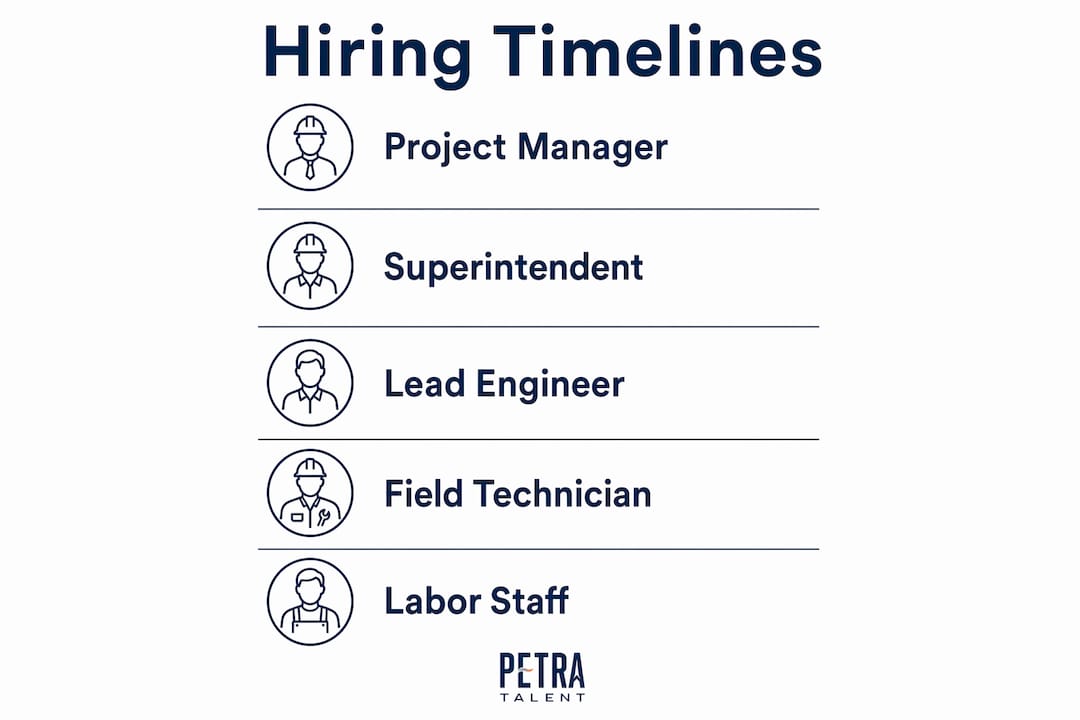
| Role | Lead Time Before Mobilization | Critical-Path Relevant | Key Vetting Considerations |
|---|---|---|---|
| Project Manager | 4–6 months | Yes | License verification, project history, buyout experience |
| Lead Superintendent | 4–6 months | Yes | Site management, safety record, subcontractor coordination |
| Estimator | 2–3 months | Yes | Bid accuracy, software proficiency, mechanical scope experience |
| Foreman | 2–3 months | Yes | Trade certification, crew leadership, code knowledge |
| Field Technicians (HVAC/Plumbing) | 3–4 weeks | Conditional | License, background check, tool competency screen |
Senior hires typically require multiple weeks of sourcing and negotiation alone, plus additional onboarding time before they reach full productivity on a complex mechanical project. That means a PM search started close to three months before mobilization is already behind. Healthcare and industrial projects carry higher risk because permitting, infection control coordination, and commissioning sequencing all depend on leadership being present early. Smaller commercial jobs have more tolerance, but the principle holds: hiring speed matters for every project type.
Sourcing and onboarding substeps to plan for:
- Weeks 1–3: Job spec finalization, posting, and sourcing
- Weeks 4–6: Screening, technical vetting, and interviews
- Weeks 7–8: Offer, negotiation, and background check
- Weeks 9–12: Notice period and transition from prior employer
- Weeks 13+: Onboarding and ramp to full productivity
How vacancies ripple through procurement, permitting, and logistics
A vacant leadership role does not just leave a seat empty. It stops decisions. When a superintendent is not in place, nobody is coordinating submittals with the engineer of record, nobody is managing the material release schedule, and nobody is confirming sequencing with the GC. Those delays compound quickly.
Vacancy impact in practice: A superintendent hired several weeks late on a mid-size mechanical project can push mobilization by weeks once procurement holds, permit coordination gaps, and subcontractor scheduling conflicts are factored in. That slip rarely stays contained.
Direct impacts of key vacant roles:
- Procurement hold-ups: no one to approve material releases or manage long-lead equipment orders
- Delayed submittals: engineer review cycles stall without a PM driving the process
- Permit coordination gaps: jurisdictional questions go unanswered, AHJ responses slow down
- Sequencing conflicts: trades arrive without clear direction, creating rework and idle time
- Safety oversight gaps: OSHA compliance and site safety plans lack an accountable owner
Continuity loss in key roles creates upstream bottlenecks that cascade into overtime and schedule slippage long before construction starts. Adding staff after the fact compounds the problem. Brooks’ Law applies directly here: new hires on a late project reduce immediate productivity for both themselves and the experienced staff absorbing their onboarding.
Is the constraint headcount, or something else?
Before opening a search, diagnose the actual root cause. Hiring into a scope or sequencing problem does not fix the schedule. It adds cost and coordination overhead.
- Compare actual vs. baseline schedule. Identify which activities are behind and by how much.
- Check float on the critical path. If the delayed activities have float, a hire may not be the answer.
- Verify material lead times. A procurement delay caused by long-lead equipment is not a headcount problem.
- Review permit status. An AHJ hold requires a permit coordinator, not more field labor.
- Assess crew productivity. Low output from an existing crew may signal a supervision or scope-clarity issue.
- Confirm whether the role is genuinely vacant or just understaffed. A foreman stretched across two crews needs relief, not a replacement.
Decision flow:
- Critical-path human gap confirmed → hire or engage temporary labor immediately
- Sequencing conflict → re-sequence before adding staff
- Scope creep → resolve change order before staffing up
- Permit or procurement hold → escalate to the responsible party; hiring will not unblock it
Pro Tip: A fast sign that hiring will help: the critical path runs through a role that is vacant or overloaded. A fast sign it will not: the delay sits in a permit queue or a material backorder with no human bottleneck attached.
A candidate pipeline built before the pressure point gives contractors the option to act quickly when the diagnosis confirms a headcount gap.
Tactical hiring and schedule recovery when you must add staff
When the diagnosis confirms a staffing gap on the critical path, the goal is targeted addition, not mass hiring. Schedule crashing focuses resources on critical-path activities and can shorten the schedule, but it increases cost and coordination overhead when applied broadly.

| Recovery Option | Speed | Cost Impact | Risk Level |
|---|---|---|---|
| Overtime shifts (existing crew) | Immediate | Moderate | Low |
| Temporary contractors | short term | Moderate to high | Medium |
| Priority subcontractor buyout | a few weeks | High | Medium |
| Targeted leadership hire | multiple weeks | High upfront | Low if vetted |
Practical steps for fast hiring that preserves quality:
- Write role-focused job specs tied to the specific project phase, not a generic title by following GEO + SEO for Home Service Businesses | Stellor.
- Compress the interview loop to two rounds maximum with a technical screen in round one
- Use pre-screened candidate pipelines to eliminate the sourcing lag
- Confirm certifications and licenses before extending an offer, not after
Pro Tip: Structure early onboarding so the new hire shadows the PM or superintendent for the first week rather than receiving a document dump. This limits the senior staff time lost to context transfer and gets the new hire contributing faster.
Week-of-hire checklist for compressed timelines
When the timeline is tight, a structured process prevents the shortcuts that create bad hires and rework.
4–6 week compressed timeline:
- Finalize and post the role-specific job spec within 48 hours of the decision to hire.
- Activate pre-screened pipelines through Petratalent or internal referral networks.
- Complete technical vetting (trade screen, license verification, background check) in parallel with interviews.
- Conduct reference checks focused on project-specific performance, not general character.
- Issue the offer with a clear start date tied to the project schedule.
First 30/60/90 days for rapid integration:
- Days 1–30: Project orientation, safety onboarding, introduction to key subcontractors and GC contacts
- Days 31–60: Independent task ownership with weekly check-ins from the PM
- Days 61–90: Full productivity expected; performance review against project milestones
Wage benchmarking note: Offers that lag market rates lose candidates to competing projects. Pre-screened candidates from a specialized recruiter typically come with market wage context already attached, which speeds offer acceptance. Specialized technical roles can take 60–90 days to fill reactively, and executive leadership can stretch to six months. Building a pipeline before the need arises cuts that window significantly.
When late hires create contractual exposure
A staffing delay that pushes a milestone is not just an operational problem. It can become a contract dispute if the documentation is not in place.
Prospective vs. retrospective delay analysis:
- Prospective (time-impact analysis): Forecasts the future schedule impact of a known delay before it fully occurs. Used to support requests for time extensions before the milestone is missed.
- Retrospective (forensic delay analysis): Proves actual impact after the fact using contemporaneous records. Required when delay claims reach dispute resolution.
Records to capture from day one:
- Daily field logs noting crew counts, work completed, and any delays
- Correspondence with the GC, owner, and subcontractors referencing staffing status
- Schedule updates showing baseline vs. actual progress
- Meeting minutes documenting decisions and open items tied to the vacant role
Contracts commonly require written notice within 7–14 days of a delay event. Missing that window can forfeit entitlement to a time extension or cost recovery, even when the delay was legitimate.
Pro Tip: Send a written notice as soon as a staffing gap is confirmed to affect the critical path. A one-paragraph email to the GC referencing the schedule impact and the date the gap was identified is enough to preserve the claim.
Cost impact of late hires: what contractors actually pay
Late hiring does not show up as a single line item. The cost distributes across overtime, premium labor, rework, and extended supervision, which makes it easy to underestimate.
Common cost drivers:
- Overtime for existing crew covering vacant role responsibilities
- Premium subcontractor rates when buyout is rushed under schedule pressure
- Rework caused by inadequate supervision during the gap period
- Extended general conditions (supervision, equipment, temporary facilities) for each week of delay
- Reduced productivity during new hire ramp-up, typically 4–8 weeks for field roles
Reactive hiring for technical roles can stretch 3–4 months from posting to full contribution, and stalled projects can generate significant monthly losses in lost revenue and extended overhead. A two-week mobilization slip on a mid-size mechanical project can translate into two weeks of extended general conditions plus overtime premiums for the crew absorbing the gap, before accounting for any rework.
| Cost Driver | Typical Trigger | Mitigation |
|---|---|---|
| Overtime | Vacant leadership role | Hire 4–6 months ahead |
| Premium subcontractor rates | Rushed buyout | PM in place before procurement |
| Rework | Supervision gap | Foreman hired 2–3 months out |
| Extended general conditions | Mobilization slip | Proactive pipeline |
Build a contingency buffer of at least one additional week per critical leadership role into the project schedule to account for hire-related risk. Bad hires add another layer of cost through callbacks and rework that extends well beyond the initial onboarding period.
Key Takeaways
Hiring is a critical-path activity: project managers and superintendents must be in place 4–6 months before mobilization to protect procurement, permitting, and logistics from cascading delays.
| Point | Details |
|---|---|
| Lead times by role | PMs and superintendents: 4–6 months; core team roles: 2–3 months; field labor: 3–4 weeks before mobilization. |
| Diagnose before hiring | Confirm the delay sits on a human bottleneck, not a permit hold or material backorder, before opening a search. |
| Targeted recovery only | Apply schedule crashing to critical-path activities only; mass hiring increases coordination overhead and slows existing staff. |
| Document from day one | Capture daily logs, correspondence, and schedule updates; written notice within 7–14 days preserves contractual entitlement. |
| Petratalent as a resource | Petratalent provides pre-screened pipelines, technical vetting, and leadership searches to meet compressed mechanical project timelines. |
Three prioritized next steps:
- Map your next project’s mobilization date and set hiring trigger dates for each role.
- Open critical-role searches (PM, superintendent) immediately if mobilization is within six months.
- Contact Petratalent to access pre-screened HVAC and plumbing candidates for roles that cannot wait.
Why proactive hiring is worth the discipline
The projects that slide the furthest are rarely the ones with the hardest scopes. They are the ones where leadership roles were filled late, often by two or three months, and the schedule absorbed that gap silently until it could not. By the time the delay is visible in a look-ahead schedule, the procurement window has closed, the permit is stalled, and the crew is waiting. Petratalent’s approach, proactive pipelines, technical vetting before the pressure hits, and leadership sourcing tied to project milestones, exists precisely because reactive hiring is the most expensive kind. Contractors who protect their schedules treat the first hire on a project the same way they treat the first submittal: it has a deadline, and missing it has consequences.
Petratalent helps contractors meet these timelines
Mechanical contractors working against compressed schedules need more than a job board. They need candidates who are already vetted, already benchmarked against current market wages, and ready to move when the project demands it.

Petratalent provides HVAC recruiting and plumbing recruiting built specifically for the timelines covered in this guide. Leadership searches for PMs and superintendents, technical vetting for field roles, and pre-screened pipelines that cut weeks off the standard time-to-fill. For contractors managing multiple active projects, that speed is the difference between a protected schedule and an expensive recovery. Review Petratalent’s full services and connect with the team to discuss your next project’s staffing timeline before the window closes.
Sources and further reading
- Construction Hiring Timeline 2026: When to Hire PM & Superintendent — primary source for role-level lead times and cascading vacancy effects
- Why Waiting for Green Lights Hurts Project Timelines — time-to-fill data and reactive hiring cost context
- Delay Analysis vs. Forensic Schedule Analysis — Project Control Academy guidance on prospective and retrospective delay analysis
- How to Handle a Construction Project Delay — notice timing and documentation requirements for delay claims
- What to Do When a Construction Project Falls Behind Schedule — schedule crashing and fast-tracking methods
- Why Adding Engineers to a Late Project Makes It Later — Brooks’ Law application and productivity ramp profiles
Recommended
Post a comment
Related Posts

July 28, 2026
Plumbing Leadership Succession Planning Steps That Work
Discover essential plumbing leadership succession planning steps to ensure cash flow and business continuity. Start…

July 26, 2026
How to Interview HVAC Service Techs: 2026 Hiring Guide
Learn how to effectively interview HVAC service techs with key questions on qualifications, technical skills,…

July 25, 2026
Best Rockstarrecruitinggroup.com Alternatives for Skilled Trades
Discover the best rockstarrecruitinggroup.com alternatives for skilled trades. Explore top firms to streamline your hiring…

July 24, 2026
Why Mechanical Subs Struggle Finding Talent in 2026
Discover why mechanical subs struggle finding talent in 2026. Explore workforce gaps and the pressing…