



TL;DR:
- Workforce shifts in HVAC, including an aging technician base and rising demand, require proactive hiring strategies. Contractors who build ongoing pipelines, adopt digital screening criteria, and leverage training subsidies will better address technician shortages and maintain service capacity. Adapting sourcing, screening, and retention practices now ensures long-term competitiveness in a changing industry.
Understanding how workforce trends affect HVAC hiring is no longer optional for contractors who want to stay competitive. The HVAC industry workforce is aging, demand is accelerating, and the skills required on the job are shifting with new technology. Many employers are still reacting to these changes after the fact. The contractors who are getting ahead are the ones who recognize that workforce shifts affect hiring at every level, from how they write job descriptions to how they build long-term technician pipelines.
Table of Contents
- Key takeaways
- How workforce trends affect HVAC hiring dynamics
- Technology adoption and evolving hiring criteria
- Financial and strategic implications for HVAC employers
- Practical hiring strategies to adapt to workforce changes
- My perspective on proactive HVAC hiring
- How Petratalent supports your HVAC hiring strategy
- FAQ
Key takeaways
| Point | Details |
|---|---|
| Aging workforce is urgent | Nearly 30% of HVAC technicians are over 55, making proactive replacement planning critical for service continuity. |
| AI reshapes hiring criteria | Employers should screen for learning agility and adaptability, not technical AI expertise, when evaluating candidates. |
| Training subsidies change sourcing | Federal legislation may reimburse up to 90% of training costs, enabling a “hire for potential” recruitment model. |
| Continuous pipelines outperform reactive hiring | Building ongoing recruitment channels through apprenticeships prevents the talent gaps that reactive hiring cannot fix. |
| Labor costs are the top risk | 35% of commercial contractors identify skilled labor shortages as their primary business risk in 2026. |
How workforce trends affect HVAC hiring dynamics
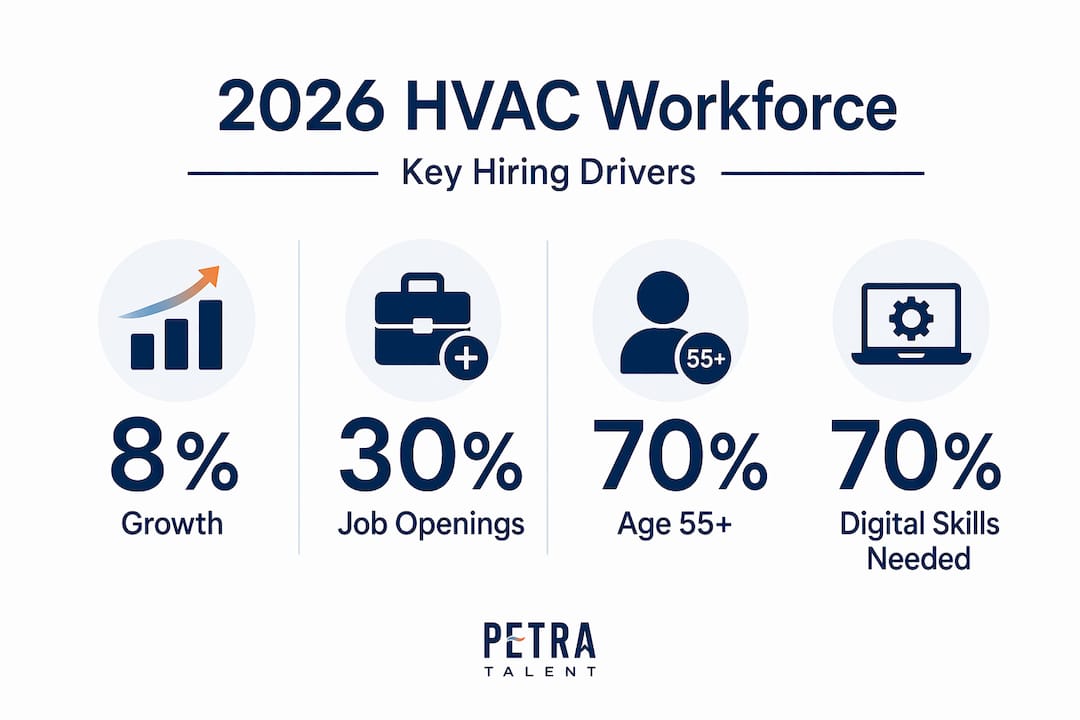
The numbers driving HVAC hiring trends in 2026 are not speculative. HVACR jobs are projected to grow 8% from 2024 to 2034, generating more than 40,000 job openings annually. That growth is not coming from demand alone. A significant portion of those openings will come from retirements, and the replacement pipeline is not keeping pace.
Nearly 30% of HVAC technicians are currently over 55 years old. As these experienced workers retire, they take institutional knowledge with them. The result is a growing mismatch between available positions and qualified candidates, which drives up wages, extends time-to-fill, and limits service capacity for contractors who are not actively recruiting ahead of the curve.
The table below shows how these workforce factors translate directly into hiring pressure across different contractor segments.
| Workforce factor | Effect on hiring |
|---|---|
| Aging technician base | Accelerated retirements shrink the experienced labor pool |
| Growing job demand | More openings compete for the same limited candidate supply |
| Low entry-level pipeline | Fewer new workers entering trades through vocational programs |
| Rising wages from scarcity | Compensation expectations increase, raising cost-per-hire |
For HVAC employers, this is not a temporary tightening. It reflects structural changes in the HVAC industry workforce that require long-term hiring adjustments, not short-term recruiting fixes. Understanding these shifts is the foundation for adapting any workforce strategy effectively.
Technology adoption and evolving hiring criteria
AI and digital tools are changing what the job of an HVAC technician actually involves. Diagnostic software, connected building systems, and digital service platforms are becoming standard parts of the job. This shift has a direct impact on trends in HVAC recruitment and the criteria employers use to screen candidates.

AI adoption in HVAC workflows has measurably affected 38% of commercial contractors in 2026. The changes are not eliminating technician roles. They are expanding those roles to include digital troubleshooting, software-assisted diagnostics, and data-driven maintenance decisions.
What this means for hiring:
- Screen candidates for digital comfort and adaptability, not fluency in any specific AI platform
- Ask interview questions that reveal how a candidate approaches unfamiliar tools and self-directed learning
- Adjust job descriptions to reflect technology-assisted workflows rather than purely manual processes
- Evaluate onboarding programs to include structured training on any proprietary or digital systems used on the job
- Balance trade expertise with the capacity to learn, since learning agility and adaptability are now the primary hiring filters as AI use grows
Pro Tip: When assessing candidates, ask them to walk through how they would diagnose a problem they have never seen before. The thinking process reveals adaptability far better than a credentials checklist.
For HVAC employers, this means the hiring bar has shifted. A technician who is strong in the trades but resistant to digital tools will require more intervention over time. Hiring for potential and openness to learning is not a compromise. It is a forward-looking strategy.
Financial and strategic implications for HVAC employers
Workforce trends in HVAC are creating financial pressure that most contractors cannot ignore. 35% of commercial specialty contractors cite skilled labor shortages and rising costs as their top business risk in 2026. That risk is not abstract. When a position stays open for weeks, it costs the company revenue. When a trained technician leaves, onboarding the replacement costs time and money all over again.
Here is how forward-looking contractors are responding financially and strategically:
- Prioritize retention from day one. Retention starts at the offer stage. Competitive pay, structured career paths, and clear expectations reduce early attrition, which is where most onboarding investment is lost.
- Reduce time-to-fill with pre-built pipelines. Contractors who maintain relationships with vocational schools and apprenticeship programs fill roles faster because they are not starting from zero when a position opens.
- Access federal training subsidies. Federal legislation could reimburse up to 90% of HVAC training costs under the proposed Employer-Directed Skills Act, significantly lowering the cost of onboarding less experienced candidates.
- Plan capacity proactively. Employers who back-calculate their hiring needs based on projected retirements and demand growth avoid the service gaps that reactive hiring cannot solve.
Pro Tip: Map out which of your current technicians are within five years of retirement age. That number tells you exactly how many hires you need to plan for in your next workforce cycle.
The contractors who treat workforce planning as an ongoing operational function, rather than an HR task, are the ones who maintain service capacity through labor shortages without compromising quality or profitability.
Practical hiring strategies to adapt to workforce changes
Adapting to the current HVAC hiring environment requires both structural changes and day-to-day recruiting adjustments. Employers who build continuous hiring pipelines outperform those who recruit only when a position becomes vacant.
Practical approaches that produce results include:
- Apprenticeship partnerships. Work with local trade schools and union apprenticeship programs to identify candidates before they hit the open market.
- Updated job descriptions. Reflect technology-assisted workflows, digital tool use, and soft skills like communication and adaptability rather than listing only certifications.
- Subsidized training programs. Use employer training subsidies to hire candidates with strong fundamentals and train up to current job requirements.
- Inclusive hiring practices. Expanding outreach to women, veterans, and career changers broadens the candidate pool and consistently reduces turnover compared to narrowly targeted searches.
The comparison below shows the difference between reactive and proactive hiring approaches in practical terms.
| Reactive hiring approach | Proactive hiring approach |
|---|---|
| Post position after a vacancy opens | Maintain a warm candidate pipeline at all times |
| Screen only for immediate qualifications | Screen for potential and invest in structured training |
| Rely on job boards as the primary sourcing channel | Combine apprenticeships, referrals, and community partnerships |
| Address retention after a resignation | Build retention incentives into initial employment offers |
Understanding the HVAC technician shortage solutions available to contractors today is a strong starting point for building a more durable hiring strategy. The workforce shift is not going away. The employers who adapt their sourcing, screening, and onboarding methods now will be in a far stronger position as competition for qualified technicians intensifies.
My perspective on proactive HVAC hiring
I have worked with enough HVAC contractors to see a clear pattern. The companies that struggle most with hiring are the ones that treat it as something to handle when a seat is empty. The companies that consistently attract and keep strong technicians think about hiring the way they think about equipment maintenance. You do not wait for something to break before you address it.
What I have seen in practice is that hiring for potential works better than most contractors expect. When you give a technically capable candidate a structured training path and pair them with an experienced tech, the ramp time is shorter than most employers assume. The candidate also tends to stay longer because they feel invested in. That dynamic changes the economics of the whole workforce equation.
I also think the technology conversation gets overcomplicated. The skills needed in HVAC are evolving, but the core of this trade is still problem solving and reliability. Employers who screen for those qualities first, then assess digital adaptability, find better long-term fits than those chasing certifications on a job posting. If you are not yet reviewing your HVAC hiring practices with that lens, it is worth doing before your next open position becomes urgent.
— David
How Petratalent supports your HVAC hiring strategy
The workforce trends covered in this article are exactly what Petratalent built its services around. As a specialized HVAC and plumbing recruitment agency, Petratalent handles the sourcing, screening, and vetting work that most contractors do not have bandwidth for. Services include direct hire placements, skills-based technical screening aligned with today’s digitally integrated roles, market wage benchmarking, and workforce consultation to help contractors plan capacity rather than just fill vacancies.
If training subsidies are part of your hiring strategy, Petratalent can help you structure your sourcing to match that approach, targeting candidates with strong potential who align with your training investment. Explore HVAC recruiting services from Petratalent, or review the full services overview to see how the team can support your workforce goals for 2026 and beyond.
FAQ
How do workforce trends affect HVAC hiring right now?
Aging technician demographics, rising demand, and AI-driven role changes are all reshaping what HVAC employers need from candidates and how urgently they need to fill positions. Contractors who do not adjust their sourcing and screening methods will face growing service gaps.
What skills should HVAC employers prioritize in 2026?
Employers should prioritize learning agility, digital adaptability, and strong foundational trade skills. AI adoption in HVAC workflows means candidates who can navigate unfamiliar tools and systems will deliver more long-term value than those limited to fixed skill sets.
What is the impact of training subsidies on HVAC recruitment?
Proposed federal legislation could reimburse up to 90% of training costs, which allows employers to hire candidates based on potential rather than requiring full qualifications upfront. This opens the candidate pool significantly and reduces hiring friction.
Why is reactive hiring a problem for HVAC contractors?
Reactive hiring means starting the search after a position opens, which extends time-to-fill and leaves service capacity gaps. Given the current technician shortage, positions can stay open for weeks, directly affecting revenue and customer service levels.
How can smaller HVAC contractors compete for talent?
Smaller contractors can compete by building relationships with vocational programs, using federal training subsidies to develop candidates, offering clear career paths, and expanding their outreach to non-traditional candidate groups such as veterans and career changers.
Recommended
Related Posts

October 13, 2026
Recruiting Contract Terms: 10 Checks and Ready to Use Clauses
Define fee triggers, candidate ownership, guarantees, and compliance terms. Get a master agreement, short schedule,…

October 12, 2026
Offer Acceptance Rates: Segment Benchmarks, HVAC’s 3–5 Day SLA
See why a 78% to 82% offer acceptance benchmark can mislead, how role and source…
October 11, 2026
Bad Hires Can Cost Construction Firms 30% to 200% of Salary
Bad hires can cost construction firms 30% to 200% of annual salary. Calculate recruiting, rework,…
October 10, 2026
Construction Labor Forecasting for PMs: 7 Steps to Time Hiring
Learn when construction project managers should use WBS or simulation, track labor KPIs, and turn…