




TL;DR:
- HVAC workforce planning involves forecasting technician demand and available capacity to ensure proper staffing during peak seasons. Starting planning 8 to 12 weeks early allows sufficient time for audits, onboarding, and scheduling adjustments. Continuous pipeline development and effective scheduling strategies are essential for retention and operational efficiency.
HVAC workforce planning is defined as the proactive process of forecasting technician labor demand against available capacity to meet service goals without over-relying on emergency measures during peak seasons. In the skilled trades industry, this practice is also called labor capacity planning or workforce capacity management. HVAC managers who treat staffing as a reactive task consistently face burnout, missed service agreements, and inflated labor costs. The most effective approach to HVAC workforce planning explained in practice combines demand forecasting, technician scheduling, and structured recruitment pipelines built well before seasonal pressure arrives. Tools like OxMaint CMMS give operations teams real-time visibility into technician utilization, capacity gaps, and preventive maintenance loads.
What is HVAC workforce capacity planning and why is timing critical?
HVAC workforce capacity planning is the structured process of matching available technician hours to projected service demand across a defined planning window. The timing of this process determines whether a company enters peak season prepared or scrambling.
Effective planning must begin 8–12 weeks before peak service seasons to allow proper scheduling, contractor onboarding, and leave management. That lead time is not arbitrary. Contractor onboarding alone can take 3–4 weeks when background checks, licensing verification, and equipment orientation are factored in.
A practical readiness assessment for HVAC managers should cover the following steps:
- Audit current technician capacity. Calculate available labor hours per technician after accounting for scheduled PTO, training days, and expected sick leave.
- Forecast demand by service zone. Use prior-year call volume data and maintenance contract counts to project workload by region or territory.
- Identify the capacity gap. Subtract available hours from projected demand hours to determine how many additional technician days are needed.
- Decide on the staffing mix. Determine what portion of the gap will be filled by overtime, subcontractors, or new direct hires.
- Initiate contractor onboarding immediately. Any gap requiring external labor must begin the onboarding process no later than week 10 before peak.
Pro Tip: Build a simple capacity tracker in a spreadsheet that maps each technician’s available hours by week for the next 12 weeks. Update it every Monday. This single habit prevents most peak-season staffing surprises.
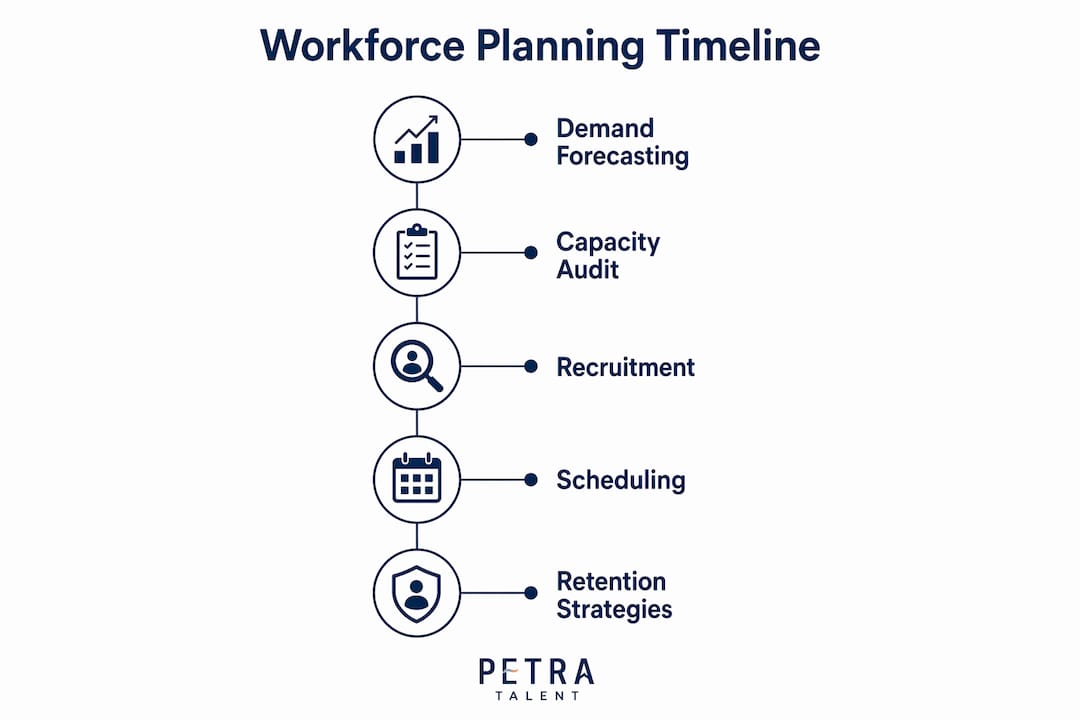
| Planning Phase | Timeline Before Peak | Key Action |
|---|---|---|
| Demand forecasting | 12 weeks | Pull prior-year call volume and contract data |
| Capacity audit | 10–11 weeks | Calculate available technician hours |
| Gap analysis | 9–10 weeks | Identify shortfall and staffing mix |
| Contractor onboarding | 8–9 weeks | Begin background checks and orientation |
| Schedule lock | 6–7 weeks | Finalize shift assignments and on-call rotations |
How do current workforce trends affect HVAC workforce planning?
The labor market conditions shaping HVAC staffing strategies in 2026 are not temporary. They reflect structural shifts in how skilled technicians evaluate employers, and managers who ignore them will keep losing people to competitors who do not.
Key trends every HVAC manager needs to factor into workforce planning:
- Advancement gaps drive early exits. 31% of younger HVAC technicians leave jobs due to a lack of advancement opportunities. This means a company without a defined career ladder is actively pushing out its most trainable talent.
- Work-life balance is a hiring filter. Nearly 50% of the operational workforce prioritize work-life balance when evaluating job offers. Compressed workweeks and rotating on-call schedules are no longer perks. They are recruitment tools.
- Pay is not the primary retention lever. 72% of technician departures are linked to non-pay factors such as culture, management quality, and burnout. Strong management and a healthy culture improve retention by 38%. Wage increases alone will not fix a turnover problem rooted in poor scheduling or weak leadership.
- Inflation increases contract labor reliance. Rising material and operational costs push many contractors toward flexible labor models. This makes contractor onboarding timelines a core planning variable, not an afterthought.
- Skill evaluation must go beyond resumes. Hiring based on credentials alone misses critical gaps in diagnostic ability and customer communication. Practical skill assessments during the interview process reduce costly mis-hires.
Understanding these workforce trends in HVAC hiring gives managers the context to build staffing strategies that actually hold up under real operating conditions.
What scheduling strategies optimize HVAC team performance?
Workforce management in HVAC is not just about having enough bodies on the schedule. The structure of those schedules directly affects technician retention, response times, and service quality.

| Scheduling Model | Best Use Case | Key Trade-Off |
|---|---|---|
| Fixed shifts | Stable commercial maintenance contracts | Low flexibility during demand spikes |
| Rotating on-call | Residential service with variable call volume | Requires clear rotation rules to prevent burnout |
| Compressed workweek (4×10) | Technicians seeking work-life balance | Requires 20% more technicians for full coverage |
| Zone-based dispatch | Multi-territory operations | Reduces drive time but needs real-time routing tools |
The shift from fixed to flexible scheduling models is one of the most impactful changes an HVAC manager can make. Rotating on-call systems reduce the perception of unfairness that builds resentment when the same technicians always cover weekends.
Technician retention improves when scheduling and communication tools give field staff real-time visibility into job status and workload. Technicians who can see their schedule, receive job updates, and communicate with dispatch without friction report lower frustration and higher job satisfaction. Platforms that integrate dispatch, time tracking, and technician communication reduce the field-to-office friction that quietly drives turnover.
Pro Tip: When rolling out a new scheduling model, pilot it with one service team for 60 days before company-wide adoption. Collect technician feedback at the 30-day mark and adjust before scaling.
HVAC employee scheduling works best when managers treat it as a retention tool, not just a logistics function.
What steps improve HVAC recruitment, retention, and workforce planning?
The best practices for HVAC workforce planning at the recruitment level require a shift from reactive hiring to a continuous pipeline model. Most contractors only recruit when a truck sits empty. That approach costs more and produces worse hires.
Practical steps that produce measurable results:
- Assign a dedicated hiring owner. Treating recruitment as a revenue-driving role with a dedicated owner improves candidate communication and shortens fill times. One person accountable for hiring speed changes outcomes faster than any job board upgrade.
- Define career paths with wage bands. Clear career ladder visibility reduces turnover by giving technicians a reason to stay and a target to work toward. Publish the criteria for promotion from apprentice to journeyman to lead technician.
- Build trade school partnerships. Paid internships at $18–$22 per hour allow contractors to trial future hires at a fraction of the cost of a failed direct hire. Partnering with local trade schools creates a consistent entry-level pipeline.
- Use AI tools for screening, not selection. AI should filter resumes and flag scheduling conflicts, but final hiring decisions require human judgment and interpersonal evaluation. Cultural fit cannot be scored by an algorithm.
- Invest in manager coaching. Retention problems start before resignation. Outdated scheduling tools and unclear career ladders are primary contributors to early technician turnover. Training field supervisors to give consistent feedback and recognize performance is one of the highest-return investments a contractor can make.
Avoiding common HVAC hiring mistakes at the recruitment stage protects the investment made in onboarding and training.
Key takeaways
Effective HVAC workforce planning requires proactive capacity forecasting, structured scheduling, and continuous recruitment pipelines built well before peak demand arrives.
| Point | Details |
|---|---|
| Start planning 8–12 weeks early | Begin capacity audits and contractor onboarding before peak season pressure builds. |
| Retention is a management problem | 72% of technician exits are linked to culture and management, not pay alone. |
| Scheduling models affect retention | Rotating on-call and compressed workweeks reduce burnout and improve job acceptance rates. |
| Career paths reduce turnover | Defined promotion criteria and wage bands give technicians a concrete reason to stay. |
| Recruitment must be continuous | Assigning a dedicated hiring owner and building trade school pipelines shortens fill times. |
What i’ve learned from watching HVAC teams plan badly
Most HVAC managers I’ve worked with are not bad planners. They are reactive planners. The pattern repeats itself every year: summer arrives, call volume spikes, and suddenly there are not enough certified technicians to cover the load. The response is always the same. Post a job, call a staffing agency, and offer overtime until the season passes.
The problem is not the response. The problem is that the response starts too late. By the time a manager posts a job in June, the best technicians available in the market were hired in April. What remains are candidates with gaps in their history or technicians leaving situations that should raise questions.
The managers who consistently outperform their peers on workforce stability share one habit. They treat their technician roster as a living document, not a static headcount. They review capacity weekly, not quarterly. They know which technicians are flight risks before those technicians update their resumes.
Modern communication tools have made this easier. When technicians can see their schedules, track their jobs, and communicate with dispatch without friction, they feel less like a number and more like a professional. That feeling matters more than most managers realize. Investing in manager coaching produces returns that no job board ever will.
— David
How Petratalent supports your HVAC workforce planning
Petratalent specializes in HVAC recruitment and workforce consultation for mechanical contractors across the United States. Whether you need to fill a single certified technician role or build a complete hiring plan ahead of peak season, Petratalent brings industry-specific sourcing, technical vetting, and market wage data to every search.

Petratalent’s HVAC recruiting services are built around the same principles covered in this article: proactive pipeline building, skill-based screening, and placement quality that reduces turnover. If your team is heading into a busy season without a clear staffing plan, now is the right time to get ahead of it. Explore Petratalent’s full approach to workforce trends and hiring strategy to see how contractors are solving these challenges in 2026.
FAQ
What is HVAC workforce capacity planning?
HVAC workforce capacity planning is the process of forecasting technician labor supply against projected service demand to prevent staffing gaps during peak seasons. It typically requires a planning window of 8–12 weeks before peak demand arrives.
How early should HVAC managers start workforce planning?
Planning should begin 8–12 weeks before peak service seasons to allow time for capacity audits, contractor onboarding, and schedule finalization.
Why do HVAC technicians leave jobs?
72% of technician departures are linked to non-pay factors including poor management, burnout, and unclear career paths. Pay increases alone do not resolve turnover rooted in culture or scheduling problems.
What scheduling model works best for HVAC teams?
Rotating on-call and compressed workweek models reduce burnout and improve job acceptance rates, particularly for residential service operations with variable call volume.
How do trade school partnerships help with HVAC staffing?
Paid internships at $18–$22 per hour allow contractors to evaluate potential hires before committing to a direct hire, reducing recruitment risk and building a consistent entry-level talent pipeline.
Recommended
Related Posts

October 13, 2026
Recruiting Contract Terms: 10 Checks and Ready to Use Clauses
Define fee triggers, candidate ownership, guarantees, and compliance terms. Get a master agreement, short schedule,…

October 12, 2026
Offer Acceptance Rates: Segment Benchmarks, HVAC’s 3–5 Day SLA
See why a 78% to 82% offer acceptance benchmark can mislead, how role and source…

October 11, 2026
Bad Hires Can Cost Construction Firms 30% to 200% of Salary
Bad hires can cost construction firms 30% to 200% of annual salary. Calculate recruiting, rework,…

October 10, 2026
Construction Labor Forecasting for PMs: 7 Steps to Time Hiring
Learn when construction project managers should use WBS or simulation, track labor KPIs, and turn…