


TL;DR:
- Poorly vetted HVAC technicians cause more callbacks and cost shops tens of thousands annually.
- Structured hiring, certification, and performance tracking significantly reduce callback rates and improve quality.
Why HVAC callbacks increase with bad hires
Bad hires are the single most controllable driver of rising HVAC callback rates. Poorly vetted technicians make more technical errors, arrive without the right parts, and fail to communicate clearly with customers — each one a direct path back to a job that should have been closed.
The financial exposure is real. Service callbacks can be costly per visit, and install callbacks run even higher, meaning a shop operating at an average callback rate burns through tens of thousands of dollars annually on rework alone. A single bad HVAC hire can cost a substantial amount when recruiting, training, lost productivity, and callback-related losses are all counted.
Key factors linking poor hires to higher callback rates:
- Technical errors: Wiring mistakes, incorrect torque on flare fittings, missed refrigerant leaks, and wrong capacitor specs are concentrated among bottom-quartile and newly hired technicians running solo too soon.
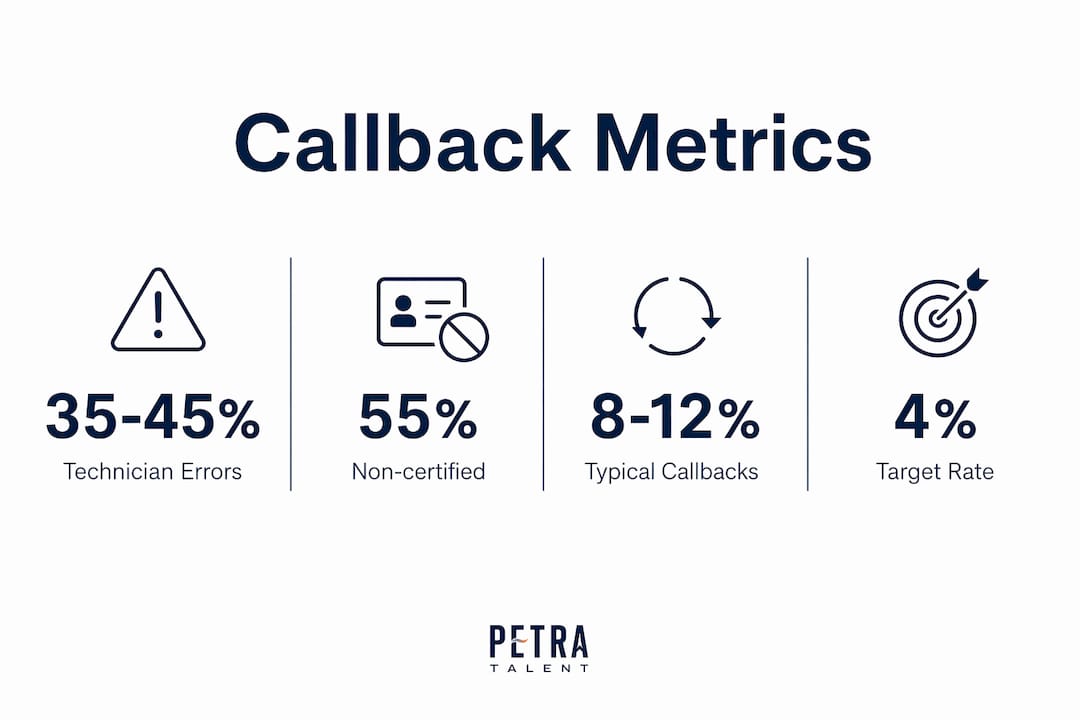
- Missing certifications: 55% of HVAC callbacks involve technicians without NATE certification, according to Interplay Learning data.
- Poor communication: Technicians who cannot explain what they did or set accurate expectations trigger callbacks from customer confusion, not equipment failure.
- Rushed hiring: Contractors who skip structured vetting fill seats with candidates who look adequate on paper but underperform in the field.
1. Common technician errors that drive callbacks
Four root causes account for the majority of HVAC callbacks, and bad hires amplify every one of them.
- Technician error: Wiring mistakes, missed refrigerant leaks, and incorrect torque on flare fittings are frequent culprits. These errors concentrate among inexperienced technicians dispatched solo before they are ready.
- Missing parts on the first visit: A tech diagnoses the problem but lacks the part, books a return, and that return gets coded as a callback. Proper truck stocking and dispatcher preparation reduce this, but only when the technician communicates job needs accurately before arrival.
- Sales-to-install mismatches: The Comfort Advisor sells one system; the install team puts in something different. Technicians who do not read work orders carefully or flag discrepancies make this worse.
- Customer expectation gaps: A homeowner expected the tune-up to fix a noise the tech never diagnosed. Poor communication skills during and after a service call are a hiring problem, not just a training one.
Technician error alone drives 35–45% of all rework visits, and it is the category most directly tied to who you hired, which is why AC maintenance lets us find repair issues early on is crucial to reduce callbacks.
2. How rushed and unstructured hiring raises callback risk
Pressure to staff up before peak season pushes contractors into hiring mistakes that cost them all season. Speed-over-quality hiring produces technicians who look capable in a short conversation but lack the field skills to close jobs correctly.
Key risks from unstructured hiring:
- Gut-feel interviews: Relying on first impressions and rapport instead of structured questions opens the door to emotional bias. Red flags get rationalized. Overconfident candidates with thin technical knowledge get offers.
- Skipping technical vetting: Contractors who do not test candidates with written or hands-on assessments cannot distinguish a technician who knows the theory from one who can execute under pressure.
- Ignoring communication skills: Hiring without vetting how a candidate explains a diagnosis or interacts with a customer leads directly to callbacks from mistrust and unclear expectations.
- Weak onboarding: Most contractors think the risk ends at the offer. In practice, a new hire who receives no structured onboarding makes more errors in the first 90 days, and those errors show up as callbacks.
- Hiding the pay range: Omitting compensation from job postings filters out skilled applicants and leaves a weaker pool to choose from.
The “hire fast, fire fast” mindset that works in office environments does not translate to field service. The downside of a mis-hire in HVAC is measured in rework costs, damaged customer relationships, and technician churn.

3. Best practices for hiring HVAC technicians to reduce callbacks
Structured hiring processes with practical testing filter out unqualified candidates before they reach the field. The contractors with the lowest callback rates treat hiring as a quality control step, not an administrative one.
- Gate on EPA 608 first: This is the non-negotiable baseline. Any candidate without it should not advance.
- Require NATE certification or a clear path to it: 79% of contractors want NATE-certified technicians, and the data consistently links certification to fewer callbacks and higher retention.
- Use written and hands-on assessments: A technical test combined with a troubleshooting scenario reveals how a candidate thinks under real conditions, not just how they interview.
- Post a clear pay range: Transparent compensation attracts experienced candidates and improves hire quality by keeping skilled technicians in the funnel.
- Move fast: With HVAC postings staying open around 31 days on average, a qualified candidate who clears your screen has likely cleared two others. A two-day callback wins the tech that a four-week loop loses.
- Structure onboarding: Graduated dispatching, where new hires run calls with a senior technician before going solo, directly reduces early-tenure callbacks.
Pro Tip: Pair every new hire’s first 30 days with a callback tracking sheet tied to their name. Early patterns reveal skill gaps before they become expensive habits.
4. How certification and professional vetting lower callbacks
NATE certification is the strongest single quality signal available during the hiring process. The data from Interplay Learning is consistent: NATE-certified technicians complete roughly 20.5% more work on average than non-certified counterparts, and 55% of callbacks involve technicians without that credential.
| Metric | Certified technicians | Non-certified technicians |
|---|---|---|
| Callback involvement rate | Lower | 55% of all callbacks |
| Work completion rate | ~20.5% higher | Baseline |
| Contractor preference | 79% want certified | Minority preference |
| Retention with funded training | — | Baseline |
Beyond NATE, professional vetting should include background checks, reference calls focused on job completion quality, and a hands-on scenario that mirrors real field conditions. Contractors who screen for certified technicians consistently report fewer rework visits and stronger customer retention. The cost savings compound quickly: at $650 per service callback, reducing the callback rate by even two percentage points on a mid-size shop recovers tens of thousands of dollars annually.
5. How Petratalent helps HVAC companies hire better and reduce callbacks
Petratalent specializes in sourcing and vetting HVAC technicians for service, construction, and leadership roles across the United States. The firm’s process goes beyond resume review: candidates are screened for technical competency, certification status, communication skills, and cultural fit before they reach a contractor’s interview stage.
For HVAC managers dealing with repeat callbacks tied to technician quality, Petratalent’s HVAC recruiting services address the root cause directly. The vetting methodology filters out candidates who would pass a casual interview but underperform in the field, which is exactly the profile that drives callback rates up. Petratalent also provides market wage insights, helping contractors post competitive pay ranges that attract experienced technicians rather than applicants who applied because no one else responded.
Pro Tip: Ask your recruiting partner to document the technical screening criteria used for each candidate. That paper trail becomes your first line of defense when a new hire’s callback rate spikes in month two.

Contractors working with Petratalent gain access to pre-screened candidates who have already cleared the vetting steps most shops skip under hiring pressure. That front-end investment pays off in lower callback rates, faster ramp-up times, and reduced turnover costs.
6. Metrics and KPIs to monitor technician performance and callback rates
Callback rate is the cleanest quality metric a residential HVAC shop has. It cannot be gamed, and it correlates directly with margin, review velocity, and membership retention.
Track three rates separately: service callback rate (30-day window), install callback rate (1-year warranty window), and maintenance-triggered callback rate (return within 30 days of a tune-up). Each one points at a different root cause. Service callbacks reveal technician skill gaps. Install callbacks expose sales-to-install handoff failures. Maintenance-triggered callbacks often signal management issues like insufficient truck stock or poor scheduling, not just technician errors.
Additional KPIs worth tracking per technician: first-time fix rate, average time per job type, parts usage versus job type, and customer satisfaction scores tied to individual dispatches. Shops that track callback rates per technician, per job type, and in 30-day rolling windows consistently outperform those that estimate their rate informally.
7. Best practices for ongoing technician evaluation and feedback
Callbacks are most useful when treated as training data, not just performance failures. Tracking technician-specific callback rates, analyzing the error type, and directing professional development toward those gaps produces better outcomes than simple blame assignment.
Practical evaluation practices:
- Weekly callback review meetings: Brief, structured, and focused on root cause rather than blame. Each callback gets categorized by error type and assigned a corrective action.
- Technician-specific scorecards: Track callback rate, first-time fix rate, and customer satisfaction per technician on a rolling 90-day basis.
- Graduated dispatching for new hires: New technicians run calls alongside senior staff before going solo. The transition point should be data-driven, not calendar-driven.
- Certification funding tied to performance reviews: Linking NATE exam funding to performance milestones creates a direct incentive for technicians to improve technical accuracy.
- Exit interview data: Voluntary departures often reveal management problems that precede callback spikes. Tracking why technicians leave is as useful as tracking why customers call back.
Key Takeaways
Bad hires increase HVAC callbacks because under-vetted technicians make more technical errors, lack certifications like NATE, and fail to communicate clearly, costing shops $650–$850 per rework visit and up to $50,000 per mis-hire.
| Point | Details |
|---|---|
| Callbacks and bad hires are linked | 55% of callbacks involve non-NATE-certified technicians; technician error drives 35–45% of all rework visits. |
| Financial cost is steep | A 5% callback rate costs a shop over $80,000 annually; a single bad hire runs $30,000–$50,000 all-in. |
| Structured hiring reduces risk | Written tests, hands-on scenarios, and clear pay ranges filter out unqualified candidates before they reach the field. |
| Certification matters | NATE-certified technicians complete roughly 20.5% more work on average and appear in fewer callbacks. |
| Ongoing tracking is required | Per-technician callback rates, first-time fix rates, and weekly review meetings catch skill gaps before they compound. |
The case for slowing down to hire right
The contractors who struggle most with callbacks are rarely the ones with bad intentions. They are the ones who hired under pressure, skipped the technical assessment because the candidate “seemed solid,” and then spent the next three months managing the fallout.
The data makes the argument plainly: a shop running an 8–12% callback rate while estimating it at “around 4%” is losing $80,000 or more per year on rework it cannot see clearly. That gap between perceived and actual performance is almost always a hiring and measurement problem, not a market problem.
What the 2026 labor market demands is not faster hiring. It demands smarter hiring. With HVAC postings staying open around 31 days on average and qualified technicians holding multiple offers simultaneously, the shops that win are the ones with a defined process: a posted pay range, a technical screening step, a structured interview, and a real onboarding plan. Communication and professionalism belong in that screen just as much as refrigerant knowledge. A technician who cannot explain a diagnosis to a homeowner will generate callbacks regardless of their technical ability.
The long-term play is building a hiring process that treats every new technician as a quality control decision. Petratalent’s specialized recruiting approach exists precisely because most contractors do not have the time or the candidate pipeline to run that process well under seasonal pressure. The shops that get this right do not just reduce callbacks. They build a reputation that compounds.
Recommended
Post a comment
Related Posts

July 28, 2026
Plumbing Leadership Succession Planning Steps That Work
Discover essential plumbing leadership succession planning steps to ensure cash flow and business continuity. Start…

July 27, 2026
How Hiring Timelines Affect Project Schedules: 2026 Guide
Discover how hiring timelines affect project schedules. Ensure timely placements for project managers and superintendents…

July 26, 2026
How to Interview HVAC Service Techs: 2026 Hiring Guide
Learn how to effectively interview HVAC service techs with key questions on qualifications, technical skills,…

July 25, 2026
Best Rockstarrecruitinggroup.com Alternatives for Skilled Trades
Discover the best rockstarrecruitinggroup.com alternatives for skilled trades. Explore top firms to streamline your hiring…