


Effective interviews with HVAC service technicians cover six core question categories: general background and motivation, behavioral and situational responses, technical knowledge, technology and tools proficiency, workplace culture and compensation, and safety compliance. Before you schedule a single interview, confirm the candidate holds EPA Section 608 certification, which is legally required for anyone handling refrigerants in the United States. Use the checklist below as your baseline framework, then build depth with the section-by-section questions that follow.
Core question categories every HVAC interviewer should cover:
- General qualifications: Work history, motivation for the trade, and verification of licenses and certifications
- Behavioral and situational: Past examples of conflict resolution, teamwork, and handling difficult customers
- Technical skills: Refrigerant handling, refrigeration cycle knowledge, diagnostics, and system components
- Technology and tools: Multimeter use, vacuum pumps, recovery machines, and field service software
- Payroll and workplace culture: Compensation expectations, scheduling availability, and management style preferences
- Safety and compliance: Lockout/tagout procedures, EPA 608 compliance, and emergency protocols
- Problem-solving and diagnostics: Step-by-step troubleshooting logic and real-world fault identification
- Customer service and communication: Explaining repairs clearly, handling complaints, and professionalism on-site
- Certifications and ongoing training: NATE certification, continuing education, and willingness to learn new systems
- System and brand familiarity: Experience with residential vs. commercial systems, specific equipment brands, and VRF or heat pump technology
Table of Contents
- How to interview HVAC service techs: general questions to start with
- Behavioral and situational questions that reveal real character
- Technical skills questions every hiring manager should ask
- Questions to assess technology and tool proficiency
- Payroll and workplace culture questions that improve retention
- Best practices for interviewing HVAC service technicians
- Questions that reveal problem-solving and diagnostic ability
- Questions on customer service and communication skills
- Questions about certifications and ongoing training
- Questions covering experience with different HVAC systems and brands
- Key Takeaways
How to interview HVAC service techs: general questions to start with
General questions set the tone and surface the basic qualifications every hiring manager needs to verify before going deeper. They also reveal how a candidate thinks about their career, which tells you a great deal about long-term fit.
-
“Walk me through your HVAC experience from the beginning.” This open-ended prompt reveals the candidate’s career arc, the types of systems they’ve worked on, and whether their experience matches your service mix. Listen for specifics: system types, company sizes, and the scope of work they handled independently versus under supervision.
-
“What certifications and licenses do you currently hold?” Confirm EPA 608 certification upfront. NATE-certified technicians complete measurably more work and command higher wages, so it’s worth asking whether the candidate holds or is pursuing that credential. NATE is voluntary, but it signals professional commitment.
-
“Why do you want to work for this company specifically?” A candidate who has done zero research is a yellow flag. Strong answers reference your service area, your reputation, or the type of work you specialize in. This question also reveals whether the candidate is job-shopping broadly or genuinely interested in your shop.
-
“What does a typical workday look like for you right now?” This surfaces scheduling habits, workload capacity, and how the candidate manages their time between service calls. It also opens a natural conversation about what they want more or less of in their next role.
-
“How do you stay current with changes in HVAC codes and technology?” The industry moves. Candidates who mention trade publications, manufacturer training, or ASHRAE resources demonstrate professional initiative. Those who can’t name a single source may struggle to adapt as systems evolve.
-
“Have you ever had a callback on a job? What happened?” Every experienced tech has had a callback. The question isn’t whether it happened, but how they handled it. Look for accountability, a clear explanation of what went wrong, and what they changed afterward.
-
“What type of work environment brings out your best performance?” This question opens the door to a conversation about team structure, dispatch style, and management approach, all of which affect whether a tech stays past the first year.
Behavioral and situational questions that reveal real character
Behavioral questions get past rehearsed answers by asking candidates to describe what they actually did in past situations. Situational questions test judgment by presenting a scenario and asking how they would respond. Both are more predictive than hypothetical “what would you do” questions alone.
-
“Tell me about a time you dealt with an angry or frustrated customer. What did you do?” This is the single most important customer service question you can ask. Listen for empathy, clear communication, and a resolution that prioritized the customer’s experience without compromising safety or quality.
-
“Describe a situation where you disagreed with a coworker or supervisor. How did you handle it?” Conflict is inevitable in any shop. A candidate who claims they’ve never had a disagreement is not being honest. Look for professionalism, a willingness to listen, and a resolution that didn’t damage the working relationship.
-
“Tell me about the most technically challenging job you’ve completed. What made it difficult, and how did you work through it?” This question reveals diagnostic depth and problem-solving persistence. Strong candidates describe a logical process, not just a lucky fix.
-
“Have you ever had to deliver bad news to a homeowner, like a failed heat exchanger or a system that needed full replacement? How did you approach that conversation?” The ability to explain expensive repairs clearly and professionally is a core skill. Consider asking the candidate to role-play this scenario if their verbal answer seems thin.
-
“Give me an example of a time you went above and beyond for a customer.” This question distinguishes techs who do the minimum from those who take ownership of the customer experience. The best answers involve a specific action the candidate took without being asked.
-
“Describe a time you had to adapt quickly to an unexpected problem on a job site.” HVAC work rarely goes exactly as planned. This question tests adaptability and composure under pressure, two traits that directly affect service quality and customer satisfaction.
-
“Tell me about a time you worked as part of a team on a complex installation or repair. What was your role?” For shops that run two-tech crews or handle commercial work, collaboration matters. Listen for clarity about the candidate’s specific contribution and how they communicated with teammates.
Technical skills questions every hiring manager should ask
Technical questions are where you separate candidates who know the trade from those who know how to talk about it. The goal is to probe diagnostic reasoning, not just vocabulary. A candidate who can explain why they take each step is far more valuable than one who recites procedures from memory.
-
“Explain the refrigeration cycle to me.” This is a foundational question. A solid answer covers the four stages: evaporation, compression, condensation, and expansion, and explains what the refrigerant is doing at each point. Candidates who can explain it simply, without jargon, tend to communicate well with customers too.
-
“How do you verify a system is properly evacuated?” The correct answer involves using a micron gauge and pulling down to an appropriate vacuum level, then confirming it holds. Candidates who say they rely on the manifold gauge needle alone are revealing a gap in their process.
-
“What is superheat, and why does it matter?” Superheat measures the temperature of refrigerant vapor above its boiling point at a given pressure. It protects the compressor by confirming only vapor, not liquid, is entering it. Candidates who can explain this without prompting have solid refrigeration fundamentals.
-
“You measure 24 volts across a switch. Is the switch open or closed?” The answer is open. If the switch were closed, it would act like a wire and show near-zero voltage drop. This question tests basic electrical theory and reveals whether the candidate understands voltage drop logic.
-
“How do you approach diagnosing a refrigerant leak?” Look for a systematic answer: visual inspection, electronic leak detector, UV dye if needed, and proper recovery before repair. Candidates who jump straight to adding refrigerant without finding the leak are a liability.
-
“What is lockout/tagout, and when do you apply it?” Lockout/tagout procedures are required before working on any equipment where unexpected energization could cause injury. A candidate who can’t describe this process clearly should not be working on live equipment unsupervised.
-
“What’s the difference between a heat pump, a furnace, and a standard air conditioning system?” This question tests system-level knowledge. Strong candidates explain the heat pump’s reversing valve, the furnace’s combustion process, and the difference in how each system moves or generates heat.
Hands-on assessment note: Resume claims are easy to make. A 15–30 minute shop test, where you introduce a fault into a unit and ask the candidate to find it, reveals actual diagnostic skill and safety habits far more reliably than verbal answers alone. Watch whether they reach for their meter first, verbalize their process, and check safety before touching anything.
- Does the candidate disconnect power and verify it’s off before working?
- Do they follow a logical sequence, or do they guess and swap parts?
- Can they explain what they’re checking and why at each step?
Questions to assess technology and tool proficiency
Modern HVAC service work requires more than mechanical skill. Techs who are comfortable with digital tools, field service software, and diagnostic equipment reduce errors, speed up service calls, and integrate more smoothly into tech-forward operations.
-
“What diagnostic tools do you use regularly, and how do you use them?” Look for specific answers: digital manifold gauges, clamp meters, multimeters, combustion analyzers, and micron gauges. A candidate who lists tools but can’t explain how they apply them in context may be overstating their experience.
-
“How comfortable are you with vacuum pumps and refrigerant recovery machines?” These are non-negotiable tools for any tech handling refrigerants. Comfort level and frequency of use tell you a lot about the depth of their field experience.
-
“Have you used any field service management software, such as ServiceTitan or Housecall Pro?” Tech literacy is increasingly a baseline expectation. Candidates who have used mobile platforms for scheduling, invoicing, and customer history access adapt faster and reduce administrative errors. Those who haven’t used any software aren’t disqualified, but factor in the learning curve.
-
“How do you document your work on a service call?” This question surfaces habits around paperwork, digital records, and communication with dispatchers. Techs who document thoroughly protect the company from liability and make it easier for the next tech who touches that equipment.
-
“Have you worked with building automation systems or smart thermostats? Which ones?” As residential and commercial systems grow more connected, familiarity with Honeywell, Ecobee, Nest, or BACnet-based commercial controls is a genuine differentiator. It’s not a requirement for every role, but it’s worth knowing where the candidate stands.
Payroll and workplace culture questions that improve retention

Compensation and culture conversations belong in the interview, not after an offer is made. Misaligned expectations on pay, scheduling, or work environment are among the most common reasons new hires leave within the first six months.
The median HVAC technician salary is about $59,810 per year according to BLS data as of May 2024, and the replacement cost per lost technician is roughly $11,962 in direct costs alone. Getting alignment on compensation and culture during the interview protects that investment.
-
“What compensation range are you targeting, and what does your current or most recent package look like?” Posting pay ranges upfront reduces wasted screening time on both sides. In the interview, this question confirms whether the candidate’s expectations align with your budget before you invest further in the process.
-
“What does your ideal schedule look like? Are you open to on-call rotations or seasonal overtime?” HVAC work is seasonal by nature. A candidate who wants strict 9-to-5 hours may not be the right fit for a shop that runs emergency calls. Surface this early.
-
“How do you prefer to receive feedback from a supervisor?” This question reveals communication style and how the candidate responds to correction. Techs who want regular check-ins need a different management approach than those who prefer autonomy with periodic reviews.
-
“What does a good team environment look like to you?” Listen for alignment with your shop’s culture. A candidate who thrives in a collaborative, mentorship-oriented environment will struggle in a high-autonomy, solo-route setup, and vice versa.
-
“What would make you leave a job within the first year?” This question is direct, and that’s the point. Candidates who cite poor communication, lack of growth, or disorganized dispatch are telling you exactly what to address during onboarding. Operations management, not pay alone, is often the deciding factor in whether a tech stays.
Best practices for interviewing HVAC service technicians
Asking the right questions is only part of the process. How you structure and run the interview has a direct impact on the quality of candidates you attract and retain.
- Move fast. Top candidates often hold multiple offers simultaneously, and companies that extend offers within 7–10 days of initial contact win the best talent. If your process runs longer than two weeks without a clear reason, you are losing candidates to faster competitors.
- Pre-screen for EPA 608 before the in-person interview. A 10-minute phone screen that confirms certification, license status, and basic availability saves everyone time. If a candidate doesn’t hold EPA 608, they cannot legally handle refrigerants, and that is a non-negotiable gate for most service roles.
- Replace resume review with a hands-on diagnostic test. A 15–30 minute shop scenario, where you introduce a fault and watch the candidate troubleshoot, reveals real skill, safety habits, and diagnostic logic that no resume can show. This approach also gives you a natural conversation starter for the technical portion of the interview.
- Write job ads that candidates actually want to read. Mobile-friendly, benefit-focused ads that lead with what the candidate gets, including pay range, tool allowances, and career path, attract higher-quality applicants. Omitting salary information deters qualified candidates who won’t waste time on an “apply to find out” posting.
- Structure onboarding over the first 90 days. Pairing new hires with senior techs during the first 90 days of onboarding reduces callbacks, builds culture, and accelerates skill development. The interview is the first impression; onboarding determines whether the hire sticks.
- Address operational chaos before you hire. Reducing disorganized dispatch, managing work hours, and providing clear communication channels improves retention more reliably than competing on wages alone. A tech who leaves because of poor operations is a preventable loss.
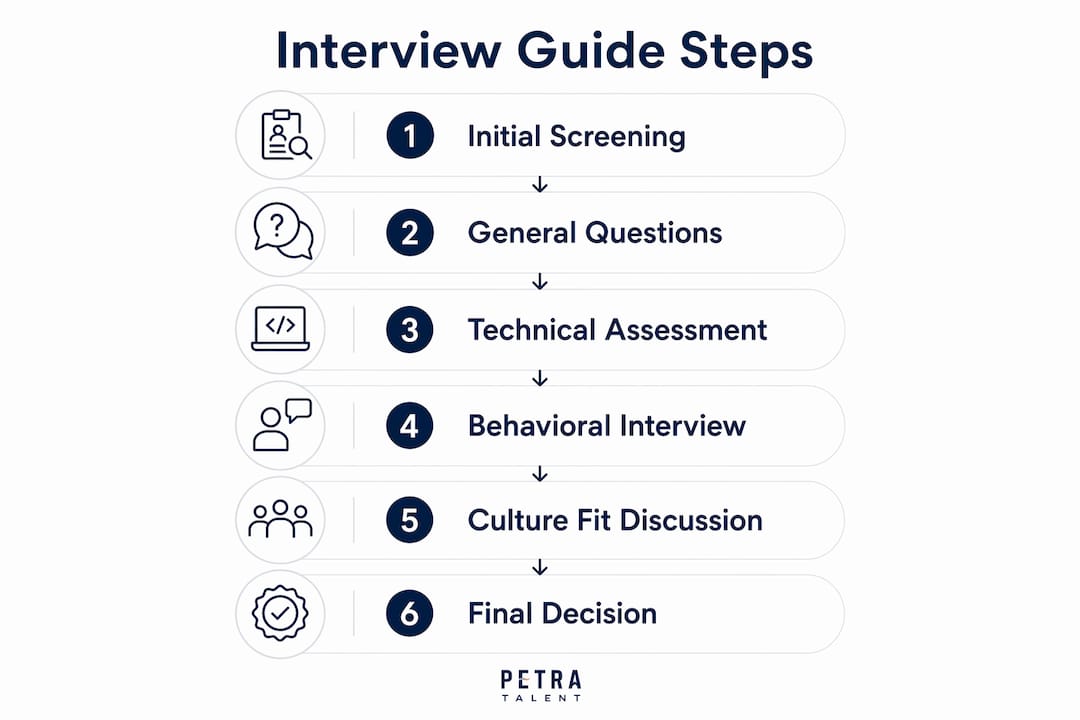
Pro Tip: Combine a multi-stage interview process, phone screen, technical assessment, and culture-fit conversation with a team review before extending an offer. Having at least one other team member weigh in, ideally a senior tech or field supervisor, improves hire quality and reduces the risk of a poor fit that costs you months of productivity.
Questions that reveal problem-solving and diagnostic ability
Diagnostic ability is the core skill that separates a productive tech from one who generates callbacks. These questions are designed to surface how a candidate thinks through a problem, not just whether they know the answer.
-
“A heat pump is short-cycling. Walk me through how you would diagnose it.” A strong answer starts with the basics: checking airflow, filter condition, and refrigerant charge before assuming a component failure. Techs who jump to replacing parts without a systematic check are expensive to have on your payroll.
-
“A condenser keeps tripping the breaker. What’s your diagnostic sequence?” Look for a logical progression: check amperage draw, inspect the capacitor, verify the contactor, and check for refrigerant overcharge or airflow restriction. The sequence matters as much as the individual steps.
-
“You arrive at a job and the previous tech’s notes say the system was running fine last week. Now it’s not cooling. Where do you start?” This question tests whether the candidate can work with incomplete information and resist the urge to assume the previous tech was wrong. Good diagnosticians start fresh with measurements, not assumptions.
-
“How do you calculate the heating or cooling load for a space?” This question is more relevant for design or commercial roles, but even service techs benefit from understanding Manual J load calculations. It reveals whether the candidate thinks about system sizing or just replaces what’s broken.
-
“You find a cracked heat exchanger. The homeowner says they can’t afford to replace it right now. What do you do?” The correct answer is to red-tag the unit and shut off the gas. Carbon monoxide risk is not negotiable. A candidate who hedges on this answer is a safety liability.
Questions on customer service and communication skills
HVAC technicians work directly in customers’ homes and businesses. Their communication skills affect your company’s reputation as much as their technical ability. These questions help you assess whether a candidate can represent your brand professionally under pressure.
-
“How would you explain a heat exchanger replacement to a homeowner who has no HVAC knowledge?” The ability to translate technical findings into plain language is a skill, not a given. Look for clarity, patience, and an explanation that respects the customer’s intelligence without overwhelming them with jargon.
-
“A customer calls back angry because the problem you fixed yesterday has returned. How do you handle that call?” This tests composure and accountability. Strong candidates acknowledge the customer’s frustration, take ownership of the situation, and commit to a resolution without becoming defensive.
-
“How do you handle a situation where a customer asks you to do something that isn’t safe or isn’t up to code?” The answer should be firm but respectful: explain the risk, document the refusal, and offer a compliant alternative. Candidates who say they’d “just do what the customer wants” are a liability.
-
“Have you ever recommended a repair or upgrade that a customer initially pushed back on? How did you handle it?” This question surfaces sales aptitude and ethical communication. The best techs recommend necessary work honestly, explain the consequences of deferring it, and let the customer decide without pressure.
-
“How do you leave a job site when you’re done?” This question catches candidates off guard, which is the point. The answer reveals professionalism: cleaning up, explaining what was done, confirming the system is running correctly, and asking if the customer has any questions. Techs who skip these steps generate complaints.
Reviewing HVAC maintenance schedules with customers at the end of a service call is a simple habit that builds trust and generates repeat business. Ask candidates whether this is part of their standard process.

Questions about certifications and ongoing training
Certifications tell you what a candidate has already proven. Questions about ongoing training tell you whether they intend to keep growing. Both matter in a trade where technology, refrigerants, and codes change regularly.
-
“Which type of EPA 608 certification do you hold: Type I, Type II, Type III, or Universal?” EPA 608 certification does not expire, but the type matters. Universal certification covers all equipment categories and is the strongest credential for a full-service tech. Verify the certificate directly, not just the candidate’s claim.
-
“Do you hold NATE certification? If not, are you working toward it?” NATE is voluntary but meaningful. Candidates who hold it or are actively pursuing it signal a commitment to professional standards that goes beyond the minimum.
-
“What training have you completed in the last two years?” This question surfaces whether the candidate invests in their own development. Look for manufacturer training on specific equipment, refrigerant transition courses related to A2L refrigerants, or code update seminars. Candidates who can’t name anything recent may be coasting.
-
“Are you familiar with ASHRAE standards, and have you applied any of them in your work?” ASHRAE standards govern ventilation, energy efficiency, and refrigeration practices across the industry. Familiarity isn’t required for every service role, but awareness of ASHRAE 15 (refrigeration safety) or ASHRAE 62.1 (ventilation) indicates a tech who reads beyond the minimum.
-
“How do you stay current with changes to refrigerant regulations, especially with the ongoing HFC phase-down?” The transition away from high-GWP refrigerants is reshaping the industry. Candidates who are aware of the EPA’s AIM Act requirements and the shift toward A2L refrigerants like R-32 and R-454B are better positioned for the work ahead.
Questions covering experience with different HVAC systems and brands
System and brand familiarity affects how quickly a new hire becomes productive. A tech who has only worked on residential split systems will need time to get up to speed on commercial rooftop units or VRF systems. These questions help you map the candidate’s experience to your actual service mix.
-
“What types of HVAC systems have you worked on most frequently: residential split systems, packaged units, commercial rooftops, or VRF?” This question establishes the candidate’s primary experience base. It’s not a disqualifier if they haven’t worked on your specific system type, but it sets realistic expectations for the learning curve.
-
“Which equipment brands are you most comfortable with, and which have you worked on least?” Familiarity with Carrier, Trane, Lennox, Daikin, Mitsubishi, or York varies widely by region and employer. Knowing where a candidate’s gaps are helps you plan training and pairing with senior techs.
-
“Have you worked on mini-split or VRF systems? What’s your experience level with commissioning and troubleshooting them?” VRF systems are increasingly common in commercial and multi-family applications. Experience here is a genuine differentiator, and the commissioning process is distinct enough that prior exposure matters.
-
“What’s the most advanced or unusual system you’ve worked on? What did you have to learn to handle it?” This question reveals both the upper end of the candidate’s technical range and their approach to learning new equipment. Strong candidates describe a specific system and a specific learning process.
-
“Have you worked on both residential and commercial accounts? How does your approach differ between the two?” Commercial work involves different system scales, different customer relationships, and often different code requirements. A tech who has worked both sides of the market brings flexibility that’s valuable as your business grows.
For contractors looking to attract experienced HVAC workers with the right system background, aligning your job postings and interview questions to your actual equipment mix reduces mismatches and speeds up time to productivity.
Key Takeaways
Hiring the right HVAC service technician requires a structured interview process that covers technical competency, safety compliance, customer communication, and cultural fit, with EPA 608 verification as a non-negotiable first gate.
| Point | Details |
|---|---|
| Verify EPA 608 early | Confirm certification type during the phone screen, before investing time in a full interview. |
| Use hands-on diagnostic tests | A 15–30 minute shop scenario reveals real skill and safety habits that resumes cannot show. |
| Move fast on strong candidates | Extending offers within 7–10 days is critical in a market where top techs hold multiple offers. |
| Address culture and compensation upfront | Misaligned pay or schedule expectations are a leading cause of early turnover; surface them in the interview. |
| Pair new hires with senior techs | A structured 90-day onboarding period with mentorship reduces callbacks and improves retention. |
Petratalent works with mechanical contractors across the United States to source, vet, and place qualified HVAC technicians for service, construction, and leadership roles. If your current interview process isn’t consistently producing the right hires, the issue is often upstream: sourcing, pre-screening, and candidate quality before the interview begins.
Petratalent’s HVAC recruiting services include technical vetting, certification verification, and role-specific candidate matching, so you spend your interview time evaluating fit, not chasing paperwork. Explore our full range of services to see how Petratalent can strengthen your hiring process from sourcing through placement.
Recommended
Post a comment
Related Posts

July 28, 2026
Plumbing Leadership Succession Planning Steps That Work
Discover essential plumbing leadership succession planning steps to ensure cash flow and business continuity. Start…

July 27, 2026
How Hiring Timelines Affect Project Schedules: 2026 Guide
Discover how hiring timelines affect project schedules. Ensure timely placements for project managers and superintendents…

July 25, 2026
Best Rockstarrecruitinggroup.com Alternatives for Skilled Trades
Discover the best rockstarrecruitinggroup.com alternatives for skilled trades. Explore top firms to streamline your hiring…

July 24, 2026
Why Mechanical Subs Struggle Finding Talent in 2026
Discover why mechanical subs struggle finding talent in 2026. Explore workforce gaps and the pressing…