


TL;DR:
- Top HVAC technicians are distinguished by certified technical knowledge, diagnostic skills, and professionalism that go beyond basic credentials. Certifications like EPA 608 and NATE signal competence and dedication, while measurable skills like callback rates and communication effectiveness predict performance. Focusing on observable behaviors and performance metrics leads to better hiring decisions and more reliable, long-term field teams.
Top HVAC service technicians are defined by a combination of certified technical knowledge, systematic problem-solving, and consistent professionalism. These qualities of top HVAC service technician performance go well beyond training hours logged. The industry standard credentials, EPA Section 608 and NATE certification, establish the baseline. But the traits that separate elite technicians from average ones show up in callbacks avoided, customers retained, and systems diagnosed correctly the first time. Hiring managers who understand this distinction make better placements and build stronger field teams.
1. Which certifications set top HVAC technicians apart?
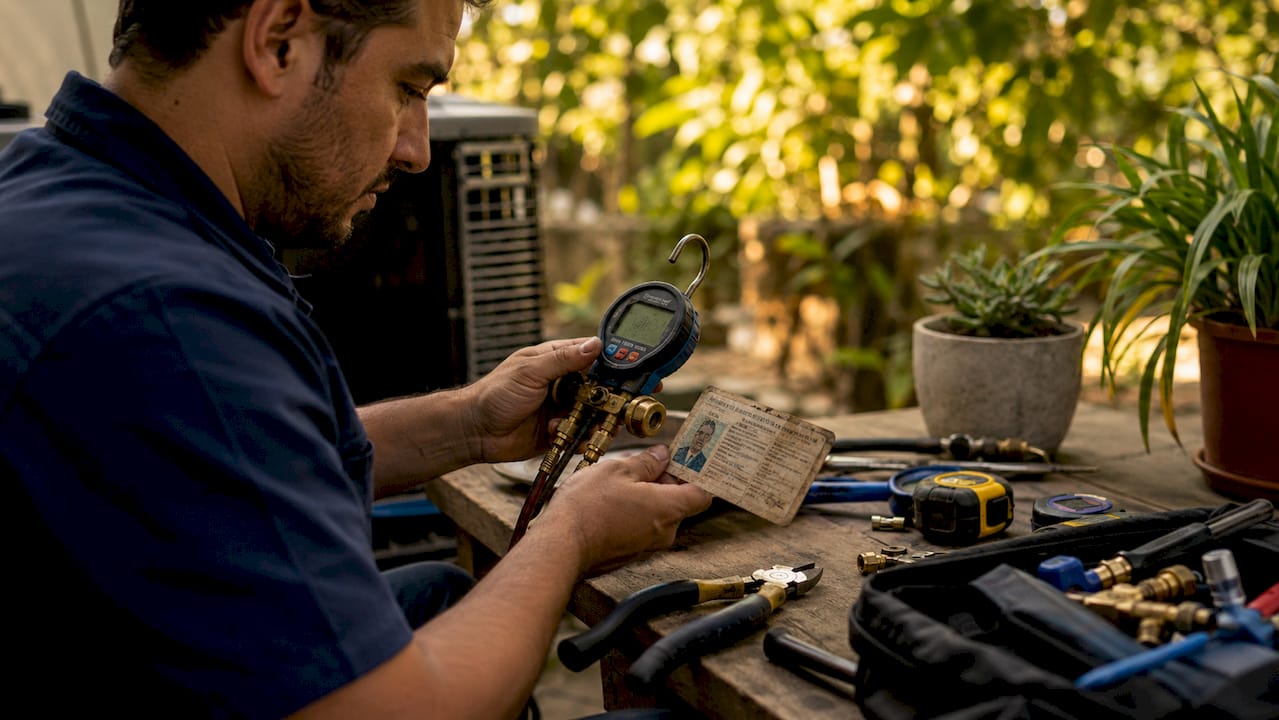
Credentials are the clearest signal of a technician’s commitment to the trade. EPA Section 608 certification is federally mandated for any technician who works with refrigerants. It never expires and carries no state exceptions. Hiring a technician without it creates immediate legal exposure for the contractor.
Beyond the federal baseline, voluntary credentials separate good candidates from great ones:
- NATE certification: NATE-certified technicians earn up to 20% more than non-certified peers. That premium reflects real competency, not just paperwork.
- OSHA 10-hour training: Signals safety awareness and reduces liability on job sites.
- State and local licenses: Requirements vary by jurisdiction. Confirm what your state mandates before posting a role.
- Stacked credentials: Combining NATE, OSHA 10, and EPA 608 can boost earning potential by 15–25%. Technicians who invest in stacking credentials are typically more serious about long-term career growth.
Pro Tip: When reviewing applications, treat EPA 608 as a pass/fail filter and NATE certification as a strong differentiator. Candidates who hold both are worth prioritizing in your pipeline.
For a deeper look at how credentials affect hiring decisions, Petratalent’s guide on HVAC certification importance breaks down what each credential signals to employers.
2. What technical skills distinguish superior HVAC technicians?
Technical skill is the core of the job, but the best attributes of HVAC techs go beyond knowing how to install equipment. The most capable technicians approach every service call with a diagnostic mindset.
- Root cause analysis. Top-tier technicians diagnose systematically rather than swapping parts until something works. This approach prevents costly callbacks and warranty claims that hurt the bottom line.
- Digital tool proficiency. Tablet diagnostics and BAS integration are now standard expectations. Technicians who cannot operate digital diagnostic tools are a liability on modern commercial jobs.
- Electrical knowledge. Reading wiring diagrams and understanding inverter-driven circuitry is non-negotiable for senior roles.
- Blueprint and schematic reading. Mechanical aptitude includes the ability to interpret technical drawings without supervision.
- Hand and power tool proficiency. Hands-on experience with the full range of field tools reduces job time and errors.
- Preventative maintenance skills. The best technicians do not just fix problems. They identify conditions that will become problems, which builds long-term client value.
Digital literacy is increasingly viewed as a core competency across the industry, not a bonus skill. Contractors hiring for commercial accounts should treat it as a requirement, not a preference. For context on how home services diagnostics are evolving with tablet-based tools, the pattern applies directly to HVAC field work.
3. How do professionalism and communication skills affect technician performance?
Professionalism is a performance variable, not a soft skill. Conscientiousness strongly predicts success in skilled trades, where precision directly prevents costly rework and liability exposure. Technicians who document accurately, show up prepared, and follow through on commitments build the kind of reputation that generates repeat business.
Clear communication is equally critical. A technician who explains findings in plain language significantly improves customer satisfaction and service closure rates. Technicians who cannot communicate clearly are liabilities regardless of their technical skill level.
Key traits to assess during interviews and ride-alongs:
- Plain-language explanations: Can the candidate describe a refrigerant leak or a failed capacitor to a homeowner without using jargon?
- Documentation accuracy: Are service notes complete, legible, and submitted on time?
- Customer empathy: Does the technician acknowledge inconvenience and set realistic expectations?
- Professional appearance: Uniform, vehicle condition, and punctuality all signal how a technician represents the company.
Pro Tip: During a ride-along, ask the technician to walk you through their findings as if explaining to the customer. That single exercise reveals communication skill faster than any interview question.
Reliability also extends beyond punctuality. The best technicians flag potential system failures during routine inspections, which builds trust and increases repeat business over time.
4. Which physical requirements should employers specify for HVAC candidates?
Physical demands are a legitimate hiring criterion in HVAC, and failing to state them clearly leads to mismatched hires and early turnover. HVAC technicians must lift 50–75 pounds and work regularly in confined spaces including attics, crawl spaces, and mechanical rooms. Candidates who are not prepared for these conditions will struggle within the first 90 days.
| Physical requirement | Why it matters |
|---|---|
| Lift 50–75 pounds | Moving equipment and parts without assistance is a daily task |
| Confined space tolerance | Attics and crawl spaces are standard work environments |
| Extreme temperature endurance | Technicians work in both freezing and high-heat conditions |
| Extended physical stamina | Peak season schedules are physically demanding over long shifts |
Stating these requirements clearly in job descriptions reduces mismatched hiring. Candidates who self-select out based on physical criteria save the contractor time and money. Petratalent’s guide on common HVAC recruitment challenges covers how vague job descriptions contribute to high turnover rates.
5. How can employers identify top performers using observable metrics?
The most reliable way to identify elite technicians is to measure what they actually do, not how many training hours they have completed. Observable performance metrics such as callback rates, repair speed, service upsell closure, and documentation quality identify the top 10% of technicians in any field team.
Hiring managers should build these indicators into both the interview process and the first 90 days of employment:
- Callback rate: A low callback rate signals accurate diagnosis and quality workmanship.
- Repair speed: Efficient technicians complete jobs within estimated time windows without cutting corners.
- Service upsell closure: Technicians who present additional service options clearly and honestly generate revenue and build customer trust.
- Documentation quality: Complete, accurate service records protect the company and support warranty claims.
- Online assessments and ride-alongs: These tools validate skills that resumes cannot confirm.
“Hiring managers often mistake hours completed for competencies demonstrated. Focusing on observable performance indicators better identifies top talent than any credential count alone.” — Training Best-in-Class Technicians
Shifting from credential counting to competency measurement is one of the most impactful changes a hiring manager can make. Petratalent’s resource on workforce trends in HVAC hiring outlines how leading contractors are making this shift in 2026.
Key takeaways
The qualities of top HVAC service technicians combine EPA 608 and NATE credentials, systematic diagnostics, clear communication, and measurable field performance.
| Point | Details |
|---|---|
| Certifications are the baseline | EPA 608 is federally required; NATE certification adds a pay premium of up to 20%. |
| Diagnostics over parts-swapping | Root cause analysis reduces callbacks and protects warranty margins. |
| Communication is a performance metric | Technicians who explain findings clearly improve customer retention and upsell rates. |
| Physical criteria reduce turnover | Stating lift and environment requirements upfront filters out mismatched candidates. |
| Measure competencies, not hours | Callback rates, repair speed, and documentation quality identify top performers reliably. |
What I’ve learned about hiring HVAC technicians that most guides miss
After working closely with HVAC contractors across the country, one pattern stands out clearly. The technicians who generate the fewest callbacks and the most repeat business are almost never the ones with the longest resumes. They are the ones who ask the right questions before they touch a system.
The most common hiring mistake I see is treating certification stacking as a proxy for competency. Credentials matter, but a technician who holds NATE and EPA 608 and still swaps parts randomly is a liability. The diagnostic mindset is the real differentiator, and it shows up in ride-alongs, not on paper.
Communication skill is the quality that most hiring managers underweight. A technician who can explain a heat exchanger failure to a homeowner in two clear sentences will outsell and outretain a technically superior technician who cannot. That skill drives customer loyalty more than any repair quality metric.
My advice to hiring managers: build a short ride-along into every final-stage interview. Watch how the candidate talks to the customer, not just how they work on the equipment. That 30 minutes will tell you more than three rounds of interviews.
— David
Petratalent’s approach to sourcing top HVAC service technicians
Finding technicians who combine the right credentials, diagnostic skill, and professionalism is a consistent challenge for mechanical contractors. Petratalent specializes in exactly this type of placement, with a recruitment process built around technical vetting and workforce solutions that go beyond resume screening.

Petratalent verifies certifications, assesses field competencies, and matches candidates to roles based on the performance indicators that actually predict success. Contractors who have struggled with high turnover or repeat callbacks from underqualified hires use Petratalent to build more stable, higher-performing field teams. Explore Petratalent’s full recruitment services to see how the process works for HVAC employers.
FAQ
What certifications are required for HVAC technicians?
EPA Section 608 certification is federally required for any technician who handles refrigerants. NATE certification is voluntary but strongly preferred by employers and linked to higher pay.
How do I assess HVAC technician skill beyond certifications?
Use ride-alongs and performance metrics including callback rates, repair speed, and documentation quality. These observable indicators identify top performers more reliably than credential counts alone.
What physical requirements should HVAC job descriptions include?
Job descriptions should specify the ability to lift 50–75 pounds and work in confined spaces such as attics and crawl spaces. Clear physical criteria reduce mismatched hiring and early turnover.
Why does communication skill matter for HVAC technicians?
Technicians who explain findings clearly in plain language improve customer satisfaction and service upsell rates. Poor communication is a liability regardless of technical ability.
How much more do NATE-certified technicians earn?
NATE-certified technicians earn up to 20% more than non-certified peers. Stacking NATE with OSHA 10 and EPA 608 can increase earning potential by 15–25%.
Recommended
Related Posts

October 13, 2026
Recruiting Contract Terms: 10 Checks and Ready to Use Clauses
Define fee triggers, candidate ownership, guarantees, and compliance terms. Get a master agreement, short schedule,…
October 12, 2026
Offer Acceptance Rates: Segment Benchmarks, HVAC’s 3–5 Day SLA
See why a 78% to 82% offer acceptance benchmark can mislead, how role and source…
October 11, 2026
Bad Hires Can Cost Construction Firms 30% to 200% of Salary
Bad hires can cost construction firms 30% to 200% of annual salary. Calculate recruiting, rework,…

October 10, 2026
Construction Labor Forecasting for PMs: 7 Steps to Time Hiring
Learn when construction project managers should use WBS or simulation, track labor KPIs, and turn…