



TL;DR:
- Following a three-step process of activating referrals, posting sales-oriented ads, and conducting rapid vet-and-offer procedures can significantly reduce time-to-fill commercial plumbing roles. Contractors who consistently implement this approach achieve staffing faster, often saving weeks compared to relying solely on job boards. Using continuous recruitment practices and character-focused hiring further improves long-term staffing success.
The fastest, lowest-risk way to fill commercial plumbing roles is a three-step sequence: activate referrals and trade-school pipelines first, post a sales-style job ad that leads with pay and career path, then run a fast two-track vet-and-offer within 48 hours of first contact. Contractors who follow this sequence consistently cut time-to-fill by weeks compared to posting on job boards and waiting.
Your 72-hour action checklist:
- Call your best tech today. Tell them you have an opening and ask for a name. Referrals convert significantly better than paid boards, and a warm introduction moves faster than any cold application.
- Post a sales-style ad tonight. Lead with pay, schedule, and career ladder. Place requirements at the bottom. Push it to Indeed, Facebook, and your local PHCC chapter board.
- Schedule a ride-and-decide for every qualified candidate. One day in the field with your best tech tells you more than three interviews.
Contact Petratalent when two or more trucks sit empty, when two hires have washed out in 90 days, or when your internal sourcing capacity is simply tapped out.
Pro Tip: The Plumbing-Heating-Cooling Contractors Association (PHCC) and the United Association (UA) both maintain active apprentice pipelines. A single phone call to your regional chapter can surface candidates your competitors never see.
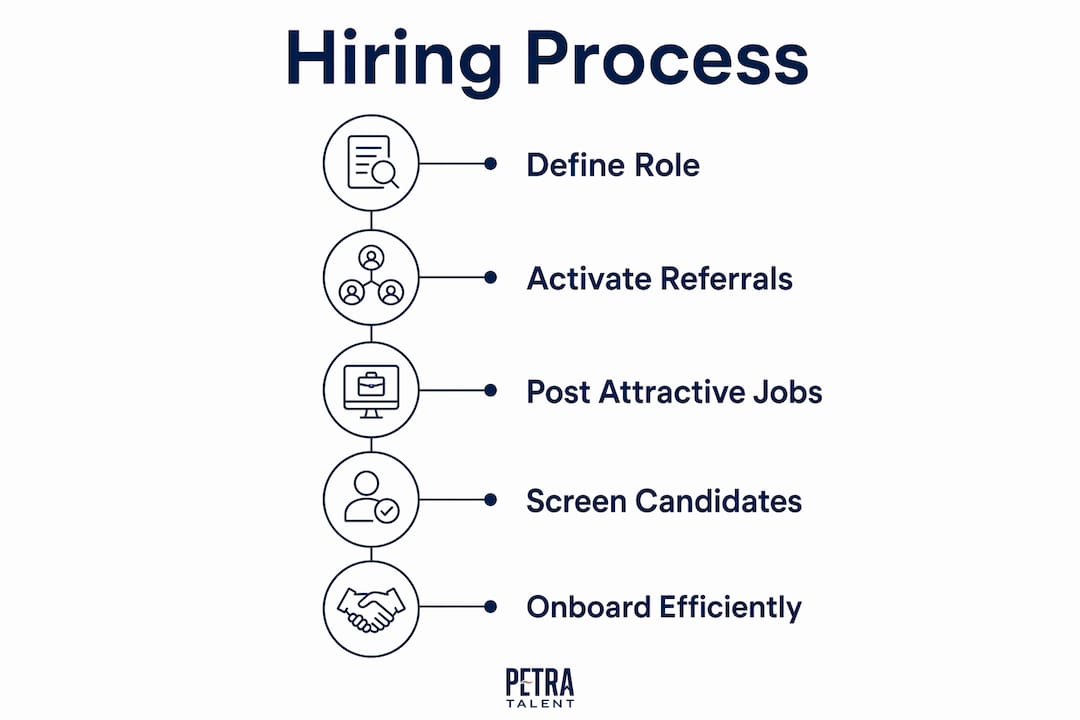
Table of Contents
- What credentials and skills does a commercial plumbing role actually require?
- Which sourcing channels actually deliver commercial plumbing talent?
- How do you write a job posting that actually converts?
- How should you screen and vet commercial plumbing candidates?
- What are the current wage benchmarks for U.S. commercial plumbing roles?
- What does a 90-day onboarding program look like for commercial plumbers?
- How long does it take to fill commercial plumbing roles, and what does it cost?
- How Petratalent helps contractors fill commercial plumbing roles faster
- Key Takeaways
- What actually separates good hiring outcomes in commercial plumbing
- Petratalent’s commercial plumbing placement services
- Useful sources for hiring commercial plumbers in the U.S.
What credentials and skills does a commercial plumbing role actually require?
Commercial plumbing roles typically require several years of commercial experience, a valid journeyman or master plumbing license, and hands-on expertise in commercial boiler, hydronic, and backflow systems. OSHA 10 is a baseline expectation at most contractors; OSHA 30 and backflow certification move a candidate from qualified to preferred.
Must-have credentials (non-negotiable):
- Journeyman or master plumbing license for the state of hire, relevant commercial field experience, OSHA 10 certification, valid driver’s license with a clean record, and ability to pass background screening and drug testing
Trainable skills (hire for character, train for these):
- Company-specific estimating software and field service apps
- Your internal documentation and work-order procedures
- Specialty certifications (medical gas, EPA 608) where required by role
Experience bands and what to expect from each:
| Level | Typical Experience | Permit Authority | Supervisory Role |
|---|---|---|---|
| Helper | 0–1 year | None | None |
| Apprentice | 1–4 years | Limited/supervised | None |
| Journeyman | 4–8 years | Full field permits | Can mentor helpers |
| Lead/Foreman | 6+ years | Full permits | Supervises crew |
Quick role-spec template you can copy:
- Headline: Commercial Plumbing [Level] — [City] — $[X]–$[X]/hr, Immediate Start
- Pay band: Published range with performance pay note
- Core responsibilities: 3–5 bullet points, field-specific
- Must-haves: License, experience years, OSHA 10, clean record
- Nice-to-haves: Backflow cert, boiler/hydronics, field service software
- Immediate goal: First 30-day expectation (e.g., solo service calls by week 6)
Which sourcing channels actually deliver commercial plumbing talent?
Running five sourcing channels in parallel produces a more reliable pipeline than relying on any single board. The table below maps each channel to the role type it serves best, its typical speed, and what it costs.
| Channel | Best For | Speed | Cost | Key Action |
|---|---|---|---|---|
| Employee referrals | Journeymen, leads | Fast (1–2 weeks) | Low (bonus only) | Weekly toolbox mention |
| PHCC / UA pipelines | Apprentices, journeymen | Moderate (2–6 weeks) | Low | Call regional chapter |
| Trade schools / CTE programs | Helpers, apprentices | Moderate (4–8 weeks) | Low | Schedule campus visit |
| DOD SkillBridge | Helpers, apprentices | Moderate (4–8 weeks) | Very low | Register as host employer |
| Facebook / trade job boards | Journeymen, leads | Fast (1–3 weeks) | Low–moderate | Sales-style ad, daily response |
| Specialized recruiter | Leads, managers | Fast when urgent | Fee-based | Engage when in-house stalls |

Supply house and parts counter outreach is an underused tactic. Plumbers who frequent your local Ferguson or Winsupply branch are active in the trade. A brief conversation with the counter staff about who comes in regularly can surface passive candidates your competitors overlook.
Younger candidates respond to culture visibility on social channels. Post employee spotlights and short hiring-day videos on Facebook and Instagram to attract under-35 talent. Pair that with passive recruiting tactics to keep a warm bench between open roles.
Pro Tip: Register as a DOD SkillBridge host employer. Transitioning service members bring discipline, safety awareness, and mechanical aptitude — and the program costs you nothing in wages during the training period.
How do you write a job posting that actually converts?
Job ads that lead with pay, benefits, and career path attract more applicants and better-quality ones than requirement-first postings. Treat the ad as a sales letter, not a compliance document.
Sales-letter structure for a commercial plumbing posting:
- Headline: Lead with the pay range and one key benefit (“$38–$44/hr | Company Truck | Commercial Work Only”)
- Opening 5 benefit bullets: Pay, schedule, tools/truck provided, career ladder, team culture
- Day-in-the-life paragraph: One short paragraph describing a typical day on the job
- Requirements: Listed at the bottom, concise, no padding
- CTA: One clear next step (“Text [Name] at [Number] to apply — we respond same day”)
Example opening — senior commercial service tech:
$42–$48/hr | Company Van | Commercial Buildings Only | Immediate Start
We’re hiring a commercial service tech who wants consistent work, a stocked truck, and a clear path to lead. No residential calls. No on-call weekends. You’ll work on commercial boiler, hydronic, and backflow systems across [City] with a crew that’s been together for years.
Example opening — commercial lead installer:
$38–$44/hr + $4,000 sign-on | Multi-Story Projects | Direct Hire
Lead installer opening for someone ready to run a crew on commercial new construction. You’ll pull permits, coordinate with the GC, and mentor two apprentices. We promote from within — our last two project managers started in this role.
The sign-on bonus structure used by contractors like Mission Mechanical ($4,000 for multi-story expertise) signals to candidates that the company values specialized skills and is serious about closing fast.
How should you screen and vet commercial plumbing candidates?
Use a two-track vetting flow: a quick phone prescreen for character, followed by fast technical verification and a one-day field trial. This combination reduces washout more reliably than multiple office interviews alone.
Phone prescreen (15 minutes):
- “Walk me through the last commercial job where something went wrong. What did you do?”
- “What systems are you most confident on — boilers, hydronics, backflow, or gas?”
- “What does a good day look like for you on a commercial job site?”
Technical verification steps:
- Confirm license number through your state plumbing board’s online lookup
- Verify OSHA 10/30 card (OSHA’s online verification tool)
- Run a reference check with a direct supervisor, not just an HR contact
The ride-and-decide protocol:
The ride-and-decide approach pairs the candidate with your highest-performing tech for one full day. Observe how they handle tools, communicate with customers, and respond when something unexpected comes up. At the end of the day, your tech gives you a simple thumbs-up or thumbs-down. That single input, from someone who works the job every day, is worth more than any structured interview score.
What are the current wage benchmarks for U.S. commercial plumbing roles?
The table below reflects market wage bands by experience level for U.S. commercial plumbing roles. Regional variation is real: Texas markets tend to run slightly below the national midpoint for journeymen, while Illinois (particularly Chicago) runs above it due to prevailing wage requirements on public projects.
Typical hourly wage bands exist for helpers, apprentices, journeymen, and lead/foreman roles, with regional variation influencing rates. For example, a foreman role in the Northeast may command a higher annual salary, with the top of the range reserved for candidates with 6+ years of experience and full licensure.
Common hiring cost components to budget:
- Job board postings: $0–$500 per posting depending on platform and duration
- Internal interviewing time: 3–6 hours per candidate across the hiring team
- Background check and drug screen: $50–$150 per candidate
- Onboarding and first-week productivity loss: varies by role complexity
- Recruiter placement fee: typically a percentage of first-year salary for direct hire
Publishing the pay band in the ad reduces screening time. Candidates who apply knowing the range are more likely to accept an offer, and you avoid wasting time on mismatched expectations.
What does a 90-day onboarding program look like for commercial plumbers?
A structured 90-day onboarding program with defined milestones materially reduces first-year churn and accelerates time-to-productivity. The structure matters as much as the content.
Onboarding arc:
- Week 1: Company culture, safety expectations, systems orientation, and introductions to key team members
- Weeks 2–6: Ride-alongs with experienced techs, progressive skill assignments, and daily check-ins
- 30-day checkpoint: Confirm technical baseline, address any gaps, confirm culture fit
- 60-day checkpoint: Solo or semi-solo assignments, feedback on communication and documentation
- 90-day checkpoint: Full performance review, pay ladder discussion, career path conversation
Retention levers that work: publish the pay ladder so techs can see exactly what journeyman-to-lead looks like in dollar terms. Run a referral bonus mention in every weekly toolbox talk. Pay referral bonuses promptly, split at day 30 and day 90, so the referring tech sees the reward before they forget they made the introduction.
Pro Tip: A field service software platform that gives techs a clean mobile experience — digital work orders, dispatch, and job history — signals that the company invests in its people. Younger techs notice this on day one.
How long does it take to fill commercial plumbing roles, and what does it cost?
Typical fill times vary significantly by role level and sourcing intensity.
- Helpers and apprentices: 2–6 weeks with active multi-channel sourcing
- Journeymen: 4–12 weeks; the range narrows to 4–6 weeks when referrals and a warm candidate bench are already in place
- Lead or foreman: 8–16+ weeks in most markets; leadership roles require more vetting and a longer notice period from the candidate’s current employer
- Speed changes outcomes: Responding to a qualified applicant within 48 hours of application significantly increases offer-acceptance rates. Candidates at the journeyman level are often fielding multiple offers simultaneously.
Two cost scenarios:
- In-house multi-channel approach: Job board fees, internal time, background checks, and onboarding typically total $1,500–$4,000 per hire for a journeyman-level role, not counting productivity loss during vacancy.
- Specialized recruiter: A placement fee on a direct hire is higher upfront, but the cost of a 90-day vacancy on a revenue-generating truck often exceeds the fee. Switch to a recruiter when a role has been open more than 30 days or when two consecutive hires have failed.
How Petratalent helps contractors fill commercial plumbing roles faster
Petratalent shortens time-to-hire and reduces washout by combining sector-specific sourcing, role-level technical vetting, and market-based offer support. The process is built for mechanical contractors who need qualified commercial plumbers, not a stack of unscreened resumes.
Petratalent’s process flow:
- Intake and role definition: Petratalent works with the contractor to define the role, confirm the pay band against current market benchmarks, and identify the sourcing channels most likely to produce qualified candidates for that specific market.
- Targeted sourcing: Candidates are sourced through trade-specific channels, not generic boards. Petratalent maintains an active pipeline of commercial plumbing professionals across the U.S.
- Technical screening and ride-day coordination: Every candidate goes through role-specific technical screening before being presented. Petratalent coordinates the ride-and-decide day with the contractor’s team.
- Offer support and onboarding handoff: Petratalent supports the offer conversation with current market data and hands off a structured onboarding checklist at placement.
Engagement triggers — contact Petratalent when:
- More than two trucks are sitting empty
- Two hires have washed out within 90 days
- A critical role has been open for more than 30 days
- Internal sourcing capacity is exhausted and production is at risk
Building a candidate pipeline before a vacancy hits is the most cost-effective use of a recruiter relationship. Petratalent works with contractors on both reactive placements and proactive pipeline development.
Key Takeaways
The most effective way to fill commercial plumbing roles combines targeted referral activation, a sales-style job posting, and a fast two-track vet-and-offer — with Petratalent as the escalation path when internal capacity runs out.
| Point | Details |
|---|---|
| Lead with referrals | Referrals convert 4–8x better than paid boards; mention the program every week in toolbox talks. |
| Write ads as sales letters | Lead with pay, schedule, and career path; place requirements at the bottom to increase application volume. |
| Use the ride-and-decide | A one-day field trial with your best tech reduces washout more reliably than multiple office interviews. |
| Budget for realistic timelines | Journeymen take 4–12 weeks; leads take 8–16+ weeks; respond to applicants within 48 hours to protect offer-acceptance rates. |
| Escalate to Petratalent early | Engage Petratalent when a role exceeds 30 days open, two hires have failed, or more than two trucks are empty. |
What actually separates good hiring outcomes in commercial plumbing
The contractors who consistently fill roles faster share one habit: they never stop recruiting. Not when they’re fully staffed, not when business slows down. They treat recruiting as a continuous channel, not a reactive task.
The conventional wisdom says to post a job when you have an opening. The contractors who outperform their market post jobs, attend trade school career days, and mention their referral program in toolbox talks every single week, whether they have an opening or not. When a journeyman gives notice on a Tuesday, they already have two names in their phone.
Character-first hiring is the other consistent differentiator. Technical skills can be verified in an afternoon. Whether someone shows up on time, communicates clearly with customers, and takes ownership of a problem — that shows up in how they answer behavioral questions and how they behave on a ride-day. Prioritizing those signals over a perfect credential list produces better long-term hires.
The ride-and-decide protocol is the single most underused tool in commercial plumbing recruitment. One day in the field costs almost nothing and eliminates most of the guesswork that leads to 90-day washouts.
Petratalent’s commercial plumbing placement services
Mechanical contractors dealing with open commercial plumbing roles have two realistic paths: build the internal sourcing capacity to run five channels in parallel, or partner with a recruiter who already has that infrastructure in place. Petratalent offers direct hire placements, technical vetting, and leadership search specifically for HVAC and plumbing contractors across the United States.
When you engage Petratalent, the first seven days look like this: a structured intake call to define the role and confirm the pay band, followed by targeted sourcing against Petratalent’s active candidate network, and a shortlist of pre-screened candidates ready for your ride-day within the first two weeks. No unscreened resumes. No wasted interview hours on candidates who don’t meet the technical baseline.
If your trucks are sitting empty or your last two hires didn’t make it past 90 days, the right next step is a conversation. Contact Petratalent through the services page with a brief role description and your target start date.
Useful sources for hiring commercial plumbers in the U.S.
- PHCC — Plumbing-Heating-Cooling Contractors Association: Regional chapters, apprenticeship programs, and contractor networking
- United Association (UA): Union apprenticeship pipelines and journeyman placement resources
- Bureau of Labor Statistics — Plumbers, Pipefitters, and Steamfitters: National wage data and employment projections
- Plumber Magazine — Hiring tactics for trade contractors: Practical sourcing and culture-first recruiting guidance
- PipelineOn — Plumber hiring in 2026: Multi-channel sourcing strategy and referral program mechanics
- Petratalent — Plumbing staffing and direct hire services: Role-specific sourcing, technical vetting, and placement for U.S. mechanical contractors
- Petratalent — How to hire plumbing apprentices strategically: Trade-school partnership tactics and apprenticeship pipeline guidance
- Petratalent — Plumbing subcontractor staffing best practices: Operational staffing guide for small to mid-size contractors
Recommended
Post a comment
Related Posts

July 28, 2026
Plumbing Leadership Succession Planning Steps That Work
Discover essential plumbing leadership succession planning steps to ensure cash flow and business continuity. Start…

July 27, 2026
How Hiring Timelines Affect Project Schedules: 2026 Guide
Discover how hiring timelines affect project schedules. Ensure timely placements for project managers and superintendents…

July 26, 2026
How to Interview HVAC Service Techs: 2026 Hiring Guide
Learn how to effectively interview HVAC service techs with key questions on qualifications, technical skills,…

July 25, 2026
Best Rockstarrecruitinggroup.com Alternatives for Skilled Trades
Discover the best rockstarrecruitinggroup.com alternatives for skilled trades. Explore top firms to streamline your hiring…