



TL;DR:
- Plumbing roles include installation, maintenance, and management of building systems, ranging from hands-on pipe work to leadership positions. Understanding these roles helps in workforce planning, career development, and ensuring project success through role clarity and proper qualification matching. Differentiating construction from service plumbers, pipefitters, and management staff is essential for accurate hiring and efficient project execution.
Plumbing construction roles are specialized positions responsible for installing, maintaining, and managing plumbing systems throughout the building process. The types of plumbing construction roles span from hands-on pipe installers to estimators and project managers, each filling a distinct function on every job. Understanding these plumbing job titles matters whether you are entering the trade, building a crew, or planning workforce needs for a mechanical contracting firm. This article breaks down each role, its core duties, required skills, and where it fits in the career progression from apprentice to master plumber.
1. what does the construction plumber role mean?
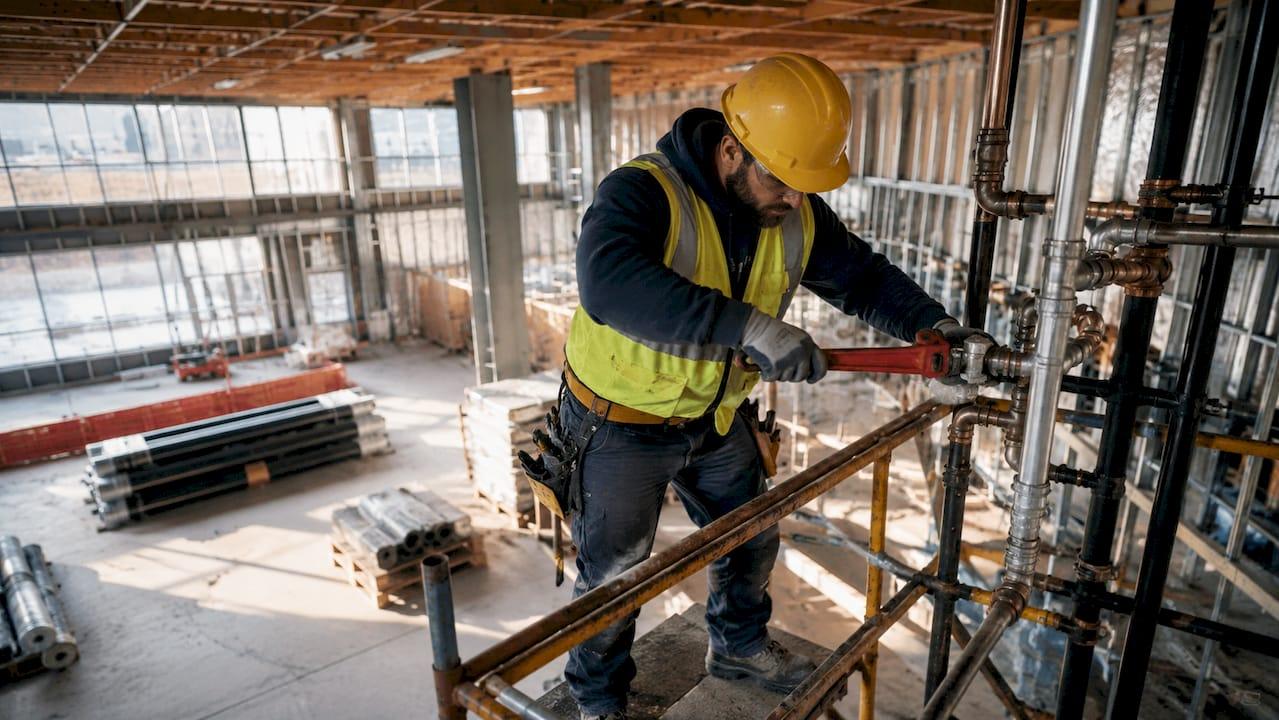
A construction plumber installs complete plumbing systems in new builds and remodels, working through both rough-in and finish stages. This is the foundational role in any plumbing construction position.
During rough-in, construction plumbers run supply and drain lines through walls, floors, and ceilings before drywall goes up. During finish work, they connect fixtures including sinks, toilets, water heaters, and shut-off valves. The national average salary for this role sits around $71,605 per year. That figure reflects both the technical skill and physical demands the position requires.
Key duties include:
- Reading and interpreting plumbing blueprints and specifications
- Fitting and joining pipe using copper, PVC, PEX, and cast iron
- Installing fixtures and connecting water supply and drainage lines
- Testing systems for leaks and pressure compliance
- Following International Plumbing Code (IPC) and local code requirements
Pro Tip: If you are entering the trade, focus your first two years on mastering rough-in sequencing. Contractors value plumbers who understand how their work affects every trade that follows.
2. how service plumbers differ from construction plumbers
A service plumber focuses on diagnosing and repairing problems in existing plumbing systems rather than installing new ones. The workflow is reactive and diagnostic rather than scheduled and sequential.
Service plumbers respond to leaks, clogs, burst pipes, and system failures in residential and commercial buildings. They use tools including drain cameras, pressure gauges, and thermal imaging equipment to locate problems without tearing open walls. Emergency response is a core part of the job, which means irregular hours and fast decision-making under pressure.
Core service plumber responsibilities include:
- Diagnosing blockages, leaks, and pressure failures
- Performing drain cleaning and hydro-jetting
- Replacing worn fixtures, valves, and water heaters
- Conducting routine maintenance inspections
- Responding to emergency calls outside standard business hours
The key distinction from construction plumbing positions is context. Construction plumbers build systems from scratch on a defined schedule. Service plumbers troubleshoot systems already in use, often with incomplete records and unknown installation history.
3. pipefitters vs. plumbers: where do they overlap?
Pipefitters install and maintain industrial and process piping systems, which is a different scope from the domestic water and gas systems plumbers handle. Both trades work with pipe, but the applications, codes, and testing methods diverge significantly.
| Factor | Plumber | Pipefitter |
|---|---|---|
| Primary systems | Water supply, drainage, gas | Industrial process, steam, HVAC |
| Applicable codes | IPC / UPC | ASME B31 standards |
| Key skills | Fixture installation, code compliance | Welding, threading, pressure testing |
| Work environment | Residential, light commercial | Industrial plants, refineries, hospitals |
| Career entry | Apprenticeship, state license | Apprenticeship, ASME certification |
Pipefitters work under ASME codes and perform welding, threading, and pressure testing on high-pressure systems. Plumbers work under IPC or UPC codes on lower-pressure domestic systems. This code and testing framework is the practical divider between the two career tracks. If you are drawn to industrial environments and mechanical systems at scale, pipefitting is the more direct path.
4. what roles focus on management and estimation?
Plumbing construction projects require more than field labor. Project managers, superintendents, and estimators each carry distinct responsibilities that determine whether a project finishes on time and within budget.

Project Manager
A plumbing project manager handles contract management, budgeting, procurement, scheduling, and client communication. They serve as the primary business contact between the contractor and the building owner. Their focus is financial performance and contract compliance, not daily field operations.
Superintendent
Plumbing superintendents manage field execution directly. They schedule crews, coordinate with other trades, enforce safety protocols, and verify that work meets code at every inspection point. They translate the project manager’s plan into daily jobsite action.
Estimator
A plumbing estimator performs material takeoffs from drawings and specifications, calculates labor and equipment costs, and develops competitive bids. Estimators cover multiple system types including water supply, drainage, gas, fire suppression, and medical gas. Their accuracy directly determines whether a contractor wins work at a profitable margin.
Pro Tip: Contractors who blur the line between project manager and superintendent duties create accountability gaps. Keep those roles separate, even on smaller projects.
5. career progression across plumbing trade professions
Career paths in plumbing follow a structured progression tied to licensure and field experience. Apprentices spend 4–5 years under supervision before qualifying for journeyman licensure. That timeline reflects the depth of technical knowledge and code familiarity the trade requires.
After journeyman status, plumbers can pursue master plumber licensure with additional experience and state exams. Master plumbers design systems, pull permits, and supervise others, with 38 states maintaining distinct master plumber licenses. From there, experienced master plumbers often move into superintendent, estimator, or project manager roles.
A simplified progression looks like this:
- Apprentice (years 1–5): Supervised field work, trade school coursework
- Journeyman Plumber: Licensed field technician, works independently
- Master Plumber: Designs systems, pulls permits, supervises crews
- Superintendent: Field leadership, scheduling, safety oversight
- Estimator: Bid preparation, material takeoffs, risk management
- Project Manager: Contract oversight, client relations, budget control
Workforce planners benefit from understanding this ladder. Hiring a journeyman for superintendent duties without the right experience creates risk. Each step requires distinct skills, and plumbing workforce vetting helps confirm candidates actually hold the qualifications their titles suggest.
6. using plumbing job titles to guide workforce decisions
Role clarity is one of the most underused tools in plumbing workforce planning. When contractors define job titles precisely, they hire more accurately, schedule more reliably, and reduce costly mid-project gaps.
Workforce planning requires distinct headcount assumptions for project managers, estimators, superintendents, and field plumbers. Treating these as interchangeable creates scheduling and risk management failures. A project manager cannot run field crews and manage contracts simultaneously at full effectiveness.
For contractors building teams, use these role distinctions as your hiring filter:
- Need someone to win work? Hire an estimator with multi-system experience.
- Need someone to run the field? Hire a superintendent with inspection and scheduling experience.
- Need someone to manage the client relationship? Hire a project manager with contract and budget background.
- Need licensed installation labor? Hire journeyman or master plumbers based on permit requirements.
For individuals planning a career, plumbing trade recruitment resources can clarify which certifications and experience levels align with your target role.
Key takeaways
The most effective approach to understanding plumbing construction roles is to treat each title as a distinct function with its own skills, codes, and career requirements.
| Point | Details |
|---|---|
| Construction vs. service plumbers | Construction plumbers install new systems; service plumbers diagnose and repair existing ones. |
| Pipefitters are not plumbers | Pipefitters work under ASME codes on industrial systems; plumbers follow IPC/UPC for domestic use. |
| Management roles are distinct | Project managers handle contracts and budgets; superintendents run field crews and safety. |
| Career progression is structured | Apprentice to journeyman to master plumber takes 4–5 years minimum before leadership roles open. |
| Role clarity improves hiring | Defining job titles precisely reduces hiring mismatches and project scheduling failures. |
What i’ve learned about role confusion in plumbing construction
The most common mistake I see on plumbing construction projects is treating the construction plumber and service plumber as the same job. They are not. One builds systems on a defined schedule. The other diagnoses problems in systems that were often installed by someone else, years ago, with no documentation. Expecting one person to excel at both is unrealistic.
The second confusion involves rough-in sequencing. Rough plumbing must pass inspection before drywall goes in. When a project manager does not understand that constraint, they schedule drywall too early and create expensive rework. Superintendents who know the inspection timeline prevent this. That knowledge gap is where role clarity pays off most directly.
For anyone building a career, I recommend deciding early whether you want to stay in the field or move toward estimation and management. Both paths are valuable, but the skills diverge after journeyman level. Pursuing plumbing leadership hiring resources early helps you understand what experience and certifications the next level actually requires.
— David
How Petratalent supports plumbing construction hiring
Filling plumbing construction positions with qualified candidates is harder than most contractors expect. Petratalent specializes in sourcing and vetting skilled professionals across construction plumber, superintendent, estimator, and project manager roles throughout the United States.

Petratalent’s plumbing recruiting services include role-specific candidate sourcing, technical screening, and market wage benchmarking. Whether you need a licensed journeyman for a commercial build or a project manager with multi-trade coordination experience, Petratalent matches contractors with candidates who meet the actual demands of the role. Workforce planners can also access consultation support to define headcount needs before a project starts, reducing mid-project hiring gaps.
FAQ
What is a construction plumber?
A construction plumber installs plumbing systems in new builds and remodels, working through rough-in and finish stages. Their work includes fitting pipe, connecting fixtures, and passing code inspections before walls close.
What does a service plumber do differently?
A service plumber diagnoses and repairs problems in existing systems using tools like drain cameras and pressure gauges. Unlike construction plumbers, they work reactively on systems already in use.
How do pipefitters differ from plumbers?
Pipefitters work on industrial and process piping under ASME codes, while plumbers install domestic water and gas systems under IPC or UPC codes. The testing methods and work environments are distinct.
What does a plumbing estimator do?
A plumbing estimator performs material takeoffs, calculates labor costs, and prepares competitive bids covering water supply, drainage, gas, and specialty systems. Their accuracy directly affects project profitability.
How long does it take to become a master plumber?
Apprentices typically spend 4–5 years in supervised training before journeyman licensure. Master plumber status requires additional field experience and a state exam, with 38 states maintaining separate master plumber licenses.
Recommended
Related Posts
October 14, 2026
HVAC Recruiter Fees: Contractors Weigh $10,000 Against Vacancy Costs
See how HVAC recruiter fees work for contractors, from 15% to 25% placement costs to…
October 13, 2026
Recruiting Contract Terms: 10 Checks and Ready to Use Clauses
Define fee triggers, candidate ownership, guarantees, and compliance terms. Get a master agreement, short schedule,…
October 12, 2026
Offer Acceptance Rates: Segment Benchmarks, HVAC’s 3–5 Day SLA
See why a 78% to 82% offer acceptance benchmark can mislead, how role and source…
October 11, 2026
Bad Hires Can Cost Construction Firms 30% to 200% of Salary
Bad hires can cost construction firms 30% to 200% of annual salary. Calculate recruiting, rework,…