


TL;DR:
- A plumbing project manager oversees the entire construction contract process, including budgets, schedules, procurement, and client relations. They require extensive field experience, technical licenses, and strong contract and financial skills to succeed in this business management role.
A plumbing project manager is the professional responsible for managing all aspects of plumbing construction contracts, from budget and schedule to procurement, client relations, and closeout. The role sits at the intersection of technical plumbing knowledge and business management. Most positions require 10+ years of industry experience, along with software proficiency in MS Office, Oracle, and Accubid. Understanding what the plumbing project manager role demands before you pursue it separates candidates who thrive from those who struggle. The job is not simply a senior plumber title. It is a contract management position that happens to require deep plumbing expertise.
What are the daily tasks and responsibilities of a plumbing project manager?
The plumbing project manager owns the full project lifecycle, from contract award through final closeout. That scope is broader than most people entering the role expect.
Day-to-day responsibilities include:
- Budget development and tracking: Building the project budget from the bid, then monitoring costs against actual spend throughout construction.
- Schedule management: Creating and updating project schedules, coordinating with general contractors and field teams to keep milestones on track.
- Procurement coordination: Sourcing and ordering materials, managing lead times, and working with suppliers to avoid delays.
- Subcontractor management: Issuing scopes of work, reviewing invoices, and holding subcontractors accountable to schedule and quality.
- RFIs and submittals: Tracking requests for information and submittal logs to keep design and field teams aligned.
- Change order management: Identifying, documenting, and negotiating changes to the original contract scope. Undocumented changes are not billable and directly threaten project profitability.
- Client and GC communication: Serving as the primary point of contact for owners, general contractors, and design teams throughout the project.
- Safety and quality oversight: Confirming that field work meets code requirements and company quality standards.
Pro Tip: Set up a change order log from day one. Waiting until the end of a project to reconcile undocumented changes is one of the fastest ways to lose money on a contract.
The PM manages contract aspects such as budget, schedule, and client relations, while the superintendent manages the field crew and daily labor assignments. Knowing where your lane ends and the superintendent’s begins prevents conflict and keeps projects moving.

How does a plumbing project manager differ from a superintendent or division manager?
These three titles appear on the same org chart but cover very different work. Confusing them is a common mistake for people new to plumbing management.
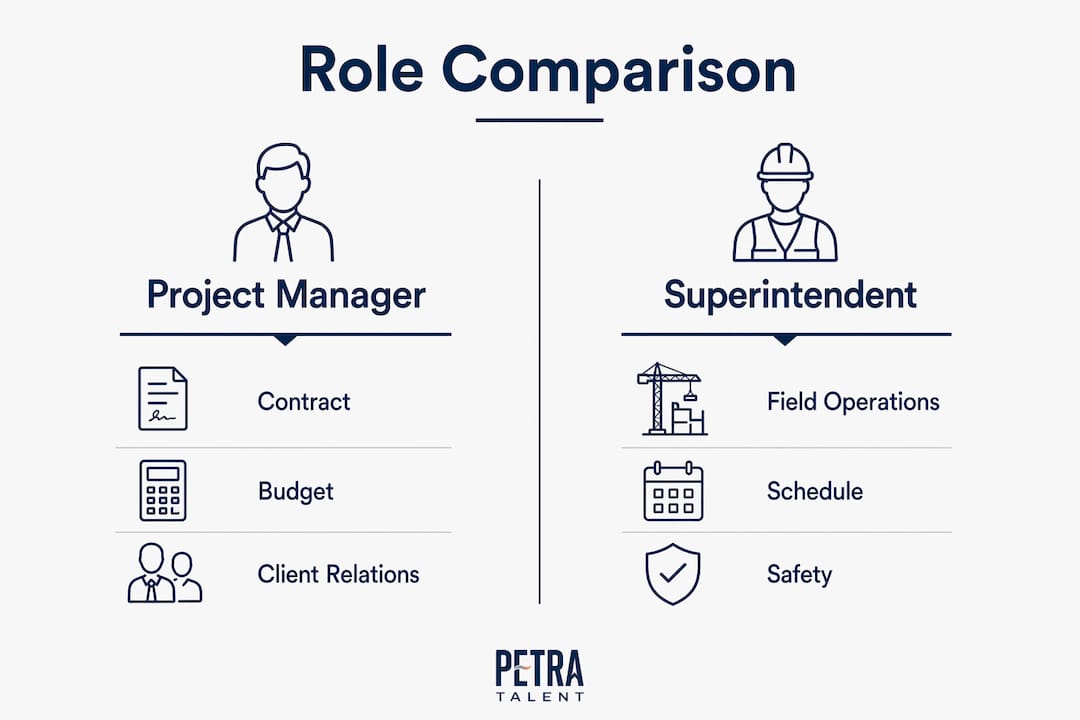
| Role | Primary Focus | Typical Scope |
|---|---|---|
| Project manager | Contract, budget, schedule, client relations | One or more active projects |
| Superintendent | Field crew, daily labor, safety, quality | On-site execution |
| Division manager | Department operations, team development, business growth | Multiple projects and teams |
The superintendent acts as the operational center bridging field work and management. The project manager works above that layer, handling the business side of the contract. On large commercial projects, these are always separate roles working closely together. On smaller projects, one person often covers both functions, which is why the distinction gets blurry early in a career.
A plumbing division manager oversees departments and team development with a focus on strategic planning and business administration rather than individual projects. That role is typically a career progression from project management or operations management. Superintendents generally hold a Journeyman or Master Plumber license and carry OSHA 30 certification. Project managers often hold the same credentials but add contract and financial management skills on top of their trade background. You can explore the full range of plumbing construction roles to see how these positions fit into a broader organizational structure.
What qualifications do plumbing project managers need?
A common misconception is that plumbing project managers only need plumbing knowledge. The reality is that they function as business managers of construction contracts, with technical expertise as the foundation rather than the full job description.
Core qualifications include:
- Field experience: Most roles require 5–10 years in the plumbing trades before moving into project management. That background builds the technical credibility needed to lead field teams.
- Licenses and certifications: A Journeyman or Master Plumber license is standard. OSHA 30 certification is expected on most commercial projects.
- Contract and financial literacy: PMs must understand lien laws, liquidated damages, and contract language. Negotiation and financial literacy are non-negotiable for protecting project profitability.
- Software proficiency: MS Office, Oracle, and Accubid are the most commonly required platforms. Familiarity with project management and estimating software signals readiness for the role.
- Communication and leadership: A project manager who cannot communicate effectively with field teams will struggle to lead. Technical knowledge earns field respect, but communication sustains it.
- Willingness to travel: Some positions require up to 25% travel, particularly on regional or multi-site contracts.
Pro Tip: Study the bid before you take over a project. Understanding how the estimate was built tells you where the margin lives and where the risk is. That knowledge changes how you manage every line item.
Contractors looking for guidance on hiring plumbing service managers will recognize these same qualifications as the baseline for any supervisory plumbing role.
What career opportunities come from a plumbing project manager role?
The project manager position is a proven foundation for broader leadership in the plumbing industry. Career progression often moves from project management to operations manager or general manager, with each step increasing leadership scope and strategic responsibility.
Here is how that path typically unfolds:
- Project manager: Manage one or two active contracts. Build skills in budgeting, scheduling, procurement, and client communication.
- Senior project manager: Oversee larger or more complex contracts. Begin mentoring junior PMs and coordinating across multiple projects simultaneously.
- Operations manager: Shift from individual project delivery to managing the systems, people, and processes that support multiple project teams.
- Division manager or general manager: Take ownership of a business unit or the full company operation. Focus moves to growth, staffing, and long-term planning rather than day-to-day project execution.
Each step builds on the skills developed at the previous level. The project manager role is where contractors learn to think like business owners, not just tradespeople. That mindset shift is what separates those who advance from those who plateau. Career growth in plumbing management depends on developing leadership beyond individual projects and moving into roles that shape operations at a broader level.
Key Takeaways
A plumbing project manager is a contract and business manager first, with technical plumbing expertise as the essential foundation for credibility and field leadership.
| Point | Details |
|---|---|
| Role definition | The PM manages budgets, schedules, procurement, and client relations across the full project lifecycle. |
| PM vs. superintendent | The PM owns the contract side; the superintendent owns field execution. Both roles are distinct and interdependent. |
| Qualifications required | Expect 5–10 years of field experience, a plumbing license, OSHA 30, and strong contract and financial skills. |
| Change order discipline | Undocumented changes are not billable. Rigorous change order tracking directly protects project profit. |
| Career trajectory | Project management leads to operations manager, division manager, and general manager roles with broader scope. |
What I’ve learned about succeeding in this role
Most people entering plumbing project management underestimate how much of the job is financial stewardship. The technical side is familiar. The contract side is where new PMs get hurt.
The biggest early mistake I see is neglecting change order management. A PM who lets undocumented scope changes accumulate will find a profitable project turning unprofitable by closeout. Document every change, every time, regardless of how small it seems.
The relationship between a PM and a superintendent is also worth taking seriously. These two roles depend on each other. A PM who dismisses field input loses credibility fast. A superintendent who ignores contract constraints creates expensive problems. Mutual respect between these roles is not a soft skill. It is a project delivery requirement.
The PMs who advance fastest are the ones who learn to communicate as clearly with a client as they do with a field crew. That range, from boardroom to job trailer, is what makes the role genuinely demanding and genuinely rewarding.
— David
Petratalent places plumbing project managers contractors can rely on
Finding a qualified plumbing project manager is one of the harder hiring challenges in mechanical contracting. The candidate needs field credibility, contract knowledge, financial literacy, and leadership ability. That combination is rare, and the hiring process for it requires a different approach than filling a technician role.

Petratalent specializes in sourcing and vetting plumbing management talent across the United States. The team understands what separates a strong PM candidate from one who looks good on paper. From leadership and management searches to technical vetting and workforce consultation, Petratalent’s recruitment services are built specifically for mechanical contractors who need to get these hires right the first time.
FAQ
What is the plumbing project manager role in construction?
A plumbing project manager oversees the full lifecycle of plumbing construction contracts, managing budgets, schedules, procurement, change orders, and client relations. The role requires both technical plumbing knowledge and strong business and contract management skills.
How many years of experience does a plumbing project manager need?
Most positions require 10 or more years of industry experience, though some roles accept candidates with 5–8 years if they hold the right licenses and have demonstrated project management ability.
What licenses does a plumbing project manager need?
A Journeyman or Master Plumber license is standard, and OSHA 30 certification is expected on most commercial projects. Contract and financial management skills are equally required alongside these credentials.
How does a plumbing project manager differ from a superintendent?
The project manager handles the contract, budget, schedule, and client communication. The superintendent manages the field crew, daily labor assignments, safety, and quality on site. On large projects, these are always separate roles.
What software do plumbing project managers use?
MS Office, Oracle, and Accubid are the most commonly required platforms. Proficiency in estimating and project management software is a standard expectation for the role.
Recommended
Post a comment
Related Posts
July 8, 2026
How to Build an HVAC Apprenticeship Pipeline That Lasts
Learn how to build an HVAC apprenticeship pipeline that lasts. Discover essential components for effective…

July 7, 2026
What Does Plumbing Compliance Mean When Hiring?
Understand what does plumbing compliance mean when hiring a contractor. Ensure safety and avoid costly…

July 6, 2026
How to Onboard New HVAC Hires: A Contractor’s Guide
Learn how to onboard new HVAC hires effectively. Boost retention and productivity with structured training…

July 5, 2026
Plumbing Subcontractor Staffing Best Practices: 2026 Guide
Discover essential plumbing subcontractor staffing best practices in 2026. Improve recruitment, compliance, and project success…