



TL;DR:
- Hiring a plumbing service manager is crucial for building teams, protecting margins, and driving growth. The best candidates have 3 to 8 years of experience, leadership skills, and software proficiency, especially with field management platforms. A structured onboarding process with clear KPIs and support prevents role failure and turnover.
Hiring a plumbing service manager is one of the highest-leverage decisions a plumbing business owner can make. The role, formally called a plumbing service manager or service operations manager, sits at the intersection of field leadership and business performance. Compensation ranges from $75,000 to $150,000 annually, reflecting the weight of the position. Get this hire right, and you gain someone who builds your team, protects your margins, and handles the daily friction that slows growth. Get it wrong, and you lose time, money, and technicians.
What qualifications matter when you hire plumbing service managers?
The strongest candidates bring a specific combination of field experience, leadership ability, and software proficiency. Technical knowledge alone does not make a service manager. Leadership and coaching ability rank above pure plumbing expertise in nearly every high-performing operation. That distinction matters because the role requires building accountable teams, not just fixing pipes.
Look for candidates who meet these core qualifications:
- Experience: 3–8 years of plumbing industry experience, with at least two years in a supervisory or lead role
- Licensing: Journeyman or Master Plumber license preferred, though not always required for office-heavy roles
- Software proficiency: Hands-on experience with field service management platforms like ServiceTitan
- Operational skills: Demonstrated ability to manage KPIs, gross profit targets, recruiting, and technician training
- People skills: Proven track record of motivating crews, handling customer escalations, and holding staff accountable
The KPI management requirement is worth emphasizing. A service manager who cannot read a gross profit report or track call conversion rates will struggle to improve your operation. Ask candidates to walk you through a metric they have managed and what they did when performance dropped.
Pro Tip: Ask candidates to describe a time they coached a technician through a performance issue. Their answer reveals whether they lead through accountability or just through authority.
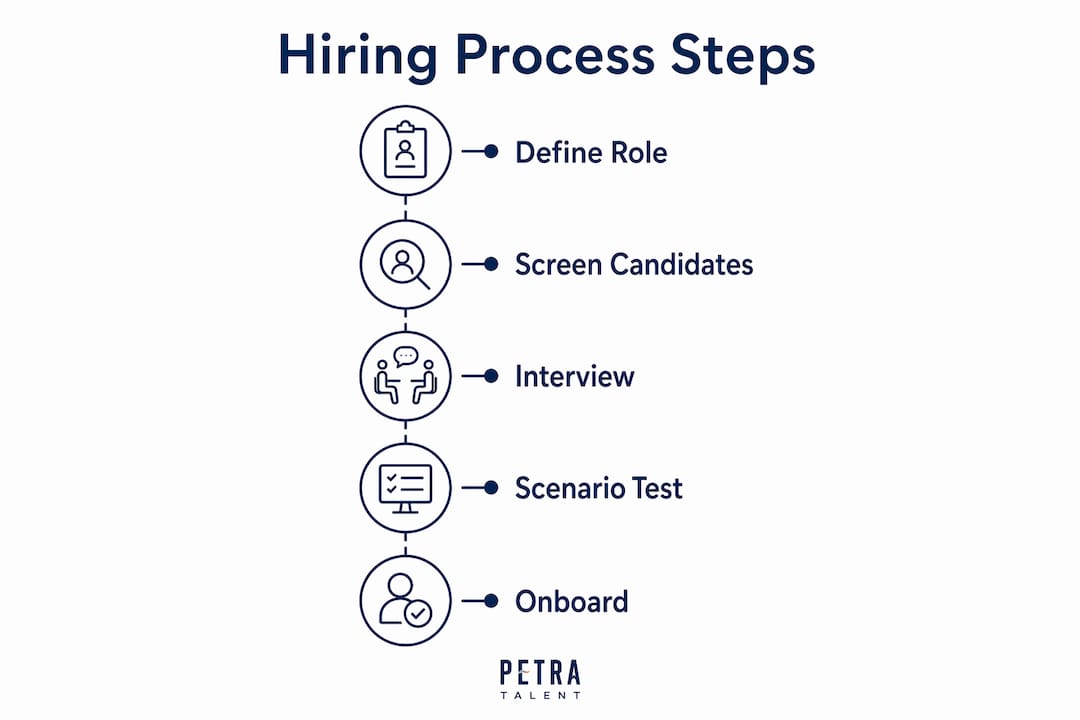
How to structure the recruitment process for plumbing manager recruitment
Finding qualified candidates requires going beyond general job boards. Plumbing leadership hiring draws from a narrow talent pool, so sourcing strategy matters as much as the job posting itself.
Follow this process to vet candidates effectively:
- Post in trade-specific channels. Industry job boards, local union halls, and trade association networks surface candidates who are already working in plumbing, not just looking for any management role.
- Screen for the hybrid skill set. Filter early for candidates who have both field experience and documented management responsibilities. Resumes that list only technical tasks signal a field tech, not a service manager.
- Conduct a structured phone screen. Ask about KPI ownership, team size managed, and software used. This eliminates candidates who overstate their experience.
- Use ride-alongs during the interview process. Ride-alongs reveal coaching and customer interaction skills that no interview question can replicate. Watching a candidate interact with a technician in the field tells you more than two hours in a conference room.
- Assess soft skills directly. Ask how they have handled a technician who repeatedly missed performance targets. Ask how they communicate bad news to a customer. These scenarios expose communication style and accountability standards.
One critical distinction to make early: a field supervisor and a service manager are not the same role. Field supervisors focus on full-time field presence and technical coaching, while service managers carry hybrid office and operational responsibilities including profit and loss oversight. Confusing the two leads to mismatched hires and frustrated employees.
Pro Tip: Build a short scenario exercise into your interview. Give candidates a mock dispatch problem or a technician performance issue and ask them to walk through their response. This tests judgment, not just experience.

Best practices for onboarding new plumbing service managers
A strong hire can fail without a structured onboarding plan. Without adequate support, new managers often revert to field technician roles due to administrative overload within the first few months. Preventing that requires deliberate setup from day one.
Effective onboarding covers these areas:
- Process training: Walk new managers through your dispatch workflow, service agreements, and escalation protocols before they touch a live call
- Software onboarding: Provide structured training on ServiceTitan or whatever platform you use, including reporting dashboards and job costing
- KPI alignment: Set clear performance goals for the first 30, 60, and 90 days so managers know exactly what success looks like
- Administrative support: Assign someone to handle routine paperwork and data entry so the manager can focus on field leadership and team development
- Mentoring: Schedule weekly check-ins for the first six months to address challenges before they become habits
Effective onboarding involves teaching new managers to navigate both field and administrative duties within six months. Without that structure, attrition risk rises sharply and the business absorbs the cost twice: once in recruiting and again in lost productivity.
The administrative support point is frequently overlooked. Balancing customer relations and operational paperwork is one of the defining challenges of plumbing service management. Managers who spend four hours a day on data entry cannot spend that time coaching technicians or closing escalations.
Common challenges in plumbing service management hiring
Plumbing business owners run into predictable problems when filling this role. Recognizing them early prevents costly mistakes.
Owners frequently misjudge technical leads as management candidates without confirming they have leadership training or software experience. A technician who is excellent at diagnosing problems may have no interest in managing people, tracking KPIs, or handling customer complaints. Promoting from within without assessing management readiness is the most common source of failed hires in this role.
The table below maps common challenges to proven solutions:
| Challenge | Solution |
|---|---|
| Promoting technical experts without leadership assessment | Use structured interviews and ride-alongs to test coaching ability before promoting |
| Role confusion between field supervisor and service manager | Define the role clearly in the job description with specific office and field time expectations |
| Manager burnout from administrative overload | Provide dedicated admin support and limit non-management paperwork |
| Poor customer escalation handling | Include escalation scenario questions in the interview and set escalation protocols during onboarding |
| Workforce morale issues after a new hire | Introduce the new manager gradually and involve the team in early goal-setting |
Technology also plays a role in solving these problems. Managers who are proficient in field service management software can track technician performance, manage dispatch efficiency, and identify revenue gaps without relying on manual reports. That capability directly reduces the administrative burden that drives burnout.
Key Takeaways
Hiring a plumbing service manager requires targeting candidates with proven leadership ability, 3–8 years of field experience, and software proficiency, then supporting them with structured onboarding and clear KPIs.
| Point | Details |
|---|---|
| Leadership over technical skill | Prioritize coaching ability and accountability over plumbing expertise alone. |
| Experience and licensing baseline | Target candidates with 3–8 years of experience and a Journeyman or Master license. |
| Ride-alongs as a vetting tool | Use field ride-alongs during interviews to observe real coaching and customer interaction. |
| Onboarding structure prevents attrition | Set 30/60/90-day KPIs and provide admin support to prevent role reversion. |
| Role clarity reduces misfires | Distinguish clearly between field supervisor and service manager before posting the job. |
What I have learned about hiring plumbing service managers
The single biggest mistake I see plumbing business owners make is treating this hire as a technical promotion. They take their best technician, give them a title, and expect leadership to follow. It rarely does. Leadership is a separate skill set, and it requires deliberate assessment during recruitment.
The ride-along interview is the most underused tool in plumbing manager recruitment. Watching a candidate coach a technician in real time, or handle a frustrated customer on-site, tells you more than any resume. I have seen candidates who interviewed brilliantly fall apart in the field and candidates who seemed average on paper turn out to be exceptional coaches.
The other thing owners consistently underestimate is how much administrative work the role carries. If you do not give your new manager real support, they will spend their days on paperwork and their technicians will drift. The manager role only works when the person in it has time to actually manage.
— David
Petratalent’s approach to plumbing service manager recruiting
Plumbing business owners who need to fill a service manager role quickly and correctly benefit from working with a recruiter who specializes in the trades. Petratalent focuses exclusively on HVAC and plumbing hiring, which means the candidate pool is already filtered for industry experience, licensing, and software proficiency.

Petratalent’s plumbing recruiting services include role-specific sourcing, technical vetting, and market wage benchmarking so contractors know they are offering competitive compensation from the start. The process covers leadership screening and soft-skill assessment, not just resume review. For contractors ready to move beyond generic job postings, Petratalent’s full recruitment and workforce solutions provide a structured path to finding the right service manager for your operation.
FAQ
What experience level should a plumbing service manager have?
Most plumbing service manager roles require 3–8 years of industry experience, with at least some time in a supervisory capacity. A Journeyman or Master Plumber license is preferred but not always required for office-heavy positions.
What is the typical salary for a plumbing service manager?
Plumbing service manager compensation ranges from $75,000 to $150,000 annually, depending on market, company size, and experience level. Field supervisor roles typically fall in the $65,000 to $120,000 range.
How is a service manager different from a field supervisor?
A field supervisor focuses on full-time field presence and technical coaching. A service manager carries broader responsibilities including profit and loss oversight, recruiting, KPI management, and office operations.
What software should a plumbing service manager know?
Proficiency in field service management platforms like ServiceTitan is a standard requirement for most service manager roles. Candidates who cannot navigate dispatch, reporting, and job costing tools will struggle with the operational side of the position.
How long does it take to onboard a plumbing service manager?
Effective onboarding takes up to six months to fully integrate a new service manager across both field and administrative responsibilities. Rushing this process increases the risk of burnout and role reversion.
Recommended
Related Posts

October 14, 2026
HVAC Recruiter Fees: Contractors Weigh $10,000 Against Vacancy Costs
See how HVAC recruiter fees work for contractors, from 15% to 25% placement costs to…

October 13, 2026
Recruiting Contract Terms: 10 Checks and Ready to Use Clauses
Define fee triggers, candidate ownership, guarantees, and compliance terms. Get a master agreement, short schedule,…

October 12, 2026
Offer Acceptance Rates: Segment Benchmarks, HVAC’s 3–5 Day SLA
See why a 78% to 82% offer acceptance benchmark can mislead, how role and source…

October 11, 2026
Bad Hires Can Cost Construction Firms 30% to 200% of Salary
Bad hires can cost construction firms 30% to 200% of annual salary. Calculate recruiting, rework,…