



TL;DR:
- The plumbing headhunter process is a structured method where agencies handle sourcing, screening, and candidate communication for contractors. It results in a shortlist of pre-qualified, licensed professionals, saving contractors weeks of effort. This approach emphasizes clear job profiles, multi-channel sourcing, rigorous vetting, and ongoing contractor-recruiter collaboration for optimal hiring outcomes.
The plumbing headhunter process is a structured recruitment method where a specialized agency manages sourcing, screening, and candidate communication on behalf of plumbing and HVAC contractors. In the trades industry, this is more formally called plumbing talent acquisition or direct hire recruitment. Understanding how plumbing headhunter process works gives business owners a clear picture of what to expect before signing on with a firm like Petratalent, HR2Fit, or Riverstone Management. The result is a shortlist of pre-qualified, license-verified candidates delivered directly to the hiring manager, saving weeks of internal effort.
What are the key steps in the plumbing headhunter recruitment process?
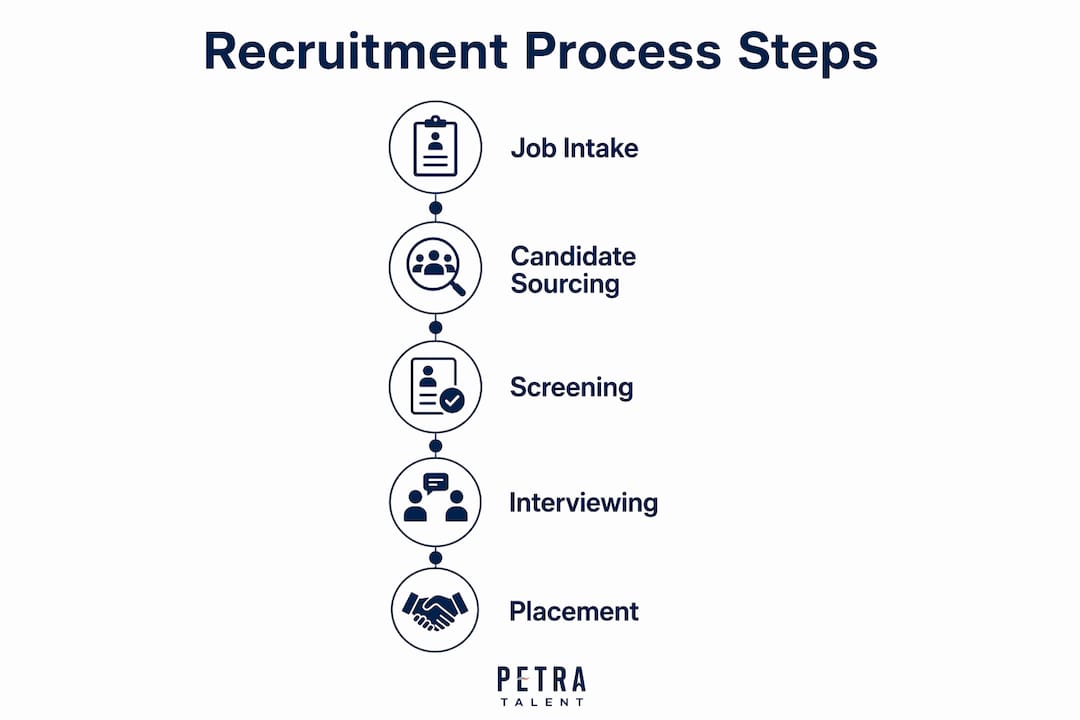
The plumbing recruitment process follows a defined sequence from intake to placement. Each step builds on the last, and skipping any one of them is where most hiring failures begin.
- Job profile creation. The recruiter meets with the contractor to define the role, required licenses, pay range, and non-negotiable skills. This intake call sets the filter for every candidate who follows.
- Multi-platform sourcing. The agency posts the role across job boards, taps its existing candidate network, and reaches out to passive candidates who are not actively searching.
- Resume screening and pre-qualification. Recruiters filter applications against the agreed criteria before any candidate reaches the contractor’s desk.
- Technical assessment and license verification. Candidates complete skills tests or video submissions, and the recruiter confirms active licenses and certifications.
- Behavioral interviews. Structured questions assess problem-solving, safety mindset, and customer service ability.
- Reference and background checks. Work history is verified, and background screenings are completed before any offer is extended.
- Candidate presentation and communication management. Recruitment firms manage all scheduling, follow-ups, and candidate communication, reducing the workload on the business owner.
Pro Tip: Ask your recruiter for a written intake summary after the job profile call. If the summary does not match what you described, correct it before sourcing begins. Misaligned intake criteria are the leading cause of poor candidate shortlists.
How do headhunters find and attract qualified plumbing candidates?
Experienced plumbing shops run five parallel recruiting streams: referrals, association partnerships, military transition programs, career-tech schools, and adjacent-trade pivots. That multi-channel approach is what separates a specialist recruiter from a general job board post.

The table below shows the most common sourcing channels and their relative strengths:
| Sourcing channel | Strength | Best for |
|---|---|---|
| Employee referrals | Highest retention, lowest cost | Journeyperson and senior roles |
| Trade school partnerships | Fresh talent pipeline | Apprentices and entry-level hires |
| Industry associations (PHCC, UA) | Credentialed, active professionals | Licensed journeypersons |
| Military transition programs | Disciplined, safety-trained candidates | Field technicians |
| Adjacent trade pivots | Expands candidate pool quickly | HVAC apprentices with pipe skills |
Passive candidate sourcing is where specialist recruiters add the most value. A contractor posting on a job board reaches only active job seekers. A recruiter contacts qualified professionals who are currently employed and not browsing listings. Headhunters also recruit from adjacent trades such as HVAC apprentices who carry transferable pipe-handling skills, which expands the candidate pool without lowering quality standards.
Key sourcing advantages of using a headhunter:
- Access to passive candidates who never see public job postings
- Established relationships with PHCC and UA chapter contacts
- Connections to military transition offices and career-tech schools
- Ability to pivot sourcing strategy mid-search based on candidate flow
How do plumbing headhunters screen and vet candidates to ensure quality?
Rigorous vetting is the core value a headhunter delivers. Standardized evaluation processes improve quality of hire and reduce the trial-and-error costs that come from placing the wrong person on a job site.
A thorough vetting sequence covers:
- Pre-screen call. The recruiter confirms license status, availability, pay expectations, and willingness to relocate if required.
- Work-sample test or video submission. Candidates demonstrate hands-on competency before meeting the contractor.
- Behavioral interview. Questions target safety decision-making, conflict resolution, and customer interaction scenarios.
- License and certification verification. The recruiter confirms active state licenses and any required certifications.
- Reference checks. At least two former supervisors are contacted to verify work history and reliability.
- Background screening. Criminal and driving record checks are completed where the role requires them.
Recruiters filter applicants rigorously, ensuring only candidates who meet non-negotiable standards reach the hiring manager. That filter protects contractors from spending time on interviews that should never have been scheduled. Effective plumbing workforce vetting also evaluates cultural fit, which reduces attrition after placement.
Pro Tip: Request a copy of the recruiter’s vetting scorecard for each candidate presented. Seeing the scores side by side makes the final hiring decision faster and more defensible.
Headhunter services vs. traditional hiring: what is the real cost difference?
Traditional job board hiring carries hidden costs of $1,500 to $2,500 per hire when accounting for no-shows, failed probationary periods, and attrition. That figure does not include the lost productivity while the role sits vacant.
| Hiring method | Average time to fill | Hidden cost risk | Candidate quality |
|---|---|---|---|
| Job board post only | 6–12 weeks | High (no-shows, washouts) | Variable |
| Internal HR with job board | 4–8 weeks | Moderate | Moderate |
| Specialist headhunter | Weeks, based on role urgency | Low (pre-vetted candidates) | Consistently high |
Referral hires cost 60–70% less than hires sourced from job boards because prior screening reduces onboarding failures. Specialist recruiters replicate that effect at scale by targeting passive candidates who are already employed and performing well.
“The real cost of a bad hire is not the recruiter fee. It is the three months of wages, the project delays, and the team morale hit that follow a failed placement.”
Contractors who rely solely on job boards also face a structural problem. Active job seekers represent a narrow slice of the available workforce. A recruiting partner reaches the larger pool of qualified professionals who are not actively looking but would consider the right opportunity.
How should contractors collaborate with headhunters for the best results?
The quality of a recruiter’s output depends directly on the quality of the contractor’s input. Vague job descriptions and shifting priorities produce weak candidate shortlists.
Contractors who get the best results from the plumbing job placement process do the following:
- Define must-haves versus nice-to-haves. Separate the licenses and experience that disqualify a candidate from the preferences that are flexible.
- Set a communication cadence. Agree on how often the recruiter will provide updates and what format those updates will take.
- Give feedback on every candidate presented. A recruiter who hears “not quite right” without explanation cannot refine the search. Specific feedback produces better candidates faster.
- Share your company culture. Describe how your crew operates, what a typical day looks like, and what has caused past hires to fail. This context shapes the behavioral interview questions the recruiter uses.
- Treat the recruiter as a long-term partner. Contractors who engage a recruiter only when a seat is empty miss the value of continuous plumbing trade recruitment. Keeping the relationship warm means faster response when urgent needs arise.
Plumbing leadership hiring requires even tighter collaboration, since the stakes of a misaligned superintendent or project manager are higher than a field technician placement.
Key Takeaways
The plumbing headhunter process delivers the most value when contractors treat it as a structured partnership, not a one-time transaction.
| Point | Details |
|---|---|
| Structured intake drives results | A detailed job profile call sets the filter for every candidate in the search. |
| Multi-channel sourcing beats job boards | Headhunters reach passive candidates through referrals, trade schools, PHCC, UA, and military programs. |
| Vetting reduces attrition | License verification, skills tests, and behavioral interviews filter out poor fits before the contractor’s time is spent. |
| Hidden costs favor headhunters | Job board hiring can cost $1,500–$2,500 per failed hire; pre-vetted candidates reduce that risk significantly. |
| Feedback improves shortlists | Specific candidate feedback after each presentation sharpens the recruiter’s search criteria. |
What I have learned from watching contractors use headhunters
Most contractors come to a recruiter after a bad run of job board hires. They are frustrated, and they want fast results. The frustration is understandable. The expectation of instant results is where things go sideways.
The contractors who get the most from a headhunter are the ones who treat recruiting as a continuous program, not a fire drill. They stay in contact between searches, share workforce changes, and give honest feedback on every candidate. That ongoing relationship means the recruiter already knows the company’s culture and standards when an urgent role opens.
The other mistake I see regularly is over-reliance on a single sourcing channel. A contractor who only wants referrals, or only trusts candidates from one trade school, limits the recruiter’s ability to find the best person for the job. Diversified sourcing, including adjacent trades and military programs, consistently produces stronger candidate pools than any single channel alone.
Mentor-led onboarding is the piece most contractors skip. A technically strong hire who lands in a disorganized first week often leaves within 90 days. The recruiter’s job ends at placement. The contractor’s job begins there.
— David
How Petratalent simplifies plumbing and HVAC hiring
Petratalent specializes in end-to-end recruitment for plumbing and HVAC contractors across the United States. The firm handles role-specific sourcing, license verification, technical screening, and candidate presentation so business owners spend time interviewing qualified finalists, not sorting through unqualified applications.

Petratalent’s plumbing recruiting services cover journeyperson placements, apprentice sourcing, and leadership searches for mechanical contractors who need dependable hires without the overhead of managing a full internal recruiting function. Contractors facing common HVAC recruitment challenges will find Petratalent’s structured process directly addresses the sourcing gaps and vetting failures that drive up hiring costs. Contact Petratalent to start a search or discuss your current workforce needs.
FAQ
What does a plumbing headhunter actually do?
A plumbing headhunter manages the full recruitment cycle on behalf of a contractor, including sourcing, screening, license verification, and candidate presentation. The recruiter delivers a shortlist of pre-qualified candidates, so the hiring manager only interviews people who meet the role’s requirements.
How long does the plumbing headhunter process take?
Placements can be completed in weeks depending on role urgency and the availability of qualified candidates in the market. Leadership and specialized roles typically take longer than journeyperson or apprentice placements.
Is using a headhunter more expensive than posting a job online?
The upfront fee is higher, but the total cost is often lower. Hidden costs of $1,500–$2,500 per hire from no-shows and failed placements make job board hiring more expensive than it appears when attrition is factored in.
What information should a contractor provide to a plumbing recruiter?
Contractors should provide a clear job description, required licenses, pay range, location, and examples of past hires who succeeded or failed in the role. That context allows the recruiter to set accurate screening criteria from the start.
Can a headhunter find candidates for both field and leadership roles?
Yes. Specialist firms like Petratalent source candidates for field technician, project manager, superintendent, and leadership roles. The vetting criteria and sourcing channels differ by role type, but the structured process applies across all levels.
Recommended
Related Posts

October 13, 2026
Recruiting Contract Terms: 10 Checks and Ready to Use Clauses
Define fee triggers, candidate ownership, guarantees, and compliance terms. Get a master agreement, short schedule,…

October 12, 2026
Offer Acceptance Rates: Segment Benchmarks, HVAC’s 3–5 Day SLA
See why a 78% to 82% offer acceptance benchmark can mislead, how role and source…

October 11, 2026
Bad Hires Can Cost Construction Firms 30% to 200% of Salary
Bad hires can cost construction firms 30% to 200% of annual salary. Calculate recruiting, rework,…

October 10, 2026
Construction Labor Forecasting for PMs: 7 Steps to Time Hiring
Learn when construction project managers should use WBS or simulation, track labor KPIs, and turn…