


TL;DR:
- A structured hiring process evaluates every candidate with consistent criteria, questions, and scoring methods, reducing bias and improving quality. For HVAC and plumbing firms, this approach saves time, enhances fairness, and supports scalable, evidence-based decisions across multiple locations. Implementing structured methods involves defining success attributes, preparing benchmark answers, and training interviewers to ensure reliable, repeatable hiring outcomes.
A structured hiring process is defined as evaluating every candidate for a role using the same criteria, questions, and scoring system, replacing subjective impressions with evidence-based decisions. For HVAC and plumbing employers, this distinction matters more than most industries realize. Skilled trades hiring is already constrained by a shallow talent pool and high turnover costs. Adding inconsistency to that equation produces mismatches that cost contractors weeks of lost productivity and thousands in rehiring expenses. GOV.UK’s guidance on fair interviewing and Google re:Work’s structured interviewing framework both confirm that standardized processes produce fairer, more predictable outcomes than gut-feel interviews.
What is a structured hiring process and how does it work?
A structured hiring process, also called a structured recruitment process or hiring framework, connects every evaluation step into a single, repeatable decision system. Alva Labs defines structured hiring as replacing guesswork with predictive accuracy by integrating criteria definition, assessment methods, and decision scoring into one unified framework rather than a collection of disconnected tools. That integration is what separates a true hiring framework from simply writing down a few interview questions.
The core components of a structured hiring process include:
- Job success attributes defined before interviews begin. For an HVAC service technician role, this means specifying technical competencies like refrigerant handling and EPA 608 certification requirements, alongside behavioral traits like customer communication and punctuality.
- Standardized, job-relevant interview questions. Google re:Work recommends using both behavioral questions (“Tell me about a time you diagnosed a complex system failure under pressure”) and hypothetical questions (“How would you handle a no-heat call in a commercial building with an unfamiliar system?”).
- Consistent scoring rubrics with benchmark answers. A rubric assigns a numerical score to each response based on pre-agreed standards, not the interviewer’s mood that day.
- Interviewer training and calibration. Every person on the panel must apply the same rating scale. Without calibration, two interviewers scoring the same answer differently will produce unreliable results.
- Documented scorecards for every candidate. Written records create accountability and allow hiring managers to revisit decisions if a hire underperforms.
Pro Tip: Before your next technician interview, write out three benchmark answers for each question at the “meets expectations,” “exceeds expectations,” and “does not meet expectations” levels. This takes 30 minutes upfront and eliminates scoring drift across your panel.
How does structured hiring benefit HVAC and plumbing employers?
The advantages of structured hiring over traditional unstructured interviews are measurable, not theoretical. GOV.UK confirms that structured interviews reduce bias by prioritizing job-relevant criteria and standardized scoring, which produces fairer outcomes and reduces the impact of applicant characteristics like gender on hiring decisions. For plumbing and HVAC contractors who want to attract a broader pool of qualified candidates, this fairness mechanism directly supports workforce diversity goals.
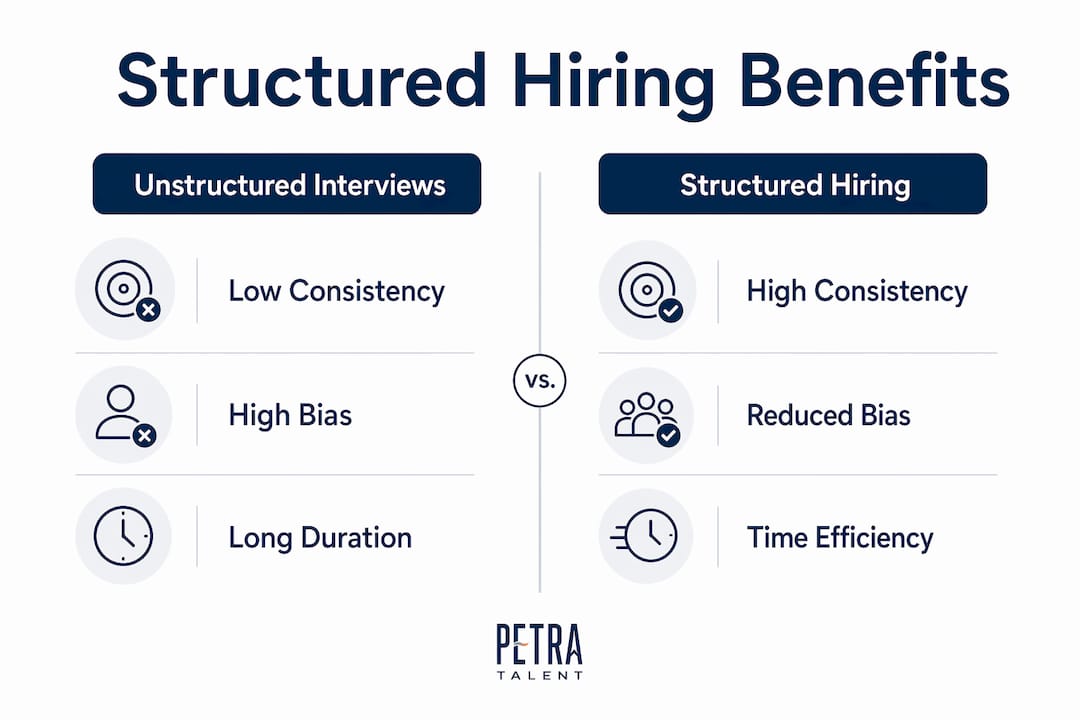
| Factor | Unstructured interviews | Structured hiring |
|---|---|---|
| Consistency across candidates | Low. Each interview varies by interviewer mood and rapport | High. Same questions and scoring applied to every candidate |
| Bias exposure | High. Gut-feel decisions favor familiar profiles | Reduced. Criteria-based scoring limits personal bias |
| Time per candidate | High. Prep and debrief are improvised | Lower. Saves approximately 40 minutes per candidate using pre-made questions and rubrics |
| Scalability | Poor. Quality degrades as volume increases | Strong. Repeatable standards scale with hiring volume |
| Decision defensibility | Weak. Hard to explain why one candidate beat another | Strong. Scorecards provide clear, documented rationale |
The time savings alone justify the investment. Saving 40 minutes per candidate across 20 applicants for a single open role returns more than 13 hours to your hiring team. For a plumbing contractor running multiple concurrent searches, that figure compounds quickly. The common HVAC recruitment challenges that slow down hiring, including inconsistent evaluations and poor candidate experience, are directly addressed by a structured approach.
Pro Tip: Candidates notice when an interview feels organized and fair. A consistent process signals to skilled technicians that your company operates professionally, which improves offer acceptance rates.
What are the challenges of implementing structured hiring in trade firms?
Adopting a structured recruitment process in HVAC and plumbing companies is not without friction. Most hiring managers in these industries learned to interview through experience, not formal training, and shifting to a rubric-based system requires deliberate effort. The following steps address the most common implementation obstacles:
- Align your hiring team on success criteria before posting the role. Disagreement about what “good” looks like should happen in a pre-hire meeting, not during candidate debriefs. Define the three to five attributes that predict success in the specific role, whether that is a field technician, project manager, or plumbing superintendent.
- Prepare benchmark answers for every interview question. GOV.UK recommends deciding benchmark answers in advance while building in flexibility for unexpectedly strong responses that differ from the anticipated format.
- Train every interviewer on the rating scale before the first interview. Google re:Work’s calibration approach uses fixed question prompts and shared rating scales to prevent scoring drift across panel members.
- Use batch interviewing where possible. Scheduling multiple candidates in the same week using the same panel reduces the memory distortion that occurs when interviews are spread over several weeks.
- Document scorecard rationale, not just scores. A number without context is hard to defend. Require interviewers to write one sentence explaining each score so that decisions are explainable and auditable.
Greenhouse notes that structured hiring reduces disagreement among interviewers and provides clear, defensible reasons for decisions. This matters especially for HVAC and plumbing firms operating across multiple locations, where hiring consistency across regions is difficult to maintain without a formal framework.
How to integrate structured hiring methods with technology and recruitment partners
Technology accelerates structured hiring when the process foundation is already solid. Greenhouse highlights that AI amplifies structured hiring by reducing manual work, but only when the underlying criteria and scoring standards are already defined. Adding software to a broken process produces faster bad decisions.
Practical integrations for HVAC and plumbing hiring managers include:
- Applicant Tracking Systems (ATS) with structured interview modules. Platforms like Greenhouse and Lever allow hiring teams to attach scorecards directly to candidate profiles, keeping all evaluations in one place.
- Validated technical assessments paired with structured interviews. For roles requiring EPA 608 certification, gas line knowledge, or commercial HVAC controls experience, a pre-interview skills screen filters unqualified candidates before they reach the panel.
- Specialized recruitment agencies with technical vetting capabilities. Petratalent’s technical vetting and workforce solutions pre-screen candidates against role-specific criteria before they reach your interview panel, which compresses your time-to-hire without sacrificing evaluation quality.
- Structured interview guides shared with all panel members in advance. A shared document containing questions, rubrics, and benchmark answers eliminates the preparation gap between experienced and inexperienced interviewers.
For plumbing trade recruitment specifically, combining a structured internal process with an external partner who understands trade-specific competencies produces the most reliable candidate pipeline.
Key takeaways
A structured hiring process is the most reliable method for HVAC and plumbing employers to reduce bias, improve hire quality, and scale evaluation consistently across roles and locations.
| Point | Details |
|---|---|
| Core definition | Structured hiring applies the same criteria, questions, and scoring to every candidate without exception. |
| Bias reduction | Standardized scoring limits the impact of personal bias and applicant characteristics on hiring decisions. |
| Time efficiency | Structured methods save approximately 40 minutes per candidate through pre-made questions and rubrics. |
| Scalability | Documented scorecards and consistent criteria allow hiring quality to hold as volume increases. |
| Implementation priority | Align your team on success criteria and benchmark answers before the first interview takes place. |
Why structured hiring is the discipline trade contractors can’t afford to skip
I’ve seen HVAC and plumbing contractors lose strong candidates to competitors not because their compensation was lower, but because their interview process felt disorganized. A candidate who walks into a panel where interviewers are asking different questions and scoring on different mental scales picks up on that inconsistency. It signals operational disorder, and skilled technicians with options will choose the employer who appears to have their act together.
The other side of this is the costly mismatch problem. When hiring decisions rely on rapport and first impressions rather than job-relevant criteria, contractors end up with technicians who interview well but perform poorly in the field. Structured hiring does not guarantee a perfect hire, but it dramatically narrows the gap between who seems right and who actually is right for the role. The investment in building scorecards, training interviewers, and calibrating your panel pays back in reduced turnover and fewer 90-day failures.
The challenge unique to trades hiring is that many hiring managers are former technicians or project managers who were promoted into leadership. They know the work deeply but were never trained to evaluate candidates systematically. That is not a criticism. It is a gap that structured hiring methods are specifically designed to fill. The discipline of writing down what good looks like before you meet a candidate changes how you see every applicant who walks through the door.
— David
How Petratalent helps HVAC and plumbing employers hire with structure
Petratalent works exclusively with mechanical contractors and trade employers across the United States, which means every search is built around the specific competencies that matter in HVAC and plumbing roles.
Petratalent’s recruitment and workforce solutions include role-specific candidate sourcing, technical vetting, and scorecard-aligned pre-screening that feeds directly into your structured hiring process. Whether you are filling a field technician position or a plumbing leadership role, Petratalent delivers candidates who have already been evaluated against your defined criteria. If you want to attract experienced HVAC workers without rebuilding your entire hiring process from scratch, Petratalent’s team can serve as the structured front end of your recruitment pipeline.
FAQ
What is a structured hiring process in simple terms?
A structured hiring process evaluates every candidate using the same questions, criteria, and scoring system, replacing subjective impressions with evidence-based decisions. GOV.UK defines it as using standardized questions in the same order with benchmark answers prepared before interviews begin.
How does structured hiring reduce bias in HVAC recruiting?
Structured hiring reduces bias by anchoring decisions to job-relevant criteria and standardized scoring rather than personal impressions. This limits the influence of applicant characteristics, including gender, on hiring outcomes.
What are the first steps in a structured hiring process?
The first steps are defining job success attributes for the specific role, writing standardized interview questions, and preparing benchmark answers before any candidate interviews begin.
How long does it take to implement a structured hiring framework?
A basic structured hiring framework for a single role, including criteria definition, question development, and scorecard creation, can be built in two to four hours. Interviewer calibration adds another session before the first interview.
Can small plumbing or HVAC contractors use structured hiring?
Structured hiring scales to any company size. A two-person hiring panel using a shared scorecard and five standardized questions is already more structured than most small contractor interviews, and produces measurably more consistent results.
Recommended
Related Posts

October 14, 2026
HVAC Recruiter Fees: Contractors Weigh $10,000 Against Vacancy Costs
See how HVAC recruiter fees work for contractors, from 15% to 25% placement costs to…

October 13, 2026
Recruiting Contract Terms: 10 Checks and Ready to Use Clauses
Define fee triggers, candidate ownership, guarantees, and compliance terms. Get a master agreement, short schedule,…

October 12, 2026
Offer Acceptance Rates: Segment Benchmarks, HVAC’s 3–5 Day SLA
See why a 78% to 82% offer acceptance benchmark can mislead, how role and source…
October 11, 2026
Bad Hires Can Cost Construction Firms 30% to 200% of Salary
Bad hires can cost construction firms 30% to 200% of annual salary. Calculate recruiting, rework,…