


TL;DR:
- Recruiting partners proactively source, vet, and screen passive candidates for technical HVAC and plumbing roles, reducing hiring time and improving quality.
- Job boards simply post listings and attract active applicants, making them suitable for volume or entry-level hiring but less effective for specialized positions.
A recruiting partner is a proactive hiring specialist who sources, screens, and vets candidates on your behalf, while a job board is a self-serve platform where employers post openings and wait for active candidates to apply. For HVAC and plumbing contractors, this distinction determines whether you fill a licensed technician role in three weeks or three months. The two approaches serve different hiring needs, operate on different models, and produce measurably different results. Understanding how a recruiting partner differs from a job board is the first step toward building a hiring strategy that actually works for technical trades.
What job boards offer HVAC and plumbing employers
Job boards are self-serve platforms where employers write a posting, publish it, and wait for applications to arrive. Platforms like Indeed, ZipRecruiter, and LinkedIn aggregate listings from multiple sources, giving employers broad reach across active job seekers. For HVAC and plumbing companies, this reach has real value in specific situations.
Job boards work well when:
- Volume hiring is the goal. Entry-level helper positions or seasonal labor roles attract enough applicants through boards to justify the approach.
- The role is straightforward. A general laborer or warehouse position does not require deep technical screening, so a broad application pool is manageable.
- Speed is the only priority. Posting takes minutes, and applications can start arriving within hours.
- Budget is tight. Most boards charge per-click or flat posting fees, making them a lower upfront cost than a recruiting partner.
The limitations become clear when the role requires real technical competency. A posting for a licensed journeyman plumber or a commercial HVAC service technician on a job board reaches only candidates who are actively searching. That pool is small, and it skews toward candidates who are between jobs rather than candidates who are currently employed and performing well. Managing multiple boards, reviewing unqualified applications, and re-posting after a failed hire adds time and cost that rarely gets factored into the initial budget.
How a recruiting partner operates differently in HVAC and plumbing hiring
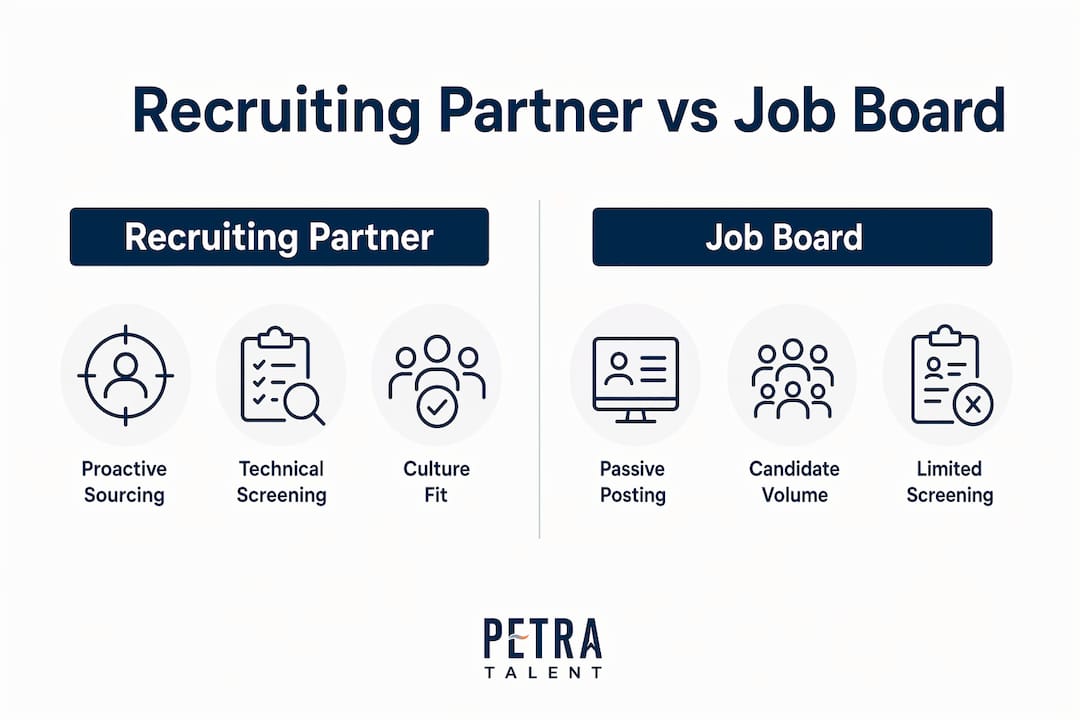
A recruiting partner does not wait for candidates to apply. Recruiting partners run a structured search that includes mapping the market, identifying passive candidates, and screening for both technical fit and motivation before a single resume reaches the hiring manager. This is the core operational difference between the two approaches.
Here is how the process typically works with a specialized recruiting partner:
- Role intake and calibration. The partner meets with the hiring manager to understand the technical requirements, team culture, compensation range, and growth expectations for the role.
- Market mapping. The partner identifies where qualified candidates currently work, which companies employ licensed plumbers or HVAC technicians in the target market, and what compensation is needed to attract them.
- Direct outreach to passive candidates. The partner contacts candidates who are not actively searching. These individuals are often the strongest performers because they are currently employed and not desperate.
- Technical screening. For HVAC and plumbing roles, validating real-world competency requires more than reviewing a resume. Partners assess licensure, hands-on experience, and job-specific skills through structured conversations.
- Shortlist delivery. The hiring manager receives a small, decision-ready list of vetted candidates rather than a stack of unfiltered applications.
- Ongoing support. Recruiting partners can manage the full lifecycle, including interview coordination and onboarding support, reducing the administrative burden on internal teams.
Pro Tip: When briefing a recruiting partner on a technical role, include the specific equipment brands, systems, or certifications the candidate must know. The more precise the intake, the faster the partner can eliminate mismatches before they reach your desk.
Pricing for recruiting partners differs from job boards as well. Retained search involves staged fees and exclusivity, which removes the incentive to rush unsuitable candidates. Contingency arrangements pay upon placement. Both models align the partner’s success with the quality of the hire, not the volume of applications generated.

Practical advantages of recruiting partners for hard-to-fill trade roles
The job board comparison becomes most stark when the role is genuinely difficult to fill. Recruiters provide better market reach, expertise, and speed than repeated posting on job boards, particularly for passive candidates and specialized positions.
| Factor | Job board | Recruiting partner |
|---|---|---|
| Candidate pool | Active job seekers only | Active and passive candidates |
| Technical screening | None; employer reviews all applications | Partner screens before submission |
| Time to shortlist | Days to weeks, with high volume | 10 to 21 days for specialized roles |
| Candidate quality | Variable; unfiltered | Vetted for technical fit and motivation |
| Employer branding | Minimal; standard posting format | Partner represents your company professionally |
| Retention risk | Higher; limited culture alignment | Lower; values and fit assessed upfront |
Specialized recruiting for HVAC engineering roles, for example, can produce placements in 10 to 21 days using technical screening methods. That speed comes from having a pre-built network and a structured process, not from casting a wider net.
“Posting jobs repeatedly on boards is ineffective. A partnership approach is the strategic way forward for consistent hiring success.”
Retention is another measurable advantage. Retained search focuses on culture alignment and long-term fit rather than filling a seat quickly. A technician who leaves after 90 days costs a mechanical contractor far more than the fee difference between a job board posting and a recruiting partner engagement.
How to choose the right hiring approach for your business
Not every open position requires a recruiting partner, and not every job board posting is a wasted effort. The right approach depends on the role, the urgency, and the internal capacity available to manage the hiring process.
Use a job board when:
- The role is entry-level or does not require specific licensure.
- You have internal HR capacity to screen a high volume of applications.
- The position is not urgent and you can afford a longer search window.
- Budget constraints make a transactional approach necessary.
Use a recruiting partner when:
- The role requires specific certifications, such as EPA 608, a master plumber license, or commercial HVAC experience.
- Previous job board postings produced few qualified applicants.
- The position is critical to operations and a bad hire carries significant cost.
- You need access to candidates who are currently employed and not actively searching.
A hybrid model works well for many HVAC and plumbing contractors. Job boards handle volume hiring for helper and apprentice roles, while a specialized recruiting partner manages searches for journeymen, project managers, and leadership positions. This approach controls cost while protecting quality where it matters most.
Pro Tip: Track your cost-per-hire and 90-day retention rate separately for job board hires and recruiting partner placements. The data will clarify which approach delivers better ROI for each role type in your specific market.
Treating recruiting partners as strategic extensions of your internal team, rather than as vendors, produces better calibration and higher candidate quality over time. The more context a partner has about your company culture, growth plans, and technical standards, the more precisely they can match candidates to your needs.
Key takeaways
A recruiting partner delivers a vetted, decision-ready shortlist through proactive sourcing and technical screening, while a job board delivers an unfiltered application pool from active candidates only.
| Point | Details |
|---|---|
| Job boards serve active candidates | Postings reach only candidates currently searching, missing the strongest employed talent. |
| Recruiting partners source proactively | Direct outreach to passive candidates produces higher-quality shortlists for technical roles. |
| Technical screening is the key differentiator | Partners validate licensure and hands-on competency before candidates reach the hiring manager. |
| Retention improves with partner hiring | Culture and values alignment during the search reduces early turnover in critical trade roles. |
| Hybrid strategies control cost | Use job boards for volume roles and recruiting partners for licensed or leadership positions. |
Why job boards alone will cost you more than you think
I have worked with HVAC and plumbing contractors who spent months re-posting the same journeyman technician role on three different job boards, reviewing hundreds of applications, and still ended up with a hire who left within 60 days. The cost of that cycle, including lost productivity, re-advertising fees, and management time, far exceeded what a recruiting partner would have charged.
The mistake most contractors make is treating a recruiting partner as an expense rather than as a risk reduction tool. A bad hire in a technical role does not just cost a salary. It costs callbacks, warranty work, customer relationships, and the time your best technician spends cleaning up someone else’s mistakes.
Modern recruiting at senior and technical levels depends on human judgment and relationships, not keyword filtering. A job board algorithm cannot tell the difference between a technician who has touched a commercial chiller once and one who has serviced them for ten years. A recruiting partner who specializes in HVAC and plumbing can.
My recommendation is straightforward: reserve job boards for roles where volume and speed matter more than precision. For any position where a wrong hire carries real operational risk, invest in a partner who knows your trade.
— David
How Petratalent helps HVAC and plumbing contractors hire better
Petratalent specializes in recruiting for HVAC and plumbing contractors across the United States, covering service technicians, project managers, superintendents, and leadership roles. The approach is built on proactive sourcing, technical vetting, and direct engagement with candidates who are not actively searching on job boards.

Petratalent’s process includes role-specific candidate sourcing, performance screening, market wage insights, and workforce compliance support. Every search is calibrated to the contractor’s specific technical requirements and company culture. For contractors who have struggled to fill licensed or specialized positions through traditional posting, Petratalent’s HVAC recruiting services and plumbing recruiting services provide a structured alternative that prioritizes quality and retention. Learn more about the full range of offerings at Petratalent’s services page.
FAQ
What is the main difference between a recruiting partner and a job board?
A job board is a platform where employers post jobs and candidates apply. A recruiting partner actively sources, screens, and vets candidates on the employer’s behalf, including passive candidates who are not searching on job boards.
When should an HVAC contractor use a recruiting partner instead of a job board?
Use a recruiting partner when the role requires specific licensure or technical competency, when previous job board postings produced few qualified applicants, or when a bad hire carries significant operational risk.
How long does it take a recruiting partner to fill a technical HVAC role?
Specialized recruiting for HVAC engineering positions can produce placements in 10 to 21 days using technical screening methods, compared to weeks or months of unproductive job board posting.
Do recruiting partners cost more than job boards?
The upfront cost is higher, but the total cost of a bad hire through a job board, including re-hiring, lost productivity, and warranty callbacks, typically exceeds a recruiting partner’s fee for a critical technical role.
Can HVAC and plumbing companies use both job boards and recruiting partners?
Yes. A hybrid model works well: job boards handle entry-level and volume roles, while a recruiting partner manages searches for licensed technicians, project managers, and leadership positions where fit and retention matter most.
Recommended
Related Posts

October 13, 2026
Recruiting Contract Terms: 10 Checks and Ready to Use Clauses
Define fee triggers, candidate ownership, guarantees, and compliance terms. Get a master agreement, short schedule,…

October 12, 2026
Offer Acceptance Rates: Segment Benchmarks, HVAC’s 3–5 Day SLA
See why a 78% to 82% offer acceptance benchmark can mislead, how role and source…

October 11, 2026
Bad Hires Can Cost Construction Firms 30% to 200% of Salary
Bad hires can cost construction firms 30% to 200% of annual salary. Calculate recruiting, rework,…

October 10, 2026
Construction Labor Forecasting for PMs: 7 Steps to Time Hiring
Learn when construction project managers should use WBS or simulation, track labor KPIs, and turn…