



TL;DR:
- Passive recruiting targets currently employed skilled plumbers who are not actively job searching, providing access to high-quality candidates. It results in better cultural fit, longer retention, and lower hiring costs by reducing competition and bidding wars. Integrating passive recruiting into hiring strategies improves workforce stability and fills hard-to-hire roles faster.
Passive recruiting is the practice of identifying and engaging skilled plumbing professionals who are currently employed and not actively searching for new jobs. This approach gives contractors access to a hidden talent pool that never appears on job boards, and it is the reason why passive recruiting benefits plumbing companies far more than reactive hiring ever can. Firms like Crawford Thomas Recruiting have documented that passive candidates consistently outperform active applicants in skill level, cultural alignment, and long-term retention. For plumbing contractors competing in a tight labor market, shifting from reactive to proactive talent sourcing is not optional. It is the difference between filling a seat and building a reliable crew.
Why passive recruiting benefits plumbing: better candidates from the start
Passive candidates are typically top performers with uninterrupted career histories and current, relevant experience. They are not searching because something went wrong. They are open to a move only if the opportunity genuinely improves their career. That motivation produces a fundamentally different hire.
Active job seekers often apply to dozens of positions at once. Passive candidates, by contrast, evaluate one opportunity carefully. According to Crawford Thomas Recruiting, passive candidates align better with company goals and culture, which leads to long-term employment stability. For a plumbing contractor, that stability translates directly into fewer callbacks, stronger field performance, and lower turnover costs.
Passive candidates also make deliberate career decisions, which means their reasons for joining a company are grounded in genuine fit rather than urgency. That intentionality shows up in how they perform on the job and how long they stay.
Key traits that make passive candidates stronger hires for plumbing roles:
- Proven field performance. They are currently producing results for another employer, not between jobs.
- Relevant licensure and experience. Their skills are active, not dormant from a gap in employment.
- Intentional career moves. They accept offers because the role fits their goals, not because they need a paycheck.
- Better cultural fit. Their deliberate decision process leads to stronger alignment with your company’s values and work style.
- Longer tenure. Contractors who hire passive candidates report fewer early departures and lower rehiring costs.
Pro Tip: Before reaching out to a passive candidate, research their current role and certifications. A message that references their specific experience gets a response. A generic outreach gets ignored.
How passive recruiting reduces competition and hiring costs
Passive candidates are not fielding five competing offers when you contact them. They are not on job boards, so other contractors are not already in conversation with them. That changes the entire negotiation dynamic.

High Five notes that engaging passive candidates involves fewer competing offers compared to active job seekers. Fewer competing offers means higher acceptance rates and less pressure to overbid on compensation. For plumbing contractors managing tight project margins, that matters.
Lower turnover also cuts costs that contractors rarely track directly. Every time a licensed plumber leaves, the company absorbs recruiting fees, onboarding time, and lost productivity during the gap. Passive candidates who join for the right reasons stay longer, which breaks that cycle.
Three cost advantages passive recruiting delivers for plumbing contractors:
- Fewer bidding wars. Passive candidates are not shopping their resume, so contractors rarely compete against multiple simultaneous offers.
- Higher offer acceptance rates. When a passive candidate says yes, they mean it. Acceptance rates are stronger because the candidate has already evaluated the opportunity carefully.
- Reduced rehiring costs. Longer tenure means contractors spend less on repeat recruiting cycles for the same role.
Passive vs. active recruiting: which method fits plumbing hiring?
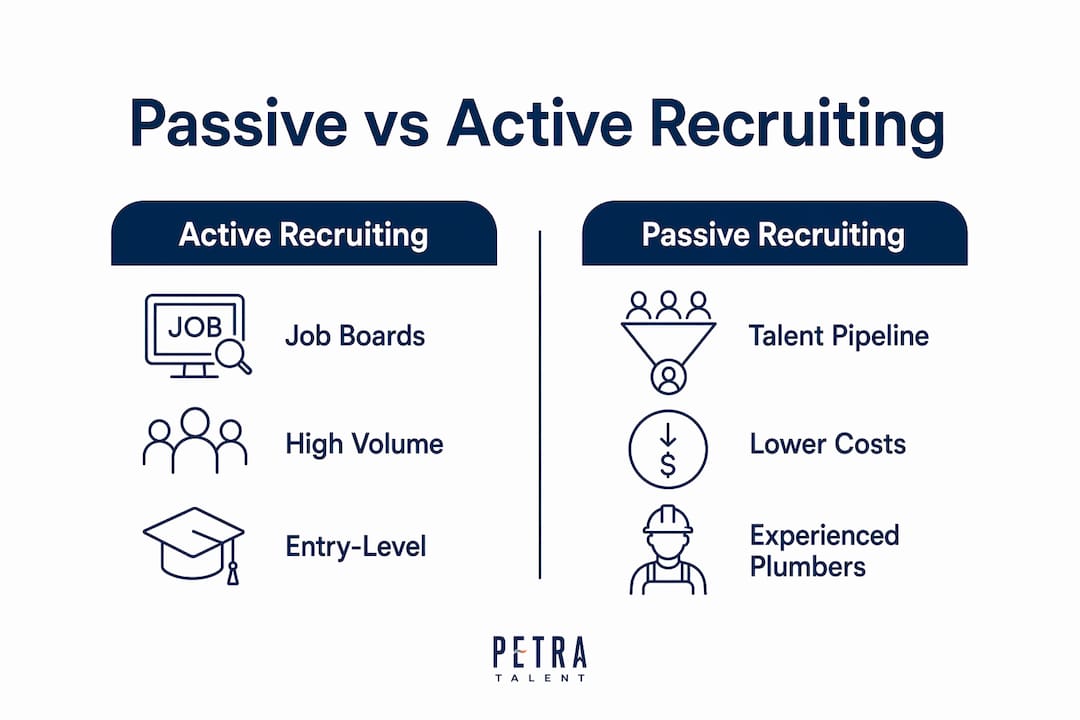
Active recruiting and passive recruiting serve different purposes. Understanding when to use each method helps contractors allocate their time and budget correctly.
| Factor | Active recruiting | Passive recruiting |
|---|---|---|
| Candidate pool | Job boards, applications | Employed professionals |
| Competition | High, multiple offers common | Low, fewer competing offers |
| Time to first contact | Fast | Requires relationship building |
| Candidate quality | Variable | Consistently higher |
| Retention rate | Lower on average | Higher due to intentional fit |
| Best use case | Urgent, entry-level fills | Skilled, hard-to-fill roles |
Active recruiting works for filling entry-level helper positions quickly. Passive recruiting is the right method for licensed journeymen, master plumbers, project managers, and plumbing leadership roles where quality and tenure matter most.
Passive recruitment also supports succession planning. Building a talent pipeline of passive candidates means contractors can fill hard-to-hire roles faster when vacancies arise, rather than scrambling after the fact.
Pro Tip: Run both methods in parallel. Use active recruiting for immediate volume needs and passive recruiting to build the bench of skilled tradespeople your company will need six to twelve months from now.
Practical strategies for implementing passive recruiting in plumbing
Passive recruiting does not happen by accident. It requires a deliberate process and consistent effort. The following approaches give plumbing contractors a clear path to building a passive talent pipeline.
- Partner with a specialized plumbing recruiter. External recruiters who focus on the trades use niche industry networks that are not accessible through public job boards. They produce vetted shortlists faster and with better candidate fit than generalist staffing firms.
- Use AI and automation tools for sourcing. Recruitment automation enables continuous passive candidate identification without requiring proportional increases in recruiting staff. Platforms that scan professional profiles and trade association databases keep the pipeline active between open roles.
- Build relationships before you need them. Contractors who stay in contact with strong candidates over time fill roles faster when vacancies open. A brief check-in every few months keeps the relationship warm without pressure.
- Screen for cultural and technical fit early. Passive candidates expect a relevant, respectful conversation. Meaningful outreach that speaks directly to a candidate’s experience and career goals increases the likelihood they will consider a new opportunity.
- Maintain a long-term talent pipeline. Proactive pipeline building decreases time-to-hire for hard-to-fill plumbing roles. Contractors who track passive candidates in a structured system are never starting from zero when a position opens.
Plumbing contractors who treat recruiting as an ongoing activity rather than a reactive task consistently outperform competitors in both hire quality and workforce stability. The workforce vetting process becomes faster and more reliable when a pipeline already exists.
Key Takeaways
Passive recruiting gives plumbing contractors access to higher-quality candidates, lower hiring costs, and stronger long-term retention than active job board recruiting alone.
| Point | Details |
|---|---|
| Better candidate quality | Passive candidates are currently employed top performers with proven, relevant field experience. |
| Less hiring competition | Passive candidates are not fielding multiple offers, which raises acceptance rates and reduces bidding wars. |
| Lower turnover costs | Intentional career moves produce longer tenure, cutting repeat recruiting and onboarding expenses. |
| Pipeline reduces time-to-hire | Maintaining passive candidate relationships means vacancies fill faster when they arise. |
| Specialized recruiters accelerate results | Niche plumbing recruiters access networks and vetted talent that job boards cannot reach. |
The case for making passive recruiting a permanent part of your hiring strategy
Contractors who rely exclusively on active recruiting are always reacting. A licensed plumber gives notice, and suddenly the team is scrambling to post a job, screen applicants, and hope someone qualified applies within the week. That cycle is expensive and predictable, and it keeps happening because the underlying approach never changes.
What I have seen consistently is that the contractors who build the strongest crews are not the ones who post the best job ads. They are the ones who already know three or four qualified plumbers they could call tomorrow. That list does not appear overnight. It comes from months of deliberate outreach, relationship maintenance, and working with recruiters who specialize in the trades.
The other reality is that the best plumbers are rarely looking. If a contractor waits for a skilled journeyman to show up on a job board, they are usually getting someone who left their last role under difficult circumstances. The candidates worth hiring are the ones who need to be found, not the ones who found you first.
Passive recruiting in plumbing is not a luxury for large contractors. It is the method that gives any firm, regardless of size, a real advantage in a market where skilled labor is genuinely scarce.
— David
Petratalent’s approach to plumbing passive recruiting
Plumbing contractors who want to build a passive talent pipeline without adding internal recruiting staff have a direct path forward with Petratalent.

Petratalent specializes in sourcing and vetting skilled plumbing professionals across service, construction, and leadership roles throughout the United States. The team uses industry-specific networks and technical screening to identify passive candidates who match both the role requirements and the contractor’s work culture. Contractors gain access to pre-vetted shortlists, market wage insights, and a structured hiring process that reduces time-to-fill for hard-to-hire positions. Explore Petratalent’s plumbing recruiting services to see how a specialized recruiting partner changes the quality and speed of your next hire.
FAQ
What is passive recruiting in the plumbing industry?
Passive recruiting is the practice of identifying and engaging skilled plumbers who are currently employed and not actively job searching. It gives contractors access to candidates who never appear on public job boards.
Why do passive candidates make better hires for plumbing roles?
Passive candidates are top performers with current, relevant experience who change jobs for deliberate career reasons. That intentionality produces stronger cultural fit and longer tenure compared to active applicants.
How does passive recruiting lower hiring costs for contractors?
Passive candidates are not fielding competing offers, which reduces bidding wars and raises acceptance rates. Longer tenure from better-fit hires also cuts the cost of repeat recruiting cycles for the same position.
When should plumbing contractors use passive recruiting vs. active recruiting?
Active recruiting works for urgent, entry-level fills. Passive recruiting is the right method for licensed journeymen, master plumbers, and leadership roles where skill level and retention are the priority.
How does a specialized recruiter help with passive candidate sourcing?
Specialized plumbing recruiters use niche trade networks that are not accessible through job boards, producing vetted shortlists with stronger candidate fit and faster time-to-hire than generalist staffing approaches.
Recommended
Related Posts

October 13, 2026
Recruiting Contract Terms: 10 Checks and Ready to Use Clauses
Define fee triggers, candidate ownership, guarantees, and compliance terms. Get a master agreement, short schedule,…

October 12, 2026
Offer Acceptance Rates: Segment Benchmarks, HVAC’s 3–5 Day SLA
See why a 78% to 82% offer acceptance benchmark can mislead, how role and source…

October 11, 2026
Bad Hires Can Cost Construction Firms 30% to 200% of Salary
Bad hires can cost construction firms 30% to 200% of annual salary. Calculate recruiting, rework,…

October 10, 2026
Construction Labor Forecasting for PMs: 7 Steps to Time Hiring
Learn when construction project managers should use WBS or simulation, track labor KPIs, and turn…