



TL;DR:
- Mechanical contractor staffing involves sourcing and verifying skilled tradespeople to match project needs. Using appropriate hiring models and maintaining structured communication with staffing agencies enhances project success and workforce stability.
Mechanical contractor staffing is the process of sourcing, verifying, and placing skilled tradespeople — HVAC technicians, plumbers, pipefitters, and project managers — using hiring models matched to project scope and organizational goals. Contractors who treat staffing as a structured discipline, rather than a reactive scramble, consistently outperform those who hire on instinct alone. Understanding how mechanical contractor staffing works means knowing which hiring model fits each role, how candidate verification protects project quality, and how communication with staffing partners determines whether a placement succeeds or fails.
How does mechanical contractor staffing work?
Mechanical contractor staffing is the industry term for workforce sourcing in HVAC and plumbing construction. It covers everything from defining a role’s technical requirements to placing a vetted candidate on a job site. The process involves three core decisions: which hiring model to use, how to verify candidate qualifications, and how to coordinate with a staffing partner throughout the project lifecycle.

Staffing agencies like KORE1 specialize in mechanical construction and can distinguish genuine project leadership from inflated resume claims. That distinction matters because a misplaced hire on a commercial HVAC project can delay schedules and trigger cost overruns that far exceed the cost of a thorough upfront search. Petratalent operates in this same space, focusing specifically on HVAC and plumbing roles across the United States.
What are the main hiring models in mechanical contractor staffing?
Aligning hiring types with long-term organizational stability versus project-specific needs is the foundation of sound workforce planning. Four models define the field.
| Hiring model | Best for | Cost profile | Typical roles |
|---|---|---|---|
| Direct hire | Core, long-term staff | Higher upfront, lower turnover cost | Lead technicians, project managers, superintendents |
| Contract staffing | Defined project duration | Predictable per-hour billing | Specialty pipefitters, commissioning techs |
| Contract-to-hire | Evaluating fit before committing | Moderate, converts to salary | Field supervisors, estimators |
| Temporary labor | Peak demand or short gaps | Lowest commitment, highest flexibility | General labor, helpers, seasonal HVAC support |
Direct hire builds the permanent core of a mechanical contractor’s workforce. It costs more to recruit but reduces the turnover expense that erodes margins over time. Contract staffing fills specialized or time-limited roles without adding permanent overhead. Understanding direct hire versus temp staffing helps contractors avoid overpaying for flexibility they do not need, or understaffing roles that require continuity.
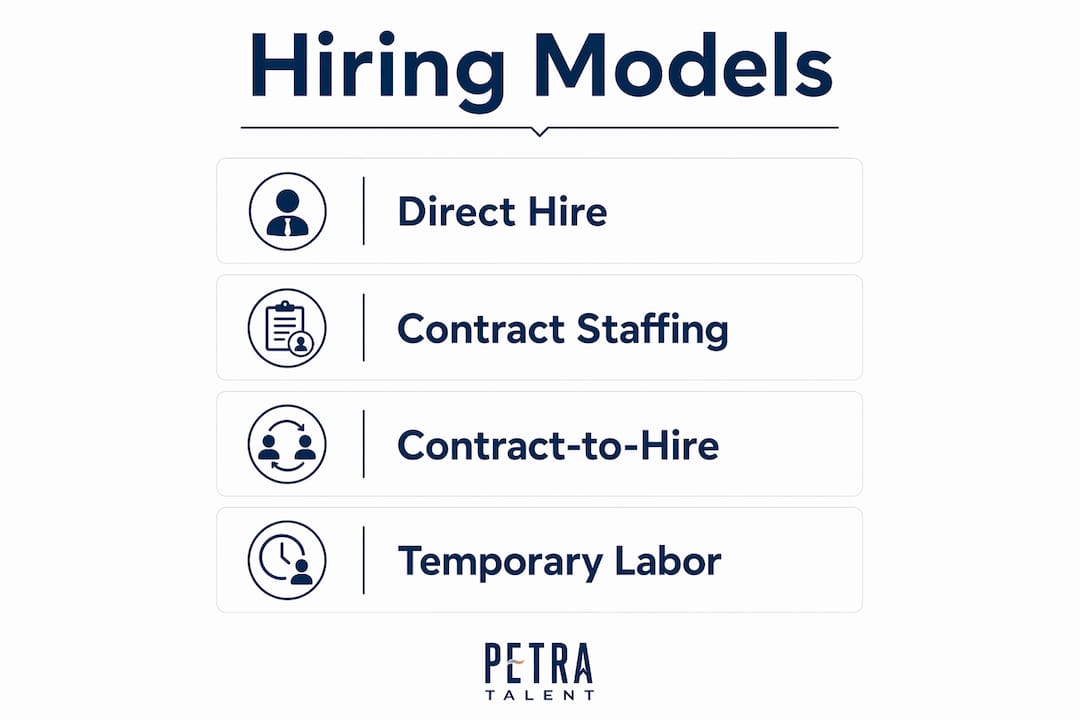
Skilled trades core to mechanical contracting should be long-term hires, while subcontractors and temporary labor fill specialized or short-term peak roles. That balance keeps overhead manageable as project pipelines grow.
Pro Tip: When a project runs longer than 90 days, convert contract placements to direct hire evaluations early. Waiting until the final weeks creates pressure that leads to poor decisions.
How does the intake and verification process work?
The intake profile phase is the most underused tool in the mechanical contractor hiring process. Contractors who invest time in detailed role definition experience far fewer candidate mismatches and onboarding problems. Early, detailed intake profiles covering site conditions, project timelines, needed tools, and regulatory environment reduce misaligned candidate submittals by 30–50%.
A thorough intake call with a staffing partner should cover:
- Site conditions — confined spaces, height requirements, union jurisdiction, and access restrictions
- Project timeline — start date, phase durations, and anticipated crew size at each phase
- Required certifications — OSHA 10 or OSHA 30, welding certifications, confined space entry, EPA 608 for refrigerants
- Tool proficiency — specific equipment the candidate must operate on day one
- Documented project history — types of systems installed, project size in square footage or tonnage, and completion record
Certifications like OSHA 10/30 primarily filter candidates at the initial screening stage, but verified project experience and references are stronger predictors of long-term success and pay grade. A worker with four years of verifiable project experience and the right certifications is more valuable than one with eight years but no documented work history. That shift from counting years to confirming proof of work is the single biggest improvement most contractors can make to their hiring quality.
Pro Tip: Ask candidates to name the last three projects they completed, the system type, and the general contractor. Candidates with real experience answer immediately. Those padding their resumes hesitate.
What are common challenges in mechanical contractor staffing?
Poor communication between contractors and staffing agencies is the leading cause of misaligned placements. Lack of structured communication early in the staffing process leads to preventable field conflicts and costly project delays. Defining points of contact, update frequency, and scope-change processes during the selection phase mitigates these risks.
Common challenges contractors face in staffing for mechanical projects include:
- Generic candidate submissions — agencies without mechanical construction expertise submit resumes that pass keyword filters but lack field-specific depth
- Scope misunderstanding — staffing partners who do not understand the difference between a commercial HVAC retrofit and a new construction install will send the wrong candidates
- Late hiring decisions — hiring too late after project award forces contractors to pay premiums to fill urgent labor gaps
- Weak feedback loops — contractors who do not report back on candidate performance give agencies no data to improve future submittals
- Onboarding gaps — candidates arrive without site-specific safety orientation, creating compliance risk and first-week delays
Addressing these challenges requires treating the staffing agency as an extension of the project team, not a vendor at arm’s length. Contractors who share project updates, flag scope changes early, and provide placement feedback consistently receive better candidates on subsequent searches. Reading about common HVAC recruitment challenges can help HR teams and field managers align their expectations before a search begins.
How can contractors integrate staffing into workforce planning?
Staffing decisions made in isolation from project forecasting create the conditions for last-minute scrambles and inflated labor costs. Contractors who recruit aligned with forecasted workload avoid the premium pricing that comes with urgent placements. The planning process should connect bid pipeline data directly to staffing timelines.
Effective workforce planning for mechanical contractors includes:
- Pipeline forecasting — reviewing awarded and likely-to-award projects 60–90 days out and identifying the trade mix each project requires
- Permanent versus flexible labor balance — keeping core technicians on direct hire while using contract labor to absorb volume spikes without adding fixed overhead
- Pre-project onboarding — completing safety orientation, site-specific training, and compliance documentation before the first day on site
- Succession planning — identifying which field supervisors and project managers are ready to step into senior roles as the business grows
Industry-specific recruiting means the staffing partner understands not just the job title but the specific system types, project phases, and compliance requirements that define success in that role. A recruiter who has placed HVAC project managers on commercial ground-up projects asks different intake questions than one who has only worked in light industrial. That depth of knowledge shortens the search and improves placement quality. Contractors building out their workforce planning approach can also reference HVAC workforce planning guidance to structure their internal processes alongside external staffing partnerships.
Key Takeaways
Mechanical contractor staffing works best when contractors match hiring models to role type, verify candidate experience through documented project history, and maintain structured communication with their staffing partners throughout the project.
| Point | Details |
|---|---|
| Match model to role type | Use direct hire for core staff and contract or temp labor for project-specific or peak-demand needs. |
| Prioritize verified experience | Documented project history and references outperform years of experience as hiring criteria. |
| Invest in the intake call | Detailed intake profiles covering site conditions and certifications reduce candidate mismatches significantly. |
| Communicate throughout the project | Structured updates and feedback loops with staffing partners improve placement quality over time. |
| Plan staffing with the project pipeline | Recruiting 60–90 days ahead of project start avoids premium labor costs and last-minute gaps. |
What I’ve learned about staffing that most guides skip
The contractors I’ve seen struggle most with staffing share one habit: they treat every open role the same way. They post a job, wait for resumes, and pick the candidate with the longest list of certifications. That approach works fine for office roles. It fails in mechanical construction.
The field rewards proof over credentials. A journeyman plumber who has completed three commercial ground-up projects and can name the GC, the system size, and the commissioning timeline is worth far more than one who lists OSHA 30 and a decade of vague “commercial experience.” Contractors who shift their intake questions toward documented project delivery stop making expensive mismatches.
The second lesson is about relationships with staffing partners. The best placements I’ve seen come from contractors who treat their recruiting partner like a subcontractor they intend to use again. They share project updates. They call when scope changes. They give feedback after the first 30 days. That behavior produces better candidates on the next search because the recruiter now understands the contractor’s actual standards, not just their job description.
An adaptive, mixed-model approach is the right answer for most growing mechanical contractors. Direct hire your core team. Use contract staffing for specialized phases. Build the pipeline relationship with a partner who knows the difference between a chiller plant and a split system. The contractors who do this consistently are the ones who stop losing projects to labor shortages.
— David
Petratalent’s approach to mechanical contractor workforce needs
Mechanical contractors who need vetted HVAC technicians, licensed plumbers, project managers, or field superintendents work with Petratalent to fill those roles without the guesswork of general job boards.
Petratalent specializes in HVAC and plumbing recruiting across the United States, with a process built around technical vetting, verified project experience, and market wage data. Contractors who want to build a more stable workforce, reduce turnover, and avoid the cost of bad hires can also access plumbing recruiting services and workforce planning consultation through Petratalent’s team. The goal is a placement that holds, not one that looks good on paper for 60 days.
FAQ
What is mechanical contractor staffing?
Mechanical contractor staffing is the process of sourcing, vetting, and placing skilled tradespeople — including HVAC technicians, plumbers, and pipefitters — using hiring models matched to project scope and organizational needs.
What hiring models do mechanical contractors use?
The four main models are direct hire, contract staffing, contract-to-hire, and temporary labor. Each suits a different combination of role duration, skill level, and budget.
Why does verified project experience matter more than certifications?
Certifications like OSHA 10/30 pass initial screening filters, but documented project history and references are stronger predictors of on-site performance and long-term retention.
When should a mechanical contractor start the staffing process?
Contractors should begin recruiting 60–90 days before a project’s labor start date. Hiring after project award without lead time forces premium labor costs and limits candidate quality.
How does a specialized staffing agency improve hiring outcomes?
Agencies with mechanical construction expertise ask role-specific intake questions, verify project leadership claims, and submit candidates who match the actual site conditions, not just the job title.
Recommended
Related Posts
October 13, 2026
Recruiting Contract Terms: 10 Checks and Ready to Use Clauses
Define fee triggers, candidate ownership, guarantees, and compliance terms. Get a master agreement, short schedule,…
October 12, 2026
Offer Acceptance Rates: Segment Benchmarks, HVAC’s 3–5 Day SLA
See why a 78% to 82% offer acceptance benchmark can mislead, how role and source…
October 11, 2026
Bad Hires Can Cost Construction Firms 30% to 200% of Salary
Bad hires can cost construction firms 30% to 200% of annual salary. Calculate recruiting, rework,…
October 10, 2026
Construction Labor Forecasting for PMs: 7 Steps to Time Hiring
Learn when construction project managers should use WBS or simulation, track labor KPIs, and turn…