




TL;DR:
- Choosing between direct hire and temp staffing is crucial for mechanical contractors to manage costs and legal responsibilities effectively. Contractors should use direct hire for core roles requiring long-term commitment and temp staffing for seasonal or project-based needs, often benBlog Modern 01efiting from a hybrid approach. Understanding the differences in employment responsibility, costs, and recruitment timelines helps create a workforce strategy aligned with business needs and growth.
Choosing between direct hire and temp staffing is one of the most consequential decisions a mechanical contractor or trades business owner makes. Yet many companies treat these two models as interchangeable, applying them to the wrong situations and paying for it through turnover, compliance issues, or ballooning labor costs. Understanding how direct hire differs from temp staffing gives HR professionals and business owners a structural advantage in workforce planning. This article breaks down the key differences in employment relationships, cost structures, and strategic fit so you can build a workforce model that actually matches your business needs.
Table of Contents
- Key takeaways
- How direct hire differs from temp staffing at its core
- Cost comparison: placement fees vs. hourly markups
- When to use each model in skilled trades
- Process and timeline differences that affect outcomes
- My take on balancing both models
- How Petratalent can support your staffing strategy
- FAQ
Key takeaways
| Point | Details |
|---|---|
| Payroll and liability separation | Temp workers stay on agency payroll; direct hires become your legal employment responsibility from day one. |
| Cost structure differs significantly | Direct hire carries upfront placement fees of 15 to 30 percent of salary; temp markups run 25 to 60 percent hourly. |
| Role type drives the right choice | Use direct hire for core and leadership roles; use temp staffing for seasonal or project-specific positions. |
| Temp-to-hire reduces bad hire risk | Trial periods let you evaluate a worker’s fit before committing to permanent employment. |
| Hybrid models outperform single-track | Top-performing trades firms use both models strategically rather than defaulting to one approach. |
How direct hire differs from temp staffing at its core
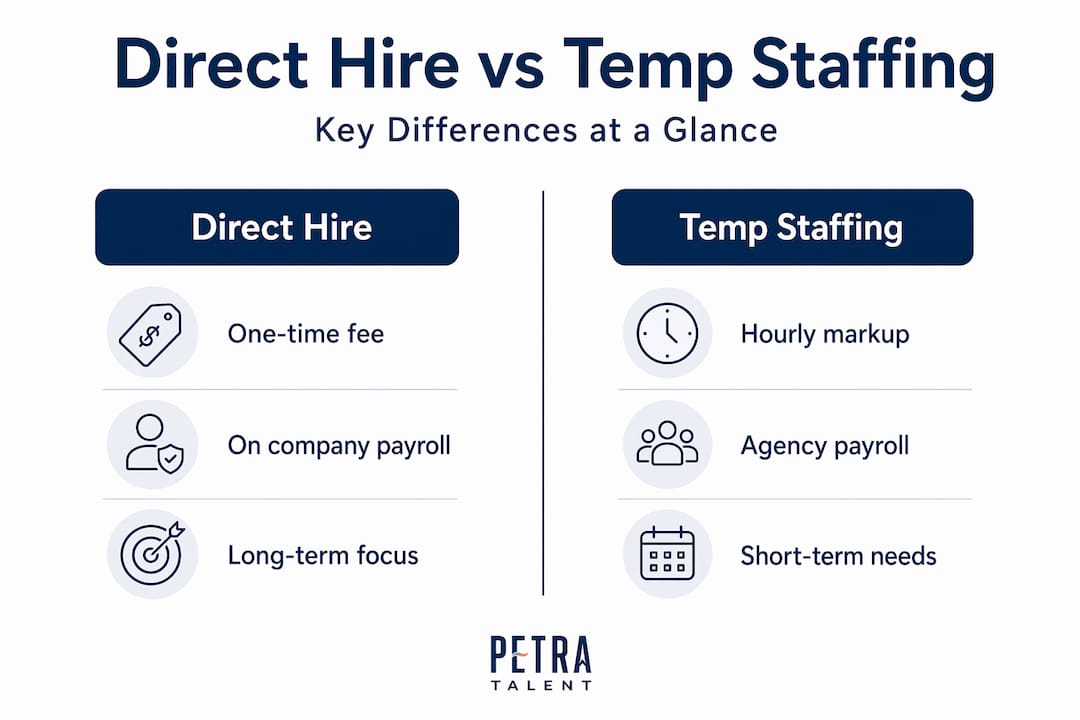
The most fundamental distinction between these two models comes down to who employs the worker legally. Temp workers stay on agency payroll, meaning the staffing agency handles their taxes, benefits, and compliance obligations. When you bring on a direct hire, that person joins your payroll from their first day, and every employment obligation transfers to your company.
This matters beyond paperwork. Here is what each model actually shifts in terms of responsibility:
- Direct hire: You manage payroll taxes, health benefits, workers’ compensation, unemployment insurance, and ACA compliance from the start.
- Temp staffing: The agency is employer of record, covering workers’ compensation claims, unemployment filings, and tax withholdings on your behalf.
- Administrative burden: Direct hire requires dedicated HR infrastructure; temp staffing offloads that complexity to the agency.
- Risk exposure: Many employers underestimate the legal obligations tied to direct employment, including ACA mandates and unemployment insurance, which temp arrangements eliminate.
For HVAC and plumbing contractors running lean HR teams, this distinction has real operational weight.
Pro Tip: If your company lacks a dedicated HR compliance function, temp staffing reduces legal exposure significantly during growth phases.
Cost comparison: placement fees vs. hourly markups
Cost is where many contractors get tripped up because neither model is simply “cheaper.” The real question is whether you are paying more upfront or more over time.
Direct hire placement fees typically range from 15 to 30 percent of the candidate’s first-year base salary. For a journeyman HVAC technician earning $65,000, that means a one-time recruitment fee of $9,750 to $19,500 paid to the staffing agency. After placement, your ongoing costs include full benefits, payroll taxes, and administrative overhead on top of the base salary.

Temp staffing works differently. Agencies charge hourly markups of 25 to 60 percent above the worker’s pay rate. At a $28 per hour base rate with a 40 percent markup, you are billing $39.20 per hour. That sounds expensive, but that rate bundles the worker’s benefits, employer taxes, and agency overhead into one line item.
Here is a side-by-side breakdown for a single skilled trades position over six months:
| Cost factor | Direct hire | Temp staffing |
|---|---|---|
| Placement fee | $9,750 to $19,500 (one-time) | None |
| Hourly labor rate | $28 to $35 base | $35 to $50 (with markup) |
| Benefits and taxes | Your responsibility | Agency covers |
| Compliance overhead | Internal HR cost | Included in markup |
| Total six-month cost estimate | $55,000 to $70,000+ | $36,000 to $52,000 |
The math shifts significantly when you factor in tenure. Over a full year, direct hire total costs including benefits and taxes may actually run comparable to or higher than keeping a contractor. However, direct hires build institutional knowledge that temps rarely match.
Pro Tip: When comparing costs, calculate total compensation including benefits, taxes, and administrative overhead. The base salary number alone misleads every time.
When to use each model in skilled trades
Neither direct hire nor temp staffing is universally superior. The decision should follow the role’s criticality, duration, and how deeply the position connects to your company’s culture and client relationships.
Direct hire works best when:
- The role is core to service delivery, such as lead HVAC technicians or licensed plumbers who serve long-term client accounts.
- You need someone to develop long-term institutional knowledge and contribute beyond task completion.
- Leadership positions, project managers, or superintendents who shape team behavior and client trust are involved.
- Your growth phase requires building a stable, trained workforce rather than cycling through workers.
Temp staffing excels when:
- Workload spikes seasonally, such as peak cooling season or winter heating demand, requiring additional technicians for a defined window.
- A construction project needs skilled labor for a set duration with no expectation of long-term employment.
- You want to evaluate a worker before committing to permanent employment through a temp-to-hire trial period.
The most effective approach is a hybrid strategy. Successful firms maintain a stable core of direct hires for mission-critical roles while using temp workers to absorb variable demand. This model builds workforce resilience without overcommitting payroll during slow periods. Petratalent’s hiring insights for trades contractors offer additional practical guidance on structuring these decisions.
Process and timeline differences that affect outcomes
The recruitment process itself looks very different depending on which model you choose. Understanding these differences helps set realistic expectations for your hiring timeline and onboarding investment.
- Direct hire screening takes longer by design. The agency or internal recruiter conducts in-depth technical vetting, reference checks, and cultural fit assessment. Direct hire roles take longer to fill because the screening prioritizes long-term match over speed. For a plumbing superintendent role, this process can take four to eight weeks from search to offer.
- Temp placements move fast. Agencies keep active rosters of prescreened workers and can often fill skilled trades positions within days. Speed is the main temp staffing advantage when demand spikes without warning.
- Onboarding depth differs substantially. Direct hires go through full onboarding including company culture, safety protocols, client relationship expectations, and benefits enrollment. This investment deepens team cohesion and long-term productivity. Temp workers typically receive site-specific orientation, not company-wide integration.
- Bad hire risk is real with direct placement. The cost of a bad hire can equal 30 to 150 percent of that employee’s annual salary when you account for lost productivity, severance, and the cost to restart recruitment. Temp-to-hire arrangements reduce this risk by giving both parties a working trial before committing.
My take on balancing both models
In my experience working with mechanical contractors across the country, the companies that struggle most with workforce stability are the ones that picked a lane and stayed in it regardless of the role or business condition. They go all temp because it feels lower risk, or they insist on direct hire for every position because they want loyalty. Neither extreme works well in skilled trades.
What I have seen actually work is treating the staffing decision like a diagnostic rather than a policy. Ask what the role requires, how long the need will last, and what the cost of getting it wrong looks like. For a commercial HVAC service manager, a bad temp hire disrupts client relationships and team morale. For a three-month retrofit project, locking someone into a direct hire creates payroll you cannot sustain.
The compliance piece is where I see the most avoidable damage. Many contractors assume they can move a temp worker to their payroll without going through proper channels, or they misclassify a long-term temp as an independent contractor. These shortcuts cost far more than a proper placement fee ever would.
My honest advice: use direct hire for roles where the cost of turnover exceeds the cost of a proper search. Use temp staffing where speed and flexibility outweigh depth of fit. And work with a recruiter who knows which is which before you start the search.
— David
How Petratalent can support your staffing strategy

Petratalent specializes in direct hire placements and workforce consulting for HVAC and plumbing contractors across the United States. When you need a licensed plumber, a commercial HVAC technician, or a project superintendent who will stay and perform, Petratalent’s recruiters conduct role-specific technical vetting, market wage analysis, and performance screening to find candidates built for the long term.
For contractors weighing which model fits their current growth phase, Petratalent also provides workforce consultation to help structure hybrid staffing approaches that reduce compliance risk and control costs. Explore the full range of recruitment and staffing services available for skilled trades businesses, or review Petratalent’s technical vetting process to understand how candidates are evaluated before they ever reach your desk.
For contractors who need health coverage options when onboarding direct hires, contractor health insurance options in your region are worth reviewing as part of your total compensation planning.
FAQ
What is the main difference between direct hire and temp staffing?
Direct hire places the worker on your company payroll with full employment obligations from day one, while temp staffing keeps the worker on the agency’s payroll. The agency handles taxes, benefits, and compliance in a temp arrangement.
When does temp staffing make more financial sense?
Temp staffing makes more financial sense for short-term, seasonal, or project-based roles where the duration does not justify the upfront costs and ongoing obligations of direct employment.
How much does a direct hire placement typically cost?
Direct hire placement fees range from 15 to 30 percent of the candidate’s first-year base salary, paid once to the recruiting agency at the time of hire.
What is a temp-to-hire arrangement?
Temp-to-hire starts the worker on the agency’s payroll for a trial period, then converts them to your direct employee if both sides agree. It reduces the risk of a bad hire by allowing performance evaluation before committing to permanent employment.
Can a skilled trades company use both models at the same time?
Yes. Many successful mechanical contractors use direct hire for core and leadership roles while relying on temp staffing to manage seasonal demand or project-specific labor needs, creating a more resilient overall workforce.
Recommended
- PetraTalent – Building the Future of HVAC Talent.
- Blog – PetraTalent
- Blog Modern 01 – PetraTalent
- Our Services – PetraTalent
Related Posts

October 13, 2026
Recruiting Contract Terms: 10 Checks and Ready to Use Clauses
Define fee triggers, candidate ownership, guarantees, and compliance terms. Get a master agreement, short schedule,…

October 12, 2026
Offer Acceptance Rates: Segment Benchmarks, HVAC’s 3–5 Day SLA
See why a 78% to 82% offer acceptance benchmark can mislead, how role and source…
October 11, 2026
Bad Hires Can Cost Construction Firms 30% to 200% of Salary
Bad hires can cost construction firms 30% to 200% of annual salary. Calculate recruiting, rework,…

October 10, 2026
Construction Labor Forecasting for PMs: 7 Steps to Time Hiring
Learn when construction project managers should use WBS or simulation, track labor KPIs, and turn…