



Plumbing project delays cost money because they generate paid crew inactivity, extend site overhead, trigger material escalation, and expose contractors to liquidated damages across every dependent trade. A single rough-in delay does not stay contained to the plumbing line item. Because plumbing sits on the critical path for most new construction and core-and-shell projects, a stall in pipe installation stops framers, drywall crews, and finish trades in sequence, multiplying the financial impact well beyond what the original schedule slip suggests. Plumbing & Mechanical reports that manual procurement workflows and fragmented supplier communication are among the most common root causes of these delays, creating non-billable time that rarely appears on a project’s risk register until it is too late. AGC workforce analyses.pdf) confirm that persistent skills gaps and labor shortages compound the problem by raising the probability of schedule slip on critical trades. The financial damage is not theoretical: a SupplyHouse survey of 1,001 U.S. homeowners found that waiting six months or longer to address a plumbing issue more than doubled average repair costs, from $380 to $868. At commercial scale, those dynamics are far more severe.
Key Takeaways
Plumbing project delays cost money because paid crew inactivity, extended site overhead, material escalation, and liquidated damages compound across every dependent trade on the critical path.
| Point | Details |
|---|---|
| Delays compound across trades | A plumbing rough-in slip stops framing, drywall, and finishes in sequence, multiplying total cost beyond the plumbing line item. |
| Cost doubles with time | The SupplyHouse survey found repair costs rise from $380 to $868 when action is delayed six months or longer. |
| Documentation wins disputes | Timestamped notices, RFI logs, delivery records, and daily crew reports are the foundation of any successful delay claim or backcharge defense. |
| Procurement is the leading cause | Manual, fragmented purchasing creates paid inactivity more often than any other single factor; digitizing this workflow is the highest-ROI fix. |
| Petratalent reduces staffing delay risk | Candidate pipelines and technical vetting through Petratalent cut time-to-fill and prevent rework from under-qualified hires. |
Table of Contents
- Why plumbing project delays cost money: the full breakdown by cost category
- What actually causes plumbing project delays?
- How plumbing delays amplify costs through ripple effects
- Contractual levers: who pays and how damages are assessed
- How to limit the financial damage of plumbing delays
- Which tools help you reduce plumbing delay costs?
- Quick estimator: how to calculate the cost of a plumbing delay
- Case study and key statistics that show the real scale
- What contractors should actually prioritize
- Staffing gaps are a delay risk you can control
- Sources
Why plumbing project delays cost money: the full breakdown by cost category
Every delay generates costs that fall into predictable categories. Knowing which ledger line each cost hits helps project managers isolate exposure and negotiate recovery.
Direct labor costs are the most visible. When a crew shows up and cannot work because materials have not arrived or an inspection has not cleared, you are paying full labor burden rates for zero productive output.
Extended site overhead accumulates daily. Superintendent time, trailer rental, temporary utilities, security, and general conditions all continue regardless of whether plumbing work is progressing.
Equipment rental differentials add up fast. A pipe threading machine or hydrostatic test pump rented for a four-week rough-in phase costs significantly more when that phase stretches to six weeks.
Material escalation and restocking fees hit when delayed orders must be re-sourced at current market prices, which may be higher than the original purchase order. Specialty fixtures with long import timelines are especially vulnerable.
Rework and corrective work often follow delays because design changes accumulate while work is paused. When crews return, they may need to undo and redo completed sections to accommodate updated drawings.
Liquidated damages (LDs) and backcharges represent the contractual cost of missing milestones. These can dwarf direct costs on commercial projects where the owner has pre-negotiated daily LD rates.
Financing and carrying costs grow when a project’s completion date slips. Owners pay interest on construction loans longer; contractors carry unbilled work-in-progress on their balance sheets.
| Cost Category | Typical Accounting Line | Who Usually Bears It |
|---|---|---|
| Paid crew inactivity | Direct labor / field overhead | Subcontractor |
| Extended site overhead | General conditions | GC or subcontractor |
| Equipment rental differential | Equipment / plant | Subcontractor |
| Material escalation | Materials / procurement | Subcontractor or owner (via CO) |
| Rework / corrective work | Direct labor + materials | Subcontractor (unless owner-caused) |
| Liquidated damages | Contract penalties | GC or subcontractor |
| Financing / carrying costs | Project overhead | Owner or GC |
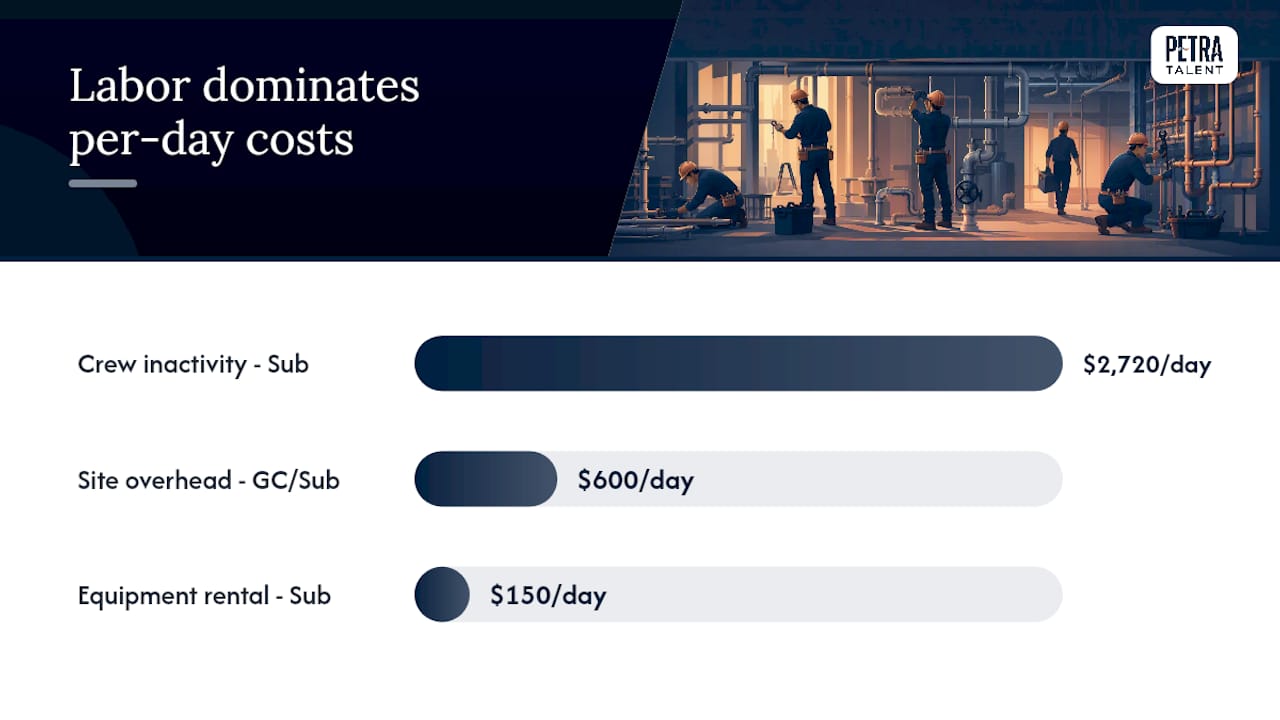
A simple cost-per-day calculation: A four-person plumbing crew with a fully loaded labor burden rate of $85 per person-hour costs $2,720 per idle day (4 × $85 × 8 hours). Add $600 in daily site overhead and $150 in equipment rental, and one day of delay costs approximately $3,470 before any material escalation, rework, or LD exposure is counted.
Escalation drivers that push variable costs higher include:
- After-hours emergency labor rates, which commonly run 1.5–3× standard rates
- Specialty parts sourced from secondary suppliers at premium pricing
- City inspection re-tests that require re-mobilization and re-scheduling
- Expedited freight charges on long-lead fixtures
What actually causes plumbing project delays?
Most plumbing schedule failures trace back to a short list of recurring failure modes. Knowing which to check first saves time when a delay first appears.
Material procurement errors are the leading cause. Manual purchasing, fragmented supplier communication, and missing lead-time tracking on specialty fixtures create late deliveries that stop crews cold. Long-lead items such as commercial water heaters, custom valve assemblies, and imported fixtures can carry 12–20 week lead times that are routinely underestimated at bid stage.
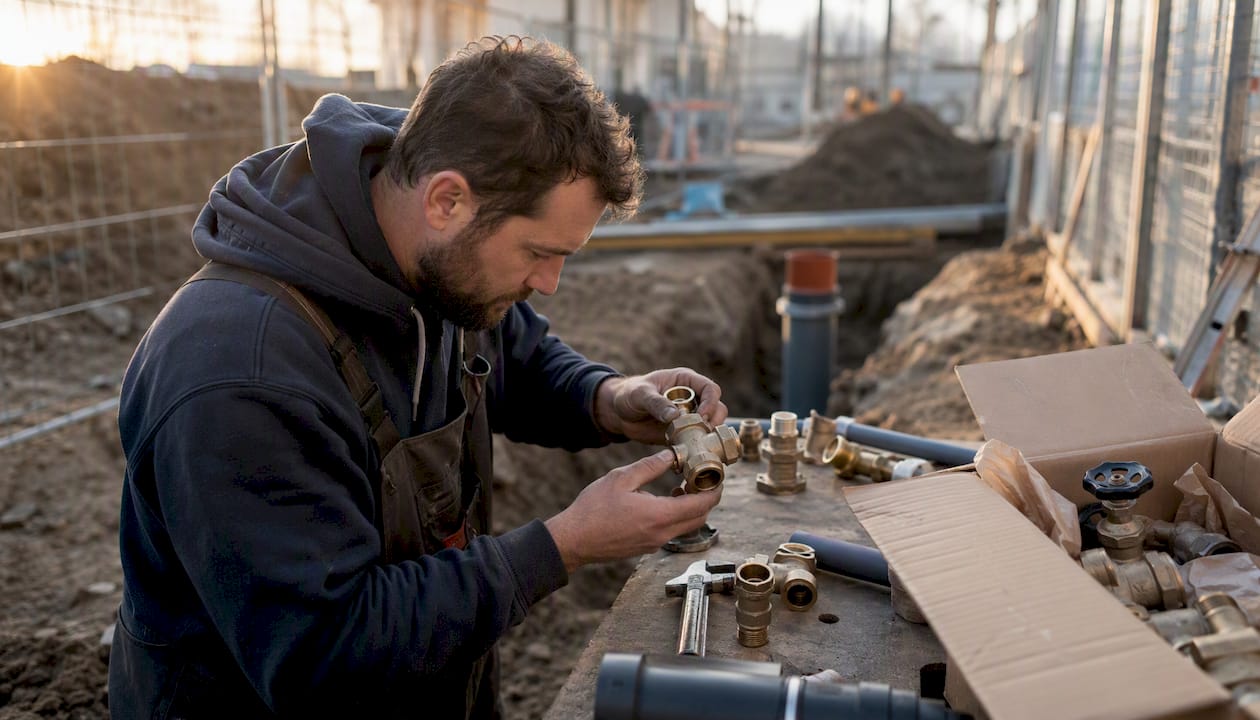
Late design changes and RFIs are the second most common driver. When architectural or mechanical drawings change after rough-in has started, plumbing crews must pause, re-coordinate, and often re-install sections of completed work.
Permit and inspection timing is a structural delay that contractors often underestimate. Jurisdictions with high permit volumes can add weeks to a schedule, and a failed inspection requires re-scheduling that may not happen for several days.
Crew shortages and low-skilled hires create both speed and quality problems. An under-qualified crew works slower, makes more errors, and generates rework that compounds the original delay. AGC workforce data shows that skills gaps in the trades remain a persistent source of schedule risk.
Prefabrication delays occur when shop drawings are not finalized early enough to allow off-site assembly. Prefab is one of the most effective schedule accelerators available, but it requires early design lock and accurate takeoffs to deliver on time.
Site access and coordination failures happen when other trades occupy the work area, mechanical rooms are not ready, or sequencing agreements break down between subcontractors.
Weather-related shutdowns affect outdoor plumbing runs, underground utility work, and any open-trench activity. Frozen ground, heavy rain, and extreme heat all create legitimate schedule relief events, but they still cost money in standby time and re-mobilization.
Ranked by impact vs. ease of fix:
- Highest impact, hardest to fix: Material lead-time failures on specialty fixtures; crew shortages in tight labor markets
- Highest impact, easier to fix: Procurement workflow digitization; early permit applications
- Moderate impact, easiest to fix: RFI response time tracking; site access coordination agreements
Pro Tip: When a delay first appears, check material delivery status and permit queue position before assuming a labor problem. In most cases, the schedule slip started upstream in procurement, not on the job site.
How plumbing delays amplify costs through ripple effects
Plumbing’s position on the critical path is what makes a delay in this trade disproportionately expensive. In new construction, rough-in plumbing must be complete before framing inspection, insulation, and drywall can proceed. A one-day slip in rough-in completion can translate into two to four days of downstream idle time across multiple trades, because re-sequencing a multi-trade schedule is rarely a one-for-one adjustment.
ASCE research on construction project performance identifies scheduling risk and coordination failures as primary contributors to cost growth and time overruns. The mechanism is straightforward: when one trade stalls, the GC must re-sequence dependent trades, which creates gaps in their schedules, reduces their productivity, and often triggers claims for lost efficiency.
The compounding effect is where most contractors underestimate their exposure. A two-week plumbing rough-in delay on a 20-unit residential project does not cost two weeks of plumbing labor. It costs two weeks of plumbing labor plus the idle time of framing, insulation, and drywall crews who cannot proceed, plus the GC’s extended general conditions, plus any LD exposure from a missed substantial completion date.
Specific ripple effects include:
- Framing and drywall crews re-sequenced to other projects, creating re-mobilization costs when plumbing clears
- Mechanical and electrical coordination meetings that must be repeated after design changes
- Inspection milestones missed, pushing certificate of occupancy and final payment
- Owner change orders and delay claims that consume project management time
- Subcontractor productivity losses from interrupted workflow, which reduce output per labor hour
Contractual levers: who pays and how damages are assessed
Understanding the contract mechanisms that govern delay costs is as important as understanding the costs themselves.
Change orders are the primary vehicle for recovering owner-caused delay costs. A valid change order requires documented proof that the delay was outside the contractor’s control, that proper notice was given, and that the cost impact is quantifiable.
Notice requirements are often the reason contractors lose delay claims they should win. Most contracts require written notice of a delay within a defined window, often 7–14 days of the triggering event. Missing that window can waive the right to recovery entirely.
Liquidated damages are pre-agreed daily penalties for missing the substantial completion date. LD rates on commercial projects commonly range from a few hundred to several thousand dollars per day, depending on project size and owner type.
Excusable delay relief covers events outside the contractor’s control, such as owner-caused changes, permit delays attributable to the jurisdiction, and qualifying weather events. Documenting these events contemporaneously is critical.
Backcharges are costs the GC deducts from a subcontractor’s payment for work the GC had to perform because the sub failed to. They are distinct from LDs, which flow from the owner to the GC.
Checklist for documenting a delay claim:
- Timestamp the triggering event with a dated written notice to the GC or owner
- Photograph site conditions showing the delay’s physical impact
- Preserve RFI logs with submission and response dates
- Retain purchase orders, supplier confirmations, and delivery receipts
- Log inspector visit dates, failed inspection reports, and re-test scheduling
- Record daily crew headcount and hours for every idle day
- Compile a cost summary that maps each delay day to a specific cost category
Pro Tip: Negotiate LD caps and carve-outs for long-lead supply disruptions before signing. A structured acceleration clause, which allows the owner to pay for overtime to recover schedule rather than assess LDs, often costs less than the LD exposure and preserves the relationship.
The practical difference between backcharges and LDs matters in disputes. Backcharges require the GC to prove the sub’s failure caused a specific, quantifiable cost. LDs are assessed automatically once a milestone date is missed, regardless of cause, unless the sub can prove an excusable delay. Contractors who document excusable events in real time win these disputes far more often than those who reconstruct the record after the fact.
How to limit the financial damage of plumbing delays
Prevention is cheaper than recovery. The following practices, organized by phase, give contractors the highest return on effort.
Early-phase actions:
- Engage the plumbing subcontractor during design development, not at bid. Early plumbing involvement catches coordination clashes before they become field corrections.
- Complete a full material takeoff and identify long-lead items within 30 days of contract award.
- Submit permit applications as early as the jurisdiction allows.
- Lock prefabrication shop drawings before mobilization so off-site assembly can run parallel to site prep.
Operational practices:
- Stage material deliveries to match installation sequence rather than ordering everything at once
- Conduct weekly look-ahead meetings that include material delivery status and inspection scheduling
- Use pull planning to identify and resolve trade conflicts before they cause idle time
- Maintain a contingency reserve in the project budget specifically for delay-related costs
Staffing practices:
- Maintain a candidate pipeline for critical plumbing roles so vacancies are filled in days, not weeks
- Cross-train crew members on adjacent tasks to reduce single-point-of-failure risk
- Use technical vetting to confirm skill levels before mobilization, reducing rework from under-qualified hires
- Consider short-term supplemental hires to cover peak installation periods rather than carrying full crew through slow phases
Financial controls:
- Negotiate lead-time contracts with primary suppliers that include delivery guarantees and restocking-hold agreements
- Build material escalation allowances into bids for projects with long schedules
- Review insurance and warranty terms to identify risk-transfer opportunities for weather and supply disruptions
When a delay is first detected:
- Issue written notice to the GC or owner within the contract’s notice window
- Document site conditions with dated photographs
- Notify the material supplier and request a revised delivery date in writing
- Assess downstream trade impact and notify affected subcontractors
- Update the project schedule and circulate a revised look-ahead
Pro Tip: For multi-site programs using the same fixture specifications, carry a modest buffer inventory of specialty fittings at a central warehouse. The carrying cost of that buffer is almost always less than one day of paid inactivity for a full crew waiting on a single missing component.
Which tools help you reduce plumbing delay costs?
Technology does not replace process discipline, but the right tools reduce the information gaps that let delays grow undetected.
Digital procurement and inventory platforms address the root cause that Plumbing & Mechanical identifies as the most common delay driver: fragmented, manual purchasing. SupplyHouse provides an online parts supply platform with real-time inventory visibility, reducing the risk of ordering wrong-spec components or discovering stockouts after mobilization.
Scheduling and 4D tools give project managers visibility into trade sequencing and critical-path dependencies. Outbuild is a construction scheduling platform built for subcontractors that supports look-ahead scheduling and pull planning, helping plumbing crews coordinate with dependent trades before conflicts become delays.
Prefabrication management software supports early design coordination and accurate takeoffs that make off-site assembly viable. Foresight is a prefabrication and project management platform designed for mechanical contractors, helping teams track fabrication progress against installation schedules.
Field capture and photo documentation tools create a contemporaneous record of site conditions, delay events, and work progress. OpenSpace uses 360-degree camera technology to document jobsite conditions automatically, providing timestamped visual evidence that supports delay claims and inspection records.
Buyer checklist for evaluating delay-reduction tools:
- Real-time inventory visibility and supplier connectivity
- Mobile field capture with automatic timestamping
- Integration with project scheduling and accounting systems
- Prefabrication tracking and shop drawing management
- RFI and submittal log management with response-time tracking
The contractors who recover delay costs most consistently are not the ones with the best lawyers. They are the ones with the best documentation. A field photo log, a timestamped RFI record, and a daily crew report are worth more in a dispute than any contract clause.
Pro Tip: Evaluate tools on integration depth, not feature lists. A procurement platform that does not connect to your accounting system creates a data entry burden that reduces adoption. Start with the tool that closes your biggest visibility gap, then add layers.
Quick estimator: how to calculate the cost of a plumbing delay
Formula:
Delay cost = (Crew labor burden rate × crew size × days idle) + (daily site overhead × days) + (equipment rental differential × days) + (material escalation % × cost of delayed material) + estimated LDs or rework allowance
| Input | Residential Example | Commercial Example |
|---|---|---|
| Crew size | 2 plumbers | 6 plumbers |
| Labor burden rate (per person-hour) | $75 | $90 |
| Hours per day | 8 | 8 |
| Days delayed | 2 | 5 |
| Daily site overhead | $200 | $800 |
| Equipment rental differential (per day) | $80 | $200 |
| Delayed material value | $4,000 | $40,000 |
| Material escalation rate | 5% | 8% |
| LD or rework allowance | $0 | $2,500/day |
Example 1: Residential service call turned emergency (2-day delay)
- Labor: 2 × $75 × 8 × 2 days = $2,400
- Site overhead: $200 × 2 = $400
- Equipment: $80 × 2 = $160
- Material escalation: 5% × $4,000 = $200
- Rework allowance: $0 (no downstream trades affected)
Total estimated delay cost: $3,160
For context, a delayed residential repair that starts as a $380 fix can exceed $868 once six months pass, per the SupplyHouse homeowner survey. At the contractor level, even a two-day residential delay generates costs that dwarf the original repair fee.
Example 2: Commercial rough-in delay impacting downstream trades (5-day delay)
- Labor: 6 × $90 × 8 × 5 days = $21,600
- Site overhead: $800 × 5 = $4,000
- Equipment: $200 × 5 = $1,000
- Material escalation: 8% × $40,000 = $3,200
- LD exposure: $2,500 × 5 = $12,500
Total estimated delay cost: $42,300
This figure does not include downstream trade idle time, which on a six-trade project could add another $15,000–$30,000 in re-sequencing and productivity loss costs.
Important limitation: This estimator produces a directional figure for bid reviews and internal planning. Formal delay claims and cost recovery require contemporaneous documentation, including daily reports, delivery records, and inspector logs, not a formula alone.
Case study and key statistics that show the real scale
Consider a mid-size commercial office fit-out where a plumbing rough-in delay of ten working days cascaded through the schedule. The delay originated from a specialty fixture order placed without confirming lead time. When the fixtures arrived two weeks late, the framing crew had already been re-sequenced to another project. Re-mobilizing them cost the GC four additional days. Drywall followed another week behind schedule. By the time the project reached substantial completion, the original ten-day plumbing slip had produced 23 days of total schedule overrun, triggering LD exposure and a subcontractor backcharge dispute.
The SupplyHouse homeowner survey data illustrates that homeowners who acted quickly paid much less for plumbing repairs than those who waited many months, with costs more than doubling over time. USA Today’s coverage of the same survey noted that homeowners wait roughly one month on average before scheduling minor plumbing issues, a behavioral pattern that mirrors the procurement delays contractors face when they defer long-lead ordering.
The SupplyHouse survey found that most homeowners delay plumbing or HVAC repairs at least sometimes, and many of those who delayed a month or more used credit or loans to cover the resulting costs. At the project scale, the same delay-and-escalate pattern plays out through change orders, LD assessments, and financing charges.
Key statistics from the survey and related research:
- Average repair cost within one week is significantly lower than after prolonged delay
- A large majority of homeowners delay repairs at least sometimes
- Nearly half of those who delayed a month or more used credit or loans to pay
The pattern is consistent across scales: delay compounds cost, and the longer the delay, the less predictable the final bill.
What contractors should actually prioritize
The conventional advice on delay prevention tends to focus on tools and technology. That is not wrong, but it misses the sequence. Process discipline and staffing stability create the conditions under which tools deliver value. A scheduling platform used by an under-resourced crew with no procurement discipline will not prevent delays.
The three investments that produce the best cost reduction per dollar, in order:
-
Early-phase plumbing engagement and prefabrication. Getting the plumbing subcontractor into the design process before drawings are finalized eliminates the most expensive category of delay: in-field rework from coordination clashes. Constructability reviews and early material takeoffs consistently reduce change orders and field corrections at a fraction of the cost of fixing them after mobilization.
-
Procurement discipline and digital inventory visibility. Manual purchasing is the most common root cause of paid inactivity. Digitizing the procurement workflow, connecting to real-time supplier inventory, and tracking lead times on specialty fixtures eliminates the category of delay that Plumbing & Mechanical identifies as most prevalent.
-
Staffing stability through candidate pipelines and technical vetting. A crew vacancy or an under-qualified hire creates schedule risk that no tool can compensate for. Maintaining a candidate pipeline for plumbing roles reduces time-to-fill and ensures that replacement hires meet the technical standard the project requires.
The caution worth stating plainly: over-investing in software without addressing the process and staffing gaps underneath it produces expensive dashboards that show delays happening in real time without preventing them. Technology is a multiplier. It amplifies what is already working.
Staffing gaps are a delay risk you can control
Skill gaps and slow hiring are among the most direct causes of paid inactivity and rework on plumbing projects. When a crew position sits vacant for two weeks, the project does not pause. It falls behind, and the cost accumulates daily. When a hire is made too quickly without proper vetting, the rework that follows is often more expensive than the original delay.

Petratalent specializes in plumbing recruiting services for mechanical contractors who cannot afford to let staffing gaps become schedule gaps. The firm’s process covers role-specific candidate sourcing, technical screening, and workforce consultation, so contractors get candidates who are qualified for the specific demands of the project, not just available. For contractors managing multi-phase commercial work or facing peak-period staffing needs, Petratalent’s plumbing staffing solutions reduce time-to-fill and lower the risk of unskilled hires generating rework costs. Review Petratalent’s full services to see how a structured hiring process fits your next project.
Sources
- The Cost of Waiting: How Delayed Plumbing and HVAC Repairs Cost More | SupplyHouse Blog
- The Hidden Cost of Material Procurement in Plumbing Projects | Plumbing & Mechanical
- Ascelibrary
Recommended
Post a comment
Related Posts

August 29, 2026
Paid Internships That Convert Interns to Hires for HVAC Trade Schools
Contractor playbook to launch HVAC trade school partnerships. Use paid internships and PAC involvement to…

August 28, 2026
Diversity Hiring in the Trades: A Contractor’s Action Plan
Explore actionable strategies for improving diversity hiring in the trades. Enhance outreach, retention, and career…
August 27, 2026
The Recruiting KPIs Construction Hiring Managers Should Track
Discover essential recruiting KPIs for construction hiring managers. Track metrics like quality of hire and…
August 26, 2026
Plumbing Estimator Hiring: A Contractor’s Playbook
Discover how to efficiently hire a plumbing estimator by leveraging multiple sourcing strategies and defining…