


The fastest path to improving diversity hiring in the trades runs through three moves: build outreach partnerships with pre-apprenticeship programs, invest in structured cohort pathways rather than one-off job postings, and pair every recruitment push with retention supports like mentoring and transportation help. Contractors working on federally funded projects have an added lever. The Mega Construction Project Program run by the U.S. Department of Labor’s OFCCP now provides free, on-the-ground compliance and recruitment assistance, and NABTU’s Multi-Craft Core Curriculum has already funneled thousands of pre-apprenticeship graduates into registered programs.
TL;DR:
- Building long-term outreach partnerships with pre-apprenticeship programs and focusing on retention efforts can significantly improve diversity in trades hiring.
- Targeted cohorts that incorporate structured mentoring and wraparound support have produced nearly four times higher women’s participation than traditional methods.
- Overcoming logistical barriers like childcare, transportation, and tools, especially for underrepresented candidates, is essential to widen the pipeline.
- Federal programs such as OFCCP’s Mega Construction Project Program and Project Labor Agreements offer valuable, underused support and compliance incentives for diversifying crews.
- Implementing a systematic, metrics-driven approach with partnerships, skills assessment, and retention strategies within a single quarter accelerates progress toward a more diverse trades workforce.
Table of Contents
- Why Diversity Hiring in Trades Still Lags, and Why the Timing Matters Now
- What Barriers Actually Stop Contractors From Hiring a More Diverse Crew?
- Which Programs Actually Work to Diversify the Trades Workforce?
- How Federal Programs and Project Rules Can Expand Your Hiring Pool
- A Step-by-Step Playbook to Improve Diversity Hiring This Quarter
- How Do You Measure Progress Without Creating Legal Risk?
- Where Petra Talent Fits Into Your Diversity Hiring Strategy
- Why This Is Workforce Strategy, Not a Compliance Checkbox
- Ready to Build a More Diverse Crew? Here’s Where to Start
- Sources
Why Diversity Hiring in Trades Still Lags, and Why the Timing Matters Now
Skilled trades employment in the United States remains far less diverse than the general workforce, and the gap shows up most sharply for women. Bureau of Labor Statistics occupational data consistently shows women holding a small single-digit share of jobs in electrical work, plumbing, and carpentry, with some craft-specific numbers running even lower. That imbalance has held steady for years, not because interest is absent, but because outreach, screening, and retention systems were built around a narrower pipeline than the one contractors now need.
A study conducted through the AFL-CIO and ICERES sheds light on where the disconnect actually lives. It found that diversity, equity, and inclusion work in non-union shops tends to concentrate almost entirely on recruitment. Retention and promotion systems, the study noted, usually lag far behind hiring pushes, which explains why some contractors see diverse new hires but watch them leave within a year or two. Programs affiliated with building trades unions that pair recruitment with structured mentoring and wraparound support consistently produce better long-term outcomes.
Why 2026 is a different moment for this conversation: federal infrastructure funding tied to the Bipartisan Infrastructure Law, the CHIPS Act, and the Inflation Reduction Act has pushed a wave of large-scale construction and mechanical work into the pipeline. Many of these projects carry hiring goals or Project Labor Agreements, and some now qualify for direct OFCCP assistance under the Mega Construction Project Program. Contractors bidding on this work face rising pressure, but also rising support, to diversify their crews.
A few figures anchor the scale of the opportunity and the gap:
- Women make up roughly 4.2% of trades workers across several referenced initiative benchmarks, with specific craft specialties sometimes running as low as 1% to 3%, according to BLS occupational breakdowns.
- NABTU’s Apprenticeship Readiness Programs using the Multi-Craft Core Curriculum have placed 2,297 participants into registered apprenticeships since 2016, drawn from 7,300 completions.
- Cohorts built on that curriculum have averaged a high share of participants from communities of color and a minority share of women, a composition that outreach design, not chance, produced.
The gap in numbers: Women’s representation in most skilled trades sits under 5%, yet targeted pre-apprenticeship cohorts using structured outreach have hit nearly four times that share in a single class. The difference is not talent supply. It is who gets invited to apply.
None of this happens automatically. The programs producing these numbers built deliberate systems for outreach, screening, and support, which is exactly where the next section picks up.
What Barriers Actually Stop Contractors From Hiring a More Diverse Crew?
Most contractors do not lack the will to diversify their workforce. They lack visibility into where the friction actually sits, and that friction rarely looks like outright discrimination. It looks like habits built up over decades of hiring from the same three sources.
Outreach and messaging gaps come first. Job postings on general boards, referrals from the existing crew, and signage at the union hall all reach the same networks repeatedly. Evidence from the Minuteman Build It! The outreach itself, not interest levels, drove who showed up.
Logistics quietly disqualify strong candidates before day one. Childcare hours that don’t align with a 6 a.m. jobsite start, no public transit route to a suburban work site, and $400 to $600 in tools and PPE due before the first paycheck all filter out candidates who would otherwise thrive. These barriers hit single parents and lower-income applicants hardest, regardless of demographic group, but they compound existing gaps because underrepresented candidates are statistically more likely to face at least one of them.
Culture problems surface after hiring, which is why they’re often invisible to recruiting teams. A worker who gets hired but then gets routed to sweeping floors and running errands for six months isn’t building the skills that lead to journeyman status or a foreman role. The ICERES study flags this pattern directly: recruitment efforts frequently outpace retention systems, and assignment bias, casual harassment, and thin onboarding are common reasons diverse hires leave within the first year.
Union and non-union shops face different versions of the same problem. A few distinctions worth understanding before choosing your intervention:
- Union contractors typically hire through structured apprenticeship intake, which gives access to programs like MC3 but less direct control over who enters the pipeline.
- Non-union contractors control hiring directly, which allows faster experimentation with outreach and screening, but they often lack the formal mentoring infrastructure that unions have built over decades.
- Unionized pay scales tend to compress gender pay gaps more effectively than non-union pay structures, according to AFSCME’s analysis of union wage data, which matters when retention conversations turn to compensation fairness.
- Non-union shops can move faster on trial programs, but they need to build the wraparound systems from scratch rather than borrowing an existing framework.
Neither structure solves the diversity gap by default. Both require intentional design, which is where proven program models offer a shortcut.
Which Programs Actually Work to Diversify the Trades Workforce?
Contractors don’t need to invent a diversity hiring strategy from scratch. Several models already have measurable track records, and most can be adapted or joined rather than built in-house.
1. Pre-apprenticeship curricula built on shared standards. NABTU’s Multi-Craft Core Curriculum gives Apprenticeship Readiness Programs a consistent foundation covering safety, math, tool familiarity, and workplace expectations before candidates enter a formal apprenticeship.

2. Female-only or women-focused cohorts for the first exposure phase. The Minuteman Build It! program demonstrated that a single structural choice, explicit invitation and welcoming imagery aimed at women, moved participation from a fraction of a typical class to nearly three-quarters. That result did not hold once outreach lapsed, which tells contractors something important: this is a maintained practice, not a one-time campaign.
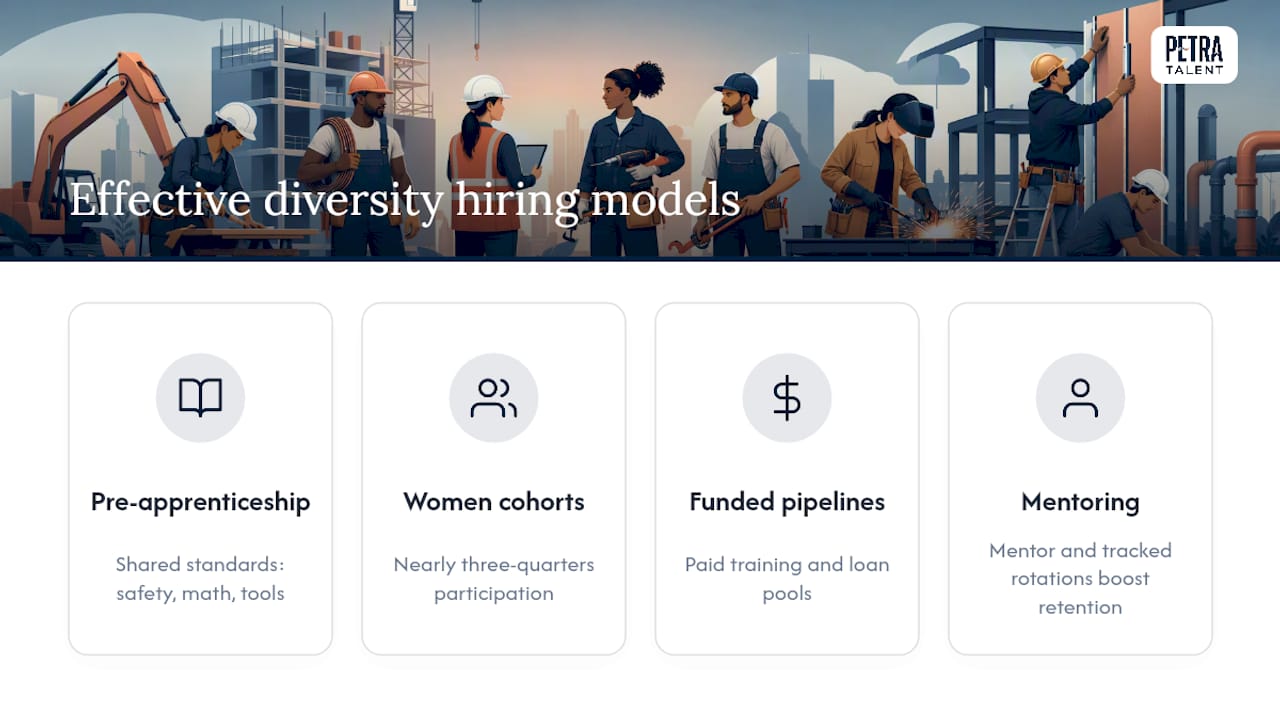
3. Community and nonprofit co-designed training pipelines. Programs like HIRE360 pair aptitude testing, paid training hours, and loan pools with direct contractor partnerships, giving candidates a funded runway into the trades instead of asking them to self-finance the gap between interest and employment. SSIR’s reporting on this model frames it as a template other regions have begun copying, precisely because it solves the logistics barrier, not just the outreach barrier.
4. Structured mentoring and rotation tracking. Retention improves measurably when early-career hires are assigned a consistent mentor and rotated through varied tasks on a predictable schedule, rather than left to whichever foreman happens to need help that week. Tracking early task assignments prevents the common pattern where underrepresented hires get stuck on marginal work that never builds toward journeyman skills.
Contractors looking to replicate this without building an entire training arm can start smaller. Partnering with an existing pre-apprenticeship program or building a lasting apprenticeship pipeline through a regional trade school gets most of the benefit without the overhead of designing curriculum from scratch.
Pro Tip: *Ask any pre-apprenticeship program you’re considering for their completion-to-placement rate by demographic group, not just an overall number.
What ties these four models together is a rejection of the “post the job and hope” approach. Each one treats diversity hiring as a designed system with specific inputs: who gets invited, what support they receive financially, and what happens to them after day one on the job. Contractors who copy the outreach step but skip the retention step tend to see a short-lived diversity number that reverts within a year, which is exactly the pattern the ICERES researchers flagged in non-union DEI efforts more broadly.
How Federal Programs and Project Rules Can Expand Your Hiring Pool
Contractors bidding on large public and federally funded projects have access to support that didn’t exist a few years ago, and most haven’t tapped it yet.
The OFCCP Mega Construction Project Program offers no-cost, on-the-ground compliance and recruitment assistance to contractors working on eligible federally funded megaprojects valued at $35 million or more. This isn’t an audit function. It’s a support function: OFCCP staff work with contractors to strengthen outreach, connect with community-based training organizations, and document good-faith recruitment efforts, all before problems surface rather than after. Contractors on qualifying projects who haven’t reached out are leaving free infrastructure on the table.
Project Labor Agreements and local-hire requirements add a second lever. When a public project carries a PLA with hiring goals for apprentices or local residents, that creates a documented demand for graduates of Apprenticeship Readiness Programs, which gives contractors a concrete reason to build a pipeline relationship now rather than scrambling when the project timeline compresses. Regional models like the Infrastructure Pathways Project, piloted in Baltimore, Philadelphia, Milwaukee, Central New York, and the Pacific Northwest, show how this works at scale: pre-apprenticeship programs get tied directly to PLA hiring goals through shared technical assistance and tracking dashboards, giving contractors a pipeline rather than a scramble.
Getting access to these resources takes a few concrete steps:
- Check whether your current or upcoming project meets the $35 million megaproject threshold or carries a PLA with hiring language.
- Contact the project’s workforce or labor compliance lead directly rather than waiting for a compliance letter. Most large public projects have a named point of contact for this.
- Register interest with your regional building trades council or a program like MC3 before the project breaks ground, since pipeline building takes months, not weeks.
- Document outreach efforts consistently from the start. This protects contractors on compliance reviews and gives OFCCP staff something concrete to build on if they get involved.
Contractors managing multiple federal contracts often find it worthwhile to formalize this tracking rather than handling it project by project. Understanding workforce compliance requirements up front prevents the scramble that happens when a project owner asks for documentation six months into the job.
A Step-by-Step Playbook to Improve Diversity Hiring This Quarter
Strategy without execution steps is just a memo nobody reads. Here’s a four-step sequence contractors can start within a single quarter, not a five-year initiative.
1. Build the outreach playbook first. Skip the generic job board post and go directly to the organizations already working with the candidates you want to reach. Contact your regional NABTU-affiliated Apprenticeship Readiness Program, a community-based nonprofit like a HIRE360 affiliate, and at least one women-in-trades organization if your crew is heavily male. Write outreach messaging that names the specific roles, pay range, and growth path rather than a vague “now hiring” post, and use imagery in any flyers or social posts that reflects who you’re actually trying to reach. The Build It! program’s data makes clear this single choice moves participation numbers more than almost anything else in the process.
2. Redesign selection to be skills-based, not resume-based. Trades work rewards demonstrated ability over polished paperwork, so build short, standardized practical assessments: basic tool handling, a blueprint-reading snippet, a simple physical task relevant to the role. Score every candidate against the same written rubric, and use a two-person interview panel rather than a single hiring manager’s gut call. This structure reduces the subjective bias that tends to favor candidates who “look like” the existing crew, a pattern the ICERES researchers identified as a quiet driver of homogeneous hiring even when contractors have no explicit intent to exclude anyone.
3. Build onboarding and retention into the hiring plan, not as an afterthought. Assign every new hire a consistent mentor for the first 90 days, not a rotating cast of whoever’s available. Create a written assignment plan that rotates the new hire through varied tasks on a predictable schedule, so they’re building toward journeyman skills rather than stuck running for coffee and materials. Address the logistical barriers directly: a small tools stipend for the first 60 days, information about transit routes or carpooling options, and flexibility on start times where the work allows it. These cost far less than the price of turnover and re-recruitment.
4. Track metrics that show whether the system is actually working. A basic dashboard should include applicant demographics by outreach source, interview-to-offer conversion by group, 90-day and one-year retention by group, and promotion or wage progression by group. Review it quarterly, not annually. If retention gaps show up for one group and not another, that’s a signal to investigate assignment patterns and mentoring consistency before assuming the pipeline itself is the problem.
| Playbook Step | Primary Action | What to Track |
|---|---|---|
| Outreach | Partner with pre-apprenticeship and community programs; revise messaging and imagery | Applicant source and applicant demographics |
| Selection | Use standardized skills assessments and panel interviews | Interview-to-offer conversion rate by group |
| Onboarding | Assign mentors; build rotation and task-assignment plans | 90-day retention and task variety logged |
| Measurement | Build a quarterly dashboard reviewed by leadership | 1-year retention and promotion rate by group |
Contractors running this playbook without a dedicated HR function often find step one, the outreach and sourcing piece, is where they lose the most time. That’s frequently the point where bringing in outside sourcing expertise, whether through a training partner or a specialty trade recruiting partner, pays for itself in hours saved.
How Do You Measure Progress Without Creating Legal Risk?
Setting numerical goals for diversity hiring is legal and common practice among federal contractors, but the language and process around those goals matter. The distinction that protects contractors is straightforward: outcome goals track aspirational representation targets tied to good-faith recruitment efforts, while unlawful quotas set a fixed number of hires reserved for a specific group regardless of qualifications. OFCCP-regulated contractors have operated under outcome-based goal frameworks for decades under existing affirmative action program requirements, and the practice generally holds up because it focuses on expanding the applicant pool rather than restricting who ultimately gets hired.
A few practices keep this on solid ground:
- Set goals as percentages of your qualified applicant pool or local labor market availability, not as fixed hiring numbers for any single position.
- Document that hiring decisions rest on the skills-based assessment scores described in the playbook above, not on demographic category.
- Track outreach efforts (who you contacted, what programs you partnered with) separately from hiring outcomes, since good-faith effort documentation is what protects contractors during a compliance review.
- Review your dashboard quarterly with whoever owns compliance internally, not just once a year during an audit scare.
For the dashboard itself, four fields cover most of what a project owner or general contractor will want to see: applicant pool composition by outreach source, interview-to-offer conversion by demographic group, retention at 90 days and one year, and wage or promotion progression over time. When a project carries a PLA or local-hire commitment, tie your reporting cadence to whatever review schedule the project owner already uses. A contractor who shows up to a monthly project meeting with clean numbers tied to their documented workforce compliance efforts builds credibility fast, and that credibility often translates into being first in line for the next phase of work.
The compliance signal that matters most: unionized pay structures show measurably smaller gender wage gaps than non-union equivalents, according to AFSCME’s wage analysis. Contractors building out pay transparency practices have a working model to reference, whether or not their shop is unionized.
Where Petra Talent Fits Into Your Diversity Hiring Strategy
Building the outreach relationships, running skills-based assessments, and tracking retention metrics described above takes real staff hours, and most contractors are running lean already. This is the exact gap a specialized recruiting partner is built to close.
Petra Talent works specifically with HVAC and plumbing contractors on the pieces of this playbook that eat the most internal time:
- Role-specific candidate sourcing that draws from broader networks than the standard referral pipeline, including relationships with training programs and trade schools.
- Technical vetting and screening that applies standardized, skills-based evaluation rather than resume-only judgment, reducing the subjective bias that quietly narrows who advances.
- Workforce consultation to help contractors design retention-minded onboarding and rotation plans before a new hire’s first day.
- Market wage insights that support the pay transparency practices linked to lower wage gaps in unionized settings.
A typical engagement starts with an intake conversation about the roles and growth path involved, moves into sourcing against a wider candidate pool, runs candidates through structured technical vetting, and ends with placement plus a follow-up check-in to catch early retention issues before they become resignations.
Pro Tip: If your team is already running a pre-apprenticeship partnership but struggling to convert graduates into placed, retained hires, that’s usually a sourcing and vetting capacity problem, not a pipeline problem. That’s the exact gap a recruiting partner closes fastest.
Contractors running one or two roles a year can often manage this in-house. Contractors scaling a crew, opening a new market, or filling leadership roles alongside technical positions tend to see faster, more consistent results when a dedicated technical vetting and workforce solutions partner runs the screening layer.
Why This Is Workforce Strategy, Not a Compliance Checkbox
Most contractors treat diversity hiring like a mandate to satisfy rather than a lever to pull, and that’s the mistake worth naming directly. The trades are facing a labor shortage that outpaces the pipeline of workers trained the traditional way. Every contractor competing for the same narrow slice of the workforce that’s always been recruited from is competing harder than they need to, while a wider, largely untapped pool sits one outreach email away.
The evidence throughout this piece points to the same conclusion from different angles: outreach that explicitly invites underrepresented candidates works, but only while it’s maintained. Retention systems, not recruitment slogans, determine whether that investment pays off. And federal infrastructure spending has created a genuine, time-limited window where support like the OFCCP Mega Construction Project Program makes acting now cheaper than acting later.
If you take one thing from this article, take this: pick one pre-apprenticeship partner, one retention practice (a mentor assignment plan works well as a start), and one measurement habit, and run all three for a full quarter before judging results. Contractors who want help executing that faster can start with Petra Talent’s services.
— David
Ready to Build a More Diverse Crew? Here’s Where to Start
Running the outreach, screening, and retention playbook above in-house takes months most contractors don’t have, especially while managing active projects. Petra Talent exists to compress that timeline. Instead of building sourcing relationships and vetting systems from scratch, contractors work with a recruiter who already has both in place, at a fraction of the internal hours a DIY build-out demands.
Petra Talent’s HVAC Recruiting Services and Plumbing Recruiting Services apply the same skills-based vetting standard described in the playbook above, so every candidate presented has already cleared a structured technical screen before a contractor spends a single interview hour. For contractors building leadership benches alongside technical crews, the Leadership & Management Search service applies that same rigor to superintendent and project manager roles.
Ready to see how this fits your hiring plan? Visit Petra Talent’s Our Services page to start an intake conversation and get a direct read on what a diversified, retained crew looks like for your specific project pipeline.
Sources
The DOL OFCCP Mega Construction Project Program announcement details eligibility and how to request assistance on federally funded projects. The ICERES/AFL-CIO study provides the research basis for MC3 outcomes and retention gaps. BLS occupational data offers current, authoritative representation figures by trade. The IWPR analysis of Build It! outreach effects documents the outreach-to-participation link in detail, and SSIR’s coverage of HIRE360 walks through a working nonprofit-industry partnership model contractors can study or join.
- U.S. Department of Labor newsroom: OFCCP Mega Construction Project Program announcement
- IWPR: From 72 to 17 — effect of outreach on women’s participation in pre-apprenticeship cohorts
- Bureau of Labor Statistics — Labor force characteristics by sex and occupation
- Stanford Social Innovation Review: Diversifying the construction industry
Recommended
Post a comment
Related Posts

August 29, 2026
Paid Internships That Convert Interns to Hires for HVAC Trade Schools
Contractor playbook to launch HVAC trade school partnerships. Use paid internships and PAC involvement to…

August 27, 2026
The Recruiting KPIs Construction Hiring Managers Should Track
Discover essential recruiting KPIs for construction hiring managers. Track metrics like quality of hire and…

August 26, 2026
Plumbing Estimator Hiring: A Contractor’s Playbook
Discover how to efficiently hire a plumbing estimator by leveraging multiple sourcing strategies and defining…

August 25, 2026
Manpower Loading Construction Schedules: A Practical Guide
Unlock your project's potential with effective manpower loading in construction. Ensure you have the right…