



TL;DR:
- Hiring speed is essential for HVAC contractors to attract top technicians in a tight labor market. Delays in response and lengthy job postings lead to lost candidates, increased costs, and operational issues. Building a structured, fast recruitment process and active candidate pipelines enhances long-term workforce stability.
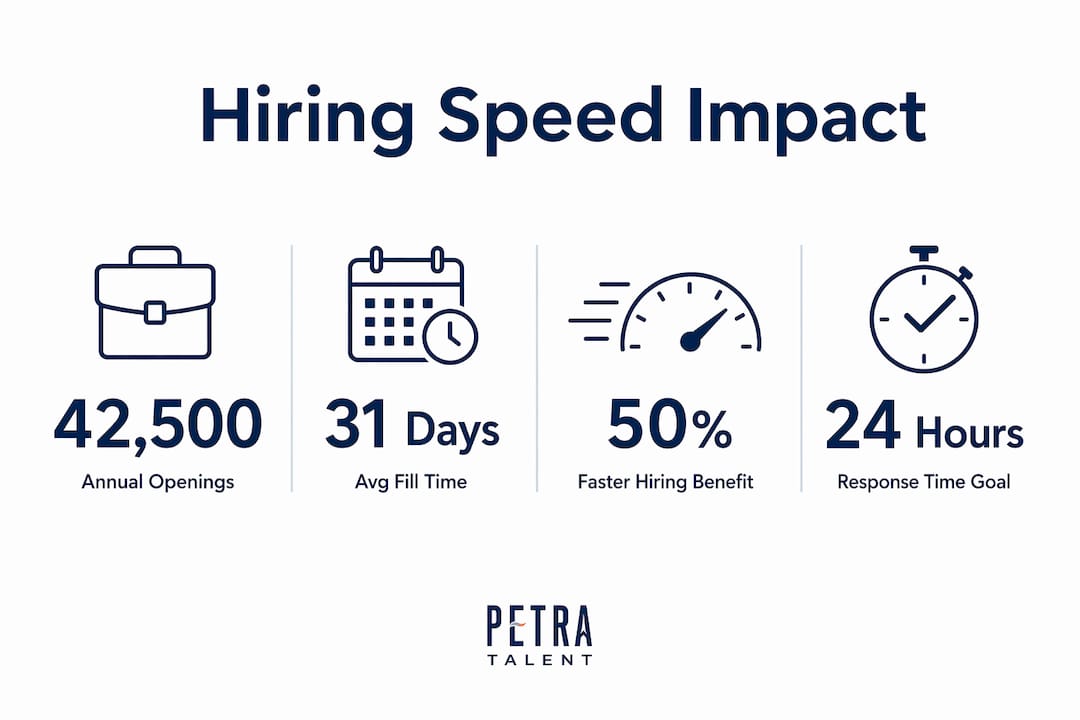
Hiring speed is the single most decisive factor in whether HVAC contractors secure top technicians or watch them accept a competitor’s offer. The HVAC labor market is under serious pressure: the Bureau of Labor Statistics projects 42,500 new job openings annually through 2032, while nearly 30% of current technicians are over age 55 and approaching retirement. Trade school enrollment is not keeping pace with that demand. For HVAC business owners and managers, understanding why hiring speed matters for HVAC contractors is no longer optional. It is a core operational priority.
What labor market trends are driving the need for faster HVAC hiring?
The HVAC workforce is shrinking at the top and not refilling fast enough at the bottom. Retirements are accelerating, and the pipeline of trained replacements remains thin. That combination creates a seller’s market for skilled technicians, where candidates hold the leverage and contractors compete for a limited pool.

The numbers tell a clear story. The Bureau of Labor Statistics projects 42,500 annual openings through 2032, driven by both growth and replacement demand. Trade school enrollment has not matched that pace, which means the available talent pool stays tight regardless of economic conditions.
| Workforce factor | Current reality |
|---|---|
| Projected annual openings | 42,500 through 2032 (Bureau of Labor Statistics) |
| Technicians aged 55 or older | Nearly 30% of the current workforce |
| Median job posting duration | Around 31 days, roughly twice comparable roles |
| Trade school enrollment | Not keeping pace with projected demand |
The median HVAC technician job posting sits open for around 31 days, which is roughly twice as long as comparable technical roles. That gap signals a structural hiring problem, not just a temporary shortage. Contractors who understand these workforce trends in 2026 can position themselves to act faster than the market average.
How does slow hiring hurt HVAC contractors operationally?
Slow hiring creates a direct chain of operational damage. Empty technician slots mean delayed service calls, declined project bids, and lost revenue. Existing staff absorb the extra workload, which accelerates burnout and increases turnover risk among the people contractors can least afford to lose.
The candidate experience suffers just as much. Delays of even a few days in feedback or interview scheduling are common deal breakers for working technicians. Candidates read a slow process as a sign of disorganization or a lack of respect for their time. That perception sticks, and it spreads through word of mouth in tight trade communities.
The competitive risk is equally serious. Experienced HVAC technicians typically hold multiple offers at the same time. A contractor who takes a week to schedule a second interview will often find the candidate already committed elsewhere. Slow hiring also raises cost-per-hire over time, because longer vacancies require more sourcing effort and sometimes force contractors into costly emergency staffing decisions. Reviewing common HVAC hiring mistakes reveals that delayed communication is one of the most frequent and preventable causes of lost candidates.
Key consequences of slow hiring:
- Lost service revenue from unfilled technician roles
- Increased burnout and turnover among current staff
- Candidates accepting competing offers before the process concludes
- Higher cost-per-hire from extended vacancy periods
- Damage to employer reputation in local trade networks
What best practices accelerate HVAC hiring without sacrificing quality?
Speed and quality are not opposites in HVAC recruitment. The contractors who hire best combine a fast process with clear evaluation criteria, so they move quickly without making careless decisions.
-
Adopt a speed-to-lead mindset. Industry experts recommend responding with personalized texts rather than passive email follow-ups. Working technicians check their phones between jobs. A text response within hours signals professionalism and urgency.
-
Post pay ranges and benefits upfront. Transparency about compensation early in the process speeds candidate decisions and filters out mismatches before they waste anyone’s time.
-
Use a two-step evaluation process. A short phone screen followed by a hands-on scenario test gives contractors enough information to make a confident offer without dragging the process across multiple rounds.
-
Maintain an active candidate pipeline. Ongoing recruitment pipelines shorten time-to-fill because contractors are not starting from zero every time a role opens. Keeping warm relationships with past applicants and referrals pays off consistently.
-
Avoid rushing hires that skip culture fit. Speed is a tool, not a shortcut. A fast hire who leaves in 90 days costs more than a slightly slower hire who stays for years.
Pro Tip: Set a firm internal rule: every candidate gets a response within 24 hours of applying. That single standard alone puts most HVAC contractors ahead of the majority of their competitors.
How can HVAC business managers implement fast hiring strategies in 2026?
Contractors who want to improve the speed of hiring HVAC contractors need a structured approach, not just good intentions. Faster hiring requires process changes, accountability, and the right external support.
Practical steps for HVAC business managers:
- Set stage-by-stage timelines. Define how long each hiring step should take: 24 hours to respond, 48 hours to schedule a screen, 72 hours to extend an offer after a final interview. Hold the team to those numbers.
- Train hiring managers on quick evaluation. Managers who know exactly what to look for in a 20-minute phone screen make faster, more consistent decisions.
- Use technology for scheduling and screening. Automated scheduling tools eliminate the back-and-forth that adds days to a process without adding value.
- Promote company culture proactively. Passive candidates respond to contractors who clearly communicate what it is like to work for them. Benefits, team culture, and growth opportunities should appear in every job posting.
- Measure time-to-fill regularly. Contractors who track this metric spot bottlenecks quickly and fix them before they become expensive habits.
| Hiring approach | Typical outcome |
|---|---|
| No defined timelines | Candidates drop off; average fill time exceeds 30 days |
| Structured two-step process | Faster decisions; higher candidate satisfaction |
| Specialized recruitment partner | Reduced sourcing time; pre-vetted candidate pool |
| Active pipeline management | Consistent candidate flow; lower cost-per-hire |
Contractors who treat recruitment with the same urgency they apply to attracting experienced HVAC workers consistently outperform those who treat hiring as a reactive task.
What role does hiring speed play in long-term HVAC workforce planning?
Hiring speed is not just a short-term fix. It connects directly to retention, growth capacity, and the long-term health of a contractor’s workforce. Contractors who fill roles quickly reduce the pressure on existing staff, which lowers burnout and keeps experienced technicians from walking out the door.
Speed also improves the quality of hires over time. When contractors move fast, they compete for the best candidates rather than settling for whoever is still available after the top tier has accepted other offers. That pattern compounds: better hires improve team performance, which strengthens the employer’s reputation, which attracts stronger future candidates.
Active recruitment pipelines become a genuine competitive advantage in a tight labor market. Contractors who maintain ongoing relationships with candidates, trade schools, and referral networks fill roles faster and at lower cost than those who post and pray. A structured hiring process built around speed also supports business growth by ensuring that new service contracts and projects can be staffed without delay.
Pro Tip: Assign one person in your organization to own the candidate pipeline year-round, not just when a role opens. That single accountability shift changes how fast your team can respond when demand spikes.
Key takeaways
Hiring speed is the defining competitive advantage for HVAC contractors in a labor market where 42,500 roles open annually, nearly 30% of technicians are nearing retirement, and top candidates hold multiple offers simultaneously.
| Point | Details |
|---|---|
| Labor market urgency | 42,500 annual openings and an aging workforce make fast hiring a business necessity. |
| Cost of slow hiring | Delays of even a few days cause candidates to accept competing offers and raise cost-per-hire. |
| Speed-to-lead communication | Responding to candidates within 24 hours via text outperforms passive email follow-up. |
| Two-step evaluation | A phone screen plus hands-on scenario delivers quality hires without slowing the process. |
| Pipeline as strategy | Maintaining ongoing candidate relationships reduces time-to-fill and supports long-term growth. |
The uncomfortable truth about HVAC hiring speed
Most HVAC contractors know they need to hire faster. The problem is that they treat hiring like a task to complete rather than a function to manage. I have seen contractors lose three strong candidates in a row, each time because a hiring manager was too busy running jobs to return a call within 48 hours. The vacancy stayed open for six weeks. The cost of that delay, in overtime, in declined work, in staff frustration, far exceeded what a structured process would have required.
The other mistake I see constantly is vague job postings. Contractors post a title and a general description, then wonder why they get low-quality applicants or none at all. Candidates want to know what they will earn, what the schedule looks like, and what the company actually values. Sharing that information upfront is not a weakness. It is a filter that saves everyone time.
Hiring is a continuous business function, not an emergency response. Contractors who build recruitment infrastructure, maintain candidate relationships, and measure their own process performance will always have an advantage over those who scramble every time a technician gives notice. The investment is modest. The return is compounding.
— David
Petratalent’s approach to faster HVAC contractor hiring
HVAC business owners who want to reduce time-to-fill without compromising candidate quality have a direct path forward with Petratalent.

Petratalent specializes in HVAC recruiting services built specifically for mechanical contractors across the United States. The team handles role-specific candidate sourcing, technical vetting, and market wage analysis, so contractors receive pre-qualified candidates rather than unfiltered applications. That process cuts the time contractors spend evaluating unsuitable candidates and puts the focus where it belongs: on making fast, confident offers to the right people. For contractors ready to build a faster, more reliable hiring process, Petratalent’s full services cover everything from direct hire placements to workforce consultation.
FAQ
Why does hiring speed matter so much for HVAC contractors?
Hiring speed matters because top HVAC technicians hold multiple offers simultaneously and accept the fastest, most organized response. Delays of even a few days in feedback or scheduling are enough to lose a strong candidate to a competitor.
How fast should HVAC contractors respond to applicants?
Contractors should respond to every applicant within 24 hours, ideally with a personalized text message. Industry experts identify rapid, direct communication as the single most effective way to engage working technicians.
What is the average time to fill an HVAC technician role?
The median HVAC technician job posting stays open for around 31 days, roughly twice as long as comparable technical roles. Contractors with structured processes and active pipelines consistently fill roles faster than that average.
How can HVAC contractors hire faster without lowering standards?
A two-step process, a short phone screen followed by a hands-on skills scenario, allows contractors to evaluate candidates quickly and confidently. Posting clear pay ranges upfront also filters out mismatches before they consume interview time.
What is a recruitment pipeline and why does it matter for HVAC businesses?
A recruitment pipeline is an ongoing pool of warm candidate relationships maintained between active job openings. Contractors with active pipelines reduce time-to-fill significantly because they are not starting from zero each time a technician role opens.
Recommended
Related Posts

July 14, 2026
How to Source Mechanical Leadership Talent Effectively
Learn how to source mechanical leadership talent effectively. Discover key skills needed for success in…

July 13, 2026
Performance-Based Screening for HVAC and Plumbing Hiring
Discover what is performance-based screening and how it enhances HVAC and plumbing hiring. Improve candidate…

July 12, 2026
Types of Plumbing Trade Certifications: A Career Guide
Explore the types of plumbing trade certifications to enhance your career. Learn how these credentials…

July 11, 2026
Why Plumbing Certifications Affect Hiring Decisions
Discover why plumbing certifications affect hiring decisions. Learn how these credentials impact wages, legal authority,…