



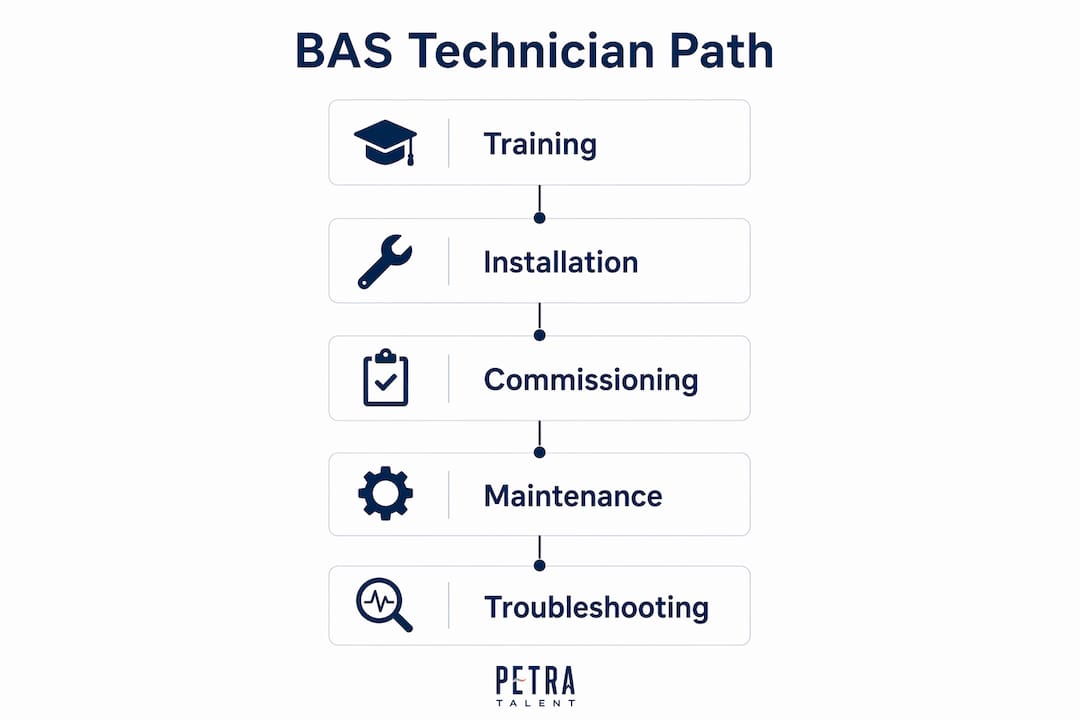
A building automation system (BAS) technician installs, programs, commissions, and maintains the computerized control systems that manage a commercial building’s HVAC, lighting, access, and energy operations. This is not a general HVAC service role. The work is split between field wiring and laptop-based programming, and the technicians who do it well combine mechanical trade knowledge with genuine IT fluency.
Baseline qualifications to enter the field:
- Basic electrical and low-voltage controls familiarity (reading schematics, wiring sensors and controllers)
- Foundational HVAC knowledge (understanding how AHUs, VAVs, and chillers operate)
- Networking fundamentals (IP addressing, basic TCP/IP, how BACnet communicates over a network)
- Willingness to complete manufacturer-specific training on common vendor platforms
- EPA 608 certification where refrigerant handling is part of the scope
Petratalent works with mechanical contractors across the United States to source and vet candidates who meet these standards. The sections below walk through every dimension of the role, from daily duties to career timelines to hiring guidance.
Table of Contents
- What does a BAS technician do every day?
- Education, training, and certifications hiring managers expect
- What tools, systems, and protocols do BAS technicians work with?
- How does a BAS career progress, and what does it pay?
- How to break into BAS work: a step-by-step path
- How contractors should evaluate and hire BAS technicians
- Safety standards and regulatory compliance for BAS technicians
- Common challenges BAS technicians face in HVAC systems
- Emerging trends shaping BAS work in HVAC
- What employers often get wrong when hiring BAS technicians
- Key Takeaways
- What actually separates strong BAS technicians from the rest
- Petratalent places pre-vetted BAS technicians for contractors
- Useful sources
What does a BAS technician do every day?
The core responsibilities of a BAS technician span installation, programming, commissioning, and ongoing maintenance of control systems across commercial buildings. Typical work settings include hospitals, universities, office towers, hotels, and data centers. The role is not primarily about turning wrenches.
Daily duties include:
- Installing and wiring DDC controllers, I/O panels, sensors, and actuators
- Programming control logic and sequences of operation for HVAC equipment
- Commissioning air handling units, VAV boxes, chillers, and boilers through point-to-point verification
- Pulling trend logs and BACnet data to diagnose equipment inefficiencies
- Troubleshooting networked devices, failed sensors, and sequence errors
- Updating graphics, schedules, and setpoints in the building management software
- Generating service reports and documenting completed work
How a BAS technician differs from an HVAC service tech
A general HVAC technician handles mechanical repairs: replacing compressors, charging refrigerant, cleaning coils. A BAS technician handles the controls layer. When a chiller is short-cycling, the HVAC tech checks the refrigerant circuit; the BAS technician checks the control sequence, the setpoints, and the network communication between the chiller and the building controller. Controls engineers sit above both, designing the sequences and specifying the hardware. BAS technicians implement and maintain what engineers design.

Stakeholders a BAS technician regularly coordinates with include facility managers, mechanical contractors, IT departments, and occasionally architects or commissioning agents during new construction.
Pro Tip: When troubleshooting a networked device on a live site, isolate the suspect controller on a laptop before making any sequence changes. Modifying a live sequence without a backup can affect every piece of equipment on that trunk, and facility managers notice immediately.
Education, training, and certifications hiring managers expect
There is no single mandatory degree for this role, but there are clear pathways that hiring managers recognize and prefer.
Common entry pathways:
- HVAC certificate or associate degree from a community college or trade school
- Electrical apprenticeship with low-voltage or controls exposure
- Direct-entry building automation or controls technology programs
- Transition from HVAC field work (the most common route in practice)
Manufacturer and platform training is where most practical BAS competency is built. Many job postings list familiarity with common vendor platforms (Tridium Niagara R2/R4 is frequently cited as a preferred qualification) alongside BACnet and Modbus exposure. These are not entry requirements for every position, but candidates who arrive with even one manufacturer certification stand out.
Certifications and credentials that strengthen a resume:
- EPA 608 (required wherever refrigerant handling is in scope)
- Manufacturer controls certificates (platform-specific, earned through vendor training programs)
- BACnet and Modbus protocol familiarity (demonstrated through coursework or field experience)
- NATE controls-related credentials where applicable
- CompTIA Network+ as a transferable networking credential
Realistic timeline for competency:
- 0–18 months: basic competency for candidates with an existing HVAC background and focused controls training
- 2–4 years: independent BAS work, handling commissioning and troubleshooting without supervision
- 5+ years: senior or lead technician level, capable of programming complex sequences and mentoring junior staff
For job-spec language, hiring managers typically write “high school diploma or equivalent plus completion of appropriate trade school courses” as the minimum, with “evidence of BAS/BMS/EMS training and three years of comparable experience” as the preferred standard. That language comes directly from public employer job classifications and reflects what most commercial contractors expect as well.
Understanding why certifications matter goes beyond checking a box. Certified candidates tend to troubleshoot faster and make fewer costly commissioning errors.
What tools, systems, and protocols do BAS technicians work with?
The BAS technician job description draws on electrical, mechanical, telecommunications, and information systems knowledge simultaneously. That breadth shows up in the tools.
Field and hand tools:
- Multimeter and clamp meter for electrical measurements
- Thermistor and thermocouple calibration tools for sensor verification
- Laptop with BMS client software installed (the primary diagnostic tool on most sites)
- Cable tester and network analyzer for low-voltage and Ethernet runs
Control hardware technicians encounter:
- DDC (direct digital control) controllers from common commercial vendors
- I/O expansion panels and field controllers
- Programmable logic controllers (PLCs) on industrial or hybrid sites
- Actuators, variable frequency drives (VFDs), and end devices
Communication protocols every BAS technician must know:
- BACnet (the dominant open protocol for HVAC integration in commercial buildings)
- Modbus (common on chillers, boilers, and older equipment)
- LonWorks (still present in legacy installations)
- TCP/IP and basic IP networking (required for any BAS that communicates over a building’s LAN)
The shift toward IT-centric responsibilities means technicians who cannot configure a network switch or assign a static IP address are increasingly limited in what they can commission independently. Employers expect at least a working understanding of subnets, VLANs, and firewall rules as they relate to BAS traffic.
Trend logs, graphics, and scheduler tools are not optional extras. Pulling a trend log to verify that a VAV box is responding correctly to a setpoint change is standard commissioning practice. Employers expect technicians to read and interpret that data without being walked through it.
How does a BAS career progress, and what does it pay?
The career ladder in building automation is well-defined, and movement through it is driven by a combination of field hours and credentials.
Career stages:
- Trainee/helper (0–2 years): Assists with wiring, point-to-point testing, and basic software tasks under supervision
- Junior technician (2–4 years): Handles independent commissioning of standard equipment, basic troubleshooting, and service calls
- Mid-level technician (4–7 years): Programs sequences, manages small projects, and trains junior staff
- Senior/lead technician (7+ years): Leads commissioning on complex projects, reviews designs, and serves as the technical authority on site
- Controls specialist or project engineer (varies): Moves into system design, project management, or sales engineering
Common employers include commercial HVAC service contractors, facilities departments at hospitals and universities, design-build mechanical contractors, and industrial facilities. The career satisfaction data consistently points to the blend of mechanical aptitude and software skills as the primary driver of long-term engagement in the field.
Typical US pay ranges (market observations, not guaranteed figures):
- Entry-level/trainee: $20–$28 per hour
- Mid-level technician: $28–$42 per hour
- Senior/lead technician: $42–$60+ per hour, or $75,000–$110,000 annually in salaried roles
Healthcare facilities and data centers consistently pay at the top of these ranges because system downtime carries direct operational risk. Credentials that move pay upward include manufacturer certifications, demonstrated BACnet programming experience, and any formal project management training.
How to break into BAS work: a step-by-step path
Getting into building automation from scratch takes 18 months to three years of deliberate effort. Here is a realistic sequence.
- Learn basic electrical safety and low-voltage fundamentals. OSHA 10 is a practical starting point. Understanding lock-out/tag-out, reading single-line diagrams, and working safely with 24V control circuits are prerequisites for any controls work.
- Earn EPA 608 certification. Even if your first BAS role does not involve refrigerant, the credential signals mechanical trade seriousness to employers.
- Complete an HVAC certificate or controls technology program. Community colleges and trade schools offer programs ranging from 6 months to two years. Look for programs that include hands-on lab time with actual controllers, not just classroom theory.
- Pursue manufacturer training. Many vendors offer free or low-cost online training for their platforms. Completing even one vendor’s foundational course before your first interview puts you ahead of most entry-level applicants.
- Get field hours. Seek HVAC service roles, join a controls installation crew as an assistant, or volunteer in a facility maintenance department. There is no substitute for time spent on actual equipment.
- Build a portfolio. Commissioning checklists you completed, sample control logic you wrote, trend logs you analyzed, and clear service reports all demonstrate competence in a way a resume alone cannot.
- Pursue specialized certifications. Once you have 2–3 years of field experience, add BACnet-specific training, a second manufacturer certification, or CompTIA Network+ to move into mid-level roles.
Pro Tip: Manufacturer training seats are often allocated through local contractors and distributors, not directly to individuals. Introduce yourself to the controls sales rep at your local HVAC distributor. They know which contractors are hiring and which vendor training sessions have open seats.
Building an apprenticeship pipeline is one of the most effective ways contractors can develop BAS talent internally rather than competing for experienced candidates on the open market.
How contractors should evaluate and hire BAS technicians
Hiring a BAS technician without a structured vetting process is one of the more expensive mistakes a mechanical contractor can make. The role requires a specific combination of skills that a general HVAC interview does not surface.
Practical vetting checklist:
- Verify hands-on commissioning experience with specific equipment types (AHUs, VAVs, chillers)
- Request documentation of manufacturer or platform training completion
- Confirm networking fundamentals: ask the candidate to explain how a BACnet/IP device gets an address and communicates on a subnet
- Ask for a sample troubleshooting case, described step by step, with the outcome
- Check references from facility managers, not just direct supervisors
Suggested interview prompts:
- “Walk me through how you would commission a VAV box from point-to-point testing through sequence verification.”
- “A zone is calling for cooling but the AHU is not responding. What is your diagnostic sequence?”
- “How do you handle a BACnet device that is showing offline on the network?”
- “Describe a time you had to explain a controls issue to a facility manager who had no technical background.”
Common red flags:
- Vague descriptions of project roles (“I helped with commissioning” without specifics)
- No commissioning documentation or service reports to show
- Inability to describe a logical troubleshooting sequence
- No exposure to any named protocol or vendor platform
Petratalent’s technical vetting process screens BAS candidates against these criteria before they reach a contractor’s desk, reducing time-to-hire and improving placement quality. Contractors who have tried to fill these roles through general job boards consistently report that most applicants lack the controls-specific depth the role requires.
Reviewing common HVAC hiring mistakes before opening a BAS requisition helps contractors avoid the most predictable sourcing errors.
Safety standards and regulatory compliance for BAS technicians
BAS technicians work across electrical, mechanical, and network domains, which means their compliance obligations span several regulatory frameworks.
OSHA requirements are the baseline. OSHA 29 CFR 1910.147 (lock-out/tag-out) applies whenever a technician works on or near energized equipment. OSHA 10 or 30 training is commonly required by commercial contractors and facility operators. Working at heights on ladder or lift equipment triggers additional fall-protection requirements under OSHA 1926 Subpart M.
Electrical codes matter because BAS technicians wire low-voltage control circuits and, in some cases, line-voltage connections to equipment. The National Electrical Code (NEC) governs wiring methods, conductor sizing, and panel work. Technicians are not typically licensed electricians, but they must understand NEC Article 725 (Class 1, 2, and 3 remote-control circuits) and work within the scope their employer’s license covers.
Refrigerant handling falls under EPA Section 608 regulations. Technicians who touch refrigerant circuits must hold the appropriate EPA 608 certification for the equipment type.
Beyond these, many facilities have site-specific safety requirements: hospital environments may require infection-control protocols, data centers have strict access and static-discharge rules, and government buildings may require security clearances. A BAS technician who treats safety compliance as a checkbox rather than a genuine practice creates liability for every contractor they work for.
Common challenges BAS technicians face in HVAC systems
The complexity of integrated building systems means troubleshooting is rarely straightforward. Several recurring challenges define the day-to-day difficulty of the role.
Legacy system integration is the most common headache. Many commercial buildings run BAS equipment from multiple vendors and multiple generations, connected through a mix of BACnet, Modbus, and proprietary protocols. Getting a 15-year-old chiller to communicate reliably with a new building controller often requires protocol gateways, careful IP configuration, and patience. Understanding HVAC commissioning fundamentals helps technicians approach these integration challenges with a structured methodology rather than trial and error.
Intermittent faults are harder to diagnose than hard failures. A sensor that reads correctly 90% of the time but drifts under specific load conditions requires trend log analysis over days or weeks, not a single site visit. Technicians who rely only on what they can see during a service call miss these patterns entirely.
Sequence conflicts occur when a control sequence written for one piece of equipment interacts unexpectedly with another. A heating sequence that fights a cooling sequence in an adjacent zone is a classic example. Resolving it requires reading the full sequence logic, not just the zone in question.
Network communication failures are increasingly common as BAS systems move onto building IT networks. IP address conflicts, VLAN misconfigurations, and firewall rules blocking BACnet traffic all produce symptoms that look like equipment faults but are actually network problems. Technicians who can distinguish between a failed controller and a blocked network port save hours of unnecessary hardware replacement.
Emerging trends shaping BAS work in HVAC
The building automation field is changing faster than most skilled trades, and the technicians who track these shifts position themselves for the strongest long-term opportunities.
IoT integration is moving BAS beyond traditional HVAC controls. Smart sensors, wireless end devices, and cloud-connected gateways are appearing in commercial buildings at scale. Technicians who understand MQTT protocols and cloud-based monitoring platforms are increasingly valuable to contractors serving Class A office and healthcare clients.
Cybersecurity awareness has become a real requirement, not a theoretical one. BAS systems connected to building IT networks are attack surfaces. Facility operators and IT departments now expect technicians to follow basic cybersecurity hygiene: changing default passwords, segmenting BAS traffic on dedicated VLANs, and flagging unusual network activity.
Energy management and decarbonization goals are driving demand for technicians who can optimize sequences for efficiency, not just comfort. Demand-controlled ventilation, fault detection and diagnostics (FDD) software, and integration with utility demand-response programs are all areas where skilled BAS technicians add measurable value.
**AI-assisted diagnostics tools are beginning to appear in enterprise BMS platforms. These tools flag anomalies and suggest sequence adjustments, but they require a technician who understands the underlying logic to evaluate and implement recommendations. The tools assist; they do not replace the judgment the role requires.
What employers often get wrong when hiring BAS technicians
Most hiring errors in this category come from treating the BAS technician role as an advanced HVAC service position rather than a distinct technical specialty.
Posting a generic HVAC job description and hoping a controls-capable candidate applies is the most common mistake. The skills overlap, but the job is different. A technician who excels at refrigerant work and mechanical repairs may have no programming experience and no interest in developing it. Screening for both in the same interview wastes everyone’s time.
Specific advice for employers:
- Write separate job descriptions for HVAC service technicians and BAS technicians. The minimum qualifications, preferred experience, and interview questions should not overlap.
- Include at least one technical scenario question in every BAS interview. Candidates who cannot walk through a logical troubleshooting sequence in an interview will not perform it reliably in the field.
- Ask for commissioning documentation. A candidate who has genuinely commissioned equipment will have checklists, point-to-point test records, or service reports. Absence of documentation is a meaningful signal.
- Check for protocol fluency, not just protocol familiarity. “I’ve heard of BACnet” and “I’ve configured BACnet/IP devices on a live network” are very different qualifications.
- Verify references with facility managers. Facility managers evaluate technicians on reliability, communication, and whether systems actually ran correctly after the technician left. That perspective is more useful than a contractor supervisor’s reference alone.
For contractors who want structured guidance on interviewing HVAC service technicians, the same principles of scenario-based questioning apply to BAS roles with additional controls-specific prompts.
Key Takeaways
A BAS technician’s value comes from combining mechanical trade knowledge with programming, networking, and communication skills that most HVAC technicians do not develop.
| Point | Details |
|---|---|
| Core role definition | BAS technicians install, program, commission, and maintain computerized controls for HVAC, lighting, and energy systems in commercial buildings. |
| Must-have skills | BACnet/Modbus protocol knowledge, DDC programming, IP networking basics, and EPA 608 certification are the practical minimum for independent work. |
| Fastest entry route | Candidates with existing HVAC experience can reach basic BAS competency within 0–18 months of focused controls training and manufacturer coursework. |
| Career timeline | Entry-level to senior/lead typically spans 7+ years; mid-level independent work is achievable in 2–4 years with the right field exposure. |
| Hiring priority for employers | Require commissioning documentation and a scenario-based troubleshooting question in every interview; vague project descriptions are a reliable red flag. |
| Petratalent’s role | Petratalent pre-screens BAS candidates against technical vetting criteria, reducing time-to-hire for contractors who cannot afford to fill this role through trial and error. |
What actually separates strong BAS technicians from the rest
Most articles about this role focus on the credential list. That is useful, but it misses what actually predicts performance on the job.
The technicians who stand out are methodical under pressure. When a system is misbehaving and a facility manager is standing over their shoulder, the best technicians slow down, work through a logical sequence, and communicate clearly about what they are doing and why. The ones who struggle either freeze or start changing things randomly, which usually makes the situation worse before it gets better.
The other trait that consistently matters is the ability to bridge trades. BAS work sits at the intersection of mechanical, electrical, and IT domains. A technician who is strong in two of those areas but dismissive of the third will hit a ceiling quickly. The candidates who progress fastest are genuinely curious about all three and willing to ask questions of IT staff, mechanical engineers, and facility operators without ego.
Communication is not a soft skill in this context. It is a technical requirement. A technician who cannot explain a sequence fault to a non-technical facility manager in plain language creates ongoing problems for the contractor they work for. The ability to translate technical findings into clear, practical terms is something Petratalent specifically evaluates during candidate screening, because it is the trait most difficult to train after hire.
Petratalent places pre-vetted BAS technicians for contractors
Contractors hiring for BAS roles face a specific problem: the candidate pool is small, the skills are hard to verify from a resume alone, and a bad hire in a controls role can affect every system in a building. Petratalent’s HVAC recruiting services are built around exactly this challenge.

Petratalent sources BAS and controls technician candidates through trade-specific channels, then screens them against the technical criteria that actually matter: commissioning experience, protocol fluency, networking fundamentals, and the communication skills that keep facility relationships intact. Contractors get candidates who have already been evaluated, not a stack of resumes to sort through. For contractors ready to fill a BAS technician role or build a longer-term controls workforce, the next step is a direct consultation with Petratalent’s technical vetting and workforce solutions team.
Useful sources
- Building Automation Systems Technician, HVAC Career Map — Role definition, typical work settings, and core skill requirements from an industry career-mapping resource.
- Green Buildings Career Map: BAS Technician — Detailed scope of work including equipment types, stakeholder interfaces, and commissioning responsibilities.
- FHDA Office of Human Resources: BAS Job Classification — Public employer job-class specification with minimum qualifications, duties, and employment standards language.
- How to Become a BAS Technician, Commercial HVAC Jobs — Practical career entry guidance including timeline benchmarks and IT-skill requirements.
- JMS Integrated Building Solutions: BAS Controls Tech Job Description — Real employer job posting with preferred qualifications including Tridium and BACnet experience.
- What Does a BAS Technician Do, ed2go — Overview of commissioning tasks, software verification, and sensor calibration duties.
- Is Building Automation a Good Career, ZipRecruiter — Career satisfaction and compensation context for BAS roles.
- Kaplan Community: BAS Technicians — Soft-skill requirements including problem-solving and stakeholder communication.
- Petratalent HVAC Recruiting Services — Petratalent’s dedicated HVAC recruitment and technical vetting services for contractors.
- What is HVAC Commissioning, LC Heating & Air — Partner resource explaining commissioning processes and best practices relevant to BAS work.
Recommended
Post a comment
Related Posts
July 30, 2026
Technical Screening Process for HVAC and Plumbing Hiring
Learn what is technical screening process for HVAC and plumbing hiring. Streamline your hiring with…

July 29, 2026
How to Fill Commercial Plumbing Roles: 2026 Hiring Playbook
Learn the fastest way to fill commercial plumbing roles with our 2026 Hiring Playbook. Activate…

July 28, 2026
Plumbing Leadership Succession Planning Steps That Work
Discover essential plumbing leadership succession planning steps to ensure cash flow and business continuity. Start…

July 27, 2026
How Hiring Timelines Affect Project Schedules: 2026 Guide
Discover how hiring timelines affect project schedules. Ensure timely placements for project managers and superintendents…