



TL;DR:
- HVAC technician turnover is mainly caused by management issues, limited career growth, and work-life imbalance. Raising wages alone will not significantly reduce attrition, which is often driven by poor management and lack of clear career paths. Providing structured career ladders and improving workplace culture are essential to retaining skilled technicians and lowering replacement costs.
HVAC technician turnover is driven by five core factors: compensation gaps, poor management, limited career growth, work-life balance failures, and weak workplace culture. According to ServiceTitan, HVAC technicians have a 16% annual turnover rate and stay with the same employer for an average of 3.54 years. That average tenure is short enough to create constant hiring pressure for contractors. Replacing one skilled technician costs between $30,000 and $110,000 when you factor in recruitment, lost productivity, onboarding, and customer churn. Understanding why HVAC technicians leave jobs is the first step toward fixing the problem.
What are the top reasons HVAC technicians quit their jobs?
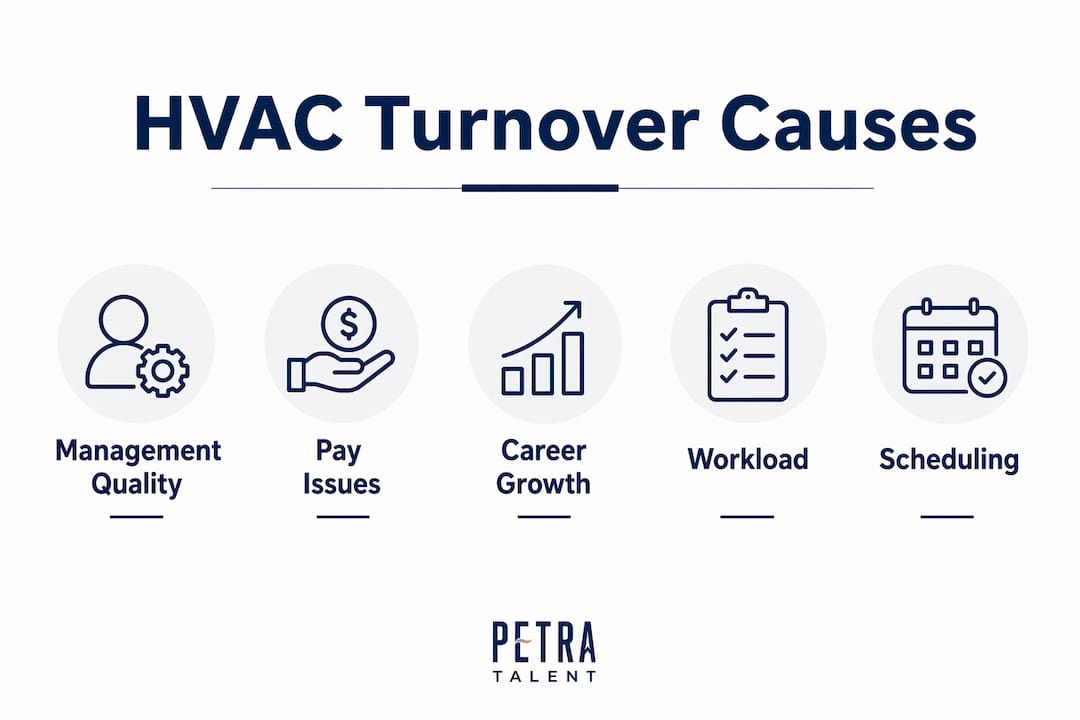
Pay is the single most cited reason technicians leave, but it is far from the only one. Exit survey data shows 39% leave for higher pay, while 33% leave due to poor management or workplace culture, 14% cite limited career growth or training, and 14% point to long hours and no work-life balance. That split matters because it means raising wages alone will not stop most of your turnover.
Many entry-level technicians also feel misled early in their careers. Recruiting marketing often overpromises earnings and understates the physical demands and scheduling realities of the trade. When the job does not match expectations, technicians leave fast, sometimes within the first year.
The reasons HVAC workers leave cluster into four categories worth tracking separately:
- Compensation: Below-market wages or flat-rate structures that punish technicians for scheduling delays they did not cause
- Management and culture: Supervisors who micromanage, fail to communicate, or create a blame-heavy environment
- Career growth: No visible path from apprentice to lead tech, no training milestones, no wage progression
- Work-life balance: Seasonal six-day workweeks, unpredictable on-call rotations, and no mental health support
Pro Tip: When a technician resigns, ask directly which of these four categories drove the decision. Structured exit interviews give you data to fix the actual problem, not just the symptom.
How do management style and workplace culture influence HVAC technician retention?
Management quality is the most underestimated driver of HVAC job dissatisfaction. Research shows 75% of turnover decisions are influenced more by management quality than by compensation. That means three out of four technicians who quit could have stayed with better leadership in place.

Poor scheduling is one of the most visible management failures. When dispatchers overbook routes, delay parts, or fail to communicate job changes, technicians lose time and money. For flat-rate technicians, scheduling inefficiencies cost $8 to $15 per wasted six-minute interval. That financial hit compounds resentment fast.
Safety culture also plays a measurable role. Companies that build genuine trust around safety see roughly 20% lower turnover than those that treat safety as a compliance checkbox. Trust built through consistent safety practices carries over into how technicians feel about the company overall.
The trades have a long-standing “toughness” stigma that discourages technicians from discussing stress or burnout openly. Problems fester in silence until a technician simply stops showing up. Contractors who create space for honest conversations about workload and mental health catch issues before they become resignations.
Practical steps that improve management quality include:
- Scheduling regular one-on-one check-ins between supervisors and technicians
- Giving technicians advance notice of schedule changes rather than last-minute calls
- Training field supervisors in basic communication and conflict resolution skills
- Recognizing technician contributions publicly, not just correcting mistakes
For more on HVAC industry retention tips, field-level best practices from experienced contractors offer useful perspective.
What role do career growth and training opportunities play in HVAC technician turnover?
Lack of career visibility is a quiet but powerful driver of HVAC technician turnover causes. Research from ACHR News shows 47% of operational talent would quit without a clear learning and development roadmap. Nearly half of your workforce is at risk if they cannot see where they are headed.
The frustration is not always about money. A technician earning competitive wages will still leave if the job feels like a dead end. Career stagnation creates the same emotional response as being underpaid: the sense that the employer does not value the person’s long-term potential.
Contractors who reduce early turnover typically build structured career ladders with four elements:
- Defined role levels: Apprentice, journeyman, lead technician, and field supervisor with clear criteria for each
- Wage bands tied to each level: Technicians know exactly what earning a certification or skill milestone is worth
- Training milestones: Specific courses, certifications, or logged hours that trigger advancement reviews
- Written documentation: A one-page career path document shared during onboarding and reviewed annually
Pro Tip: Share the career ladder during the hiring process, not six months in. Technicians who see a path before they start are far more likely to commit through the first year, which is when turnover risk is highest.
Petratalent works with contractors to attract experienced HVAC workers who are specifically looking for employers with structured growth opportunities, which reduces early attrition from the start.
How do workload, scheduling, and work-life balance affect technician job satisfaction?
Physical and scheduling demands are a consistent factor in HVAC employee burnout. Seasonal peaks push many technicians into six-day workweeks for months at a time. On-call rotations add unpredictability that makes planning personal life nearly impossible. Over time, that grind wears people down.
Burnout often stays hidden because the trades culture treats endurance as a virtue. Technicians who feel exhausted rarely say so. They push through until they reach a breaking point, then quit without warning. That abrupt exit is costly and preventable.
Strategies that reduce burnout without requiring major budget increases include:
- Four-week rotation schedules: Spreading on-call duties evenly so no single technician carries the load every weekend
- Guaranteed days off during peak season: Even one protected day per week signals that the company respects personal time
- Mental health resources: Employee assistance programs (EAPs) give technicians a confidential outlet before problems escalate
- Operational fixes: Reducing parts delays and improving dispatch accuracy removes daily frustrations that drain morale
Pro Tip: Fixing operational inefficiencies like scheduling and parts delays can improve morale and reduce turnover without increasing pay. Start there before assuming compensation is the problem.
Contractors who want to grow their HVAC field workforce sustainably need to treat workload management as a retention tool, not just an operational concern.
Key Takeaways
HVAC technician turnover is driven by management quality, career visibility, and workload as much as by pay, and fixing all three together produces the strongest retention results.
| Point | Details |
|---|---|
| Pay is necessary but not sufficient | 39% leave for pay, but 61% leave for management, culture, growth, or balance issues. |
| Management drives most exits | 75% of turnover decisions are influenced more by management quality than compensation. |
| Career paths reduce early attrition | 47% of technicians would quit without a clear learning and development roadmap. |
| Burnout is hidden until it is too late | Trades culture suppresses burnout discussions, causing abrupt quits that are hard to predict. |
| Replacement costs are high | Losing one technician costs between $30,000 and $110,000 in total business impact. |
What I’ve learned about why HVAC technicians really leave
After working closely with HVAC contractors and technicians across the country, the pattern I see most often is not what people expect. Contractors assume pay is the problem. They raise wages, and the turnover continues. The real issue is almost always a combination of management behavior and invisible career ceilings.
The technicians who stay longest are not always the highest paid. They are the ones who feel respected, who know what the next step in their career looks like, and who trust their supervisor to communicate honestly. That trust is built through small, consistent actions: a supervisor who calls ahead about a schedule change, a manager who acknowledges a job well done, a company that posts the career ladder on the wall.
The mental health piece is the most overlooked factor in this industry. The toughness culture is real, and it costs contractors good people every year. Normalizing conversations about workload and stress is not soft management. It is practical retention strategy.
— David
How Petratalent supports HVAC retention from the first hire
High turnover starts with the wrong hire. When a technician is placed in a role that does not match their skills, schedule expectations, or career goals, they leave quickly and the cycle repeats.

Petratalent specializes in HVAC recruiting services that go beyond resume screening. The process includes technical vetting, wage benchmarking, and career path alignment to match technicians with contractors where they are likely to stay. Contractors working with Petratalent also gain access to workforce consultation that addresses the structural causes of turnover, not just the open positions. If your team is losing technicians faster than you can replace them, Petratalent’s staffing and workforce solutions are built to address exactly that problem.
FAQ
Why do HVAC technicians leave jobs so frequently?
HVAC technicians leave most often due to below-market pay, poor management, and no visible career path. The 16% annual turnover rate in the trade reflects how common these issues are across the industry.
Is pay the main reason HVAC workers quit?
Pay is the top single factor, cited by 39% of technicians, but 61% leave for reasons unrelated to wages, including management quality, workplace culture, and burnout.
How does management affect HVAC technician retention?
Management quality influences 75% of turnover decisions. Poor scheduling, weak communication, and a blame-heavy culture push technicians out faster than below-market wages.
What can contractors do to keep HVAC technicians longer?
Contractors see the best results by combining competitive pay with structured career ladders, consistent supervisor communication, and workload management that prevents burnout.
How much does it cost to replace an HVAC technician?
Replacing one skilled HVAC technician costs between $30,000 and $110,000, including recruitment, onboarding, lost productivity, and customer churn from service disruptions.
Recommended
Related Posts

August 29, 2026
Paid Internships That Convert Interns to Hires for HVAC Trade Schools
Contractor playbook to launch HVAC trade school partnerships. Use paid internships and PAC involvement to…

August 28, 2026
Diversity Hiring in the Trades: A Contractor’s Action Plan
Explore actionable strategies for improving diversity hiring in the trades. Enhance outreach, retention, and career…

August 27, 2026
The Recruiting KPIs Construction Hiring Managers Should Track
Discover essential recruiting KPIs for construction hiring managers. Track metrics like quality of hire and…
August 26, 2026
Plumbing Estimator Hiring: A Contractor’s Playbook
Discover how to efficiently hire a plumbing estimator by leveraging multiple sourcing strategies and defining…