



For U.S. HVAC and plumbing contractors, the term “insurance job recruiter” covers two distinct roles. The first is a recruiter who fills positions inside insurance companies: claims adjusters, underwriters, risk managers. The second is a trades-specialist recruiter who handles field technicians, service managers, and site leaders for mechanical contractors. Choosing the wrong type costs time and money.
Quick decision guide:
- Hiring a field tech, service manager, or project superintendent? Use a trades-specialist recruiter with HVAC or plumbing industry focus.
- Hiring for a claims team, warranty operations, or insurer-facing role? An insurance-industry recruiter is the right fit.
- Key trust signals to verify before signing anything: confirm whether the fee is contingency-based (pay only on a successful hire) or retained (upfront component), and ask for the guarantee window. Leading firms offer guarantees from 90 days up to a 365-day guarantee.
Two immediate next steps: Define whether the open role is a technical field position or an insurance-facing one, then request recruiter references and written guarantee terms before any agreement.
Table of Contents
- What does “insurance job recruiter” actually mean?
- How does a specialist recruiter run a search?
- When should you hire a trades recruiter vs. an insurance recruiter?
- How do you evaluate and vet an insurance job recruiter?
- What are the alternatives to using a specialist recruiter?
- What contractors should expect from Petratalent
- How do you measure long-term outcomes across recruiter types?
- How does candidate quality differ between recruiter types?
- Common pitfalls when engaging insurance job recruiters as a contractor
- Key Takeaways
- Why niche always wins for technical trades hiring
- Petratalent: trades-focused recruiting for HVAC and plumbing contractors
- Useful sources and further reading
What does “insurance job recruiter” actually mean?
The phrase gets used in two ways, and the difference matters for contractors.
- Insurance-industry recruiter: Fills roles inside insurance carriers, brokerages, and managing general agents. Typical placements include underwriters, claims analysts, compliance officers, and insurance producers.
- Recruiter for insurance-related roles inside a contractor business: Fills positions that interface with insurers, such as warranty claims coordinators, risk managers, or safety officers employed by a mechanical contractor.
- Trades-specialist recruiter: Focuses on HVAC, plumbing, and mechanical contractors. Sources and vets field technicians, service managers, project managers, and leadership talent. This is the category most relevant to contractors reading this guide.
Engagement models contractors will encounter
| Model | How it works | Best for |
|---|---|---|
| Contingency | Fee paid only after a successful permanent hire | Contractors with tight budgets; lower upfront risk |
| Retained/search | Upfront fee component plus completion payment | Senior leadership and hard-to-fill roles |
| RPO (Recruitment Process Outsourcing) | Recruiter manages part or all of the hiring function | High-volume hiring or rapid workforce expansion |
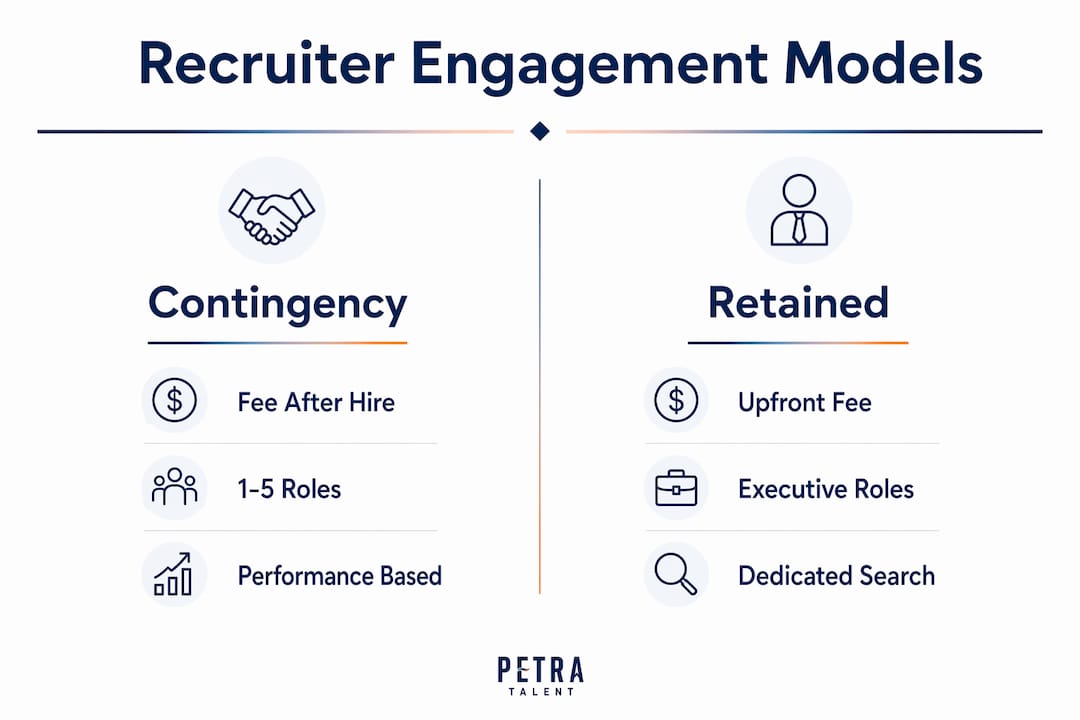
For most HVAC and plumbing contractors filling one to five roles at a time, contingency is the standard model. Retained search makes sense for VP-level or general manager hires where the search demands deep market coverage.
How does a specialist recruiter run a search?
A well-run search follows a consistent sequence regardless of whether the recruiter specializes in insurance or trades.
- Discovery and briefing: The recruiter conducts a consultative intake to capture role requirements, compensation structure, culture, and success criteria. A thorough discovery-first model leads to faster shortlist delivery and better retention.
- Sourcing: Specialist recruiters draw from niche candidate networks not visible on public job boards. This is the primary advantage over generalist staffing firms.
- Technical screening: Candidates are evaluated against role-specific criteria. For HVAC and plumbing hires, this means verifying trade certifications, OSHA records, driver records, and practical skill history.
- Interview management: The recruiter coordinates and often facilitates interviews, providing feedback on both sides.
- Offer negotiation: Specialist recruiters use market wage benchmarking and competitor hiring data to help contractors craft competitive offers.
- Onboarding support: Leading firms assist through the new hire’s first weeks, which is when early attrition risk is highest.
Fill time benchmarks: Aggressive specialist claims cite fill times as short as 14 days for well-networked roles. More typical averages from specialist firms run around 47 days depending on role seniority and location. Guarantee windows commonly range from 90 days up to a 365-day guarantee.
Pro Tip: When evaluating any recruiter for HVAC or plumbing hires, ask specifically what technical vetting steps they perform. License verification, OSHA 10/30 records, and a practical skills assessment should be standard, not optional.

When should you hire a trades recruiter vs. an insurance recruiter?
The decision comes down to where the role sits in the business.
- Choose a trades-specialist recruiter when the hire involves field service, installations, maintenance, site supervision, or operations leadership inside a mechanical contracting business.
- Choose an insurance-industry recruiter when the hire sits in claims, underwriting, risk management, or insurer-facing operations, regardless of whether the employer is a contractor or an insurer.
- Hybrid roles (for example, a service manager who also handles warranty claims and insurer documentation) benefit from a joint brief. Write a single role description that covers both the technical field requirements and the insurance-process competencies, then share it with a trades-specialist recruiter who has placed insurance-adjacent roles before.
Hiring a claims adjuster for a contractor’s warranty team calls for an insurance-industry recruiter who understands claims workflows. Hiring a service manager who occasionally coordinates insurance inspections calls for a trades recruiter who understands field operations first.
HVAC leadership hiring follows different criteria than field technician hiring, and the recruiter’s network needs to reflect that distinction.
How do you evaluate and vet an insurance job recruiter?
15-point evaluation checklist
- Industry focus matches the role type (trades vs. insurance)
- Verifiable sample placements in similar roles
- Written guarantee terms (minimum 90 days)
- Technical vetting process documented and specific
- References from clients in your industry
- Time-to-fill metrics available by role seniority
- Sourcing channels beyond public job boards
- Candidate pipeline transparency during the search
- Clear fee structure with no hidden costs
- Replacement policy if a hire exits within the guarantee window
- Market wage data provided as part of the brief
- Dedicated point of contact, not a rotating team
- Communication cadence agreed upfront
- Onboarding support included or available
- Track record with roles at your company size and geography
10 questions to ask in a discovery call
- Show me three recent placements similar to this role.
- What technical vetting steps do you perform for HVAC or plumbing candidates?
- What is your average time-to-fill for this role type?
- What is your guarantee period and what triggers a replacement?
- How do you source candidates beyond job boards?
- Can you provide two client references from the past 12 months?
- How do you handle offer negotiation if a candidate counters?
- What market wage data can you share for this role in our region?
- How many active searches are you running right now?
- What does your onboarding support look like after placement?
Red flags to watch for: vague sourcing answers (“we use all the major boards”), no written guarantee, refusal to share references, inability to name recent comparable placements, and fee structures that change after the brief is signed.
| Metric | Typical range |
|---|---|
| Contingency fee: often a percentage of the first-year base salary, varying by firm and role | |
| Guarantee window | 90 days up to 365 days |
| Time-to-fill (field roles) | 14–47 days (specialist firms) |
| Time-to-fill (leadership) | 90 days |
What are the alternatives to using a specialist recruiter?
- Internal sourcing and talent pools: Low cost, but requires dedicated HR time and an existing candidate database. Best when the pipeline is already warm.
- Temp-to-hire staffing: Reduces permanent hire risk; the worker proves performance before conversion. Slower path to a committed employee.
- Trade school and apprenticeship partnerships: Strong for entry-level and early-career technicians. Measure success by conversion rate from apprentice to full-time hire within 12 months.
- Employee referral programs: Often produce the fastest hires with the best cultural fit. Set a referral bonus and a 30-day SLA for initial screening.
- Direct sourcing via skilled trades platforms: Useful for volume hiring, but requires internal vetting capacity to screen candidates properly.
Each alternative trades speed or cost against candidate quality. Referral programs and temp-to-hire tend to produce the best fit for field roles; specialist recruiters outperform on leadership and hard-to-fill technical positions.
What contractors should expect from Petratalent
Petratalent operates as a trades-specialist recruitment partner for HVAC and plumbing contractors across the United States. The service offering covers:
- Direct hire placements for field technicians and service roles
- Leadership and management search for supervisors, project managers, and operations leaders
- Technical vetting and workforce solutions including license checks, OSHA records, and skills verification
- Workforce consultation and role design support
- Market wage benchmarking to help contractors build competitive offers
- Onboarding support through the placement guarantee period
The engagement follows three steps: a structured discovery session to capture role requirements and culture fit, active sourcing from a niche trades network, and placement with a guarantee period. The model is contingency-based, meaning contractors pay only when a hire is made.
Pro Tip: Ask Petratalent for a sample shortlist timeline and a written guarantee term before the search begins. Knowing the replacement policy upfront protects the contractor if the hire exits early.
How do you measure long-term outcomes across recruiter types?
Evaluating a recruiter’s success rate goes beyond fill time. The metrics that matter for long-term outcomes are 90-day retention rate, one-year retention rate, and time-to-productivity for the new hire.
Insurance-industry recruiters tend to produce strong outcomes for claims and underwriting roles because their networks are deep in those functions. For HVAC and plumbing contractors, however, a candidate sourced through an insurance-industry network may lack the field experience and trade credentials that drive performance on the job. Trades-specialist recruiters, by contrast, pre-screen for certifications and practical skills, which shortens onboarding time and reduces early attrition.
When comparing recruiters, request retention data by role type. A recruiter who cannot provide 90-day and one-year retention figures for past placements has not been tracking the outcomes that matter most.
How does candidate quality differ between recruiter types?
The core difference is network depth. Specialist recruiters maintain active relationships with passive candidates who are not responding to job postings. Generalist staffing firms and insurance-industry recruiters working outside their specialty tend to rely on active job seekers, which is a narrower and often less experienced pool.
For trades roles, this gap is significant. A licensed journeyman plumber or a certified HVAC technician with five years of commercial experience is rarely browsing job boards. Trades-specialist recruiters reach these candidates through direct outreach, referral networks, and long-term relationship management. The result is a shortlist of candidates who are qualified, vetted, and genuinely interested in the role rather than just available.
Insurance-specialist recruiters provide equivalent depth for claims and underwriting roles. Using one for a field technician hire produces weaker results for the same reason: the network does not match the role.
Common pitfalls when engaging insurance job recruiters as a contractor
Contractors unfamiliar with insurance roles often make three consistent mistakes.
First, they assume any recruiter who works in “insurance” understands their business. An insurance-industry recruiter who fills claims and underwriting roles has no meaningful network of licensed HVAC technicians or plumbing foremen. The role type and the recruiter’s network must align.
Second, contractors skip the guarantee negotiation. A recruiter who resists putting a replacement guarantee in writing is signaling low confidence in their own placements. Written guarantee terms, including the trigger conditions and the replacement timeline, should be non-negotiable.
Third, contractors accept vague vetting descriptions. “We conduct thorough background checks” is not a vetting process. For trades hires, technical screening should specify which certifications are verified, whether OSHA records are reviewed, and how practical skills are assessed. Hiring insured technicians also reduces liability exposure, a point worth confirming with any recruiter placing field workers. For context on why that matters, see why hiring insured technicians reduces repair costs.
Key Takeaways
Trades-specialist recruiters consistently outperform generalists and insurance-industry recruiters for HVAC and plumbing field and leadership hires because their networks, vetting processes, and market knowledge match the role requirements.
| Point | Details |
|---|---|
| Define the role type first | Field and trades roles need a trades-specialist recruiter; claims and underwriting roles need an insurance-industry recruiter. |
| Verify the fee model and guarantee | Contingency fees are pay-on-hire; always get guarantee terms in writing, with 90–365 days as the standard range. |
| Demand specific vetting steps | Ask for license verification, OSHA records, and skills assessment details before signing any agreement. |
| Measure long-term outcomes | Request 90-day and one-year retention data from any recruiter before committing to a search. |
| Petratalent for trades searches | Petratalent offers contingency-based direct hire, leadership search, and technical vetting for HVAC and plumbing contractors across the United States. |
Why niche always wins for technical trades hiring
The conventional wisdom says a good recruiter can fill any role. The evidence says otherwise. Niche networks, role-specific vetting, and market wage intelligence are not features a generalist can replicate by working harder. They are built over years of focused activity in a single industry.
For HVAC and plumbing contractors, the practical implication is straightforward: a recruiter who spends their days placing claims adjusters and underwriters does not have a warm pipeline of licensed plumbers or commercial HVAC technicians. The right recruiter for a trades hire is one whose entire business is built around that candidate pool. Guarantee negotiation and clear onboarding checkpoints are the final layer of protection. Get both in writing before the search begins.
Petratalent: trades-focused recruiting for HVAC and plumbing contractors
HVAC and plumbing contractors need a recruiter whose network is built around the trades, not around insurance carriers or corporate functions. Petratalent fills that gap with contingency-based direct hire placements, leadership searches, and technical vetting designed specifically for mechanical contractors across the United States.
The process starts with a structured discovery session, moves to active sourcing from a niche trades network, and closes with a placement backed by a written guarantee. Contractors pay only when a hire is made. Services cover everything from field technicians to operations managers, with wage benchmarking and onboarding support included.
To get started, review Petratalent’s full service offerings or go directly to HVAC recruiting services or plumbing recruiting services to request a shortlist for your open role.
Useful sources and further reading
- Stone Hendricks Group — Insurance recruiting specialist with a 365-day placement guarantee; cited for guarantee standards and fill time benchmarks.
- The Jacobson Group — Insurance recruiting firm; cited for contingency fee model descriptions and consultative process detail.
- The Jonus Group — Insurance staffing and recruiting; cited for niche network sourcing, wage benchmarking, and guarantee evaluation guidance.
- Top Hat Recruiting — Insurtech and insurance recruiting; cited for specialization value and technical vetting recommendations.
- TGC Search — Insurance executive recruitment; reference for insurance leadership role types and hiring process structure.
- Kaye/Bassman Insurance and Risk Management Recruiters — Specialist in insurance brokerage and carrier placements; reference for role categories and industry expertise scope.
- SSP Recruiting — Insurance-exclusive recruiter since 2004; reference for passive candidate access and recruiter-client partnership model.
- Petratalent HVAC Recruiting Services — Trades-specialist recruiting for HVAC contractors; primary reference for technical vetting and direct hire process.
- Petratalent Benefits of a Specialized HVAC Recruiter — Explains niche recruiter advantages for trades businesses.
Recommended
Related Posts

August 29, 2026
Paid Internships That Convert Interns to Hires for HVAC Trade Schools
Contractor playbook to launch HVAC trade school partnerships. Use paid internships and PAC involvement to…

August 28, 2026
Diversity Hiring in the Trades: A Contractor’s Action Plan
Explore actionable strategies for improving diversity hiring in the trades. Enhance outreach, retention, and career…

August 27, 2026
The Recruiting KPIs Construction Hiring Managers Should Track
Discover essential recruiting KPIs for construction hiring managers. Track metrics like quality of hire and…
August 26, 2026
Plumbing Estimator Hiring: A Contractor’s Playbook
Discover how to efficiently hire a plumbing estimator by leveraging multiple sourcing strategies and defining…