




TL;DR:
- Growing an HVAC workforce requires strong management, clear career paths, and strategic recruitment efforts to reduce costly turnover. Investing in supervision, training, community engagement, and competitive wages significantly increases retention and profit margins, creating a sustainable team. Contractors who proactively develop their technicians and prioritize culture see long-term growth and stability in their service teams.
Growing your HVAC field workforce is defined as the deliberate process of recruiting, retaining, and developing skilled technicians to meet sustained service demand. The HVAC technician shortage is not a temporary dip. The industry is short by 110,000 qualified techs as of 2026, with 40,100 job openings projected annually through 2034. Contractors who treat workforce growth as a hiring problem alone will keep losing ground. The contractors who win are those who combine targeted recruitment with structured career paths and management quality that gives technicians a reason to stay.
What does it take to grow your HVAC field workforce?
Before executing any recruitment or retention plan, contractors need the structural foundations in place. Without them, new hires leave as fast as they arrive, and the cycle of costly turnover continues.
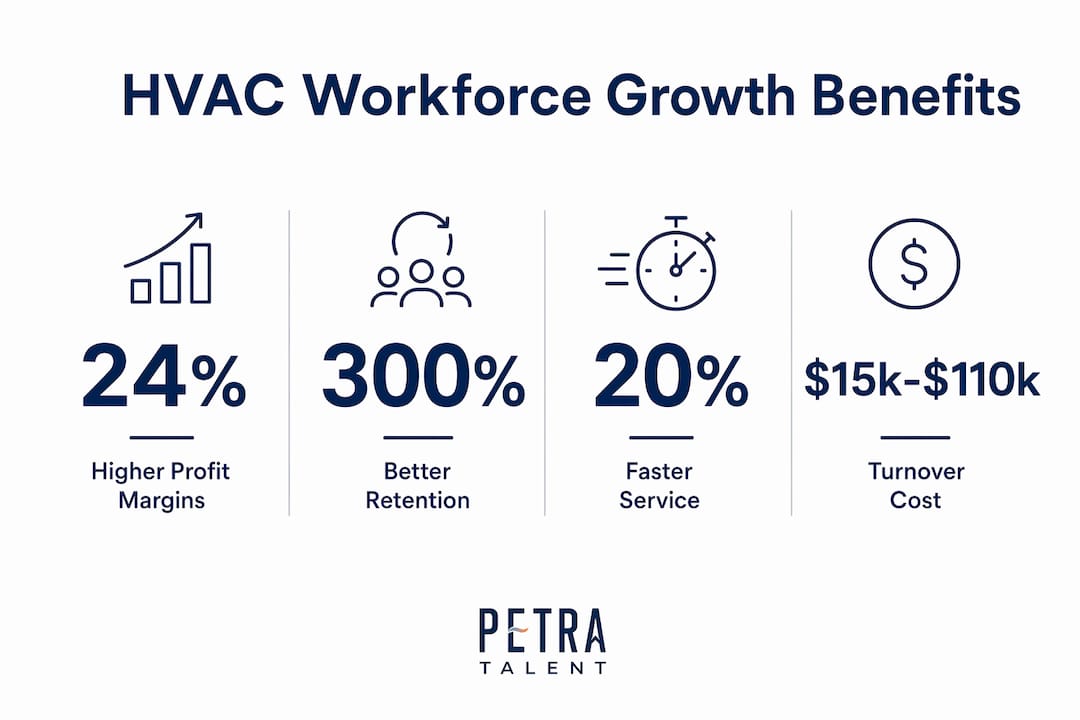
The financial stakes are clear. Replacing one technician costs between $15,000 and $110,000 when you factor in recruiting fees, productivity loss, onboarding time, and the morale hit on your remaining crew. With home services turnover averaging 15 to 20% annually, a 10-tech team could realistically lose two people per year. That is a six-figure problem hiding in plain sight.
The structural prerequisites every contractor needs include:
- Career ladders with defined wage bands at each level, from apprentice to lead tech to service manager
- Management training focused on coaching, feedback delivery, and scheduling fairness
- Field service management software such as FullyOps to reduce administrative friction and support tech workflows
- Workload caps set at 55 to 60 hours per week maximum during peak season
- Market wage benchmarking conducted at least annually to stay competitive
Pro Tip: Run a simple cost-of-turnover calculation before your next budget cycle. Multiply your average annual turnover rate by the low-end replacement cost of $15,000. The number will justify almost any retention investment you are considering.
Companies that prioritize technician development see 24% higher profit margins, 300% better retention, and 20% faster service calls. The data confirms that workforce investment is not a cost center. It is a growth driver.
How to recruit and onboard HVAC technicians who actually stay
Effective HVAC technician recruitment starts before a position opens. Contractors who build pipelines in advance hire better candidates at lower cost and with stronger loyalty from day one.
- Partner with trade schools. Establish relationships with local HVAC programs at institutions like Lincoln Tech, Fortis College, or community college trade departments. Offer paid summer internships at $18 to $22 per hour with a clear pathway to full-time employment at $24 to $28 per hour. Trade school partnerships cost less than recruiting external hires and produce candidates already aligned with your market.
- Match wages to market data. Use current wage benchmarks from sources like the Bureau of Labor Statistics or regional compensation surveys. Candidates who receive below-market offers during hiring are already planning their exit before their first day.
- Build community presence. Attend local trade events, sponsor apprenticeship programs, and maintain an active presence on platforms where technicians look for work. Contractors who are known in their local market attract referrals from their own techs.
- Pair new hires with top performers. Pairing apprentices with your most experienced technicians benefits both parties. Senior techs get workload relief. New hires get accelerated skill development and a direct connection to company culture.
- Avoid quick hire-fire cycles. Rapid turnover signals a broken process, not a bad labor market. Each rushed hire that fails adds to your replacement cost and damages team morale.
Pro Tip: When onboarding a new technician, assign a named mentor for the first 90 days. Set three check-in milestones at 30, 60, and 90 days with specific skill and culture benchmarks. This structure alone reduces early-stage attrition significantly.
For more on attracting experienced technicians, Petratalent has published a detailed contractor guide covering sourcing tactics and offer structuring.
What retention strategies reduce HVAC workforce turnover significantly?
Retention is primarily a management problem, not a compensation problem. 60 to 70% of HVAC technicians quit because of poor management, lack of growth opportunity, excessive hours, or a toxic culture. Pay is rarely the primary driver of departure.
The most effective HVAC workforce retention strategies address the root causes directly:
- Conduct stay interviews during low-volume months, not exit interviews after someone has already decided to leave. Ask techs directly what would make them stay and what frustrates them most. Stay interviews reveal burnout causes and low-cost fixes that most managers never discover.
- Cap overtime at 55 to 60 hours weekly. Technicians working over 50 hours per week are 2.3 times more likely to quit within 12 months. High-burnout shops see turnover rates as high as 73%.
- Define transparent promotion timelines. Technicians who can see exactly what they need to do to reach the next level and earn more money have a concrete reason to stay.
- Invest in supervisor coaching. Management training focused on clear feedback and mentoring can reduce technician turnover by more than 40%.
- Open direct communication channels between field techs and office leadership. Technicians who feel ignored by management disengage faster than any other group.
Retention is not about perks. It is about whether a technician believes their manager respects their time, communicates honestly, and gives them a path forward.
Pro Tip: Schedule stay interviews in October or November when call volume drops. A 20-minute conversation with each of your top five techs will surface more retention intelligence than any survey tool.
How to develop HVAC technicians through training and career clarity
Workforce development is the long-term engine of HVAC workforce expansion. Contractors who invest in growing HVAC skills internally reduce their dependence on external recruiting and build a team with deeper loyalty.

The table below compares two common development approaches:
| Approach | What it delivers | What it misses |
|---|---|---|
| Informal on-the-job learning | Low cost, flexible, tech-driven | No structure, inconsistent outcomes, no visible promotion track |
| Formal mentoring and career ladder program | Clear milestones, wage band transparency, measurable skill growth | Requires upfront time investment from leadership |
Formal programs consistently outperform informal learning for retention and productivity. Contractors should build a visible promotion track that shows the exact timeline and wage increases from apprentice to journeyman to lead tech to service manager. Skill evaluations conducted every six months give technicians feedback on their progress and identify training gaps before they become performance problems.
Technology and AI tools such as field service platforms can support learning by reducing administrative load and giving techs more time to focus on skill development. However, software alone does not improve retention without career path visibility and overtime management in place.
Leadership development deserves specific attention. Promoting your best technician to supervisor without management training is one of the most common and costly HVAC hiring mistakes contractors make. Train your supervisors in coaching, conflict resolution, and scheduling before they take on direct reports.
Pro Tip: Create a one-page career map for each technician role in your company. Post it in your shop. When techs can see the path in writing, the conversation about staying becomes much easier to have.
Key takeaways
Growing an HVAC field workforce requires management quality, career path clarity, and structured recruitment working together, not independently.
| Point | Details |
|---|---|
| Turnover costs are quantifiable | Replacing one technician costs $15,000 to $110,000, making retention investments financially justified. |
| Management drives retention | 60 to 70% of technicians quit for non-pay reasons; supervisor coaching reduces turnover by over 40%. |
| Trade school pipelines lower hiring costs | Paid internships at $18 to $22 per hour produce loyal hires at lower cost than external recruiting. |
| Overtime caps protect your workforce | Technicians working over 50 hours weekly are 2.3 times more likely to resign within 12 months. |
| Development programs increase profits | Companies with structured career ladders see 24% higher profit margins and 300% better retention. |
What I have learned about building HVAC teams that last
After working with dozens of mechanical contractors across the U.S., the pattern I see most often is this: contractors invest heavily in finding technicians and almost nothing in keeping them. They treat recruitment as the solution when retention is the actual problem.
The contractors with the most stable teams share three habits. They schedule proactively to prevent burnout before it starts. They communicate honestly with their techs about pay, workload, and advancement. And they pair new hires with senior techs not just for training, but for cultural integration.
The ROI on supervisor training is also consistently underestimated. A service manager who knows how to coach and give feedback is worth more to your retention numbers than any signing bonus. Pay matters, but culture and career clarity are what keep your best people from answering a competitor’s call.
— David
How Petratalent helps HVAC contractors build stronger field teams

Petratalent specializes in HVAC technician recruitment and workforce development for mechanical contractors across the United States. The team handles role-specific candidate sourcing, technical vetting, and market wage consulting so contractors can hire with confidence and reduce costly mis-hires. Whether you need to fill a field tech position quickly or build a long-term workforce recruitment strategy, Petratalent provides the industry-specific expertise to get it done. The agency also supports HVAC recruiting services tailored to your company’s size, market, and growth targets. Contractors who work with Petratalent gain a recruitment partner who understands the trades, not just the hiring process.
FAQ
What is the main reason HVAC workforce turnover happens?
60 to 70% of HVAC technicians leave due to poor management, lack of career growth, excessive hours, or culture issues rather than pay alone. Addressing management quality is the highest-impact retention action a contractor can take.
How much does it cost to replace an HVAC technician?
Replacing a single technician costs between $15,000 and $110,000 when accounting for recruiting, onboarding, productivity loss, and team morale impact.
What is the most effective way to reduce HVAC workforce turnover?
Conducting stay interviews during low-volume months, capping weekly overtime at 55 to 60 hours, and providing transparent career advancement tracks are the three highest-impact retention strategies for HVAC contractors.
How do I create an HVAC employee retention plan?
Start by auditing your current turnover rate and identifying whether departures stem from management, workload, pay, or lack of advancement. Then build a structured career ladder with defined wage bands and invest in supervisor coaching before adding any other retention programs.
Why do HVAC wage gaps cause turnover?
Below-market wages signal to technicians that the company does not value their skills. Combined with poor management or no promotion path, a wage gap accelerates departure. Annual wage benchmarking against Bureau of Labor Statistics data and regional surveys keeps offers competitive.
Recommended
Related Posts

October 13, 2026
Recruiting Contract Terms: 10 Checks and Ready to Use Clauses
Define fee triggers, candidate ownership, guarantees, and compliance terms. Get a master agreement, short schedule,…

October 12, 2026
Offer Acceptance Rates: Segment Benchmarks, HVAC’s 3–5 Day SLA
See why a 78% to 82% offer acceptance benchmark can mislead, how role and source…
October 11, 2026
Bad Hires Can Cost Construction Firms 30% to 200% of Salary
Bad hires can cost construction firms 30% to 200% of annual salary. Calculate recruiting, rework,…

October 10, 2026
Construction Labor Forecasting for PMs: 7 Steps to Time Hiring
Learn when construction project managers should use WBS or simulation, track labor KPIs, and turn…