



TL;DR:
- A talent pipeline in HVAC is a structured system that continually sources, trains, and engages qualified technicians to fill roles efficiently. Contractors who build and maintain strong pipelines reduce hiring times, lower costs, and improve workforce stability over reactive methods. Active engagement, structured training programs, and partnerships with educational institutions are essential for sustainable pipeline success.
A talent pipeline in HVAC is a proactive, structured system that continuously sources, trains, and engages qualified technicians so contractors can fill roles without scrambling. Unlike reactive hiring, which treats every open position as a fresh emergency, a well-built pipeline keeps a warm bench of candidates at various stages of readiness. The HVAC industry faces a projected shortage of roughly 12,000 technicians in California alone, which signals a national workforce gap that reactive hiring cannot close. Understanding how talent pipeline works in HVAC means understanding a system built on partnerships, training programs, and consistent candidate engagement.
What are the core components of a successful HVAC talent pipeline?
A functioning HVAC talent pipeline operates across four interconnected layers: sourcing, training, engagement, and bench management. Each layer feeds the next, and a gap in any one of them slows the entire system.
Sourcing is where the pipeline begins. Contractors who build strong pipelines do not wait for job boards to deliver applicants. They establish relationships with trade schools, community colleges, and United Association (UA) apprenticeship programs to gain early access to emerging talent. This approach, sometimes called a “farm system” model, mirrors how professional baseball develops players through minor leagues before they reach the majors.

Training and certification form the pipeline’s backbone. Programs like Frederick County’s 16-week VR HVAC training deliver 25-plus hours of simulation alongside three entry-level certifications, producing candidates who arrive job-ready rather than needing months of on-the-job remediation. Structured assessments and mandatory check-ins within these programs also build employer trust by making candidate progress transparent.
Engagement keeps candidates warm between initial contact and an actual hire. Regular communication, whether through text updates, site visits, or informal check-ins, prevents candidates from accepting offers elsewhere before a position opens.
Bench management is the discipline of maintaining a ranked list of pre-vetted candidates at all times. Contractors who manage a bench reduce their average fill time significantly compared to those who start from zero with each vacancy.
- Build sourcing relationships with at least two local trade schools or community colleges
- Enroll in or sponsor a UA apprenticeship cohort to access pre-screened candidates
- Use structured training programs with published timelines and certification targets
- Maintain a candidate communication cadence even when no roles are open
- Keep a tiered bench: ready-now candidates, candidates in training, and long-term prospects
Pro Tip: Text messaging outperforms email for reaching active HVAC technicians. Most technicians are on job sites during the day and check texts far more frequently than email inboxes.
How do different talent pipeline approaches compare in HVAC recruitment?
Not all pipeline strategies deliver equal results. The three most common approaches in HVAC talent acquisition are reactive hiring, competitor poaching, and proactive partnership-based pipelines. Each carries distinct tradeoffs.
Reactive hiring means posting a job when a seat goes empty and waiting for applicants. This approach routinely produces 30-day average fill times, which translates directly into lost revenue, overworked existing staff, and delayed project timelines. It is the default for many contractors, but it is also the most expensive option when total cost is calculated.
Competitor poaching, or recruiting technicians away from rival contractors, creates short-term gains but does nothing to grow the overall talent pool. It also tends to trigger counter-offers and wage inflation without improving workforce stability for anyone in the market.
Partnership-based pipeline building, by contrast, focuses on consistent recruit flow through educational institutions and apprenticeship programs. It takes longer to establish but produces candidates who are trained to the contractor’s standards and more likely to stay.
| Approach | Speed to hire | Cost | Workforce stability | Long-term viability |
|---|---|---|---|---|
| Reactive hiring | Slow (30+ days) | High per hire | Low | Poor |
| Competitor poaching | Fast | High (wage inflation) | Low | Poor |
| Partnership pipeline | Moderate initially | Lower over time | High | Strong |
| Apprenticeship sponsorship | Slow initially | Subsidized options available | Very high | Excellent |
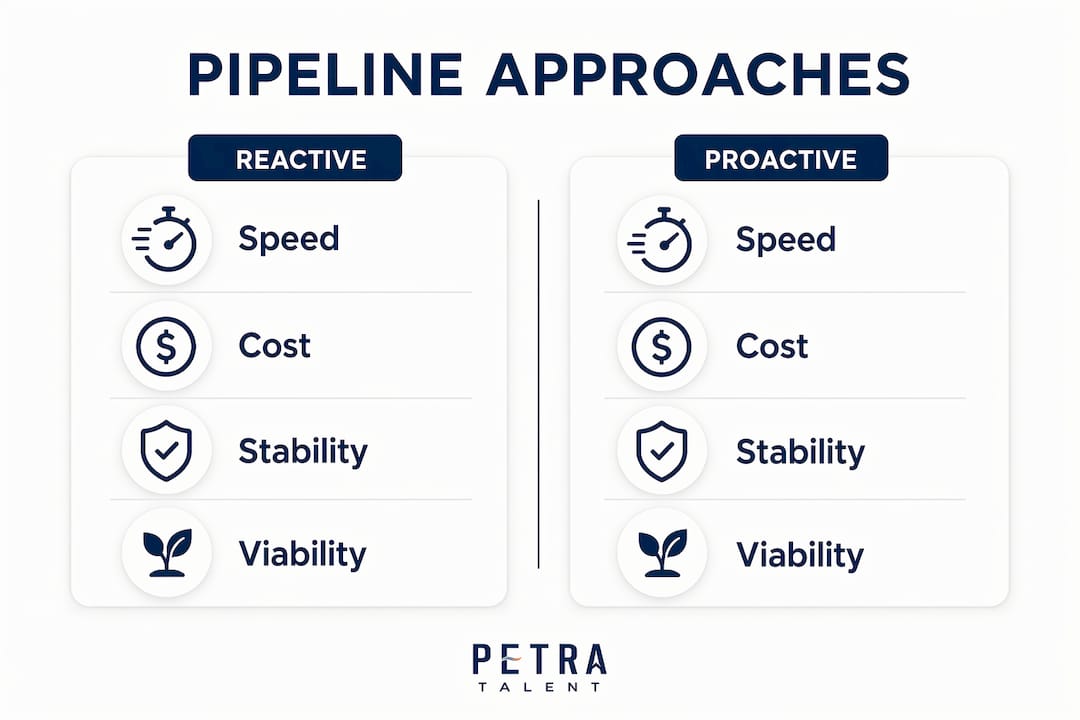
The data makes the case clearly. Contractors who invest in HVAC workforce development through structured pipelines consistently outperform those relying on reactive or poaching strategies when measured over a two-to-three year window.
What role do training programs and partnerships play in pipeline development?
Training programs are not just a source of candidates. They are the infrastructure that determines whether a pipeline produces job-ready technicians or candidates who still need significant development after hire.
Trane Technologies’ Advanced Technology Training Center (ATTC) serves as one of the clearest examples of scaled pipeline infrastructure. The ATTC trains up to 4,500 students yearly and delivers more than 100,000 training hours annually through a hybrid model combining in-person instruction with e-learning. Trane has also committed to hiring more than 1,000 additional technicians as demand for advanced HVAC systems grows. That level of throughput demonstrates what dedicated training infrastructure can accomplish at scale.
Public funding is accelerating pipeline development at the regional level. Massachusetts’ Heat Pump and HVAC Training initiative allocates up to $800,000 to community colleges and workforce programs, directly tying technician supply to the state’s clean energy building retrofit agenda. California has committed $37.2 million for apprenticeship expansion, including HVAC, with 40 to 60 percent classroom cost reimbursements and wage subsidies for first-year apprentices. Contractors who leverage these programs reduce their training costs substantially while building a more stable workforce.
Pro Tip: Join the advisory committee of at least one local HVAC training program. Advisory committee members gain early visibility into graduating cohorts and can shape curriculum to match their specific technical requirements.
Employer participation in school advisory committees gives contractors first access to top graduates and direct influence over what skills those graduates develop. This is one of the highest-return, lowest-cost pipeline investments available to most mechanical contractors.
| Training initiative | Annual capacity | Key benefit | Funding source |
|---|---|---|---|
| Trane ATTC | 4,500 students | Hybrid learning, 100,000+ hours | Private (Trane Technologies) |
| Frederick County VR program | Cohort-based | 3 certifications, simulation hours | Workforce services funding |
| Massachusetts Heat Pump initiative | Multiple colleges | Career pathway and upskilling | Up to $800,000 state funding |
| California apprenticeship expansion | Statewide | 40-60% cost reimbursement | $37.2 million state allocation |
What practical tactics can HVAC hiring managers deploy to maintain their pipelines?
Building a pipeline is one task. Keeping it active and productive requires a different set of disciplines. The following tactics address the most common points where HVAC talent pipelines stall or break down.
-
Adopt a speed-to-lead mindset. When a candidate expresses interest, respond within hours, not days. The fastest communication channel for reaching active technicians is text messaging. A delayed response often means losing the candidate to a competitor who moved faster.
-
Practice Always-Be-Recruiting (ABR). Treat recruitment as an ongoing function, not a project triggered by vacancies. Attend trade school career fairs, maintain contact with past applicants, and keep relationships warm with candidates who were not hired due to timing rather than fit. Reviewing common HVAC recruitment challenges can help hiring managers identify where their current process loses candidates.
-
Pre-qualify candidates before roles open. Conduct technical screening conversations with promising candidates even when no position is available. This creates a bench of pre-vetted talent that can be activated quickly when a role does open, directly addressing the 30-day fill time problem.
-
Balance urgency with cultural fit. Rushing a hire to fill a seat quickly often produces a bad hire that costs more to replace than the original vacancy. Evaluate both technical competency and team compatibility before extending an offer. Avoiding common hiring mistakes at this stage protects the pipeline’s long-term integrity.
-
Schedule regular pipeline reviews. Set a monthly calendar reminder to review the candidate bench, update contact information, and reach out to anyone who has gone quiet. Pipelines decay without maintenance.
Key takeaways
A sustainable HVAC talent pipeline requires proactive sourcing, structured training partnerships, and consistent candidate engagement to eliminate the costly delays of reactive hiring.
| Point | Details |
|---|---|
| Pipeline vs. reactive hiring | Proactive pipelines reduce fill times and lower per-hire costs compared to posting jobs reactively. |
| Training programs as infrastructure | Programs like Trane’s ATTC and state-funded apprenticeships produce job-ready candidates at scale. |
| Advisory committee participation | Joining school advisory committees gives contractors early access to graduates and curriculum influence. |
| Speed-to-lead communication | Texting active technicians first dramatically improves response rates and candidate conversion. |
| ABR as a discipline | Always-Be-Recruiting prevents pipeline decay and keeps a warm bench ready before vacancies appear. |
What I’ve learned about HVAC pipelines that most guides miss
After working with mechanical contractors across the country, the most consistent pattern I see is this: contractors who struggle most with hiring are not failing at sourcing. They are failing at maintenance. They build a list of candidates, get busy, and let those relationships go cold. Six months later, they are back to square one.
The contractors who hire well treat their candidate bench the same way a good technician treats a PM schedule. It gets attention on a regular cadence, not just when something breaks. The partnerships with trade schools and UA programs matter enormously, but they only pay off if someone on the team owns the relationship and shows up consistently.
The technology side of HVAC is also changing faster than most pipelines are built to handle. As heat pump systems, building automation, and refrigerant transitions accelerate, the skills required at hire are shifting. A pipeline built around yesterday’s technician profile will produce candidates who need retraining on day one. Contractors who sit on advisory committees and stay close to training program updates will adapt. Those who treat hiring as a back-office function will fall further behind.
— David
How Petratalent helps HVAC contractors build stronger pipelines
Petratalent specializes in HVAC talent acquisition for mechanical contractors who need more than a job board. The team provides role-specific candidate sourcing, technical vetting, and market wage insights designed to support both immediate placements and long-term workforce pipeline development. Whether a contractor needs a single field technician or a full leadership team, Petratalent applies a structured recruiting process built specifically for the HVAC and plumbing trades. For contractors dealing with persistent technician shortages, Petratalent’s HVAC recruiting services offer a direct path to qualified, pre-screened candidates without the overhead of managing the full pipeline internally.
FAQ
What is a talent pipeline in HVAC?
A talent pipeline in HVAC is a structured system for continuously sourcing, training, and engaging qualified technicians so contractors can fill roles quickly without starting from scratch each time a vacancy opens.
How long does it take to build an HVAC talent pipeline?
Initial pipeline relationships with trade schools and apprenticeship programs typically take three to six months to establish, but the bench of pre-vetted candidates grows steadily once sourcing and engagement processes are in place.
Why does reactive hiring fail in HVAC recruitment?
Reactive hiring produces average fill times of around 30 days and leaves contractors without coverage during peak demand. It also increases the risk of rushed hires that do not meet technical or cultural requirements.
What is the best way to engage HVAC technician candidates?
Text messaging is the most effective channel for reaching active HVAC technicians, who are typically on job sites during business hours and check texts far more frequently than email.
How do apprenticeship programs support HVAC talent pipelines?
Apprenticeship programs like those funded by California’s $37.2 million expansion provide contractors with pre-trained candidates while offering 40 to 60 percent classroom cost reimbursements, making them one of the most cost-effective pipeline investments available.
Recommended
Related Posts

July 14, 2026
How to Source Mechanical Leadership Talent Effectively
Learn how to source mechanical leadership talent effectively. Discover key skills needed for success in…
July 13, 2026
Performance-Based Screening for HVAC and Plumbing Hiring
Discover what is performance-based screening and how it enhances HVAC and plumbing hiring. Improve candidate…

July 12, 2026
Types of Plumbing Trade Certifications: A Career Guide
Explore the types of plumbing trade certifications to enhance your career. Learn how these credentials…
July 11, 2026
Why Plumbing Certifications Affect Hiring Decisions
Discover why plumbing certifications affect hiring decisions. Learn how these credentials impact wages, legal authority,…