



A competent chiller technician combines refrigeration fundamentals, mechanical repair skills, electrical and controls knowledge, and structured troubleshooting with EPA Section 608 certification, the one credential the law requires. Employers layer on NATE certification, OSHA 10/30 safety training, and OEM factory courses from Trane, Carrier, or York to separate hire-ready candidates from the rest. The rest of this guide breaks down exactly how to build that skill set and prove it on paper.
TL;DR:
- Most candidates need EPA Section 608 certification and OEM factory training from brands like Trane or Carrier to be considered hire-ready.
- Demonstrating skills in refrigeration cycles, compressor oil management, water-side system balance, and trend logging is essential for effective diagnosis.
- Electrical knowledge should include wiring diagram reading, VFD troubleshooting, and verifying BAS logic, controls, and setpoints during system testing.
- Strong documentation of troubleshooting, OEM training, and OEM certifications significantly accelerates career advancement and hiring prospects.
- Safety practices such as lockout/tagout, refrigerant handling compliance, and confined-space protocols are non-negotiable in working with large chillers.
Table of Contents
- What core technical skills does a chiller technician need?
- How important are electrical and controls skills for chillers?
- What tools and diagnostic techniques do you need to master?
- What certifications and licenses do chiller technicians actually need?
- What safety practices matter most on large-tonnage chillers?
- How do you progress from helper to chiller specialist?
- How do you prepare your résumé and ace a chiller technician interview?
- What Petra Talent sees on hire-ready chiller technician résumés
- A note on the mistakes I keep seeing
- Sources
- FAQ
What core technical skills does a chiller technician need?
Chiller work starts with the refrigeration cycle: compression, condensation, expansion, evaporation, and the pressure-temperature relationship that governs all of it. Reading a P/T chart against actual gauge readings is how you spot a system running low on charge versus one fighting a restriction, and that single skill separates technicians who guess from technicians who diagnose.
Compressor knowledge matters just as much. Centrifugal, screw, and scroll compressors behave differently under load, and each has its own oil-management demands. Oil analysis catches bearing wear and refrigerant contamination before a compressor fails outright, which is why routine preventive maintenance and oil sampling show up so often in job postings for the role.
Water-side systems round out the core skill set. Large chillers depend on condenser water loops, cooling towers, strainers, and pumps working in balance with the refrigerant circuit, and moving from small residential units to plant-level equipment means shifting attention toward hydronics, tower coordination, and oil management rather than just refrigerant charge.
Expect to demonstrate:
- Reading and interpreting P/T charts under real operating conditions
- Identifying compressor type and its specific oil and lubrication requirements
- Inspecting strainers, tower fill, and condenser water flow for fouling or scale
- Performing approach-temperature and delta-T checks across the heat exchanger
- Logging superheat and subcooling trends over multiple visits, not just one snapshot
How important are electrical and controls skills for chillers?
Chillers fail on the electrical side almost as often as they fail mechanically, so reading wiring diagrams and testing starters, contactors, and motor windings has to be second nature. A technician who can’t trace a control circuit with a multimeter will misdiagnose a controls fault as a mechanical one, and that mistake costs hours.
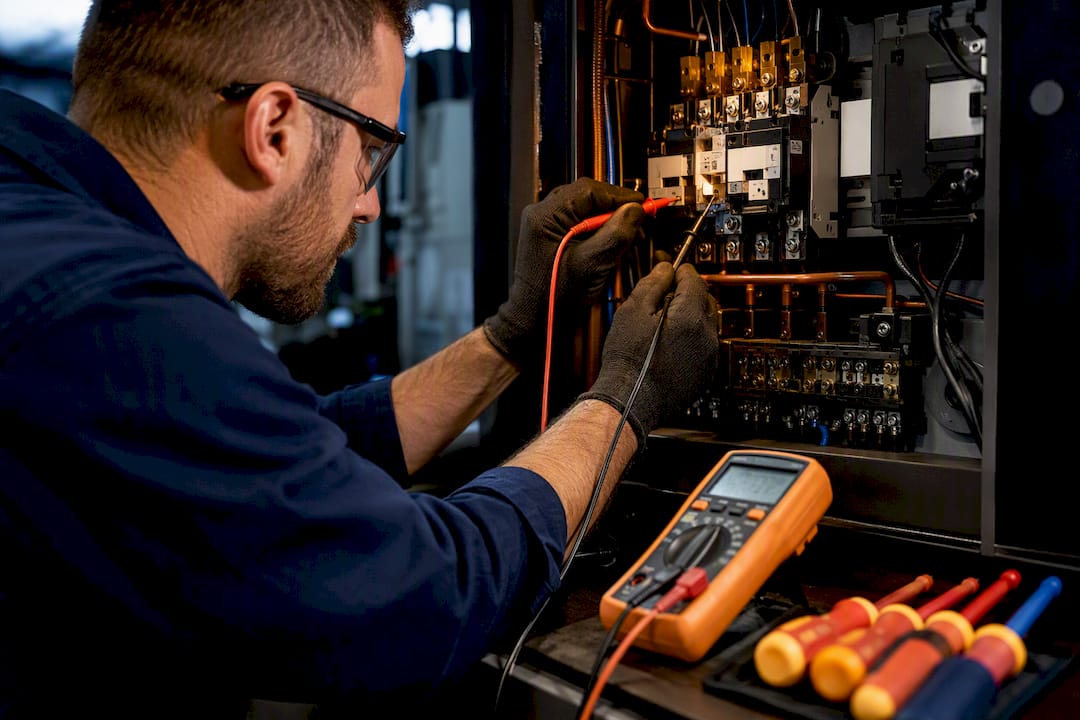
Variable frequency drives (VFDs) add another layer. Commissioning checks, fault-code diagnostics, and confirming output frequency matches commanded speed are routine tasks on modern equipment, and a tripped drive often mimics a compressor problem until you check the fault log.
Building automation systems (BAS) tie it all together. You don’t need to be a programmer, but you need working familiarity with platforms like Tridium Niagara, Johnson Controls Metasys, or Siemens Desigo, since sequence-of-operation logic explains symptoms that look mechanical but aren’t.
- Verify motor amperage against nameplate values before assuming a mechanical fault
- Check VFD fault history and output frequency during startup
- Confirm BAS setpoints and staging logic match the actual sequence of operation
- Trace low-voltage control circuits when a chiller won’t start or short-cycles
What tools and diagnostic techniques do you need to master?
Digital manifold gauges, vacuum pumps, refrigerant recovery machines, and electronic leak detectors are the baseline toolkit for any technician who plans to work on commercial refrigerant charges. Predictive tools, including vibration analyzers, oil sampling kits, and thermal imaging cameras, catch bearing wear and electrical hot spots before they turn into failures, and knowing when to reach for each one is a skill in itself.
Effective troubleshooting follows a sequence:
- Isolate the mechanical side first: check charge, oil level, and compressor operation
- Move to electrical: test motor windings, starters, and control voltage
- Check controls last: verify BAS setpoints and sequence logic against actual behavior
- Cross-reference trend data against the P/T chart before condemning a component
- Coordinate with tower and BAS teams during startup to rule out false negatives from outside the chiller itself
Pro Tip: Keep a personal log of every fault you diagnose, including the symptom, the root cause, and the fix. Six months of documented troubleshooting is worth more in an interview than a résumé line that just says “chiller experience.”
What certifications and licenses do chiller technicians actually need?
EPA Section 608 certification is the legal floor. You cannot legally purchase or handle refrigerants without it, and there are four levels, with Universal certification being the one most chiller technicians pursue early since it covers the full range of equipment types they’ll encounter on commercial jobs.
Beyond that legal minimum, credentials become a competitive question rather than a legal one:
- OSHA 10-hour or 30-hour safety training, expected on most commercial and industrial job sites
- NATE certification, which signals verified technical competence to employers even though it isn’t mandated
- RSES membership and coursework, useful for technicians building toward senior or specialist roles
- State-specific licensing requirements, which vary significantly, so check your state’s contractor licensing board directly rather than assuming a neighboring state’s rules apply
- Manufacturer factory training from OEMs like Trane, Carrier, or York, often required before a technician can work independently on that brand’s centrifugal or screw chillers
The Bureau of Labor Statistics lists mechanical aptitude, math, detail orientation, customer service, and problem-solving among the core qualities that separate strong HVACR candidates from weak ones, and that list holds up well against what contractors say they actually screen for. Recertification expectations vary by credential, so track renewal dates the same way you’d track a driver’s license.
What safety practices matter most on large-tonnage chillers?
Large chillers carry serious refrigerant volumes, high-voltage electrical panels, and confined mechanical rooms, and mistakes in any of the three carry real consequences. Refrigerant recovery and charging must follow environmental handling rules to the letter, since venting refrigerant is both illegal and expensive to clean up.
Lockout/tagout procedures, confined-space protocols for equipment rooms, and proper PPE for cooling tower and plant-room work aren’t optional extras. They’re the baseline expectation on any commercial job site.
- Follow lockout/tagout procedures on every electrical panel before opening it, no exceptions for “quick” checks
- Treat mechanical rooms and cooling towers as confined spaces requiring proper ventilation checks
- Keep refrigerant logs current and accurate, since incomplete documentation creates liability for both technician and employer
- Report near-misses and incidents promptly rather than letting them go undocumented
How do you progress from helper to chiller specialist?
Most technicians reach basic chiller exposure within 6 to 12 months on the job, but real independence takes longer. Formal apprenticeships typically run 3 to 5 years, and senior specialist status, the kind that gets you working solo on centrifugal or magnetic-bearing equipment, usually requires 7 to 10 years combined with OEM certifications.
- Complete EPA 608 Universal and at least one OSHA safety course in your first year
- Pursue NATE certification once you have hands-on experience to back it
- Add OEM factory training (Trane, Carrier, York, Daikin) as you gain exposure to their specific equipment
- Document every commissioning report, failure analysis, and OEM badge, since that paper trail is what actually moves you up faster than tenure alone
Specializations like ammonia systems or magnetic-bearing centrifugal chillers carry their own certification and experience requirements, and building an apprenticeship pipeline with a contractor who invests in OEM training tends to accelerate that timeline considerably.
How do you prepare your résumé and ace a chiller technician interview?
Your résumé should lead with EPA 608 status, OSHA training, and any OEM courses completed, followed by measured achievements rather than vague duty statements. “Reduced compressor downtime by tracking oil analysis trends” beats “performed maintenance” every time.
- List certifications first, in order of relevance: EPA 608, OSHA, NATE, then OEM badges
- Prepare two or three short troubleshooting stories that show your diagnostic sequence, not just the fix
- Bring physical evidence: service logs, commissioning reports, or photos of completed work
- Research apprenticeship programs and manufacturer-sponsored classes through local union halls or OEM dealer networks before you interview, so you can speak to your training plan
Interviewers commonly ask how you’d approach a chiller that’s short-cycling or a compressor that trips on high pressure. Answer with your sequence: mechanical first, electrical second, controls last, and reference the documented logs that back up your process.
What Petra Talent sees on hire-ready chiller technician résumés
Petra Talent reviews technical résumés across HVAC and plumbing contractors daily, and EPA 608 combined with documented field troubleshooting consistently separates interview-ready candidates from the pile. Reliability and a clear paper trail, not just a certification list, is what gets a candidate through technical vetting.
Contractors serious about building a pipeline should look at structured apprenticeship programs and sponsor OEM training early, since technical screening works best when candidates arrive with documented, verifiable experience rather than a generic job history.
A note on the mistakes I keep seeing
The most common mistake I see is under-documentation. Technicians with strong field skills lose interviews because they can’t produce logs, commissioning reports, or specific troubleshooting examples. If you do one thing this year, get your EPA 608 Universal certification and enroll in one OEM course. That combination opens more doors than years of undocumented experience ever will.
— David
Sources
- Heating, Air Conditioning, and Refrigeration Mechanics and Installers : Occupational Outlook Handbook: : U.S. Bureau of Labor Statistics
- What Certifications Do I Need To Be An HVAC Technician? — Lincoln Tech
- Chiller technician career path — CommercialHVACJobs
- Chiller Technician – CalTek Staffing
FAQ
What Are the Five Skills a Chiller Technician Should Have?
Mechanical aptitude, electrical diagnostic skill, controls and BAS familiarity, refrigerant handling knowledge, and strong documentation habits form the core skill set most employers screen for.
What Are the Responsibilities of a Chiller Technician?
Chiller technicians perform preventive maintenance, leak detection, refrigerant recovery and charging, compressor and pump repairs, and work with BAS platforms and OEM equipment on a routine basis.
How Much Do Chiller HVAC Technicians Make?
Pay varies by region, experience, and specialization, and it’s not publicly listed as a single flat national figure. Check the Bureau of Labor Statistics for current wage data by metro area and experience level.
What Skills Are Needed to Become a Chiller Technician?
EPA Section 608 certification is mandatory, and strong candidates pair it with mechanical, electrical, and controls knowledge alongside OSHA safety training and, ideally, NATE certification or OEM factory courses.
How Long Does It Take to Become a Chiller Specialist?
Basic chiller exposure typically comes within 6 to 12 months, formal apprenticeships run 3 to 5 years, and senior specialist status usually takes 7 to 10 years plus OEM certifications.
Recommended
Post a comment
Related Posts

September 20, 2026
Construction Offer Letters for HR: Site Assignments, Certs, Petra Tips
HR ready construction offer letters: copy ready language for site assignments, certs, contingencies, and a…

September 19, 2026
Create E-Verify Cases by Day Three: U.S. HVAC & Plumbing Rules
E-Verify for U.S. HVAC and plumbing contractors: who needs I-9s, the three business day case…
September 18, 2026
72.5¢ Rate: Take Home Vehicle Policy for Employers and Agencies
Checklist and policy language for employers and agencies: apply the IRS 2026 mileage rate (72.5…

September 17, 2026
Avoid Overtime Back-Pay: Job-to-Job Travel Pay for U.S. Technicians
U.S. employers: learn DOL/WHD travel-pay tests, a blended rate overtime example, state pitfalls, and Petratalent…