



Send a short, written offer letter with the job title, pay rate, start date, worksite, and a clear contingency list, then attach a signed PDF with a stated acceptance deadline. That single document, built from an annotated template rather than a generic form, prevents most post-hire disputes. Petra Talent and industry checklists like SHRM’s both point to the same fix: standardize the letter, don’t improvise it.
TL;DR:
- Construction offer letters should specify project site, travel requirements, and necessary credentials as pre-start contingencies to prevent confusion or turnover.
- Including clear details on pay structure, overtime, benefits, and at-will language in separate sections reduces legal and onboarding risks.
- Tailoring templates for different roles—hourly labor, supervisors, or management—ensures clarity and compliance across diverse job types.
- Verifying licenses and certifications before extending offers minimizes delays and ensures onboarding stays on track.
- Standardized templates, supported by verbal confirmation and timely document collection, improve consistency and reduce disputes in construction hiring.
Table of Contents
- What Templates Work Best for Offer Letters in Construction?
- What Should Be Written in a Construction Offer Letter?
- Which Clauses Are Unique to Construction Hiring?
- Can You Copy This Annotated Offer Letter?
- How Do You Send the Offer and Track Acceptance?
- What Do Recruiters See Go Wrong With Construction Offers
- The Templates Aren’t the Hard Part
- Get Help Standardizing Your Hiring, Not Just Your Paperwork
- Authoritative Templates and HR Resources
- Sources
- FAQ
What Templates Work Best for Offer Letters in Construction?
Different roles need different letter formats. A field laborer paid hourly doesn’t need the same document as a salaried project manager, and treating them identically creates confusion on both sides.
- Field hourly labor: A one-page letter stating hourly rate, shift schedule, and jobsite address. Deliver as a PDF with e-signature; pair with a full employment agreement only if the role involves specialized equipment liability.
- Foreman/superintendent: Add a section on site oversight duties and reporting lines. These roles often benefit from a short addendum covering multi-site rotation.
- Salaried project manager: Include benefits eligibility, PTO accrual, and bonus structure. This role almost always warrants a companion employment agreement referenced in the letter.
- Short contract/temporary: State the end date or project completion trigger explicitly. Skip benefits language entirely to avoid implying permanent status.
Adjust tone for your state’s pay transparency rules. Several states now require salary ranges or specific hourly rates listed upfront rather than “competitive pay” language, so check your state labor department before finalizing wording.
What Should Be Written in a Construction Offer Letter?
A compliant offer letter covers four categories: identity, compensation, terms, and administration. Miss one and you invite a dispute or a delayed start.
- Core fields: job title, start date, worksite address, reporting manager, expected weekly hours.
- Compensation details: base pay or hourly rate, overtime eligibility, per diem for travel days, and any bonus or commission language stated as discretionary rather than guaranteed.
- Employment terms: at-will status, contingencies (background check, I-9 verification, drug screen), a one-line benefits summary, and PTO accrual if applicable.
- Administrative items: acceptance deadline, signature block naming who signs on the company’s behalf, and return instructions (email, e-sign portal, or physical mail).
Most U.S. offer letters follow this same structure: position, start date, compensation, contingencies, at-will language, benefits, and a clear acceptance deadline. Skipping the contingency section is the most common construction-hiring mistake. Employers assume a background check is understood, then get stuck when a candidate treats the verbal offer as final before that check clears.
Pro Tip: Put the at-will statement in its own short paragraph, not buried inside the compensation section. Courts and candidates both read isolated language as more deliberate, which reduces the odds of it being challenged as accidental.
Which Clauses Are Unique to Construction Hiring?
Generic offer letter templates miss the clauses that actually matter on a jobsite. Construction hires expect specifics that office-based templates never anticipate.
- Project and site assignment: name the initial jobsite and state whether the role involves rotation across multiple sites or travel requirements, including any percentage of travel expected.
- Required credentials: list OSHA 10 or OSHA 30 completion, trade licenses, or CDL requirements, and state whether verification is a pre-start contingency.
- Safety and site access: reference drug and alcohol testing policy, PPE obligations, and any site-specific access or badge requirements.
- Schedule variables: address overtime rules, how weather delays affect pay, and whether on-call rotation is part of the role.
Job postings for construction roles frequently spell out certification and travel expectations up front. Offer letters that skip this detail push the confusion to week one, when it’s harder and more expensive to fix. Ambiguity between what a supervisor promised verbally and what the letter states in writing is one of the most frequent drivers of early turnover on construction crews.
Can You Copy This Annotated Offer Letter?
Below is a one-page template built for a field or supervisory construction role. Copy it, swap the bracketed placeholders, and adjust the compensation section for hourly versus salaried structure.
Dear [Candidate Name],
[Company Name] is pleased to offer you the position of [Job Title], reporting to [Manager Name] at our [Worksite/Project Name] location. Your anticipated start date is [Date].
This position is [hourly at $/hour / salaried at $/year], paid [weekly/biweekly]. You will be eligible for overtime per applicable law. This offer includes [benefits summary line] and [PTO accrual line].
This offer is contingent upon successful completion of a background check, verification of I-9 eligibility, a negative drug screen, and confirmation of [required certification/license]. Employment with the company is at-will, meaning either party may end the relationship at any time, for any lawful reason.
Please sign and return this letter by [Date, typically 3 to 5 business days out]. Full terms are outlined in the attached Employment Agreement / Employee Handbook.
- The at-will paragraph sits alone so it reads as intentional, not buried boilerplate.
- Contingencies are listed together, ahead of the signature line, so the candidate can’t claim they missed them.
- The acceptance deadline forces momentum. Without one, candidates sit on offers while shopping competing bids.
Reference a full employment agreement whenever the role involves equipment liability, non-compete terms, or executive-level compensation. A short letter plus a referenced agreement is standard practice for nearly every hire below the executive tier.
How Do You Send the Offer and Track Acceptance?
Sequence matters more than most hiring managers assume. Skipping the verbal step and jumping straight to a PDF often reads as impersonal in a trades market where relationships close deals.
- Call first. A quick verbal offer confirms interest and surfaces objections before you draft paperwork.
- Send the written offer. Email a signed PDF with an e-signature link and a firm acceptance deadline, typically 3 to 5 business days for field roles and up to a week for leadership hires.
- Collect pre-start items. I-9 documentation, W-4, drug screen receipt, and certification proof should all be in hand before day one.
- Confirm first-day logistics. Site address, reporting time, and required PPE should go out once acceptance is signed.
Shorter acceptance windows help in tight labor markets where candidates are fielding multiple offers simultaneously.
What Do Recruiters See Go Wrong With Construction Offers
Inconsistent offer letters create legal exposure and onboarding friction, particularly when different supervisors draft their own versions with different promises baked in. Standardizing the template across every hire, regardless of who manages the requisition, closes that gap.
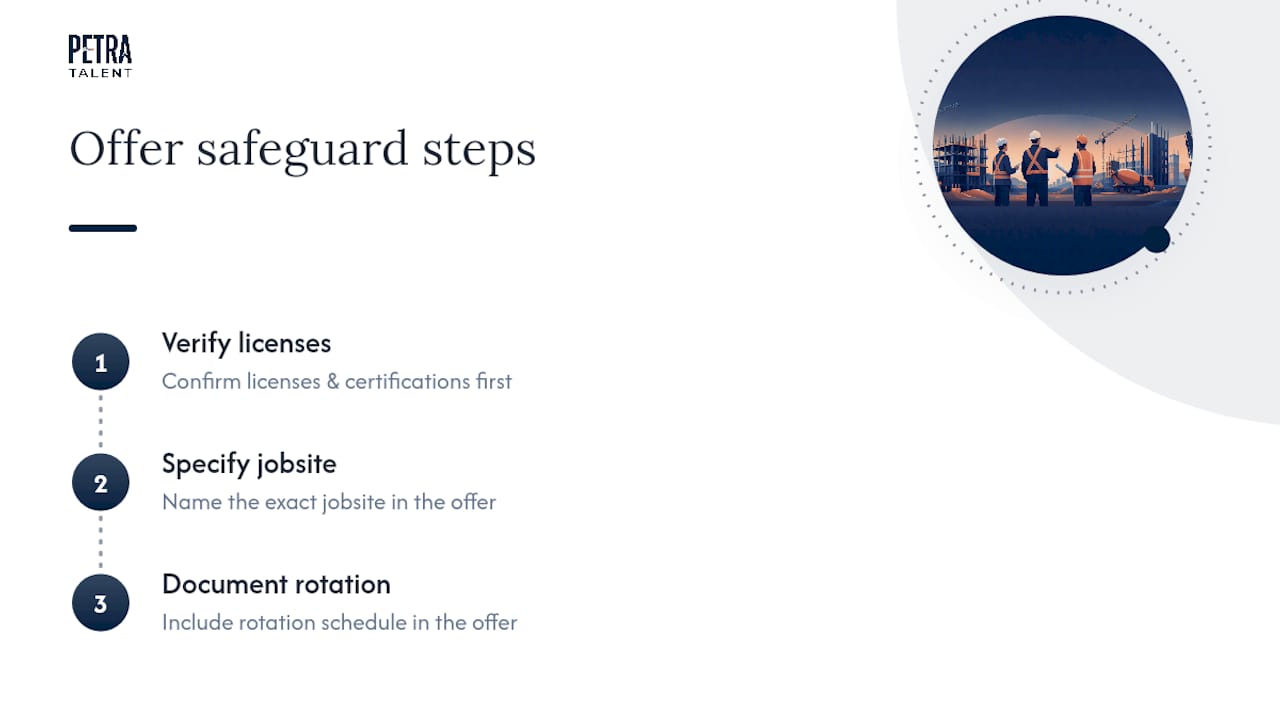
Technical vetting before the offer goes out matters just as much as the letter itself. Verifying licenses and certifications ahead of time reduces the chance a conditional acceptance falls apart during onboarding, which shortens time to productivity on the crew. One practical fix: name the specific jobsite and any rotation schedule directly in the offer, not in a separate onboarding email sent later.
The Templates Aren’t the Hard Part
Most offer letter guides treat construction hiring like office hiring with a hard hat added. That’s backwards. The real risk in trades hiring isn’t the paperwork format, it’s the gap between what a site supervisor promises on a phone call and what actually lands in writing.
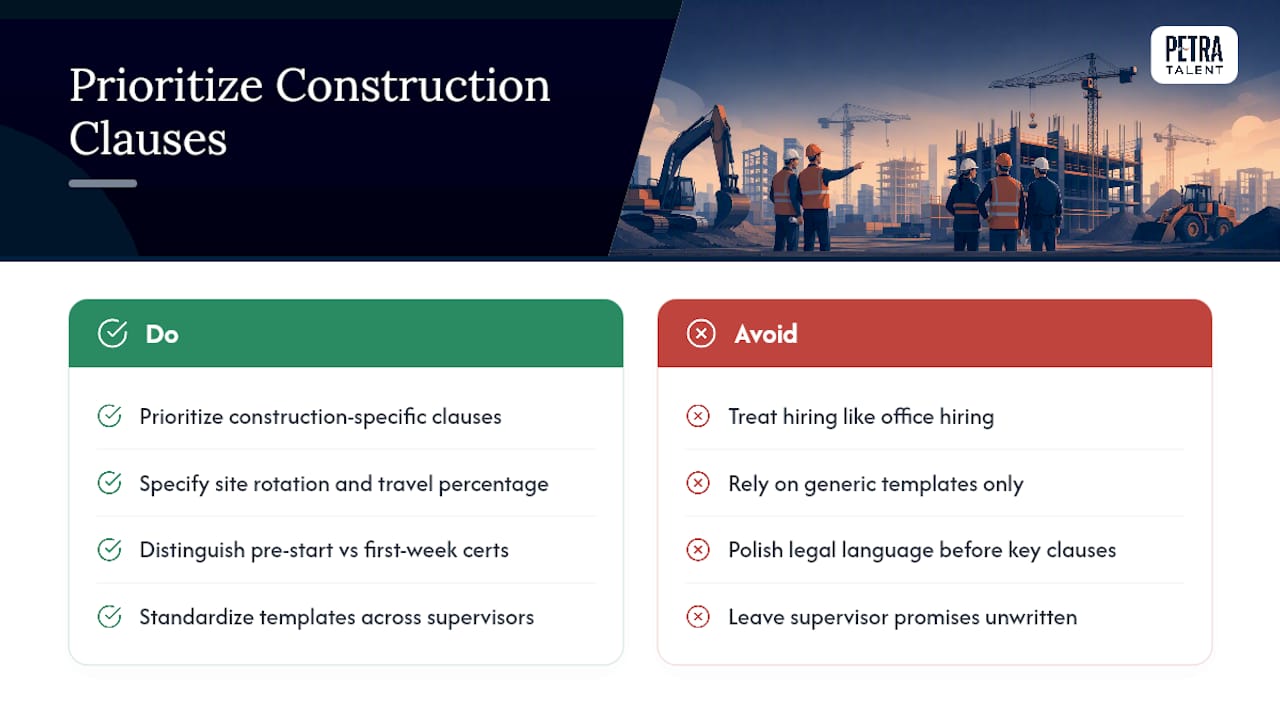
Generic templates handle pay and at-will language fine. They almost never handle site rotation, travel percentage, or which certifications are pre-start contingencies versus first-week paperwork. That’s where construction hires actually walk away or show up confused. A perfectly worded at-will clause means nothing if the candidate accepted believing they’d work one site and shows up assigned to three.
Prioritize the construction-specific clauses before polishing legal language. Standardize the template so every supervisor sends the same structure. The letter is a communication tool first and a legal document second, and treating it only as the latter is how most disputes start.
— David
Get Help Standardizing Your Hiring, Not Just Your Paperwork
There are alternatives to building your hiring process from scratch: rather than drafting templates, chasing certifications, and hoping a candidate’s background check clears before your acceptance deadline expires, you can work with partners who vet technical credentials before candidates reach the offer stage.

Engaging Petra Talent typically means direct-hire placement support, technical vetting on licenses and certifications, and market wage guidance so your compensation section doesn’t need guesswork. Placement runs on an 18% one-time placement fee, paid only on a successful hire. If you’re hiring HVAC or plumbing trades and want fewer post-offer surprises, look at HVAC Recruiting Services or schedule a conversation about how vetted candidates move faster from offer to start date.
Authoritative Templates and HR Resources
For jurisdiction-specific clauses, Workable’s offer letter format and Doxuno’s template cover legal phrasing. Track site assignments in Bidware’s project management software to keep offer details consistent with actual scheduling.
Sources
- Formal job offer: Sample offer letter format — Workable
- Free offer letter template & AI generator | Dropfile
- Job offer letter template (US) — Doxuno
- Civil Engineer Construction Manager — Leidos (job posting)
FAQ
What Are Red Flags in a Construction Offer Letter?
Watch for missing contingency language, vague pay descriptions like “competitive rate” without a number, and no stated acceptance deadline. A letter that omits at-will language or buries site assignment details is also a warning sign, since it usually means the terms weren’t thought through before being sent.
Does an Offer Letter Mean You’re Hired?
Not automatically. Most offer letters are contingent on background checks, I-9 verification, and drug screens clearing first, so signing the letter starts the process rather than finalizing employment. The at-will clause also means either party can end the relationship after start, regardless of the offer’s terms.
What Does a Proper Construction Offer Letter Look Like?
A proper letter fits on one page: job title, pay rate, start date, worksite, contingencies, at-will language, and an acceptance deadline. Construction-specific versions add site assignment, required certifications, and travel expectations that generic templates skip.
What Should Be Written in an Offer Letter?
At minimum, include position, start date, compensation, contingencies like background checks and I-9 verification, at-will status, a benefits summary, and a signature deadline. Construction roles should also state the worksite, any travel or rotation requirements, and required licenses or safety certifications.
Can Petra Talent Help With Offer Letter Templates?
Petra Talent focuses on vetting and placing skilled trades candidates rather than drafting legal documents, but its technical vetting process confirms certifications before an offer goes out, which reduces the chance a conditional offer falls through.
Recommended
Post a comment
Related Posts

September 19, 2026
Create E-Verify Cases by Day Three: U.S. HVAC & Plumbing Rules
E-Verify for U.S. HVAC and plumbing contractors: who needs I-9s, the three business day case…

September 18, 2026
72.5¢ Rate: Take Home Vehicle Policy for Employers and Agencies
Checklist and policy language for employers and agencies: apply the IRS 2026 mileage rate (72.5…

September 17, 2026
Avoid Overtime Back-Pay: Job-to-Job Travel Pay for U.S. Technicians
U.S. employers: learn DOL/WHD travel-pay tests, a blended rate overtime example, state pitfalls, and Petratalent…

September 16, 2026
Chiller Technician Skills Employers Check on Resumes and in Interviews
Employer tested checklist for chiller technicians: refrigeration, electrical and controls, EPA 608, OSHA/NATE, plus resume…