



Ordinary home-to-work commuting is generally not compensable. Travel during the workday, job-to-job driving, and company-required trips that cut into normal working hours are compensable under the Department of Labor’s travel time guidance and the Portal-to-Portal Act. Employers who miss this distinction routinely underpay overtime without realizing it.
TL;DR:
- Travel during the workday or between job sites is compensable, but ordinary home-to-work commuting is generally unpaid unless a company practice or contract states otherwise.
- Employers must calculate overtime pay on a blended regular rate that considers multiple pay rates for the same week, avoiding underpayment or miscalculations.
- State laws may impose stricter travel pay rules than federal regulations, requiring employers to review local requirements and update policies accordingly.
- Proper documentation, clear policies, and route optimization are key to reducing travel time expenses and preventing wage disputes.
- Placing technicians closer to service areas or using workforce vetting can significantly lower travel-related costs before payroll calculations.
Table of Contents
- Federal Travel Time Pay Rules Technicians Are Covered By
- How Travel Time Pay Rules Apply to Real Technician Schedules
- Calculating Travel Pay and Overtime Without Getting It Wrong
- State Rules Can Be Stricter Than Federal Law
- Building a Travel Pay Policy That Actually Holds Up
- Reducing Travel Exposure Through Smarter Hiring
- Getting the Rules Right Without Losing Technicians
- A Workforce Fix for Travel Cost Petratalent Delivers
- Sources
- FAQ
Federal Travel Time Pay Rules Technicians Are Covered By
The Fair Labor Standards Act treats most travel that happens during work hours as hours worked, but the Portal-to-Portal Act carves out an exception for ordinary commuting. Getting the two statutes straight is the whole game for HR teams managing hourly technicians.
Three regulations do the heavy lifting:
- 29 C.F.R. § 785.35 covers normal home-to-work travel. A technician driving from home to the first job of the day is not on the clock, even if the drive runs 45 minutes.
- 29 C.F.R. § 785.38 addresses travel between job sites during the workday. Once a technician starts working, every trip from one site to the next counts as hours worked.
- 29 C.F.R. § 785.39 governs travel away from home on overnight assignments, which is compensable when it falls within the employee’s normal working hours, even on a non-work day.
The Portal-to-Portal Act (29 U.S.C. § 254) is what allows employers to exclude ordinary commuting in the first place. It also means an employer can voluntarily make that commute compensable through a contract, custom, or practice, and once that commitment exists, it becomes enforceable. The WHD Fact Sheet #22 restates this same job-to-job standard, and the Department of Commerce echoes it for its own workforce, which tells you this isn’t an isolated interpretation limited to one agency.
How Travel Time Pay Rules Apply to Real Technician Schedules
Federal statutes read abstractly until you match them against an actual dispatch schedule. Here’s how the rules play out in the situations HR departments run into most often:
- Job-to-job travel during the workday. A technician who finishes an install at 10 a.m. and drives 30 minutes to the next appointment is working during that drive. It counts as hours worked, full stop.
- Home-to-first-job commute. Generally unpaid, with one major exception: if the technician loads a company truck, checks in parts inventory, or handles dispatch calls before leaving the driveway, that prep work converts the trip into compensable travel.
- Employer-provided vehicles. Driving a company vehicle home does not, by itself, create paid time, as long as the drive stays within the normal commuting area and any personal use restrictions are documented.
- Same-day special assignments. Send a technician to a job outside their usual territory and back the same day, and the employer must pay the travel time, minus whatever time the employee’s ordinary commute would have taken.
- Overnight travel. Time spent traveling as a passenger during normal working hours is compensable, even on a Saturday, per the WHD opinion letter from April 2018, which walks through several of these exact scenarios.
- Work performed en route. Answering dispatch calls, filing paperwork, or coordinating parts pickups while driving turns that segment of the trip into paid time, regardless of the general commuting rule.
Calculating Travel Pay and Overtime Without Getting It Wrong
Every paid travel hour counts toward the 40-hour overtime threshold, the same as a wrench-turning hour on a job site. That single fact is where a lot of payroll systems quietly break.
The complication shows up when a technician earns two different rates in the same week, say, a full hourly rate for repair work and a lower, pre-announced rate for drive time. The FLSA still requires overtime to be calculated on a weighted average regular rate, not on whichever rate happened to apply during the overtime hour.
Statistic Callout: The blended-rate math employers skip. Say a technician works 35 hours at $28/hour and 8 hours of travel at $15/hour in one week, for 43 total hours. Total straight-time pay is $980 plus $120, or $1,100. Divide by 43 hours to get a regular rate of about $25.58. Overtime on the 3 hours over 40 is paid at 1.5 times that blended rate, not at $28 or $15 alone. McDonald Hopkins points out this weighted-average step is the one contractors most often skip or miscalculate.
To stay clean on this, employers should:
- Track travel hours separately from job hours in the payroll system, not lump them together, following a thorough Zeitarbeit Compliance Checkliste for documentation best practices.
- Recalculate the regular rate weekly whenever more than one pay rate applies.
- Confirm the blended rate never dips below the applicable minimum wage.
- Audit payroll quarterly, since the Bradley law firm’s guidance treats this as a standard wage-and-hour safeguard for field service employers.
State Rules Can Be Stricter Than Federal Law
Federal law is the floor, not the ceiling. Several states apply broader definitions of compensable travel or impose stricter timekeeping obligations than the FLSA does, so a policy that passes federal muster can still violate state law.
Before finalizing or changing a travel pay policy, run through this checklist:
- Confirm your state labor department’s specific rules on travel time, portal-to-portal exclusions, and reporting-time pay.
- Review any collective bargaining agreements or written employment contracts for travel pay language that may exceed federal minimums.
- Recalculate minimum wage and overtime compliance under state formulas, which sometimes differ from the federal weighted-average method.
- Document any policy change in writing and notify affected technicians before it takes effect.
- Keep time records detailed enough to reconstruct a technician’s full day if a wage claim arises.
Pro Tip: Bookmark your state labor department’s wage-and-hour division page and check it whenever you touch travel pay policy. State agencies update guidance more often than most contractors expect, and an outdated assumption is what typically triggers a claim.
Building a Travel Pay Policy That Actually Holds Up
A written policy prevents more disputes than any payroll software feature. It should define, in plain terms, what counts as compensable travel, what rate applies to it, how technicians log it, and what the rules are for company vehicles.
Strong policies include:
- A clear definition of the normal commuting area, so employees know exactly when a trip crosses into compensable territory.
- Written vehicle-use agreements for anyone driving a company truck home, spelling out personal-use limits.
- Advance written notice of any travel-specific pay rate, since the McDonald Hopkins commentary confirms employers can pay a lower rate for travel, but only with notice given before the work occurs.
- A consistent method for logging travel time, whether that’s GPS timestamps, a dispatch app, or manual entry reviewed weekly.
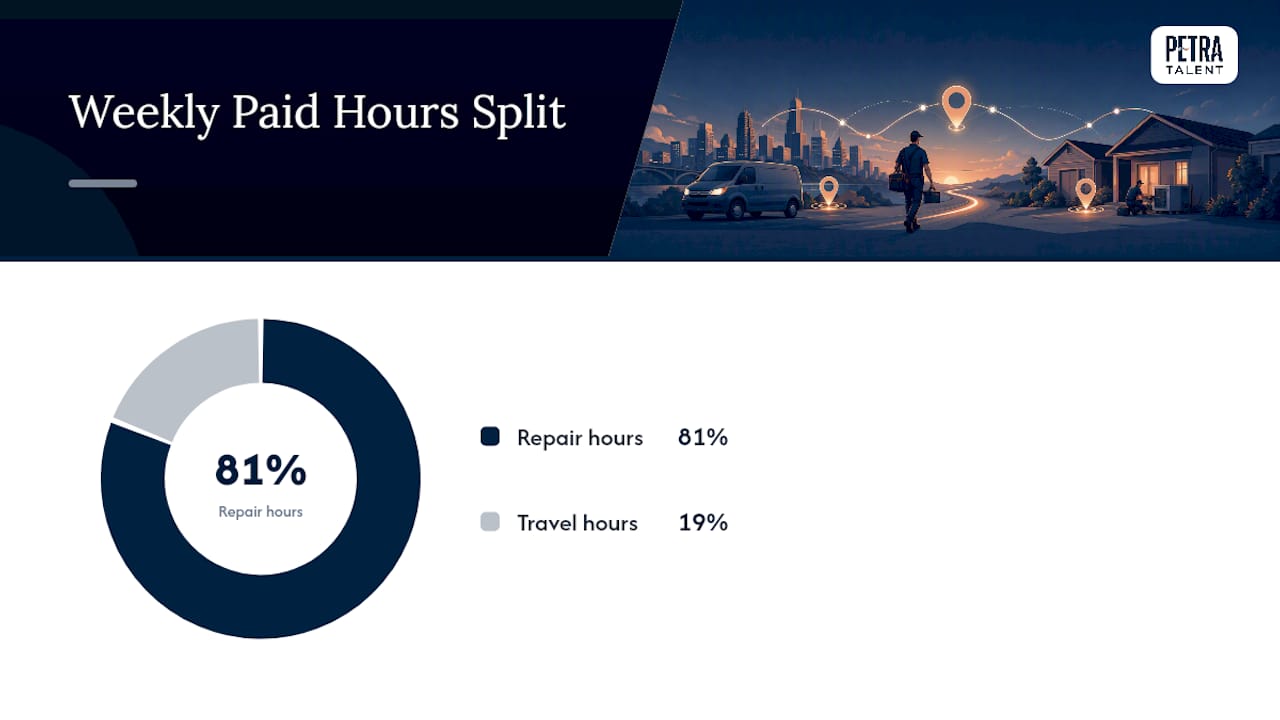
On the operations side, windshield time commonly eats 15% to 30% of a technician’s paid workday, and best practice is keeping it under a target percentage through route clustering and tighter scheduling. Some contractors recover part of that cost through travel surcharges or minimum-visit fees rather than cutting technician pay, which sidesteps FLSA exposure entirely.
Pro Tip: Route density matters as much as pay rate math. Two technicians covering tight, overlapping territories will always cost less in travel liability than one technician crisscrossing a sprawling service area.
Reducing Travel Exposure Through Smarter Hiring
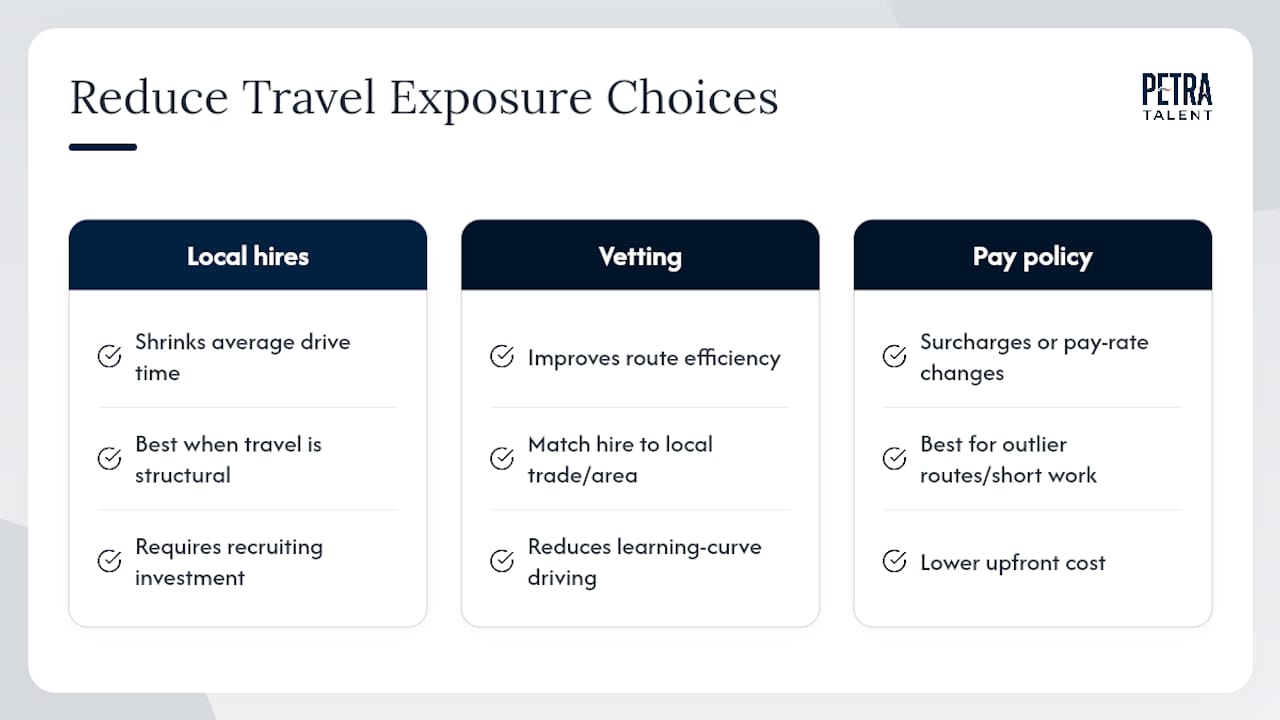
Payroll fixes only go so far when the underlying problem is geography. Hiring technicians who live closer to your densest service clusters shrinks average drive time before any pay calculation even applies, and Petratalent’s market wage insights help contractors see whether local hiring or pay-policy adjustment solves the problem more affordably.
Technical vetting also plays a role here: a well-matched hire who already knows the territory or trade tends to run tighter routes than someone learning the market. Recruiting is worth the investment when travel costs are structural; surcharges and pay-rate changes are the better fix when the issue is a single outlier route or short-term project.
Getting the Rules Right Without Losing Technicians
Compliance here is rarely the hard part. The hard part is running a payroll system precise enough to catch a blended overtime rate every single week without an HR team spending hours on it.
What separates contractors who avoid wage claims from those who get burned is transparency: technicians who understand exactly how their travel pay works file far fewer disputes than ones left guessing. Routine payroll audits catch blended-rate errors before they become six-figure back-pay claims. None of this replaces smart workforce planning, which is where reducing travel exposure at the hiring stage starts to matter.
*— David
A Workforce Fix for Travel Cost Petratalent Delivers
Adjusting pay rates and auditing payroll only manages travel cost after the fact. Petratalent tackles it at the source: placing technicians whose home base actually fits your service territory, so windshield time shrinks before it ever hits a paycheck.

Petratalent’s HVAC Recruiting Services and Plumbing Recruiting Services build candidate pools around your actual service map, not a generic job board radius. Technical vetting confirms a candidate can handle the route and the trade before you extend an offer, and workforce consultation helps contractors decide whether the smarter fix is hiring closer to the work or restructuring travel pay. Placement runs on a straightforward one-time fee model, no long-term retainer required.
If travel exposure keeps showing up in your payroll audits, start by reviewing your open technician roles with Petratalent’s recruiting team and see what a tighter service map could save.
Sources
FAQ
Is My Employer Required to Pay Me for Travel Time?
Yes, when the travel happens during the workday, between job sites, or on a required special assignment. Ordinary home-to-work commuting is generally unpaid unless a contract or company practice makes it compensable.
What Are the Highest-Paying Travel Tech Jobs?
Roles that combine specialized licensing with heavy multi-site travel, such as senior HVAC service technicians and industrial refrigeration specialists, tend to command the highest pay. Petratalent’s leadership and management search placements often reflect this premium for technicians who also supervise multi-site routes.
How Much Do You Charge for Travel Time?
There’s no single national rate. Employers can lawfully pay a lower, pre-announced rate for travel time, but must still meet minimum wage and calculate overtime using a weighted-average regular rate across all hours worked that week.
What Is the 7-Minute Rule for Employees?
The rounding rule refers to a common timekeeping practice where time worked is rounded to the nearest quarter hour. It applies to general timekeeping, not specifically to travel time compensability.
Recommended
Post a comment
Related Posts

September 20, 2026
Construction Offer Letters for HR: Site Assignments, Certs, Petra Tips
HR ready construction offer letters: copy ready language for site assignments, certs, contingencies, and a…

September 19, 2026
Create E-Verify Cases by Day Three: U.S. HVAC & Plumbing Rules
E-Verify for U.S. HVAC and plumbing contractors: who needs I-9s, the three business day case…

September 18, 2026
72.5¢ Rate: Take Home Vehicle Policy for Employers and Agencies
Checklist and policy language for employers and agencies: apply the IRS 2026 mileage rate (72.5…

September 16, 2026
Chiller Technician Skills Employers Check on Resumes and in Interviews
Employer tested checklist for chiller technicians: refrigeration, electrical and controls, EPA 608, OSHA/NATE, plus resume…