



Seasonal hiring for HVAC contractors comes down to three moves executed in order: respond to candidates within hours, gate every applicant on EPA Section 608 before you screen anything else, and start the process about two to three months before your demand curve turns up. Contractors who forecast capacity instead of reacting to it avoid the overtime spiral entirely. Petra Talent builds this exact process for mechanical contractors who need it running faster than they can build it alone.
TL;DR:
- Starting hiring 8 to 10 weeks before peak season allows building a qualified technician pipeline through multiple sourcing channels for faster deployment.
- Credential gate on EPA Section 608 certification and a structured three-step screening process ensure quality hires without unnecessary delays.
- Pre-booking subcontractor capacity and scheduling shoulder-season work help maintain productivity during demand fluctuations and avoid costly last-minute staffing.
- Local labor market conditions and regional wage benchmarks significantly influence sourcing strategies and pay ranges during seasonal hiring.
- Effective management includes frequent performance checks, motivational incentives, and clear communication to retain seasonal hires and prepare them for future work.
Table of Contents
- What Does a Seasonal HVAC Hiring Sprint Actually Require?
- When Should You Start Hiring Before Peak Season?
- Which Sourcing Channels Actually Deliver Qualified HVAC Technicians?
- How Do You Screen HVAC Candidates Fast Without Cutting Corners?
- What Should a Seasonal HVAC Offer Actually Include?
- How Does Demand Forecasting Prevent Last-Minute Hiring Premiums?
- How Do You Onboard Seasonal Technicians for Fast Ramp-Up?
- Legal and Regulatory Considerations for Seasonal HVAC Employment
- Health and Safety Protocols Specific to Seasonal HVAC Work
- Seasonal Workforce Scalability Strategies
- Impact of Local Labor Market Conditions on Seasonal Hiring
- Best Practices for Managing Seasonal Employees Post-Hire
- Why Contractors Should Treat Recruiting Like Sales
- How Petra Talent Accelerates Your Seasonal Hiring Sprint
- Sources
What Does a Seasonal HVAC Hiring Sprint Actually Require?
A seasonal hiring sprint has eight moving parts, and skipping any one of them slows the whole pipeline down. Run these in the order below, not sequentially over weeks.
-
Name one person as the hiring owner and set a response service-level agreement, ideally text-first contact within hours of an application landing.
-
Post every job with an EPA Section 608 credential gate and a published pay range.
-
Activate referrals, trade-school outreach, and trade-specific boards on the same day, not staggered over weeks.
-
Screen in three steps: credential gate, then a 20-minute phone screen, then a 15 to 30 minute hands-on scenario.
-
Have conditional-offer templates ready to go so you can lock a candidate before running background checks.
-
Pre-book subcontractor bench capacity as a fallback before you need it.
-
Schedule shoulder-season maintenance work now so your core crew stays productive between peaks.
-
Build a one-week onboarding checklist with a mentor pairing assigned before day one.
The contractors who close seasonal hires fastest treat speed-to-lead like a sales metric, not an HR courtesy. A technician who applies to five shops on a Tuesday afternoon usually takes the first offer that shows up in writing, not the best one that arrives three days later.
When Should You Start Hiring Before Peak Season?
Seasonal HVAC hiring runs on a fixed clock, and the clock starts further back than most contractors assume. Waiting until call volume spikes to post a job means you’re hiring into a labor shortage you created yourself.
- 12+ weeks out: Forecast demand by service area, set a hiring target headcount, and lock the budget for wages and any signing incentives.
- 8 to 10 weeks out: Open every sourcing channel at once and start building your subcontractor bench. Finalize job postings with real pay ranges attached.
- 4 weeks out: Run phone and hands-on screens, issue conditional offers to your top candidates, and get trucks, tools, and PPE staged.
- 1 to 2 weeks out: Confirm final availability, schedule shadow shifts with mentors, and finalize parts and refrigerant pre-orders.
Build in decision checkpoints tied to your forecast, not the calendar. If a heat wave hits early and call volume outpaces your hiring pace, that’s your trigger to activate subcontractors or approve overtime rather than wait for the next scheduled review. HVAC workforce planning built around these milestones turns a scramble into a schedule.
Which Sourcing Channels Actually Deliver Qualified HVAC Technicians?
Generic job boards produce volume, not quality, and volume without screening capacity just clogs your pipeline. The channels below consistently outperform for seasonal HVAC roles.
- Employee referrals: A modest paid incentive, paired with a submission process that takes under two minutes, turns your current crew into a sourcing engine. Referral hires tend to retain longer than open-board applicants, which matters even for a seasonal role you might want to convert later.
- Trade schools and apprenticeship programs: Building a relationship with a local trade school or veterans transition program gives you first access to graduating cohorts before competitors post a single ad.
- Trade-specific job boards and social groups: A posting on a trade-focused board or an HVAC-specific social group reaches people who already have the credential you’re gating on. Generic boards reach everyone else.
- A pre-vetted subcontractor bench: Onboard a handful of subcontractors to your systems, safety protocols, and dispatch software before peak season, so activating them later is a phone call, not a negotiation.
Route every one of these channels through a single hiring owner. Fragmented intake, where three managers each field applications independently, is how strong candidates fall through the cracks during the exact week you can’t afford it.
Pro Tip: Ask every referred candidate how they heard about the role, and track which channel actually converts to hire, not just to application. Most contractors are surprised by which channel underperforms once they measure it.
How Do You Screen HVAC Candidates Fast Without Cutting Corners?
Speed and rigor aren’t in conflict if your screening sequence is built correctly. The structure that works, confirmed across multiple industry hiring guidance sources, is a three-step gate that filters hard on credentials before you invest any time in conversation.
- Credential gate: Confirm EPA Section 608 certification type directly in the application. This isn’t optional. Working with refrigerants without it exposes your business to real legal risk, not just a hiring inconvenience.
- 20-minute phone screen: Cover certifications, on-call tolerance, pay expectations, and actual availability dates. This step exists to eliminate mismatches before anyone drives to your shop.
- 15 to 30 minute hands-on scenario: Walk the candidate through a diagnostic scenario and a customer de-escalation prompt. This is where you separate technicians who talk well from technicians who diagnose well.
Score each scenario on two axes: technical accuracy and communication under pressure. Candidates who score high on both go straight to dispatch-ready status. Candidates who diagnose well but communicate poorly, or vice versa, go on a mentored track rather than immediate solo dispatch, protecting your service-level agreements during the exact weeks you can least afford a callback.
Once you find a candidate worth locking, issue a conditional offer immediately and run background checks afterward. Shops that structure hiring this way, credential gate to phone screen to hands-on test, consistently land better technicians faster than shops screening resumes alone.
What Should a Seasonal HVAC Offer Actually Include?
A vague job post with “competitive pay” listed instead of a number loses candidates to the contractor down the street who published a range. Compensation clarity is one of the strongest levers on conversion when your hiring window is only a few weeks long.
- Publish an actual pay range on every posting, and spell out overtime and on-call premiums along with weekly-hour expectations up front.
- Layer in non-pay levers that seasonal candidates weigh heavily: a take-home truck, a tool allowance, funded NATE training, a signing bonus, and a visible path to a permanent role.
- Build conditional-offer templates with a defined review cadence, typically at 30 and 90 days, so both sides know when performance gets evaluated.
- Model the real economics before you decide how to staff: compare the cost of pre-booking or carrying staff through a shoulder season against the cost of delay and last-minute replacement. Carrying a technician through a slow month is often cheaper than the overtime premium and lost calls from being short-staffed when demand spikes.
How Does Demand Forecasting Prevent Last-Minute Hiring Premiums?
Weather-linked demand forecasts running 14 to 21 days out are accurate enough to act on, and contractors who use them consistently pre-book labor and parts instead of paying emergency premiums when a heat wave lands. Forecast-driven hiring reduces both emergency supplier costs and missed service-level agreements during exactly the weeks that matter most.
If you don’t have a forecasting tool, a manual version still works: pull your historical monthly call volumes and correlate them against temperature deviation from seasonal norms. Three years of your own dispatch data will tell you more about your specific service area than a generic industry forecast will.
- Pre-order refrigerant and parts against your forecast window, not against current inventory levels.
- Pre-schedule preventive maintenance visits into what would otherwise be dead shoulder-season weeks.
- Define a specific trigger, a call-volume threshold or a forecast-confidence level, that activates your subcontractor bench automatically rather than waiting for a manager to notice you’re behind.
Capacity planning that folds shoulder-season scheduling into the forecast keeps crews busy and billable during slow stretches instead of laying off and rehiring every few months.
Pro Tip: Set your subcontractor activation trigger before peak season starts, in writing, with a specific number attached. Deciding “we’ll call in subs if things get bad” in the middle of a heat wave is how contractors end up understaffed for two extra weeks.
How Do You Onboard Seasonal Technicians for Fast Ramp-Up?
The first week determines whether a seasonal hire becomes productive fast or becomes a liability you’re managing instead of dispatching.
- Pair every new hire with a mentor for their first dispatches and limit their initial scope to jobs that match their screened skill level.
- Walk through safety and refrigerant-handling procedures explicitly, even for experienced hires, and use checklist-based sign-offs rather than a verbal confirmation.
- Offer to sponsor NATE certification or reimburse exam costs. It’s a low-cost retention lever that also tends to reduce callbacks, since certified technicians diagnose more accurately.
- Keep seasonal hires engaged through shoulder-season work and training rather than laying them off the moment demand dips, so your best seasonal performers are available again next peak.
- Run 30- and 90-day checkpoints that include a mentorship review and an honest conversation about a longer-term career path, even for a role that started as temporary.
Contractors who treat these checkpoints as a formality lose their best seasonal hires to competitors who make the permanent-role conversation explicit.
Legal and Regulatory Considerations for Seasonal HVAC Employment
Seasonal employment doesn’t exempt a contractor from standard labor law. Fair Labor Standards Act rules on overtime pay, minimum wage, and recordkeeping apply to seasonal HVAC technicians exactly as they apply to year-round staff. Misclassifying a seasonal technician as an independent contractor to avoid payroll tax and overtime obligations is one of the most common and most costly mistakes contractors make during a hiring sprint. If the person works your hours, uses your tools, and takes direction from your dispatcher, the IRS and most state labor departments will view them as an employee regardless of what the contract calls them.
EPA Section 608 certification requirements apply regardless of employment duration. A technician handling refrigerant for six weeks needs the same credential as one who’s been with you for six years, and a contractor who lets that slide is exposed to EPA enforcement action, not just a hiring headache.
State-specific rules on seasonal or temporary workers vary meaningfully. Some states require specific notice language in offer letters for fixed-term roles; others have their own predictive-scheduling or on-call pay statutes that affect how you structure shift assignments. Workers’ compensation coverage requirements typically apply from day one of seasonal employment, with no grace period tied to how long the role is expected to last.
Background checks run after a conditional offer, not before, protect you from disparate-impact claims while still letting you verify a candidate before they’re on a truck alone. Contractors expanding into new service territories for a season should also confirm licensing reciprocity requirements in that state before dispatching a technician across a line they didn’t expect to matter. Time-phased staffing plans built around geographic expansion typically flag these requirements earlier in the process than a hiring manager working alone would catch them.
Health and Safety Protocols Specific to Seasonal HVAC Work
Seasonal HVAC technicians face concentrated exposure to the exact hazards that cause the most serious injuries in the trade, often within their first weeks on the job. Heat stress during summer cooling season and cold exposure during winter heating season both require specific protocols that a rushed onboarding process tends to skip.
Refrigerant handling safety deserves particular attention for seasonal hires, since a technician new to your specific equipment mix may have handled a different refrigerant type at a previous shop. Confirm hands-on familiarity with your actual refrigerant types during the scenario screen, not just certification status on paper.
Electrical safety around rooftop and attic units, working at height on ladders and rooftops, and confined-space protocols for crawlspace and mechanical-room work all need explicit walk-throughs during week one, not an assumption that a certified technician already knows your specific site conditions. A checklist-based sign-off, where a mentor confirms each protocol was demonstrated and understood before independent dispatch, closes the gap between “certified” and “ready for your jobs specifically.”
Personal protective equipment needs to be staged and fitted before the first dispatch, not issued reactively once someone points out it’s missing. During peak season, when trucks are moving fast and schedules are tight, PPE gaps are exactly the kind of thing that gets deprioritized under pressure. Building the PPE check into your 1 to 2 week preseason milestone, alongside truck and parts staging, keeps it from becoming an afterthought.

Heat and cold stress monitoring matters as much for seasonal hires as for veteran staff, and arguably more, since a new technician may be reluctant to flag symptoms or ask for a break during their first weeks proving themselves. Setting an explicit, stated expectation that hydration breaks and heat-stress check-ins are standard practice, not a sign of weakness, protects both the technician and your liability exposure.
Seasonal Workforce Scalability Strategies
Scaling a workforce up and down without whiplash requires building flexibility into your staffing model before the season starts, not improvising it in week one of peak demand. The subcontractor bench described earlier in this playbook is the single most reliable scalability lever: pre-onboarded subs who already know your dispatch software and safety protocols can absorb overflow within days rather than the weeks a new hire requires.
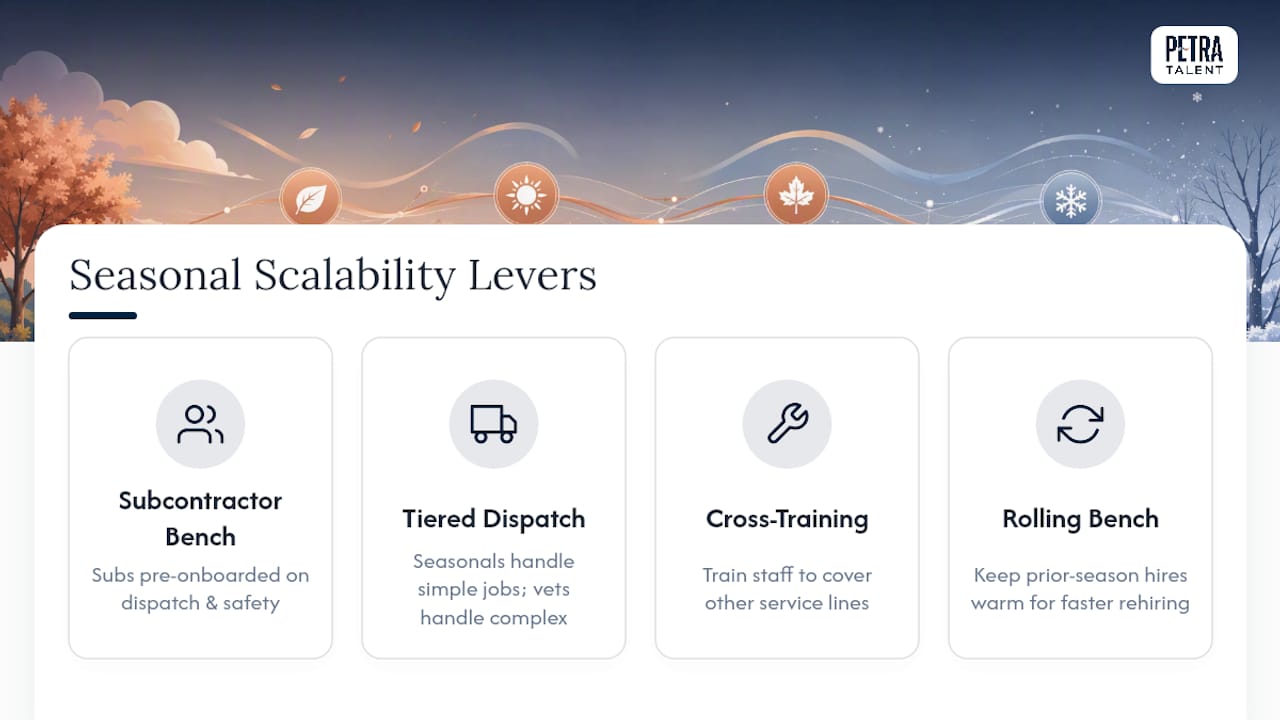
Tiered dispatch, where seasonal hires handle simpler, well-defined jobs while veteran technicians take complex diagnostic calls, lets you scale headcount without diluting service quality. This only works if your screening scenario actually sorted candidates by skill level in the first place, which is another reason the hands-on screen matters more than a resume review.
Cross-training core staff to flex between service lines, say, moving a plumbing technician into basic HVAC maintenance support during a cooling-season spike, gives you internal scalability that doesn’t depend on the external labor market at all. It requires investment in training during slow periods, but it pays back every time demand spikes faster than your hiring pipeline can respond.
Contractors who scale successfully year after year tend to run a rolling bench rather than starting from zero each season. Keeping relationships warm with last season’s strong seasonal hires, even during the off months, means your sourcing pipeline for next year starts with people who already know your systems rather than strangers who need a full onboarding cycle. That’s a scalability advantage that compounds every year you maintain it.
Impact of Local Labor Market Conditions on Seasonal Hiring
Local labor market tightness changes every lever in this playbook, and a national average tells you almost nothing about your specific service area. A metro with several large mechanical contractors competing for the same certified pool will require faster speed-to-lead, higher pay ranges, and earlier sourcing starts than a market with less competition for the same talent.
Markets where the HVAC labor pool is structurally tight tend to reward contractors who build long-term pipeline relationships with trade schools, since waiting to source until you need bodies means competing for the same shrinking applicant pool everyone else is chasing. Contractors in looser labor markets have more room to be selective in screening, but shouldn’t assume that flexibility will hold if a competitor moves into the area or a nearby contractor scales up.
Regional wage benchmarking matters more during seasonal hiring than during steady-state hiring, because a seasonal candidate comparing offers across two contractors will notice a pay gap immediately, with no tenure or benefits history to offset it. Contractors who underprice their seasonal roles relative to the local market typically discover it only after losing several candidates to a competitor’s better-published range, at which point the sprint is already behind schedule.
Local economic conditions beyond the trade itself, construction activity, new housing starts, commercial development, also shift labor availability. A market experiencing a construction boom pulls skilled labor toward new-build HVAC installation, tightening the pool available for service and seasonal maintenance roles specifically. Tracking these adjacent conditions, not just HVAC-specific job postings, gives a more accurate read on how hard your seasonal sourcing will need to work this year.
Best Practices for Managing Seasonal Employees Post-Hire
Getting a seasonal technician hired is half the job. Managing them well enough that they’re productive by week three, and possibly interested in returning next season, is the other half, and it’s the half most contractors underinvest in.
Performance management for seasonal hires needs to be more frequent and more structured than for permanent staff, simply because there’s less time to course-correct. Weekly check-ins during the first month, tied to the same checklist-based sign-offs used in onboarding, catch small problems before they become missed appointments or safety incidents.
Motivation during a short-term role is different from motivation during a career. Seasonal technicians respond well to visible, near-term incentives: a completion bonus tied to finishing the season, recognition for strong customer feedback, or a clear signal about return-next-season priority for top performers. Framing the season as a tryout for a permanent role, when that’s genuinely on the table, tends to improve effort and reduce mid-season attrition more than pay alone.
Clear communication about schedule changes matters especially during peak weeks, when overtime and last-minute dispatch changes are common. Seasonal hires without a longer relationship to draw trust from are more likely to disengage or quit mid-season if they feel jerked around without explanation.
Documenting performance consistently, even for a six-week role, protects the contractor if a rehire decision or a dispute comes up later, and it gives you real data on which sourcing channels and screening scores actually predicted strong performance. That data is what makes next year’s hiring sprint faster than this year’s.
Why Contractors Should Treat Recruiting Like Sales
Recruiting is a sales function, and most contractors run it like an administrative afterthought. Measure your follow-up speed the way you’d measure a sales team’s response time to a lead, because that’s functionally what it is. Contractors who keep relationships warm with strong seasonal performers year round, instead of starting cold every spring, walk into peak season with a bench instead of a job posting. That’s the difference Petra Talent’s technical screening process and case-study placements are built to shorten, one hiring cycle at a time.
— David
How Petra Talent Accelerates Your Seasonal Hiring Sprint
Building the sourcing, screening, and offer infrastructure described throughout this playbook takes real time, and most contractors are trying to do it while also running service calls during their busiest weeks. Petra Talent exists specifically to run this process for you, with a pre-vetted technician bench already gated on EPA Section 608 and ready before your season starts.

Petra Talent’s HVAC recruiting services cover direct-hire placement, technical vetting through structured scenario screening, workforce consultation for capacity planning, and leadership search for the project managers and superintendents who run your seasonal crews. Every candidate moves through the same credential gate, phone screen, and hands-on scenario sequence outlined in this article, so you’re reviewing a shortlist of dispatch-ready technicians instead of a stack of unfiltered resumes. Conditional-offer templates and background-check coordination are already built into the process, which typically cuts weeks off a contractor’s time-to-hire compared to running the sprint from scratch.
If your next peak season is 8 to 12 weeks out, that’s the window to act. Visit Petra Talent’s services overview to request a seasonal-hiring audit or start a pilot placement before the demand curve turns against you.
Sources
- The new rules of HVAC hiring | Contracting Business
- ACCA HVAC blog: hiring/process improvement content
- ServiceTitan HVAC recruiting guidance
- Seasonal planning for HVAC businesses | Profitability Partners
Recommended
Related Posts

September 20, 2026
Construction Offer Letters for HR: Site Assignments, Certs, Petra Tips
HR ready construction offer letters: copy ready language for site assignments, certs, contingencies, and a…

September 19, 2026
Create E-Verify Cases by Day Three: U.S. HVAC & Plumbing Rules
E-Verify for U.S. HVAC and plumbing contractors: who needs I-9s, the three business day case…

September 18, 2026
72.5¢ Rate: Take Home Vehicle Policy for Employers and Agencies
Checklist and policy language for employers and agencies: apply the IRS 2026 mileage rate (72.5…

September 17, 2026
Avoid Overtime Back-Pay: Job-to-Job Travel Pay for U.S. Technicians
U.S. employers: learn DOL/WHD travel-pay tests, a blended rate overtime example, state pitfalls, and Petratalent…