



The national median for HVAC technicians sits at $59,810 a year, or roughly $28.75 an hour, according to the most recent federal wage data. That’s base pay only. Once you factor in overtime, spiffs, a company truck, and benefits, a working journeyman commonly lands between $75,000 and $95,000 in total compensation, while senior techs, controls specialists, and commissioned sales-service hybrids can clear six figures.
TL;DR:
- HVAC technicians’ total compensation often ranges from $75,000 to $95,000 annually, with specialized roles and certifications significantly increasing pay.
- Moving into roles with commission or specialization, such as controls or commercial refrigeration, is the fastest way to cross the six-figure salary threshold.
- States like Alaska, Massachusetts, and California pay HVAC technicians 20% to 40% above the national median, but local cost of living may offset wage advantages.
- Certifications like NATE, controls, and union membership reliably boost pay, especially when tied to verified skills or scarce specialties.
- Comparing pay should include total compensation components—base wages, bonuses, benefits, and tools—rather than just hourly rates or base salary figures.
Table of Contents
- HVAC Technician Pay 2026: The National Baseline
- How HVAC Technician Salary Changes by Experience and Role
- Which States Pay HVAC Technicians the Most in 2026
- Certifications and Specializations That Raise HVAC Pay
- Building a Real Total Compensation Picture
- How to Increase Your HVAC Pay Faster
- Where This Data Comes From
- What Recruiters See That Salary Surveys Miss
- Benchmark Your HVAC Pay and Hiring Strategy
- Sources
HVAC Technician Pay 2026: The National Baseline
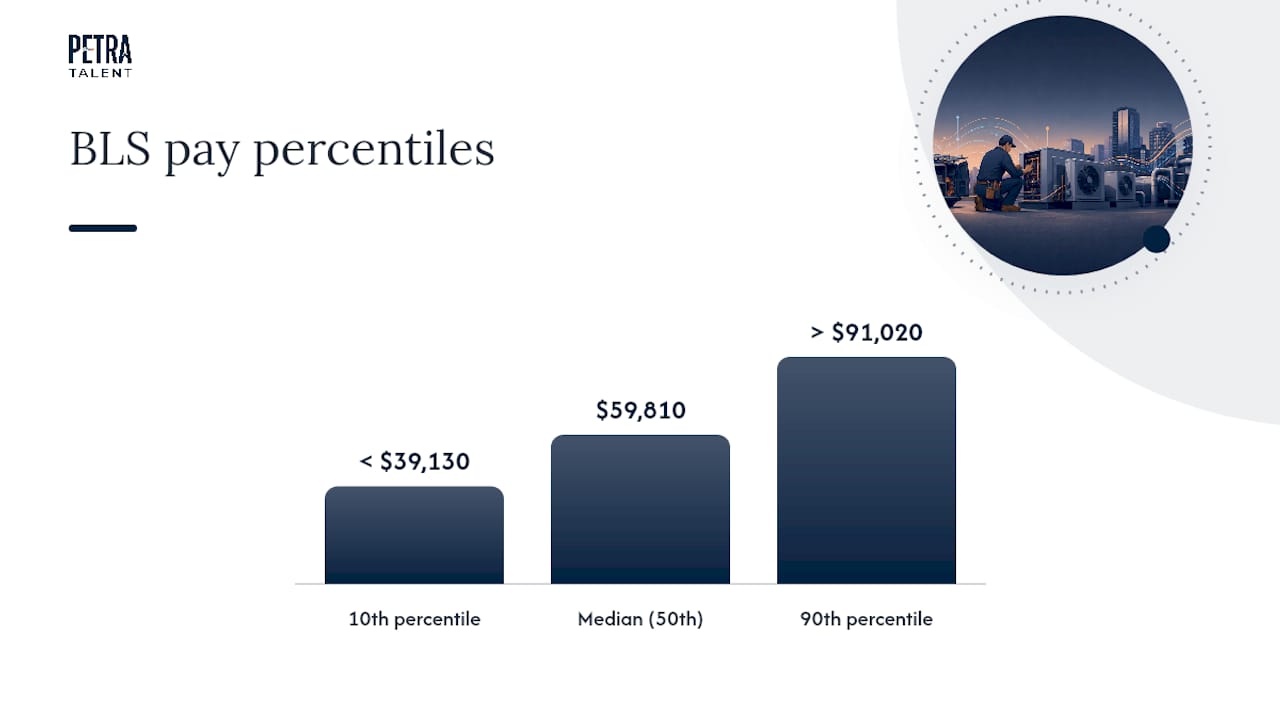
Start with the number every recruiter, contractor, and job board eventually cites: the Bureau of Labor Statistics puts the median annual wage for heating, air conditioning, and refrigeration mechanics and installers at $59,810, which works out to $28.75 an hour. That figure is a midpoint, not a ceiling, and the spread around it tells the real story.
The BLS percentile breakdown looks like this:
- 10th percentile: under $39,130 (typically apprentices and entry-level helpers)
- 25th percentile: a figure below the median, reflecting early-career pay levels
- 50th percentile (median): $59,810
- 75th percentile: a figure above the median, indicating experienced technician pay levels
- 90th percentile: over $91,020 (senior journeymen, leads, and specialists)
Pro Tip: When you’re comparing your pay against national data, ask which percentile you actually sit in based on years of experience and certifications, not just your job title. A “senior technician” at a small residential shop and a “senior technician” running commercial rooftop units can be $20,000 apart.
Job boards muddy this picture constantly. Indeed reports an hourly average near $30.46, which annualizes higher than the BLS median because its sample skews toward urban markets and self-reported figures that sometimes bundle in overtime. Glassdoor and ZipRecruiter show similar variance because they pull from job postings and self-reported salaries rather than the BLS’s employer-surveyed methodology. None of these sources are wrong exactly. They’re measuring different things: posted pay ranges versus actual paid wages, urban samples versus national ones, base pay versus total comp. When you see a number that seems too high or too low, check what it’s actually counting before you compare it to your own paycheck.
How HVAC Technician Salary Changes by Experience and Role
Pay in this trade tracks skill acquisition closely, and the jumps between tiers are steeper than in a lot of skilled trades because licensing and certification gates control who can legally do what.
- Apprentice (0 to 2 years): lower starting pay, usually hourly with limited overtime access while learning under supervision.
- Journeyman (2 to 6 years): mid-range base pay, often with overtime and light spiff eligibility once fully licensed.
- Senior technician / lead installer (6 to 10+ years): higher pay range, frequently structured as base plus performance bonuses.
- Specialist (controls, commercial refrigeration, industrial): above-average pay reflecting scarcity of the skill set more than tenure alone.
- Comfort advisor / commissioned sales-service tech: compensation often includes commission and can be considerably higher than base technician pay.
The technicians who break into six-figure territory almost always share two traits: they’ve moved into a role with commission or spiff exposure, and they’ve picked up a specialization that’s in short supply locally. A residential service tech doing straight hourly work rarely crosses $90,000 no matter how many years they log. A tech who adds commercial refrigeration knowledge or shifts into a comfort advisor role selling system replacements has a realistic path past $100,000. Reviewing what separates top-performing service technicians from average ones often comes down to exactly this kind of role positioning, not raw technical skill.
Which States Pay HVAC Technicians the Most in 2026
Geography moves the needle more than almost any other single factor besides certification. States like Alaska, Massachusetts, California, and the District of Columbia routinely pay HVAC technicians 20% to 40% above the national median, while states like Mississippi and Arkansas run 15% to 25% below it.
- Higher-paying states: Alaska, Massachusetts, California, Washington, DC, New York
- Lower-paying states: Mississippi, Arkansas, West Virginia, and much of the rural South
- Mid-range but competitive: Texas and Florida, where high demand and population growth partially offset lower average wages
Cost of living complicates any straight comparison. A California technician earning 30% above the national median may still have less purchasing power than an Ohio technician earning near the median, once housing costs are factored in. Before you assume a higher-paying state is a better deal, run the math on rent, state income tax, and vehicle costs, not just the headline wage. Relocating for HVAC work can pay off, particularly for licensed technicians willing to move to high-demand metro areas with union representation. But it rarely makes sense purely on a wage-differential basis without checking the local cost structure first. Remote work isn’t really on the table for this trade. HVAC service is hands-on by definition, so pay improvement through location almost always means physically relocating rather than working remotely for a higher-paying region.
Certifications and Specializations That Raise HVAC Pay
EPA Section 608 certification is the floor, not the ceiling. It’s legally required to handle refrigerants, and without it, a technician can’t touch most cooling equipment at all. Every other certification and specialization builds pay on top of that baseline.
- NATE certification. North American Technician Excellence credentials signal verified competency to employers and often show up as a distinct line in job offers, particularly at larger commercial contractors that use NATE status as a hiring filter.
- Controls and building automation. Techs who can program and troubleshoot building automation systems are scarce enough that this specialization consistently pulls a meaningful premium over general residential service work, according to state-level salary data.
- Commercial refrigeration. Grocery, cold storage, and industrial refrigeration work pays more than residential comfort systems because the equipment is more complex and the failure cost to the client is higher.
- Union membership. Union HVAC technicians earn roughly 23% more in base pay than non-union peers, plus pension and benefit value that rarely shows up in base salary comparisons.
The pattern here is consistent: certifications tied to legal requirements or verified skill gaps move pay faster than years of general residential experience alone.
Building a Real Total Compensation Picture
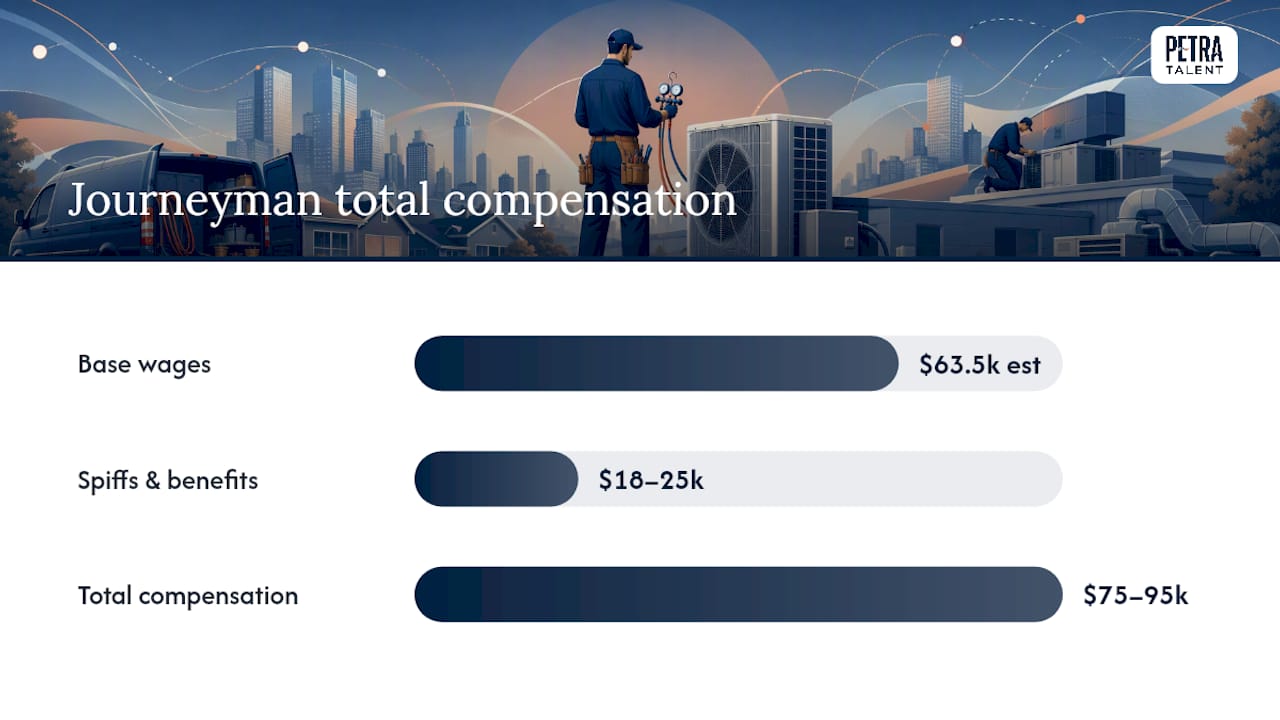
Base salary comparisons mislead more than they inform in this trade, because so much HVAC pay arrives outside the paycheck. A fair total-comp calculation includes base wages, overtime, spiffs or commission, the value of a company truck and tools, health insurance, and any 401(k) match.
Industry compensation analysis shows journeyman total compensation frequently lands between $75,000 and $95,000 once these components are added, with spiffs and benefits alone contributing $18,000 to $25,000 on top of base pay.
Contractors should think about this the same way from the budgeting side. The all-in cost of employing a technician runs well above the posted wage once fuel, insurance, tools, and benefits are added, and that all-in figure is what actually determines whether a compensation package is competitive in a given market.
How to Increase Your HVAC Pay Faster
The fastest pay jumps come from a short, deliberate list of moves rather than simply waiting out the calendar for annual raises.
- Get EPA 608 Universal certified immediately if you haven’t already. It’s non-negotiable for refrigerant work and opens doors that stay closed without it.
- Pursue NATE certification within your first three years. It’s the single most portable credential in the trade and travels with you between employers.
- Move toward a commissionable role once you have the technical chops. Comfort advisor and install sales positions carry the highest realistic ceiling for techs who are good with customers.
- Specialize in controls or commercial refrigeration if you want to separate your pay from the general residential labor pool entirely.
- Ask about total compensation, not just hourly rate, when evaluating a new employer. A lower base with a truck, full benefits, and spiff eligibility often beats a higher base with none of it.
Pro Tip: Before your next performance review, calculate your own total compensation the same way a recruiter would, then bring that number to the conversation instead of just your hourly rate. It reframes the discussion around value delivered, not just wage comparison.
For apprenticeship pathways specifically, Apprenticeship remains the most reliable federal resource for finding registered programs that reduce training costs and speed up the path to journeyman status.
Where This Data Comes From
The core wage figures in this article come from the BLS Occupational Outlook Handbook, which surveys employers directly rather than relying on self-reported job board data. Total compensation estimates blend BLS base wage data with industry analysis on spiffs, benefits, and truck value, cross-checked against recruiter-reported figures.
- BLS OEWS data anchors the national median, hourly rate, and percentile breakdowns
- EPA Section 608 program pages confirm certification requirements
- Apprenticeship.gov informs entry-level training pathway figures
- Industry total-comp analysis informs the blended dollar ranges beyond base wage
One caveat worth flagging: union reporting and non-union reporting aren’t always separated cleanly in aggregator data, so the union pay premium should be read as directional rather than exact for every local market.
What Recruiters See That Salary Surveys Miss
Salary surveys measure the market. Recruiting doesn’t. What shows up in actual placements is that contractors chronically underestimate what it costs them to lose a technician, and overestimate what it costs to keep one.
PetraTalent’s recruiter-backed benchmark puts the 2026 median for U.S. HVAC project managers at $95,000, a useful anchor point when technicians ask what leadership tracks are actually worth versus staying in the field. That gap between top technician pay and management pay is smaller than most techs assume, which is exactly why the leadership route deserves more consideration than it usually gets.
On retention, modest bonuses in the $5,000 to $10,000 range routinely pay for themselves when replacement costs for a single technician can exceed $30,000 in recruiting fees, lost productivity, and training time. The most common hiring mistake we see is contractors advertising base pay only and losing strong candidates who are calculating total compensation elsewhere. Fix the offer, not just the number.
— David
Benchmark Your HVAC Pay and Hiring Strategy
Comparing your own pay against national averages only gets you so far. Contractors who want to know whether their offers are competitive in their specific market, and technicians deciding whether a new opportunity is actually a step up, both need numbers grounded in real local placements rather than national medians alone.

Some recruitment firms work directly with mechanical contractors across the country to build pay packages and hiring strategies that hold up against what’s actually happening in local labor markets, not just what a national survey reports. This can include market wage benchmarking, technical vetting for licensed candidates, and direct-hire placement for service, install, and leadership roles. If you’re a contractor trying to figure out whether your technician pay scale is costing you good candidates, request a benchmark review through Petratalent’s HVAC recruiting services page and get a clearer picture of where your offers stand before your next hire walks away.
Sources
- Heating, Air Conditioning, and Refrigeration Mechanics and Installers (BLS OOH)
- Section 608 technician certification requirements (EPA)
Recommended
Post a comment
Related Posts

September 20, 2026
Construction Offer Letters for HR: Site Assignments, Certs, Petra Tips
HR ready construction offer letters: copy ready language for site assignments, certs, contingencies, and a…

September 19, 2026
Create E-Verify Cases by Day Three: U.S. HVAC & Plumbing Rules
E-Verify for U.S. HVAC and plumbing contractors: who needs I-9s, the three business day case…

September 18, 2026
72.5¢ Rate: Take Home Vehicle Policy for Employers and Agencies
Checklist and policy language for employers and agencies: apply the IRS 2026 mileage rate (72.5…

September 17, 2026
Avoid Overtime Back-Pay: Job-to-Job Travel Pay for U.S. Technicians
U.S. employers: learn DOL/WHD travel-pay tests, a blended rate overtime example, state pitfalls, and Petratalent…