



Start with hourly plus spiffs for service techs, salary plus commission for comfort advisors, and hourly or piece-rate structures for installers and apprentices. Get those three pieces right and the rest of the pay plan mostly designs itself.
TL;DR:
- HVAC pay plans should prioritize hourly wages for apprentices and installers, with sales-driven roles earning through commissions or bonuses.
- Incentive pay, including spiffs and commissions, must be properly factored into overtime calculations to avoid costly payroll errors.
- Designing a pay plan requires role-specific goals, accurate labor cost modeling, and clear metrics to balance growth with quality.
- Implementing a new pay plan effectively involves structured rollout, communication, regular review, and alignment with staffing to prevent turnover.
Table of Contents
- What Are the Main Types of HVAC Pay Plans?
- How Much Do HVAC Technicians and Installers Actually Earn?
- How Do You Design a Pay Plan Step by Step?
- Are Spiffs and Bonuses Subject to Overtime Rules?
- What Does a 90-Day Pay Plan Rollout Look Like?
- Petra Talent’s Perspective: Pay Plans and the Hiring Pipeline
- Let Petra Talent Help You Hire Around Your New Pay Plan
- Sources
- FAQ
What Are the Main Types of HVAC Pay Plans?
Most HVAC pay structures fall into five families, and each one pushes technicians toward different behavior.
- Straight hourly: predictable for apprentices and journeymen still building skill; does nothing to reward speed or upsells.
- Hourly + spiff: base wage plus flat bonuses for specific sales (maintenance plans, IAQ add-ons); works well for service techs who diagnose and recommend but don’t run a full sales process.
- Hourly + commission: base pay plus a percentage of ticket revenue or gross profit; fits senior techs and comfort advisors who close larger jobs.
- Revenue-share: pay tied directly to a percentage of jobs completed, often used for lead installers or crew chiefs managing their own schedule.
- Salary + KPI bonus: fixed pay with bonuses tied to metrics like callback rate or customer reviews; best for project managers and team leads whose impact is hard to measure ticket by ticket.
Comfort advisors and outside sales roles almost always perform better under commission because the job is selling, not fixing. Apprentices need hourly stability while they’re still learning the trade. Piece-rate or revenue-share variants suit installers on repeatable, standardized jobs where speed and quality can both be measured cleanly.
How Much Do HVAC Technicians and Installers Actually Earn?
The Bureau of Labor Statistics reports a median annual wage of $59,810 ($28.75 an hour) for heating, air conditioning, and refrigeration mechanics and installers. The top 10% earn significantly more than the median, while the bottom 10% earn substantially less, reflecting experience, licensing, and specialization levels. That spread is a useful anchor whether you’re setting a starting wage or building a technician total compensation package.
Benchmark snapshot: BLS median pay for HVAC mechanics and installers sits at $59,810/year. Top earners clear $91,020; entry-level techs often start under $39,130.
Market ranges typically break out this way:
- Entry-level/apprentice: near or below the BLS bottom 10% while training.
- Journeyman: within striking distance of the median, often $55,000 to $70,000 with steady spiffs.
- Senior tech or controls specialist: pushes past $80,000 once commission or complex-system work enters the mix.
On the incentive side, flat spiffs commonly run $75 to $150 for a maintenance plan sale and $100 to $200 for indoor air quality add-ons, according to pipelineon’s spiff program benchmarks. Financed jobs need separate treatment in that math. As NerdWallet’s guide to HVAC financing notes, lender fees and payment splits change the gross profit a commission is calculated against, so build financed-job math into the plan before it goes live, not after the first dispute.
How Do You Design a Pay Plan Step by Step?
Building a plan role by role, rather than copying a competitor’s structure, is what keeps margins intact once incentives start driving behavior.
- Map the role to a behavioral goal. Decide what you actually want the position to prioritize: speed and volume for installers, diagnostic accuracy and attach rate for service techs, close rate and average ticket for comfort advisors.
- Run the loaded labor math. Add wages, payroll taxes, workers’ comp, and benefits, then divide by the revenue that role generates. Builtontenth’s guidance on how much to pay HVAC technicians treats roughly 22% of revenue as a workable target. If a $500,000-revenue tech costs you $150,000 loaded, you’re at 30%, well past the danger line, and the plan needs adjusting before launch.
- Pick metrics that balance growth against quality. Pair ticket-driving incentives (attach rate, average sale) with guardrail metrics (first-time fix rate, callback rate, customer reviews) so a tech isn’t rewarded for selling a job that comes back broken.
- Set cadence, caps, and clawback rules. Decide how often spiffs pay out, whether commissions cap at a certain dollar amount, and what happens if a sale gets refunded or a callback traces back to bad work.
Pro Tip: *Model the loaded labor percentage against last year’s actual payroll before you announce anything.
Role mapping only works if your roster mix supports it. Use workforce planning guidance for HVAC managers to check whether you have the right ratio of techs to advisors to leads before you lock in a structure built around roles you don’t currently staff.
Are Spiffs and Bonuses Subject to Overtime Rules?
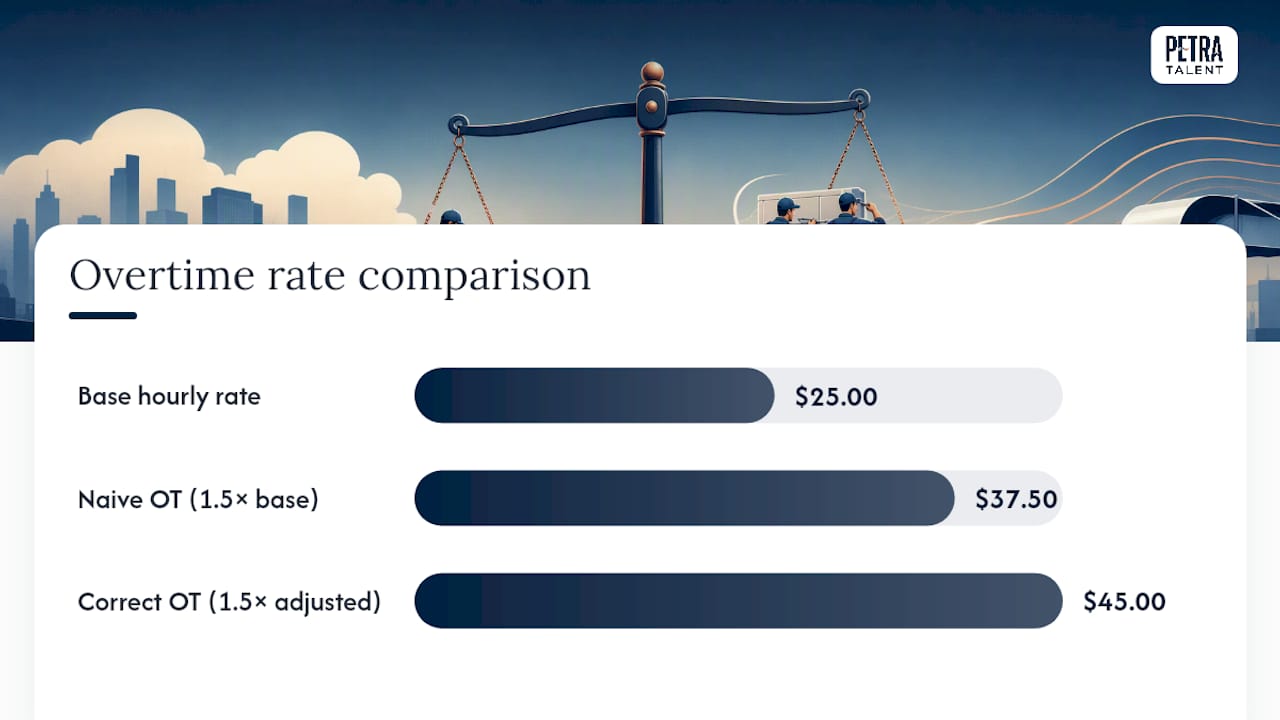
Yes. Under the FLSA, nondiscretionary bonuses, which includes most spiffs and production incentives, must be folded into the “regular rate” used to calculate overtime pay. A bonus tied to a predetermined performance target isn’t optional or a surprise reward; it’s a promised payment, and the law treats it that way regardless of what a shop calls it internally.
Here’s the math in practice: a technician earns $25/hour, works 45 hours in a week, and earns $200 in spiffs that same week. Regular pay is 40 hours × $25, plus $200 in spiffs, equals $1,200. Divide by 40 hours worked at straight time to get a regular rate of $30/hour. Overtime for the 5 extra hours pays at 1.5× that rate, or $45/hour, not $37.50. Skipping this recalculation is one of the most common and expensive payroll mistakes shops make once commission plans go live.
- Flag spiffs and commissions as nondiscretionary in your payroll system, not as bonuses excluded from overtime.
- Pay spiffs on a consistent, ideally weekly, cadence so the regular-rate math stays current instead of piling up at month-end.
- Loop in payroll counsel before rolling out a new incentive structure across more than a handful of techs.
What Does a 90-Day Pay Plan Rollout Look Like?
A rollout that skips communication or tracking setup tends to generate more disputes than motivation, no matter how well the plan is modeled.
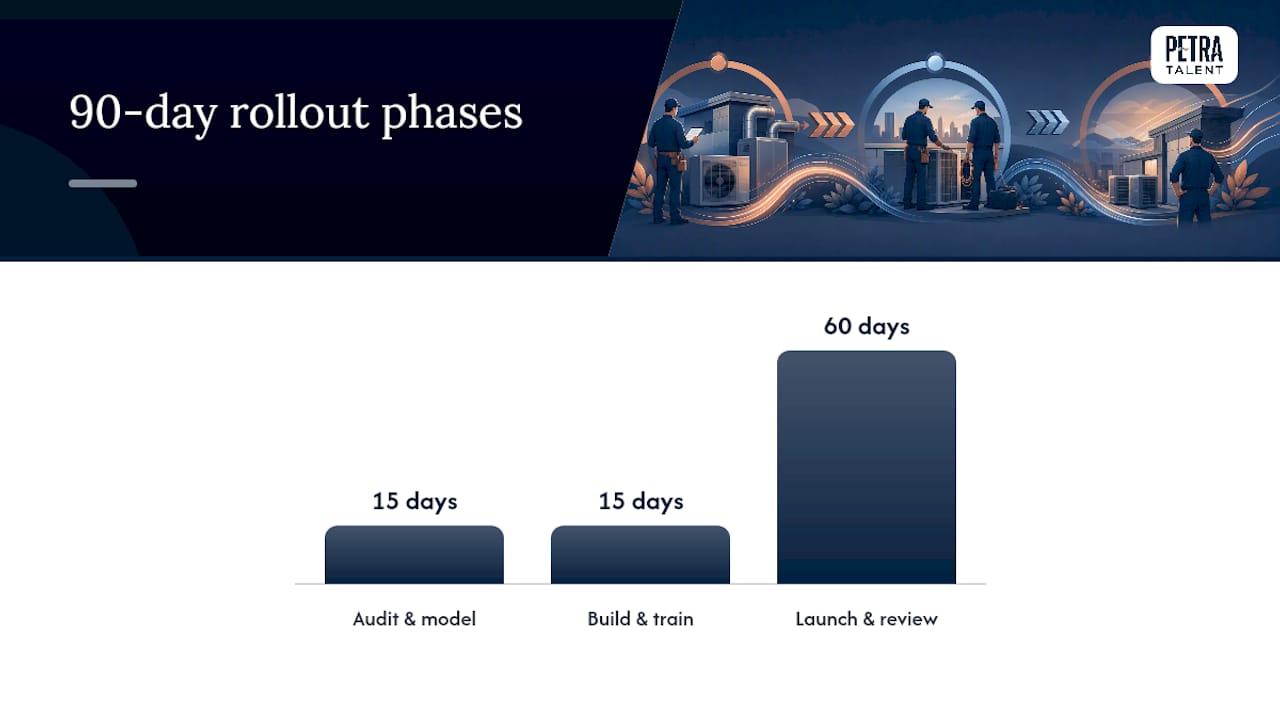
- Days 1 to 15: audit and model. Review current pay by role, run the loaded-labor scenarios, and brief managers before anything reaches the shop floor.
- Days 16 to 30: build and train. Set up tracking software, document the plan in plain language, and train dispatch and service managers on how spiffs get logged.
- Days 31 to 90: launch, pay weekly, and review. Pay spiffs on a weekly cadence, since research on payout timing shows manual monthly payroll can cut the behavioral lift from a spiff program by 15% to 25%. Review labor percentage, attach rates, and callback rates at the 30, 60, and 90-day marks, adjusting spiff size or commission caps if margin drifts.
Pro Tip: Set your adjustment triggers before launch, not after you see the first month’s numbers. Deciding in advance that a 3-point labor cost overage triggers a plan review keeps the conversation about data, not defensiveness.
Retention risk shows up fast when a rollout is rushed. Reviewing why HVAC technicians leave jobs before launch can help you spot which parts of your current plan are already driving turnover.
Petra Talent’s Perspective: Pay Plans and the Hiring Pipeline
Clear, well-documented pay plans do more than protect margin. They shorten the 90-day window where most bad hires reveal themselves, because candidates who understand exactly how they’ll be paid make fewer assumptions and raise fewer disputes during probation. Petra Talent sees this repeatedly in placement work: recruiter-backed pay bands reduce early departures because expectations get set before the first paycheck, not after.
Senior selling techs respond to commission upside and a defined path to higher tickets. Apprentices respond to wage stability and a visible growth track. Confusing the two signals in a single generic plan is a common reason contractors lose candidates they thought were sold. It is recommended to build explicit pay bands, set probation targets tied to the same KPIs used in the pay plan, and use interview scorecards that ask candidates how they’ve been paid before, not just what they’ve earned.
— David
Let Petra Talent Help You Hire Around Your New Pay Plan
A redesigned pay plan only works if you can staff it with people who fit the roles you just defined. A specialized recruitment partner can help with market wage benchmarking to assess whether new bands are competitive, technical vetting to confirm candidates’ skill levels, and direct-hire placements for roles critical to the pay plan.

Contractors rolling out a new structure often need both pieces at once, a pay plan that protects margin and a roster that can deliver against it. Petra Talent’s workforce consultation services cover both, from benchmarking your rates against current market data to sourcing candidates who’ve been vetted against the exact behaviors your KPIs reward. If your last hire didn’t work out under the old pay structure, it’s worth reviewing common HVAC recruitment challenges before you staff the new one. Reach out to Petra Talent to benchmark your plan and start the search for the roles it’s built around.
Sources
- Heating, Air Conditioning, and Refrigeration Mechanics and Installers : Occupational Employment and Wage Statistics : U.S. Bureau of Labor Statistics
- Maximize Profits with HVAC Spiff Programs: A Comprehensive
FAQ
Can HVAC techs make $100,000 a year?
Yes, though it’s above typical pay. The BLS reports the top 10% of HVAC mechanics and installers earn more than $91,020 a year, and senior techs who add commission or controls specialization can clear six figures.
What field of HVAC pays the most?
Controls and commercial refrigeration specialists, along with comfort advisors on commission, tend to out-earn general residential service techs, since both combine technical scarcity or sales upside with the base wage.
Do HVAC techs make good money?
The median HVAC mechanic or installer earns $59,810 a year, above many skilled trades, and pay climbs quickly with licensing, specialization, and incentive-based plans layered on top of base wage.
Do HVAC techs commonly hit six figures?
It’s achievable but not typical for the median worker. Six-figure earners usually combine senior-level base pay with strong commission or spiff income, or move into project management and leadership roles where salary bands run higher.
Recommended
Post a comment
Related Posts

September 20, 2026
Construction Offer Letters for HR: Site Assignments, Certs, Petra Tips
HR ready construction offer letters: copy ready language for site assignments, certs, contingencies, and a…

September 19, 2026
Create E-Verify Cases by Day Three: U.S. HVAC & Plumbing Rules
E-Verify for U.S. HVAC and plumbing contractors: who needs I-9s, the three business day case…

September 18, 2026
72.5¢ Rate: Take Home Vehicle Policy for Employers and Agencies
Checklist and policy language for employers and agencies: apply the IRS 2026 mileage rate (72.5…

September 17, 2026
Avoid Overtime Back-Pay: Job-to-Job Travel Pay for U.S. Technicians
U.S. employers: learn DOL/WHD travel-pay tests, a blended rate overtime example, state pitfalls, and Petratalent…