



TL;DR:
- Plumbing compliance requires contractors to meet licensing, permitting, inspection, and code standards before work is hidden.
- Failing to adhere to these regulations risks legal penalties, insurance denial, and resale issues for property owners.
Plumbing compliance is defined as the full adherence of all plumbing work to applicable local, state, and federal codes, licensing requirements, permits, and inspection standards. When hiring a plumbing contractor, compliance means verifying that the professional holds the correct license, pulls the required permits, and passes every inspection stage before work is concealed. Key regulatory frameworks include the International Plumbing Code (IPC), the Uniform Plumbing Code (UPC), and federal mandates such as the Safe Drinking Water Act. Skipping any of these steps exposes property owners to legal penalties, insurance denials, and serious resale complications.
What plumbing compliance requirements must contractors meet?
Contractors must satisfy several distinct requirements before and during any plumbing project. Each requirement carries legal weight. Plumbing codes are legally enforceable safety standards, not optional guidelines, and local jurisdictions adopt updated editions on their own schedules.
The core compliance requirements are:
- Contractor licensing. Every state requires plumbers to hold a valid license at the appropriate level. The license level determines what work a contractor can legally perform and certify.
- Permit issuance. Major installations, relocations, and replacements require a permit before work begins. Standard residential permit fees range from $75 to $400 depending on job scope and location. A water heater replacement typically costs $75–$250; a full sewer line replacement runs $150–$400.
- Staged inspections. The inspection process covers three stages: underground, rough-in, and final. Work cannot be covered or concealed until each stage receives approval.
- Pressure testing. The 2024 IRC requires new water supply systems to pass pressure testing at 10 psi above operating pressure, or 50 psi air pressure, held for at least 15 minutes and witnessed by an inspector before concealment.
- Code version verification. The US uses two primary code frameworks: the IPC, adopted by 37 states, and the UPC, used mostly in western states. Both update every three years. The code in effect is the edition adopted at the time the permit is issued.
| Requirement | Typical Standard |
|---|---|
| Permit fee range | $75–$400 depending on job scope |
| Pressure test duration | 15 minutes minimum, witnessed |
| Inspection stages | Underground, rough-in, final |
| Code update cycle | Every 3 years (IPC and UPC) |
| Federal floor | Safe Drinking Water Act applies nationwide |
Pro Tip: Ask your contractor to show you the permit before any work begins. A legitimate contractor will have it on-site or be able to produce it immediately.
Why is hiring a licensed plumber critical for compliance?
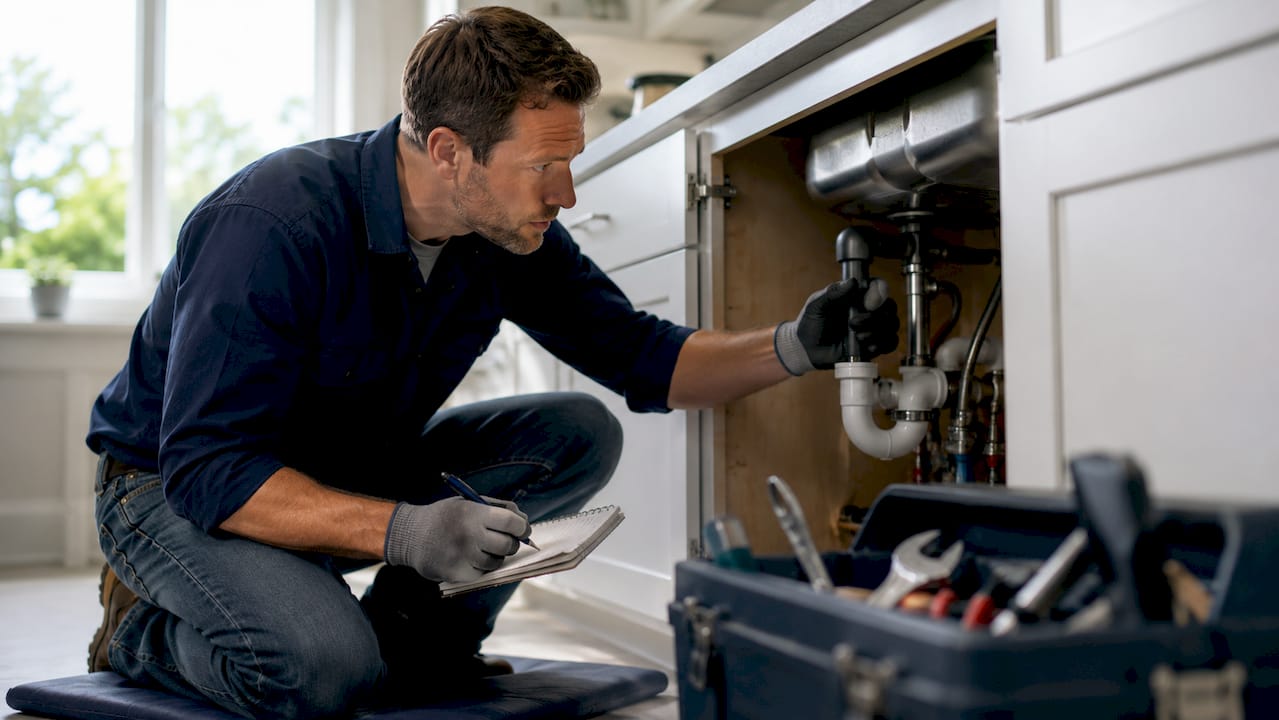
Licensed plumbers know local code requirements and Authority Having Jurisdiction (AHJ) inspection processes. That knowledge directly increases inspection pass rates and reduces costly rework. Licensed professionals carry the tools and technical knowledge required to meet local AHJ standards, which vary even within the same state.
Understanding license levels matters. The four main categories are:
- Apprentice. Works under direct supervision. Cannot pull permits or certify work independently.
- Journeyman. Qualified to perform most plumbing work but typically cannot contract directly with property owners.
- Licensed contractor. Holds full authority to contract, pull permits, and issue compliance documentation. Only licensed contractors can legally certify completed work.
- Unlicensed worker. Has no legal authority to perform permitted work. Hiring one voids most manufacturer warranties and exposes the property owner to full liability.
Licensed contractors also protect property owners from insurance risk. If an unlicensed worker causes water damage, the homeowner’s insurance policy will likely deny the claim. For Arizona homeowners specifically, local code compliance requirements illustrate how regional permit rules add another layer that only licensed contractors reliably navigate.
Pro Tip: Verify a contractor’s license number through your state licensing board’s online portal before signing any contract. The search takes under two minutes and confirms both license status and any disciplinary history.
What are the practical steps for verifying compliance when hiring?
Verification happens before, during, and after the project. Contractors who resist any of these steps are a red flag.
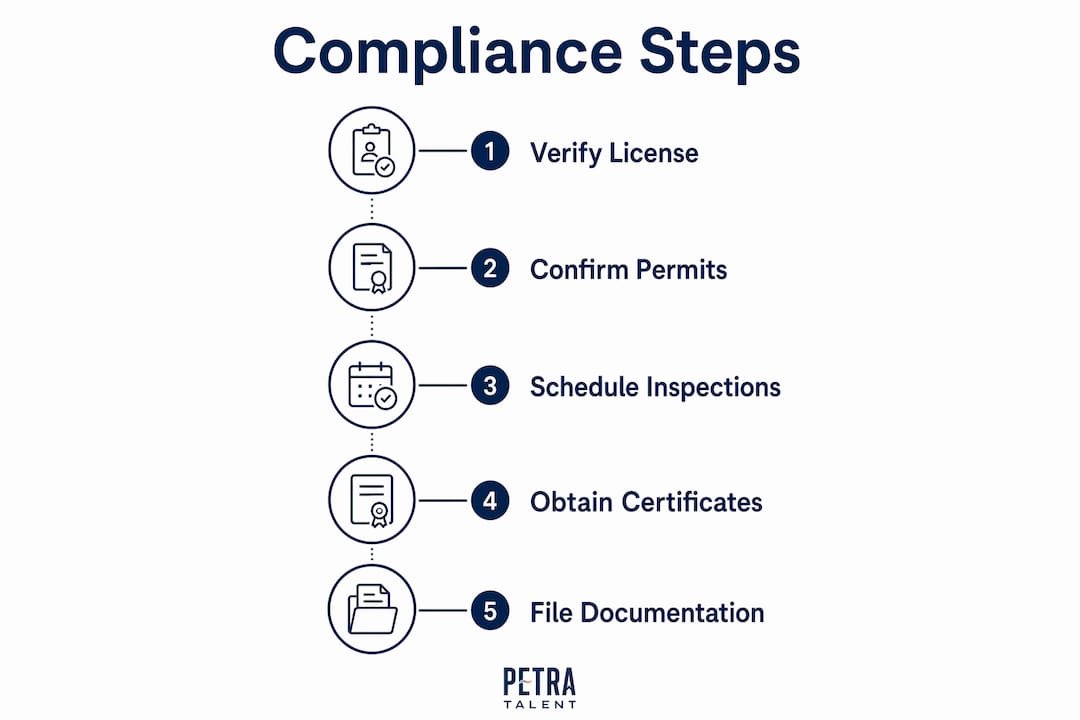
Before hiring, confirm the following:
- License verification. Search the contractor’s license number on your state board’s website. Confirm the license is active, covers the scope of work, and has no active violations.
- Insurance coverage. Request a certificate of general liability and workers’ compensation insurance. Confirm the policy is current, not expired.
- Permit inclusion in the quote. Permit fees must appear as a line item in the written estimate. If they are absent, ask directly. A contractor who plans to skip permits will avoid this question.
- AHJ familiarity. Ask the contractor how many projects they have completed in your specific municipality. Contractors familiar with local AHJ inspectors know the exact documentation and scheduling requirements.
During the project, track inspection milestones. Request copies of each passed inspection report. Work concealed before inspection approval creates a serious problem. Unearthing plumbing hidden behind finished walls for belated inspections is expensive and entirely avoidable with honest scheduling.
After the project, request the certificate of compliance or final inspection sign-off. File it with your property records. Lenders and home inspectors will ask for this documentation during any future sale or refinancing.
For a deeper look at how plumbing trade recruitment connects to compliance vetting, the process starts well before a contractor sets foot on the job site.
What risks arise from ignoring plumbing compliance?
Non-compliance carries financial and legal consequences that far exceed the cost of doing things correctly from the start.
Retroactive permitting for work already completed costs 2–3 times the original permit fee, plus the expense of opening walls, ceilings, or floors for the required inspection. Buyers routinely demand $3,000–$15,000 in price concessions when home inspectors flag unpermitted plumbing work.
The specific risks include:
- Insurance claim denial. Insurers deny claims for water damage caused by unpermitted or non-code-compliant installations. The property owner absorbs the full cost of repairs.
- Stop-work orders and fines. The AHJ can issue a stop-work order at any time. Fines for skipping permits run 2–3 times the original permit fee, plus mandatory correction costs.
- Voided manufacturer warranties. Water heaters, boilers, and other equipment require permitted installation to maintain the manufacturer’s warranty. Failure to permit voids these warranties entirely.
- Resale complications. Home inspectors and mortgage lenders flag non-compliant work. The seller either corrects it or accepts a price reduction.
- Liability exposure. Non-compliant installations that cause injury or property damage leave the property owner legally exposed, especially when an unlicensed contractor performed the work.
For contractors managing plumbing construction roles across multiple projects, the compliance risk compounds quickly when license levels and permit responsibilities are not clearly assigned.
Key Takeaways
Plumbing compliance requires verified licensing, pulled permits, staged inspections, and documented code adherence before any work is concealed or considered complete.
| Point | Details |
|---|---|
| Compliance is legally enforceable | Plumbing codes carry the force of law; violations result in fines, stop-work orders, and forced rework. |
| License level determines authority | Only a licensed contractor can pull permits, certify work, and protect the property owner from liability. |
| Permits protect property value | Unpermitted work triggers buyer concessions of $3,000–$15,000 and can void manufacturer warranties. |
| Three inspection stages are required | Underground, rough-in, and final inspections must each be approved before work is covered. |
| Verify before signing | Confirm license status, insurance, and permit inclusion in the quote before any contract is signed. |
Why compliance should be the first question, not the last
Contractors who skip the compliance conversation early tend to skip the permit later. That pattern is consistent across markets and project types. The property owner almost never finds out until a home inspection, an insurance claim, or a stop-work order forces the issue into the open.
The most common mistake I see is treating compliance as a formality to confirm after the contractor is already selected. The right sequence is the reverse. License verification, insurance confirmation, and a direct question about permit responsibility belong in the first conversation, not the contract review. Contractors who are uncomfortable with those questions are telling you something important.
Working with professionals who are already familiar with local AHJ requirements saves time at every inspection stage. That familiarity is not a bonus. It is a baseline qualification. Investing in a properly licensed, permit-pulling contractor upfront eliminates the retroactive costs that make non-compliance so expensive. Compliance is not optional. It is the minimum standard for work that protects the property, the occupants, and the investment.
— David
Petratalent’s approach to compliance-ready plumbing hiring
Hiring a licensed, compliant plumber is straightforward when the vetting happens before the job posting goes live.

Petratalent specializes in sourcing and screening plumbing professionals who meet licensing, insurance, and code-compliance standards across the United States. Every candidate goes through a structured review of license level, AHJ experience, and permit history before being presented to a contractor. For mechanical contractors who need dependable, compliance-ready talent, Petratalent’s plumbing recruiting services cover direct hire placements, technical vetting, and workforce consultation. Explore the full range of recruitment and vetting solutions to see how Petratalent matches compliant professionals to the roles that need them.
FAQ
What does plumbing compliance mean when hiring a contractor?
Plumbing compliance means the contractor holds a valid license, pulls required permits, passes all inspection stages, and performs work that meets the currently adopted local plumbing code. It is a legal requirement, not a preference.
What should you ask a plumbing contractor before hiring?
Ask for their license number, proof of insurance, and confirmation that permit fees are included in the quote. Also ask how many projects they have completed under your local AHJ.
What happens if plumbing work is done without a permit?
Unpermitted work can result in stop-work orders, fines of 2–3 times the original permit fee, voided manufacturer warranties, insurance claim denials, and buyer concessions of $3,000–$15,000 at resale.
What is the difference between the IPC and the UPC?
The IPC is adopted by 37 states, while the UPC is used primarily in western states. Both update every three years, and the version in effect is the edition adopted by the local jurisdiction at the time the permit is issued.
Does hiring an unlicensed plumber void my insurance?
Yes. Insurance carriers deny claims for damage caused by unpermitted or unlicensed work. The property owner bears the full cost of any resulting repairs.
Recommended
Related Posts
October 13, 2026
Recruiting Contract Terms: 10 Checks and Ready to Use Clauses
Define fee triggers, candidate ownership, guarantees, and compliance terms. Get a master agreement, short schedule,…
October 12, 2026
Offer Acceptance Rates: Segment Benchmarks, HVAC’s 3–5 Day SLA
See why a 78% to 82% offer acceptance benchmark can mislead, how role and source…
October 11, 2026
Bad Hires Can Cost Construction Firms 30% to 200% of Salary
Bad hires can cost construction firms 30% to 200% of annual salary. Calculate recruiting, rework,…
October 10, 2026
Construction Labor Forecasting for PMs: 7 Steps to Time Hiring
Learn when construction project managers should use WBS or simulation, track labor KPIs, and turn…