


TL;DR:
- Plumbing workforce consultation is a structured process that assesses labor gaps and develops targeted hiring and training plans. It helps address industry shortages and projected job openings by enabling contractors to plan proactively. Regular consultation cycles improve workforce stability and support effective talent recruitment and retention.
Plumbing workforce consultation is defined as a structured process through which plumbing businesses assess their current labor capacity, identify skill gaps, and plan targeted hiring and training strategies. The industry faces a documented shortage of 500,000 plumbers and 42,600 annual job openings projected between 2022 and 2032. That scale of shortage makes workforce planning a core business function, not an optional exercise. Contractors who consult their workforce systematically gain the data they need to hire smarter, retain longer, and grow with confidence.
What is plumbing workforce consultation and why does it matter now?
Plumbing workforce consultation is the method by which plumbing businesses evaluate their labor needs, engage employees and stakeholders, and build a plan to close the gap between current capacity and business demand. The industry term most commonly used by workforce bodies is workforce planning consultation, though plumbing contractors often refer to it simply as workforce planning or labor consultation.
The urgency is real. The U.S. plumbing labor shortage costs the economy over $38 billion annually. That figure reflects lost productivity, delayed projects, and service gaps that affect contractors directly. Workforce consultation gives business owners a structured way to respond rather than react.
The World Plumbing Council and similar industry bodies recognize workforce consultation as a formal practice. Internal committees that bridge leadership and field staff are a recognized best practice for surfacing real labor constraints and training needs. These structures turn informal frustrations into documented, addressable data.
What challenges make workforce consultation essential for plumbing firms?
The plumbing industry faces a combination of pressures that no single hiring decision can fix. Workforce consultation addresses the full picture.
- 70% of plumbing and heating firms report difficulty recruiting skilled staff, with 69% citing low availability of qualified professionals. That means the talent pool is thin across the board, not just in specific regions.
- Only 21% of firms say they are likely to increase staff due to cost constraints. Growth plans stall when hiring budgets cannot keep pace with demand.
- Only 22% of plumbing and heating firms plan to recruit apprentices in the near term, despite the urgent need for new entrants. This gap widens the aging workforce problem year over year.
- Vocational schools face capacity constraints that limit the number of new plumbing entrants entering the field. The pipeline is not growing fast enough to replace retiring tradespeople.
The aging workforce problem is not a future risk. Plumbing firms losing experienced technicians to retirement without a replacement pipeline face compounding service and revenue losses within the next five years.
These pressures combine to create a workforce crisis that reactive hiring cannot solve. Consultation provides the structured analysis needed to build a real response.
How does plumbing workforce consultation work in practice?
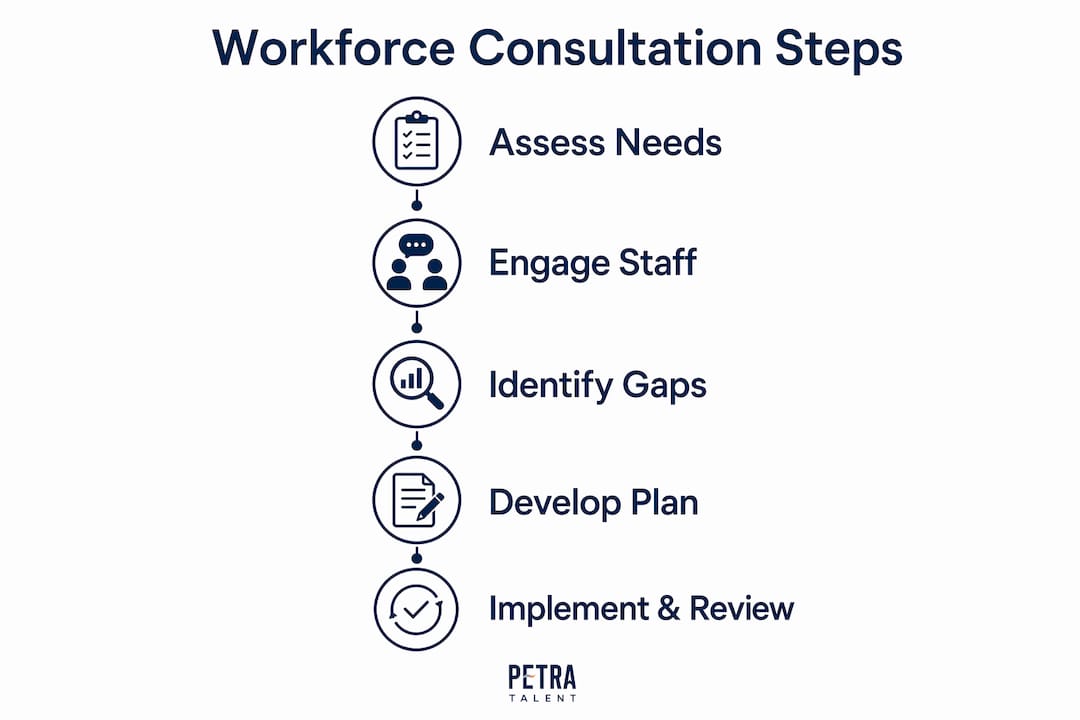
A well-run consultation follows a clear sequence. Each step builds on the last to produce workforce planning data that business owners can act on.
- Data collection. Gather current headcount, role distribution, turnover rates, and projected retirements. This baseline reveals where the gaps actually exist rather than where they are assumed to be.
- Employee engagement. Survey or interview field staff and supervisors. Gen Z workers prioritize work-life balance and transparent training pathways, so their input shapes recruitment messaging and onboarding design directly.
- Skills assessment. Map current technical certifications, licensing levels, and field competencies against the work the business needs to perform. A master plumber role, for example, carries licensing requirements that affect project eligibility and bid capacity.
- Gap analysis. Compare current skills to projected needs. Identify which gaps require external hiring, which can be closed through training, and which require apprenticeship pipelines.
- Planning and policy integration. Translate findings into hiring targets, training programs, and retention policies. Integrating consultation results into policy is what separates a one-time exercise from a sustained workforce strategy.
Pro Tip: Form a cross-functional committee that includes at least one field technician, one project manager, and one HR or operations lead. Field staff surface barriers that leadership rarely sees from the office.
Mentoring is a direct output of this process. Mentoring that explains why standards matter increases confidence and long-term retention among new plumbing technicians. Apprenticeship programs built from consultation data are more targeted and more likely to produce technicians who stay.

What strategic benefits do plumbing businesses gain from workforce consultation?
Workforce consultation produces measurable outcomes across hiring, retention, and operations. The benefits are not abstract.
- Better hiring alignment. Contractors who shift from reactive hiring to proactive consultative recruiting see stronger alignment between candidate profiles and actual workforce needs. Fewer bad hires means lower early turnover costs.
- Reduced early turnover. Tailored onboarding and mentorship paths built from consultation data address the specific reasons new technicians leave. Mentoring and supportive education improve new technician confidence by bridging the gap between classroom training and field realities.
- Stronger apprenticeship pipelines. Consultation identifies exactly where apprentice capacity is needed, making strategic apprentice hiring a targeted investment rather than a general expense.
- Compliance and culture. Consultation surfaces compliance gaps in licensing, safety training, and certification renewal before they become liabilities. It also builds a culture of transparency, which improves morale and reduces disengagement.
- Financial productivity gains. Firms that plan workforce needs in advance avoid the premium costs of emergency hiring and contract labor. The $38 billion annual economic cost of the plumbing shortage falls hardest on firms without a plan.
What steps can plumbing companies take to implement workforce consultation?
Plumbing business owners do not need a large HR department to run an effective consultation program. A focused, repeatable process works at any company size.
- Form a workforce committee. Include field staff, supervisors, and operations leadership. Meet quarterly to review hiring data, turnover trends, and training completion rates.
- Engage leadership actively. Owners and project managers must participate, not just delegate. Workforce planning decisions affect bid capacity, project timelines, and client relationships.
- Promote transparency with staff. Share what the consultation process found and what changes will follow. Employees who see their input reflected in policy are more likely to stay and refer peers.
- Integrate findings into hiring and training policies. Use consultation data to set annual hiring targets, define apprenticeship slots, and build technical training calendars. Passive recruiting strategies work well when consultation has already defined the ideal candidate profile.
- Leverage tech-based training. Apprenticeships, mentoring, and tech-based field training are recognized best practices for retaining talent and building productivity in complex field environments.
- Measure and adjust. Track turnover rates, time-to-fill, and training completion quarterly. Adjust the plan based on what the data shows, not on assumptions.
Key takeaways
Plumbing workforce consultation is the most direct tool contractors have for converting labor market pressure into a structured, manageable plan.
| Point | Details |
|---|---|
| Define the process clearly | Workforce consultation means assessing labor gaps, engaging staff, and building a hiring and training plan. |
| Industry pressure is severe | A shortage of 500,000 plumbers and a $38 billion annual economic cost demand a proactive response. |
| Committees drive results | Cross-functional internal committees surface real field barriers that leadership alone cannot identify. |
| Gen Z requires a new approach | Younger workers need transparent training pathways and work-life balance commitments to be recruited and retained. |
| Integration is the final step | Consultation findings must feed directly into hiring, training, and retention policies to produce lasting results. |
Why workforce consultation is the one investment plumbing owners cannot skip
I have watched plumbing contractors lose experienced crews to retirement and scramble to replace them with whoever was available, not whoever was right. The pattern is predictable and expensive. The firms that avoided it were not the ones with the biggest budgets. They were the ones that had a conversation with their workforce before the crisis hit.
Workforce consultation is not a corporate process reserved for large mechanical contractors. A three-person committee meeting quarterly, reviewing turnover data, and asking field technicians what they actually need is a consultation. The structure matters less than the habit. What I have seen consistently is that contractors who ask their people what is working and what is not get answers that change their hiring decisions for the better.
The common pitfall is treating consultation as a one-time audit. The firms that benefit most run it as an ongoing cycle. They adjust their apprenticeship targets, update their training programs, and revisit their recruiting messaging every year. That continuous loop is what keeps a workforce plan relevant as the market shifts.
— David
How Petratalent helps plumbing contractors build stronger workforces
Plumbing business owners who have completed a workforce consultation often face the same next challenge: finding qualified candidates who match the profiles the consultation identified.
Petratalent specializes in plumbing recruiting services built specifically for mechanical contractors across the United States. The team sources and vets candidates for service, construction, leadership, and technical roles, using market wage data and performance screening to match contractors with professionals who fit their workforce plan. Contractors who want to move from workforce analysis to actual hiring can review the full range of workforce and vetting solutions Petratalent offers. The process is designed to complement the consultation work contractors have already done, not replace it.
FAQ
What is plumbing workforce consultation?
Plumbing workforce consultation is a structured process where plumbing businesses assess their labor capacity, identify skill and staffing gaps, and develop targeted hiring and training plans. It is also called workforce planning consultation in formal industry contexts.
Why does the aging plumbing workforce matter for business owners?
The plumbing industry faces a shortage of 500,000 plumbers and projects 42,600 annual job openings through 2032. Firms without a replacement pipeline for retiring technicians face direct revenue and service capacity losses.
How do internal committees support workforce consultation?
Internal committees that include field staff and leadership identify real technical barriers and training needs that management alone cannot see. They convert informal workforce problems into documented, addressable data.
How does workforce consultation help with Gen Z recruiting?
Gen Z workers prioritize transparent training pathways and work-life balance. Consultation gathers their input directly, which allows contractors to redesign recruiting messaging and onboarding programs to match what younger workers actually need.
How often should plumbing companies run a workforce consultation?
Workforce consultation works best as a quarterly or annual cycle rather than a one-time audit. Regular reviews of turnover data, training completion, and hiring targets keep the workforce plan aligned with actual business conditions.
Recommended
Related Posts
October 13, 2026
Recruiting Contract Terms: 10 Checks and Ready to Use Clauses
Define fee triggers, candidate ownership, guarantees, and compliance terms. Get a master agreement, short schedule,…
October 12, 2026
Offer Acceptance Rates: Segment Benchmarks, HVAC’s 3–5 Day SLA
See why a 78% to 82% offer acceptance benchmark can mislead, how role and source…
October 11, 2026
Bad Hires Can Cost Construction Firms 30% to 200% of Salary
Bad hires can cost construction firms 30% to 200% of annual salary. Calculate recruiting, rework,…
October 10, 2026
Construction Labor Forecasting for PMs: 7 Steps to Time Hiring
Learn when construction project managers should use WBS or simulation, track labor KPIs, and turn…