



TL;DR:
- Effective HVAC job descriptions include clear titles, detailed responsibilities, and transparent pay to attract qualified applicants. Tailoring descriptions to experience levels and highlighting operational benefits improve candidate engagement and reduce turnover. Transparency about certifications, physical demands, and on-call policies is crucial for successful recruitment.
Writing effective HVAC job descriptions means crafting clear, detailed, and transparent postings that specify certifications, physical demands, compensation, and role-level expectations upfront. A well-written posting is the first filter in your hiring process. It determines whether a qualified EPA-certified technician applies or scrolls past. HR professionals and hiring managers who learn to write HVAC job descriptions with precision see measurable improvements in applicant quality, candidate self-selection, and long-term retention. This guide covers every component, from job title structure to on-call disclosures, using 2026 recruitment best practices.
What are the critical elements to include when writing HVAC job descriptions?
A strong HVAC job description follows a defined structure. Each section serves a specific purpose, and missing any one of them costs you qualified applicants.

Job title. Titles that rank best are 50–60 characters and lead with a value proposition like “Fully Stocked Truck” or “Guaranteed Hours” rather than corporate history. That length aligns with mobile display limits and matches how technicians run Boolean keyword searches on job boards.
Role summary. Write two to three sentences that sell the position. State the service area, the type of systems the technician will work on, and the single biggest benefit of the role. Hiring managers who treat the role like a product attract higher-quality applicants than those who open with company history.
Responsibilities. List specific, measurable tasks. “Troubleshoot VRF systems and document findings in ServiceTitan” is useful. “Perform HVAC duties as assigned” is not. Breaking responsibilities into specific tasks prevents misunderstanding and lowers turnover by up to 50%.
Qualifications. Separate mandatory credentials from preferred ones. EPA 608 certification may be required. NATE certification or a Carrier manufacturer credential may be preferred. Mixing the two causes underqualified candidates to apply and overqualified candidates to opt out.
Compensation and benefits. Listings with pay ranges get 30% more applicants and build immediate trust with top talent. State the hourly range, overtime policy, health benefits, and any sign-on bonus in plain numbers.
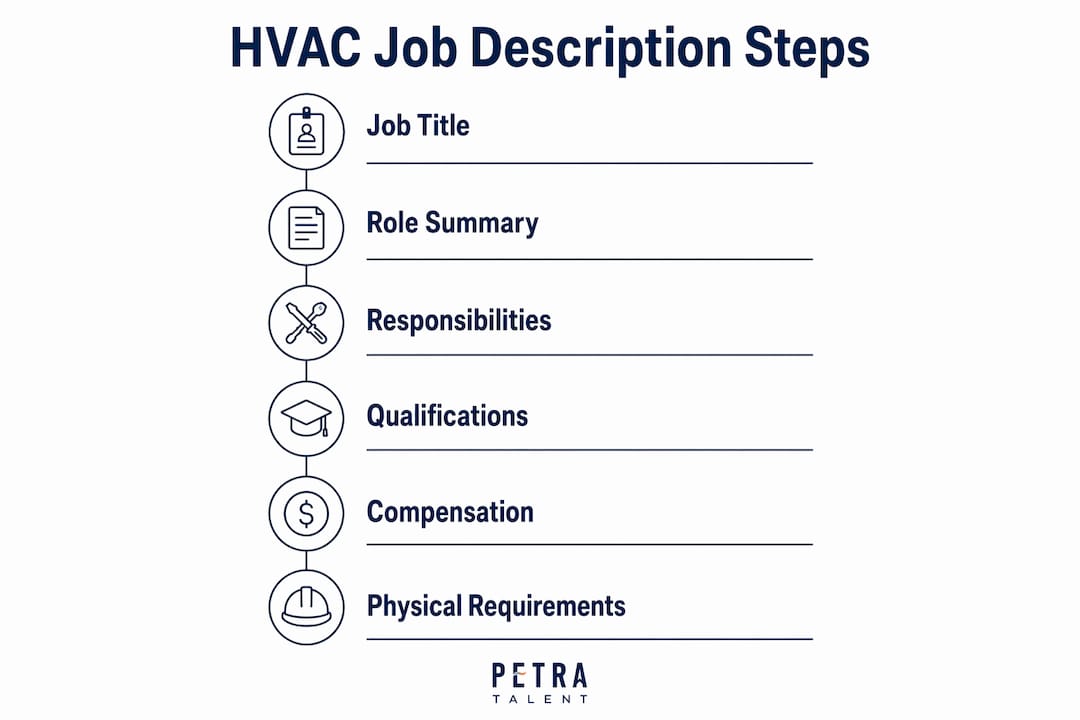
Physical and schedule requirements. Specify weight limits, ladder use, confined space work, and on-call rotation frequency. Hiding these details leads to early turnover.
Pro Tip: Format the qualifications section as two labeled lists: “Required” and “Preferred.” This single change reduces unqualified applications and speeds up screening.
How to tailor HVAC job descriptions for different roles and experience levels
Not all HVAC roles are the same, and a single generic posting will underperform across all of them. The table below shows how key elements shift across common role levels.
| Element | HVAC Technician I (Entry) | HVAC Technician II (Mid) | HVAC Technician III (Senior) |
|---|---|---|---|
| Experience required | 0–2 years | 3–5 years | 6+ years |
| Certifications | EPA 608 (in progress or held) | EPA 608, NATE preferred | EPA 608, NATE, manufacturer cert |
| Primary responsibilities | Assist, maintain, basic repairs | Independent service calls, diagnostics | Complex installs, VRF, mentoring |
| Typical pay range | Entry market rate | Mid market rate | Senior market rate |
| Physical demands | Standard | Standard plus rooftop units | Full range including confined spaces |
Beyond the table, residential and commercial roles require different language. Residential postings should emphasize customer communication skills and drive time expectations. Commercial postings should reference building automation systems, chiller maintenance, and coordination with facilities managers.
Experienced technicians prioritize certifications from manufacturers such as Carrier, Daikin, and Mitsubishi alongside EPA and NATE credentials. Listing these specifically signals that the posting is written by someone who understands the trade. That credibility alone improves applicant quality.
Adjust the tone by level as well. Entry-level postings can emphasize training programs and career paths. Senior-level postings should lead with autonomy, compensation, and equipment quality. A Technician III reading a posting written for a Technician I will disengage immediately.
What are best practices to improve job description visibility and candidate engagement?
Visibility and engagement are separate problems. A posting can rank well and still fail to convert. These practices address both.
-
Use Boolean-friendly job titles. Elite HVAC technicians use Boolean keyword searches on platforms like Indeed and LinkedIn. Titles like “HVAC Service Technician” or “Commercial HVAC Technician” match those search patterns. Titles like “HVAC Superstar” or “Climate Control Specialist” do not.
-
Lead with operational benefits. State dispatch efficiency, truck stocking policy, and schedule structure before listing employer expectations. Experienced technicians prioritize on-call policies, dispatch efficiency, and truck stocking support when evaluating a role.
-
Phrase sections as technician questions. Writing job descriptions as questions an experienced technician would ask improves alignment with how AI models index and rank content. “What systems will I work on?” performs better than “Systems include.”
-
Keep the posting 300–700 words. Optimal job description length is 300–700 words with short paragraphs and bullet lists for mobile readability. Long blocks of text reduce application rates on mobile devices.
-
Include localized context. Name the service area, climate conditions, and any regional licensing requirements. A posting for Phoenix, Arizona should reference high-volume cooling season demands. A posting for Chicago should mention heating system complexity.
Pro Tip: Test your job title by searching it on Indeed from a mobile device. If it truncates or returns unrelated results, revise it before publishing.
How to avoid common mistakes in HVAC job postings
The most common HVAC job posting failures share one root cause: vagueness. Many HVAC job descriptions fail by sounding like brochures instead of answering real technician questions, which hurts both search ranking and candidate engagement.
Specific mistakes to correct:
- Mixing required and preferred qualifications. This is the single fastest way to flood your inbox with unqualified applicants. Separate them clearly.
- Hiding compensation. Listing clear salary ranges helps employers filter candidates and builds immediate trust with sought-after HVAC professionals. Vague phrases like “competitive pay” signal that the offer may not be competitive.
- Omitting on-call details. On-call policy details like rotation frequency and double-time pay are critical to technician trust and job satisfaction. Leaving them out creates surprises that drive early turnover.
- Using outdated postings. A job description written in 2022 may reference outdated certifications, equipment, or pay scales. Review and update every posting before republishing.
- Writing for the company, not the candidate. A posting that spends three paragraphs on company history and one sentence on the role will not attract experienced technicians. Flip that ratio.
Contractors who want to avoid these patterns in depth can review common HVAC hiring mistakes for a fuller breakdown of what goes wrong and how to fix it.
Key takeaways
A well-written HVAC job description requires clear titles, separated qualifications, transparent pay, and role-specific detail to attract qualified candidates and reduce early turnover.
| Point | Details |
|---|---|
| Job title length matters | Keep titles 50–60 characters and use Boolean-friendly terms like “HVAC Service Technician.” |
| Separate required from preferred | Label certifications clearly to filter applicants and speed up screening. |
| Post pay ranges | Listings with pay ranges attract more applicants and build trust with experienced technicians. |
| Match the role level | Adjust tone, certifications, and responsibilities for Technician I, II, and III separately. |
| Disclose on-call policies | State rotation frequency and overtime pay to prevent early turnover from unmet expectations. |
What I’ve learned from reviewing hundreds of HVAC job postings
The most consistent pattern I see is that contractors write job descriptions for themselves, not for the technician reading them. The posting reflects what the company values, not what the candidate needs to know to decide whether to apply. That disconnect is where most postings fail.
Transparency is the single highest-leverage change a hiring manager can make. When a posting states the hourly range, the on-call rotation, the truck stocking policy, and the exact certifications required, it does three things at once. It filters out poor fits before the phone screen. It signals respect for the technician’s time. And it positions the company as one that operates with clarity.
The HVAC recruiting market in 2026 is tight. Technicians with five or more years of experience and NATE or manufacturer certifications have options. They read job postings the way a buyer reads a contract. Vague language reads as a red flag, not a mystery to explore. Contractors who attract experienced HVAC workers consistently are the ones who write postings that answer every operational question before the first interview.
— David
How Petratalent supports HVAC hiring with specialized recruitment
Petratalent works exclusively within the HVAC and plumbing industries, which means the team understands exactly what a well-written job description needs to accomplish before a single candidate is sourced.

When contractors partner with Petratalent, job description quality directly affects how quickly qualified candidates are identified and vetted. The team uses technical screening to match candidates against the specific certifications, experience levels, and physical requirements outlined in each posting. Petratalent also provides market wage insights to help hiring managers set pay ranges that are accurate for their region and role level. For contractors ready to improve both their postings and their pipeline, Petratalent’s HVAC recruiting services offer a structured path from job description to placement.
FAQ
What should every HVAC job description include?
Every HVAC job description should include a clear job title, role summary, specific responsibilities, separated required and preferred qualifications, transparent pay range, and physical and schedule requirements. Missing any of these elements reduces applicant quality and increases early turnover.
How long should an HVAC job posting be?
The optimal length is 300–700 words with short paragraphs and bullet points for mobile readability. Postings longer than 700 words see lower application rates, particularly on mobile devices.
Should HVAC job descriptions list salary ranges?
Listings with pay ranges get 30% more applicants and build trust with experienced technicians. Vague compensation language signals uncertainty and deters top candidates who have competing offers.
How do I write HVAC technician listings for different experience levels?
Adjust certifications, responsibilities, and tone for each level. Entry-level postings should emphasize training and career growth. Senior-level postings should lead with autonomy, equipment quality, and compensation. Mixing language across levels confuses candidates and weakens applicant fit.
What certifications should HVAC job descriptions mention?
At minimum, list EPA 608 certification as required. NATE certification and manufacturer credentials from Carrier, Daikin, or Mitsubishi should appear as preferred qualifications for mid to senior roles. Listing these specifically attracts candidates with verified technical authority.
Recommended
Related Posts

July 14, 2026
How to Source Mechanical Leadership Talent Effectively
Learn how to source mechanical leadership talent effectively. Discover key skills needed for success in…

July 13, 2026
Performance-Based Screening for HVAC and Plumbing Hiring
Discover what is performance-based screening and how it enhances HVAC and plumbing hiring. Improve candidate…

July 12, 2026
Types of Plumbing Trade Certifications: A Career Guide
Explore the types of plumbing trade certifications to enhance your career. Learn how these credentials…

July 11, 2026
Why Plumbing Certifications Affect Hiring Decisions
Discover why plumbing certifications affect hiring decisions. Learn how these credentials impact wages, legal authority,…