



TL;DR:
- A structured HVAC hiring process involves five evaluation stages, objective scoring, and a phased onboarding plan to improve hire quality and retention. Implementing a rapid, guided recruitment system reduces mis-hires and accelerates onboarding, leading to a more efficient workforce. Utilizing scoring rubrics and dedicated hiring ownership further minimizes bias and delays during the hiring cycle.
A structured HVAC hiring process is defined as a staged, evidence-based system that moves candidates through defined evaluation phases, from job description to signed offer, using objective scoring at every step. HVAC businesses that rely on informal hiring, gut feel, and slow follow-up consistently lose qualified technicians to competitors who move faster and communicate better. The framework covered here combines five core hiring stages, scoring rubrics, practical skills assessments, and a 30-60-90 day onboarding plan to give contractors a repeatable system that produces better hires in less time.
What are the essential steps to structure an HVAC hiring process?
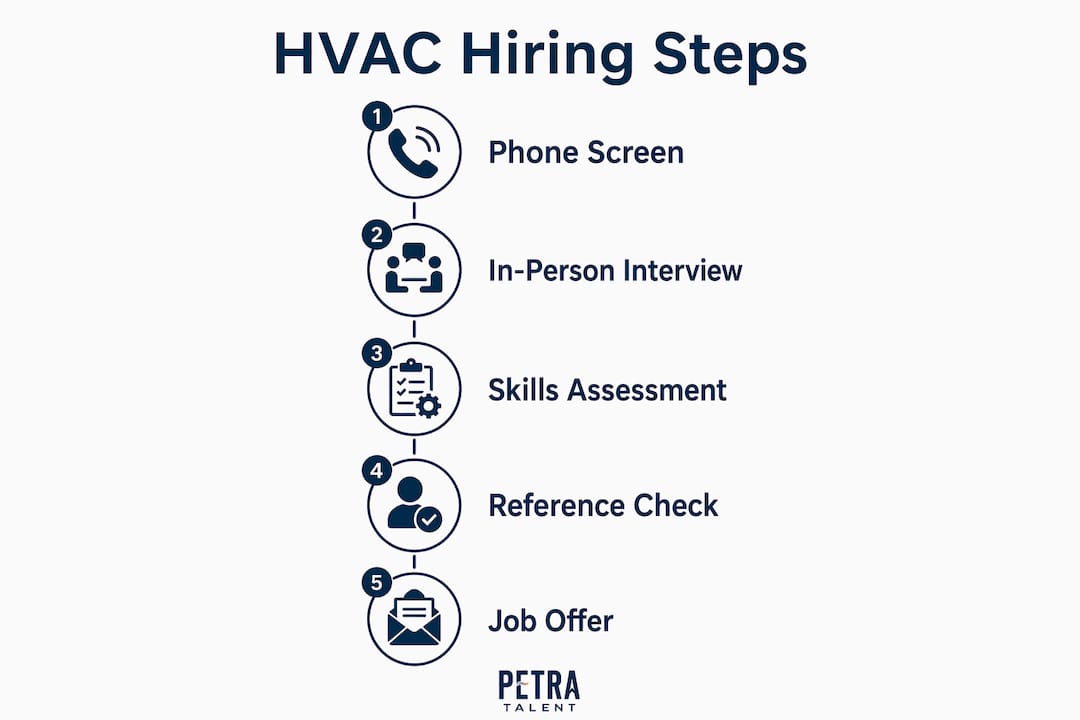
A 5-step HVAC hiring framework covers phone screening, in-person interviews, practical skills assessments, reference checks, and the offer. Each phase has a specific purpose, and skipping any one of them increases the risk of a costly mis-hire. Here is how to execute each step with precision:
-
Write a specific job description. Generic postings attract generic applicants. List the certifications required (EPA 608, NATE), the service area, the truck setup, and the compensation range. Contractors who post vague descriptions spend more time screening unqualified candidates.
-
Run a 10-minute phone screen within 24 hours. Contact every qualified applicant the same day their application arrives. Confirm certifications, availability, and salary expectations. Book phone screens within 24 hours to stay ahead of competing offers already in motion.
-
Conduct a structured in-person interview. Use a mix of technical questions (“Walk me through diagnosing a refrigerant leak”) and behavioral questions (“Describe a time a customer was unhappy with your work”). Have two or more interviewers score candidates independently using a rubric before comparing notes.
-
Administer a practical skills assessment. Set up a hands-on station that tests real troubleshooting scenarios. Safety behaviors must be observed first, before measuring technical proficiency. A candidate who communicates well but bypasses lockout/tagout is a liability, not an asset.
-
Check references and move to offer. Call two or three previous supervisors and ask specifically about reliability, customer interactions, and the reason for leaving. Once references clear, make the offer the same day. Delays at this stage cost contractors candidates who are already fielding competing offers.
Pro Tip: Assign one person to own the entire recruiting process from posting to offer. Contractors who split hiring duties across operational managers consistently experience slower timelines and dropped communication.
How do scoring rubrics improve HVAC candidate evaluation?
Moving from gut-based to score-based candidate evaluations reduces informal bias and produces more accurate hiring decisions. The standard approach uses a 1 to 5 scale across four to five weighted categories.
| Category | Weight | What to Assess |
|---|---|---|
| Technical Skills | 35% | Certifications, diagnostic accuracy, equipment knowledge |
| Problem-Solving | 25% | Troubleshooting logic, response under pressure |
| Customer Service | 20% | Communication style, conflict resolution examples |
| Safety Awareness | 15% | Knowledge of protocols, past incident history |
| Culture Fit | 5% | Team orientation, communication with dispatch |
Each interviewer scores candidates independently, then the group compares totals after all interviews are complete. This prevents the first interviewer’s opinion from anchoring everyone else’s score. A competency matrix takes this further by mapping each candidate’s skill levels against the role’s requirements, creating a clear picture of where gaps exist before the hire even starts.
The competency matrix also serves as a communication tool between the hiring team and whoever manages onboarding. If a new hire scores a 2 out of 5 on refrigeration fundamentals, that gap feeds directly into their first 30-day training plan. This is what separates structured hiring from a simple checklist: the evaluation informs what happens after the offer is signed.
Pro Tip: Print individual rubric sheets for each interviewer. Collecting scores on paper before any group discussion eliminates the social pressure that skews panel interviews toward the most vocal opinion in the room.
Why does HVAC hiring take so long, and how do you fix it?
Open HVAC roles take roughly 30 days to fill on average, and every day a service truck sits idle represents direct revenue loss. The root cause is rarely a shortage of candidates. It is almost always a process problem: slow outreach, passive communication, and no single owner accountable for moving candidates forward.
The fixes are specific and repeatable:
- Adopt a speed-to-lead mindset. Treating recruiting as a revenue-driving function changes how quickly managers respond to applications. A new applicant is no different from a new service lead. Both go cold fast.
- Text before you call. Most technicians are on job sites during business hours. A short text message asking for a good time to connect gets faster responses than a voicemail that sits unanswered for two days.
- Compress the timeline. Phone screen on day one, in-person interview by day three, skills assessment by day five, offer by day seven. Contractors who follow this cadence consistently outpace those running two-week interview cycles.
- Assign a dedicated hiring owner. A dedicated hiring owner improves recruiting consistency and speed by managing the entire process without competing priorities. Overloaded operations managers are the single biggest cause of slow HVAC hiring timelines.
- Keep candidates informed at every stage. Silence between stages is interpreted as disinterest. A brief update text after each step costs 30 seconds and prevents candidates from accepting other offers while waiting.
Reviewing common HVAC hiring mistakes before launching a new process helps contractors avoid the patterns that slow timelines and reduce offer acceptance rates.
How to design a 30-60-90 day onboarding plan for HVAC hires
Structured onboarding plans shared with new hires on day one improve clarity, accelerate productivity, and increase retention. The 30-60-90 framework divides the first three months into three phases, each with measurable goals and a formal review checkpoint.
| Phase | Days | Focus | Example Goals |
|---|---|---|---|
| Learning | 1 to 30 | Orientation, systems, safety protocols | Complete EPA 608 review, shadow 3 senior techs, pass safety gate assessment |
| Contributing | 31 to 60 | Independent work with oversight | Complete 15 solo service calls, receive customer satisfaction scores above 4.0 |
| Owning | 61 to 90 | Full role ownership | Manage own call schedule, mentor one junior tech, hit monthly revenue targets |

Set three to five measurable goals per phase across learning, performance, and relationship categories. Share the plan with the new hire on day one and invite them to adjust goals that feel misaligned with their experience level. Co-creating the plan increases commitment and signals that the company invests in the person, not just the labor.
Scheduled formal reviews at 30, 60, and 90 days increase retention by giving new hires structured feedback and a clear path forward. Contractors who skip these checkpoints often find themselves surprised by early turnover that a single honest conversation could have prevented.
Key takeaways
A structured HVAC hiring process requires five defined stages, objective scoring rubrics, a compressed timeline, and a phased onboarding plan to consistently produce quality hires and reduce turnover.
| Point | Details |
|---|---|
| Five-stage framework | Phone screen, interview, skills assessment, reference check, and same-day offer reduce mis-hires. |
| Scoring rubrics reduce bias | Independent 1 to 5 scoring across Technical, Safety, and Culture categories improves decision accuracy. |
| Speed wins top candidates | Compressing the hiring timeline to seven days prevents candidates from accepting competing offers. |
| Dedicated hiring owner | One person managing the full process eliminates delays caused by overloaded operations managers. |
| Phased onboarding retains talent | A 30-60-90 day plan with formal reviews at each milestone accelerates productivity and reduces early turnover. |
What I have learned from watching HVAC hiring go wrong
After working closely with mechanical contractors across the United States, the pattern I see most often is not a lack of candidates. It is a lack of process. Companies post a job, get applications, and then lose the best ones while they are still deciding who to call first.
The shift from gut feel to scored evaluations is harder than it sounds. Most hiring managers believe they can read people accurately in a 20-minute conversation. The data says otherwise. Rubrics do not remove judgment from hiring. They give judgment a structure that holds up under scrutiny.
The other mistake I see consistently is treating onboarding as paperwork. The 30-60-90 plan is not an HR formality. It is the continuation of the promise made during the interview. When a new hire shows up on day one and there is no plan, no goals, and no clear path forward, the company has already started losing them.
Contractors who attract experienced HVAC workers and retain them long-term share one common trait: they treat hiring as a system, not an event.
— David
How Petratalent helps HVAC contractors build better hiring systems
Petratalent specializes in HVAC and plumbing recruitment across the United States, providing role-specific candidate sourcing, technical vetting, and workforce consultation for mechanical contractors. The team handles the sourcing and screening stages so that hiring managers receive only pre-qualified candidates who meet certification, experience, and compensation requirements. This cuts the average time-to-fill significantly without sacrificing candidate quality.
For contractors who need a full recruiting partner rather than a job board, Petratalent’s HVAC recruiting services cover direct hire placements, leadership searches, and market wage analysis. Explore all available services to find the right level of support for your hiring goals.
FAQ
What are the key steps in an HVAC hiring process?
The five core steps are phone screening, structured in-person interviews, practical skills assessments, reference checks, and a same-day offer. Each stage filters candidates on specific criteria, reducing the risk of a mis-hire.
Why does HVAC hiring take so long?
Most delays come from slow outreach, no dedicated hiring owner, and passive communication between stages. Open roles average 30 days to fill, but contractors with a compressed, seven-day process consistently outperform that average.
How do scoring rubrics work in HVAC interviews?
Interviewers score candidates independently on a 1 to 5 scale across categories like Technical Skills, Safety Awareness, and Culture Fit, then compare totals after all interviews. This method reduces bias and produces more consistent hiring decisions.
What should a 30-60-90 day HVAC onboarding plan include?
Each phase should include three to five measurable goals across learning, performance, and relationship categories, with formal review checkpoints at days 30, 60, and 90. Sharing the plan with the new hire on day one improves commitment and reduces early turnover.
How do practical skills assessments improve HVAC hiring?
A baseline skills assessment uses a safety gate, a fundamentals quiz, and a hands-on troubleshooting station to verify that candidates can perform the job safely before they are placed in the field.
Recommended
Related Posts

October 13, 2026
Recruiting Contract Terms: 10 Checks and Ready to Use Clauses
Define fee triggers, candidate ownership, guarantees, and compliance terms. Get a master agreement, short schedule,…

October 12, 2026
Offer Acceptance Rates: Segment Benchmarks, HVAC’s 3–5 Day SLA
See why a 78% to 82% offer acceptance benchmark can mislead, how role and source…
October 11, 2026
Bad Hires Can Cost Construction Firms 30% to 200% of Salary
Bad hires can cost construction firms 30% to 200% of annual salary. Calculate recruiting, rework,…

October 10, 2026
Construction Labor Forecasting for PMs: 7 Steps to Time Hiring
Learn when construction project managers should use WBS or simulation, track labor KPIs, and turn…