


TL;DR:
- Workforce consultation involves actively listening to employees and their representatives before significant decisions to ensure their views influence outcomes. Legal triggers like redundancies and employee thresholds demand structured consultation processes to prevent costly penalties and build trust. Effective early, documented, and genuine engagement enhances decision quality, legal compliance, and workforce relations, especially in industries like HVAC and mechanical contracting.
Many business owners and HR professionals treat workforce consultation as a box to check before announcing a decision. That misunderstanding creates real legal and operational risk. What does workforce consultation mean, at its core? It means actively listening to employees and their representatives before major decisions are made, with a genuine intent to let those views shape outcomes. This article covers the definition, legal triggers, different consultation types, and practical ways to apply consultation in workforce planning and hiring strategies.
Table of Contents
- Key Takeaways
- What workforce consultation means and why it matters
- Legal frameworks and statutory requirements
- Types of workforce consultation compared
- Benefits of effective workforce consultation
- My take on where most organizations get it wrong
- How Petratalent supports your workforce strategy
- FAQ
Key Takeaways
| Point | Details |
|---|---|
| Consultation requires genuine listening | Employers must actively consider employee input, not simply inform workers of decisions already made. |
| Legal triggers determine the process | Collective consultation rules activate at 20+ redundancies in 90 days, with specific timelines and representatives required. |
| Types of consultation differ significantly | Collective and individual consultation run alongside each other and serve different but complementary purposes. |
| Documentation protects employers | Keeping clear records of the consultation process is critical for meeting legal standards and avoiding disputes. |
| Early engagement produces better outcomes | Starting consultation before decisions are finalized allows employee input to genuinely influence proposals. |
What workforce consultation means and why it matters
The workforce consultation definition starts with a simple premise: consultation means talking and listening to employees or their representatives about issues that affect them, with the goal of finding solutions or reaching agreement. ACAS describes it as an ongoing engagement process, not a one-time announcement.
What makes this definition important for HR professionals is the distinction it draws between informing and consulting. Employers retain final decision-making authority after consultation. That said, employers listen and consider views before making those final calls. The process is not collective bargaining. Employees do not gain a veto. But genuine engagement is required.
Workforce consultation applies across a range of business decisions:
- Proposed redundancies and restructuring
- Changes to employment terms and conditions
- Workplace health and safety arrangements
- Business transfers or acquisitions
- Workforce planning and organizational changes
Beyond legal obligations, consultation is a recognized management practice. Organizations that build it into their standard processes tend to make better decisions because they incorporate frontline knowledge that leadership often lacks.
Pro Tip: Do not wait for a legal trigger to start consulting your workforce. Regular informal consultation on smaller decisions builds the organizational habits and employee trust that make formal consultation processes far smoother when they become necessary.
Legal frameworks and statutory requirements
The legal side of workforce consultation matters because getting it wrong carries financial penalties. There are two main statutory frameworks HR teams need to understand.
The first is collective consultation. Under section 188 of the Trade Union and Labour Relations (Consolidation) Act, collective consultation is triggered by 20 or more proposed redundancies within 90 days at a single establishment. When this threshold is met, employers must consult with appropriate representatives, which means recognized trade union representatives or, where none exist, elected employee representatives.
The second is the Information and Consultation of Employees (ICE) regulations. The ICE regulations apply to employers with 50 or more employees and require that formal information and consultation arrangements be negotiated if employees request them. These regulations create a procedural framework rather than a mandate to consult on every business decision.
| Framework | Trigger | Representatives Required | Key Obligation |
|---|---|---|---|
| Collective consultation (TULRCA) | 20+ redundancies in 90 days | Trade union or elected reps | Consult with view to agreement |
| ICE Regulations | 50+ employees, upon request | Negotiated arrangements | Establish formal info and consultation structure |
| Individual consultation | Applies in all redundancy cases | The affected employee | Address personal impact and alternatives |
Timing matters considerably. Meaningful consultation must begin before final decisions are made, allowing employee input to genuinely shape proposals. Starting late, or treating the process as a notification exercise, exposes employers to legal challenges.
Pro Tip: Treat collective consultation deadlines as hard compliance milestones, not administrative tasks. Missing the start date for formal consultation in a redundancy situation is one of the most common and costly HR errors.
Types of workforce consultation compared
Understanding the different forms of consultation helps HR teams avoid one of the most common pitfalls: mixing statutory and non-statutory processes without recognizing their different requirements.
The table below shows how the main types compare:
| Consultation Type | Focus | Who Is Involved | Outcome Goal |
|---|---|---|---|
| Collective consultation | Workforce-wide changes | Representatives (union or elected) | Agreement or consensus on proposals |
| Individual consultation | Personal impact on one employee | The individual employee | Fair process and alternative options explored |
| ICE arrangements | Ongoing information sharing | Negotiated employee body | Structured engagement framework |
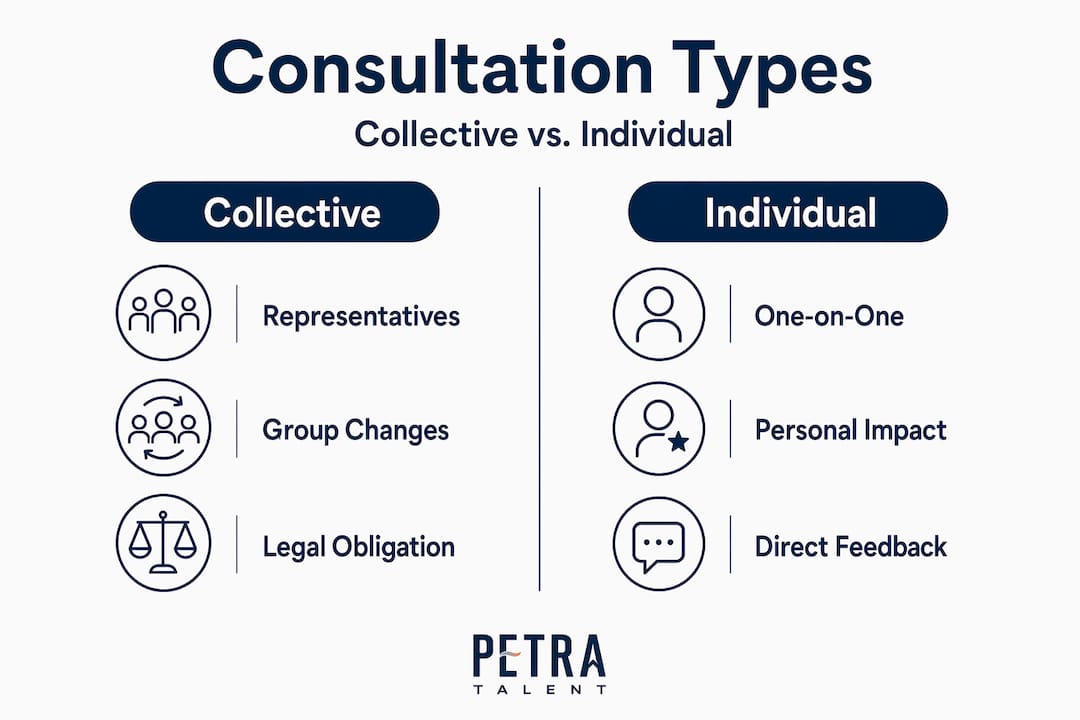
Collective and individual consultation are distinct processes that run alongside each other during a redundancy exercise. Collective consultation addresses the overall plan, including selection criteria, ways to minimize redundancies, and the timeline. Individual consultation addresses each affected employee’s specific situation, including whether alternatives to redundancy exist for that person.
A frequent confusion is treating ICE arrangements as a decision-making mechanism. They are not. ICE arrangements create a structure for ongoing dialogue. They do not give employee bodies the authority to block decisions. Recognizing this distinction prevents organizations from either over-committing in ICE negotiations or under-estimating what collective consultation requires.
Benefits of effective workforce consultation
Effective consultation is not just a compliance activity. It produces measurable organizational benefits when done well.

Involving employees improves workplace relations and helps manage change more successfully. Employees who feel heard are less likely to resist changes and more likely to understand the business rationale behind difficult decisions.
Concrete benefits include:
- Better decisions. Employees often identify practical problems with proposals that leadership has not considered. Their input can prevent costly implementation failures.
- Reduced resistance. When people have a genuine opportunity to contribute to a process, they are more willing to accept outcomes they may not prefer.
- Alternative solutions. Consultation frequently surfaces alternatives that reduce the scale of workforce changes, particularly in redundancy scenarios.
- Legal protection. Proper consultation, when documented correctly, provides evidence of a fair process and reduces the risk of successful employment tribunal claims.
- Workforce trust. Consultation processes vary by business size and context, but consistent, genuine engagement builds long-term trust that supports workforce retention and hiring quality.
For HVAC and mechanical contractors specifically, this last point connects directly to workforce trends affecting HVAC hiring. Organizations known for treating their workforce with respect attract better candidates and retain experienced technicians longer.
Failure to properly conduct collective consultation can result in protective awards of up to 90 days’ pay per affected employee. That financial exposure makes consultation compliance a direct cost control issue, not just an HR formality. Companies that invest in getting it right from the start avoid tribunal proceedings, legal fees, and reputational damage in tight labor markets.
My take on where most organizations get it wrong
I have seen many organizations approach workforce consultation as a scripted announcement with a question-and-answer session at the end. It almost always creates problems. Employees sense when a consultation is performative, and it damages trust more than no consultation at all would.
What I have found consistently is that the organizations that do this well start earlier than they think they need to. They bring employees into the conversation when proposals are still genuinely forming, not when the only question left is the timeline. Early consultation in redundancy exercises allows meaningful input and avoids rushed processes.
The other mistake I see is poor documentation. Consultation records must show a real exchange of views aimed at finding solutions, not just meeting notes that log attendance. If a legal challenge arises, that documentation is your defense. Thorough records also reinforce internal accountability by showing that consultation shaped the final decision.
My recommendation: treat consultation as a structured management discipline with a clear process, assigned responsibilities, and documented outcomes. That approach protects the organization legally and builds the kind of workforce culture that makes hiring and compliance support far easier to manage over time.
— David
How Petratalent supports your workforce strategy

Petratalent works with mechanical contractors and HVAC companies across the United States to build stronger workforce strategies from the ground up. That includes helping teams understand their compliance obligations, structure their hiring processes, and source the skilled professionals their operations depend on. Whether you need direct-hire recruiting support or a broader review of your workforce planning approach, Petratalent’s full range of services is built specifically for the trades. Reach out to explore how a dedicated recruiting partner can reduce risk and improve your hiring outcomes.
FAQ
What is the simplest workforce consultation definition?
Workforce consultation means employers talk with employees or their representatives before making major decisions, genuinely considering their views before finalizing any course of action.
When is collective consultation legally required?
Collective consultation becomes a statutory obligation when an employer proposes 20 or more redundancies within a 90-day period at one establishment, requiring engagement with recognized or elected representatives.
Does consultation give employees the power to block decisions?
No. Employers retain final decision-making authority after consultation. The legal requirement is to listen and genuinely consider employee input, not to obtain employee approval before proceeding.
How does individual consultation differ from collective consultation?
Collective consultation addresses workforce-wide changes and involves representatives, while individual consultation focuses on each affected employee’s personal situation, including exploring alternatives to redundancy for that person specifically.
What happens if an employer fails to consult properly?
Failure to meet collective consultation duties can result in a protective award of up to 90 days’ pay per affected employee, issued by an employment tribunal as a financial penalty for non-compliance.
Recommended
Related Posts

October 14, 2026
HVAC Recruiter Fees: Contractors Weigh $10,000 Against Vacancy Costs
See how HVAC recruiter fees work for contractors, from 15% to 25% placement costs to…

October 13, 2026
Recruiting Contract Terms: 10 Checks and Ready to Use Clauses
Define fee triggers, candidate ownership, guarantees, and compliance terms. Get a master agreement, short schedule,…

October 12, 2026
Offer Acceptance Rates: Segment Benchmarks, HVAC’s 3–5 Day SLA
See why a 78% to 82% offer acceptance benchmark can mislead, how role and source…

October 11, 2026
Bad Hires Can Cost Construction Firms 30% to 200% of Salary
Bad hires can cost construction firms 30% to 200% of annual salary. Calculate recruiting, rework,…