



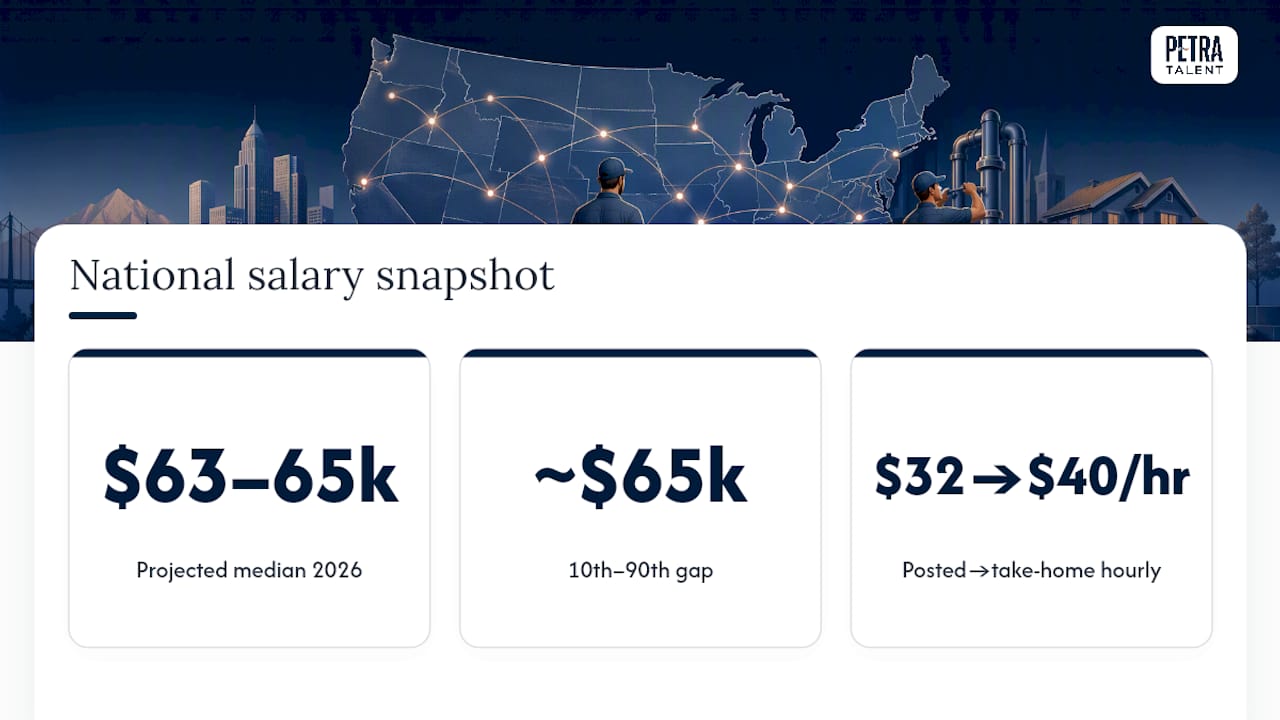
Plumbers earned a national median annual wage of $62,970 in May 2024, or roughly $30 an hour, and industry projections put the 2026 median in the $63,000 to $65,400 range. Pay stretches from under $40,670 for the lowest 10th percentile to higher amounts for top earners. Three factors move that number the most: where you work, your license level, and whether you’re in residential service or industrial pipefitting.
TL;DR:
- The national median plumber salary in 2026 is projected to be between $63,000 and $65,400 per year, driven mainly by labor shortages.
- Experience levels influence pay, with apprentices earning $18 to $26 per hour and master plumbers earning significantly more, especially if they own their business.
- Sector and location are key, with union-heavy markets and high-cost regions like Illinois and California offering the highest median wages, sometimes exceeding $75,000 annually.
- The largest salary variation stems from geographic and specialization factors, with industrial and pipefitting roles paying the most, especially in high-demand projects.
- To increase earnings, plumbers should pursue certifications, target high-paying sectors, negotiate total compensation, and consider ownership paths, as labor market trends favor workers.
Table of Contents
- What Determines Plumber Salary in 2026: National Data
- Plumber Pay by Experience: Apprentice to Master
- Residential, Commercial, and Industrial Pay Differences
- Where Plumbers Earn the Most (and Least) in 2026
- Why Plumber Demand and Pay Are Both Climbing
- How to Increase Your Plumbing Salary in 2026
- Reading Plumber Salary Data the Right Way
- PetraTalent’s View From the Recruiting Desk
- What the 2026 Numbers Actually Tell Us
- How PetraTalent Helps Contractors Hire and Benchmark Pay
- Sources
What Determines Plumber Salary in 2026: National Data
The Bureau of Labor Statistics tracks plumbers, pipefitters, and steamfitters as one occupational group, and its May 2024 Occupational Employment and Wage Statistics remain the benchmark most recruiters and contractors use for wage planning. Industry salary trackers project that trend forward into a 2026 median of about $63,000 to $65,400, a modest step up driven by continued labor tightness rather than a dramatic wage jump.
Base pay tells only part of the story. Total compensation on a full-time journeyman schedule frequently runs well above the advertised hourly rate once overtime, call-back pay, and prevailing-wage differentials on industrial projects get factored in. A plumber quoted $32 an hour on a job posting could easily clear $40 an hour in take-home earnings during a busy overtime season.
Here’s how the national percentile breakdown looks, based on BLS data:
The headline number to remember: the gap between the 10th and 90th percentile is nearly $65,000 a year, which means the label “plumber salary” without context tells you almost nothing. Location, license, and sector explain almost all of that spread, and the sections below break down each one.
Plumber Pay by Experience: Apprentice to Master
Wage progression in plumbing follows a fairly predictable ladder, and understanding where you sit on it is the fastest way to judge whether a job offer is fair.
- Apprentice: Starting pay typically falls between $18 and $26 per hour, with raises tied to program milestones rather than annual reviews. Most apprenticeship programs run four to five years and increase pay roughly every six months to a year as skills and OJT hours accumulate.
- Journeyman plumber: Once licensed, journeyman pay commonly lands in the $38 to $50+ per hour band, depending on region and specialization. Overtime, on-call rotations, and additional certifications (backflow prevention, medical gas, gas fitting) push many journeymen toward the higher end of that range.
- Master plumber: Master-level licensing raises the wage ceiling further, and business ownership raises it again. A master plumber running their own service company often earns several multiples of a W2 journeyman wage once you count owner profit alongside labor pay.
Understanding these bands matters whether you’re comparing a job offer or figuring out what to counter with. A journeyman plumber’s pay sitting at the low end of the range in a high cost-of-living metro is a signal to negotiate, not necessarily a signal the employer is lowballing.
Pro Tip: Ask any employer how they define “journeyman rate” before comparing offers. Some contractors count only base hourly pay, while others quote a blended rate that already folds in guaranteed overtime. The number means nothing without knowing what’s inside it.
Residential, Commercial, and Industrial Pay Differences
Not all plumbing work pays the same, even at identical experience levels. Sector and project type shift compensation as much as geography does.
- Residential service plumbers typically see steady, moderate pay with less overtime volatility, since call volume is spread across the year rather than concentrated in project phases.
- Commercial construction plumbers often earn more than residential counterparts on large builds, particularly when prevailing-wage rules apply to public or federally funded projects.
- Industrial and pipefitting work, including process piping, refinery turnarounds, and steamfitting, tends to pay the highest premiums. These roles often carry prevailing wage requirements, per diem for travel, and overtime baked into the schedule.
- Specialized certifications, like medical gas installation or semiconductor cleanroom piping, routinely command a wage bump over general commercial rates because so few plumbers hold the credential.
The recent wave of CHIPS Act semiconductor fabs and AI data center construction has created a hiring surge for traveling process-piping plumbers, and those workers are commanding some of the strongest per diem and overtime packages in the trade right now. Contractors evaluating multi-skilled staffing strategies are seeing this play out firsthand as demand outpaces the supply of qualified pipefitters.
Where Plumbers Earn the Most (and Least) in 2026
Geography shapes plumber salary in 2026 more than almost any other factor. The same journeyman license can produce a $20,000 pay difference depending on the metro.
High cost-of-living states and union-dense metros consistently post the strongest numbers. States like Illinois, Oregon, and parts of the West Coast, along with metros around Sunnyvale and San Jose, report some of the highest median plumber pay in the country, driven by a mix of union scale, high demand, and elevated living costs. Union contracts in these markets frequently push total compensation well above the open-shop average once pension contributions and health benefits get counted alongside the hourly rate.
At the other end of the spread, lower cost-of-living states in parts of the South and rural Midwest post medians well below the national figure, sometimes by $15,000 to $20,000 a year. That gap doesn’t necessarily mean those markets are worse for plumbers financially. A $52,000 salary in a low cost-of-living state can leave a plumber with comparable or better purchasing power than a $75,000 salary in a metro with steep housing costs.
A few things worth checking before you compare any two markets:
- Union scale versus open shop: union locals negotiate wage scales that often outstrip non-union pay once pensions and health coverage are included, so a straight hourly comparison undersells the union number.
- Cost-of-living adjustment: run any cross-state comparison through a cost-of-living calculator before assuming one job offer beats another.
- Metro versus statewide averages: a state’s overall median can mask enormous variation between its biggest city and its rural counties.
The takeaway most job seekers miss: the “best-paying state” question is less useful than the “best-paying state for my specific license and specialization” question. A journeyman with process-piping experience will find dramatically different opportunities in an industrial hub than a residential service tech will find in the same state.
Why Plumber Demand and Pay Are Both Climbing
Plumbing wages are rising largely because the labor supply hasn’t kept pace with retirements. A meaningful share of the experienced plumbing workforce is aging into retirement faster than apprenticeship programs are producing replacements, and that imbalance is the single biggest wage driver heading into 2026 and beyond.
Three forces are compounding that shortage:
Infrastructure investment tied to federal spending programs is generating sustained commercial and municipal construction work, which keeps demand for licensed plumbers elevated across most regions rather than concentrated in a few hot markets.
CHIPS Act semiconductor projects and AI data center construction have created an entirely new category of high-paying, high-demand pipefitting work. These projects need process piping specialists in volumes the existing workforce struggles to supply, which is part of why specialty pipefitters are seeing some of the strongest wage growth in the trade.
Retirements and apprenticeship pipeline gaps are the quieter but more persistent pressure. Programs listed through Apprenticeship are expanding, but training a plumber to journeyman level takes four to five years, meaning today’s apprenticeship enrollment won’t fully address today’s shortage for several more years. That lag is exactly why wages keep climbing even in markets without dramatic construction booms.
For contractors, this dynamic means competing for a shrinking pool of licensed talent. For plumbers, it means leverage. Labor market trends heading into 2026 increasingly favor the worker, not the employer, in wage negotiations.

How to Increase Your Plumbing Salary in 2026
Plumbers who actively manage their career path tend to out-earn peers with identical licenses by a wide margin. Here’s what actually moves the needle:
- Pursue specialty certifications. Backflow prevention, medical gas installation, and process piping credentials are in short supply relative to demand, and each one typically opens access to higher-paying project types.
- Target industrial and pipefitting work if you can relocate or travel. Per diem and prevailing-wage projects consistently outpay residential service work for equivalent experience.
- Negotiate around total compensation, not just base rate. Framing a request around project ROI, your certification value, and your availability for overtime or travel tends to move employers further than asking for a flat raise.
- Ask about review schedules and bonus structures upfront. A lower starting wage with a defined 90-day review and performance bonus can outperform a marginally higher flat rate with no review path.
- Consider the ownership path. Master plumbers who move into business ownership control their own pricing, and pricing strategy, not just labor hours billed, is what ultimately raises owner income beyond the employee wage ceiling.
Pro Tip: When negotiating, ask for the total compensation breakdown in writing before comparing two offers. A $2 hourly gap disappears fast if one employer offers a signing bonus, PTO accrual, and a 90 day review with a built in raise.
Reading Plumber Salary Data the Right Way
Not all salary numbers are built the same way, and mixing sources without checking their methodology leads to bad comparisons. BLS/OES data comes from employer payroll surveys and reflects actual wages paid, while job-board averages are often self-reported by users and skew toward whoever bothers to submit a number. Employer job ads, meanwhile, frequently post a base range that excludes overtime, per diem, or bonus pay entirely.
Before trusting any local salary figure, run it through this checklist:
- Confirm whether the number is base pay only or includes overtime and bonuses.
- Check the sample size behind metro-level figures; small metros can post skewed averages from just a handful of respondents.
- Verify the publish date. A “current” salary figure pulled from a three-year-old survey understates today’s market in a tight labor environment.
- Cross-reference at least two sources, ideally one government dataset and one industry estimate, before treating a number as reliable.
PetraTalent’s View From the Recruiting Desk
PetraTalent works inside plumbing and HVAC hiring every day, and the salary conversations happening in 2026 look different than they did even two years ago. Contractors are losing candidates to competitors offering $3 to $5 more per hour, and journeymen with specialty certifications are fielding multiple offers at once.
In placement conversations, negotiation targets increasingly center on total compensation rather than base rate alone. Signing bonuses, defined 90-day review raises, and per diem clarity are closing offers that a flat hourly bump used to close on its own. Contractors who benchmark pay against current market wage data before posting a role are filling positions faster than those relying on last year’s pay scale.
That gap between what a role paid a year ago and what it needs to pay now is exactly where hiring plans stall if contractors don’t adjust.
What the 2026 Numbers Actually Tell Us
The conventional advice on plumber pay treats the national median as the answer, when it’s really just the starting point for a much more useful question: what does someone with my license, in my region, doing my kind of work, actually earn? The data supports a clearer conclusion than most salary guides admit. Location and specialization explain more of the pay spread than experience alone, and a journeyman in industrial pipefitting in a union metro can out-earn a master plumber doing residential service in a low-wage state.
Where the standard advice falls short is negotiation framing. Most guides tell plumbers to “ask for market rate,” but market rate is a range, not a number, and the workers who do best treat total compensation, not base hourly pay, as the real negotiation target.
If you’re deciding what to prioritize first, it’s this: get your specialty certification lined up before you negotiate, not after. Credentials change which range you’re negotiating within, and that shift matters more than any single conversation tactic.
— David
How PetraTalent Helps Contractors Hire and Benchmark Pay
Contractors reading this data are usually asking one question: are we paying enough to keep our best people and attract the next hire? PetraTalent is built specifically to answer that, pulling current market wage benchmarks and pairing them with technical vetting so contractors know exactly what a qualified journeyman or master plumber costs in their market before they post a job.

PetraTalent’s plumbing staffing services cover direct hire placements, role-specific candidate sourcing, and workforce consultation designed around the pay realities covered in this guide, not generic industry averages. Contractors get access to real-time wage benchmarking, technical screening to confirm a candidate’s license and specialization actually match the job, and compliance support for prevailing-wage or union-scale roles.
If your current pay scale hasn’t been checked against 2026 market data, request a benchmark through PetraTalent’s services page and get a clear read on where your offers stand before your next posting goes live.
Sources
- Plumbers, Pipefitters, and Steamfitters | U.S. Bureau of Labor Statistics
- Occupational Employment and Wages, May 2025 — 47-2152 Plumbers, Pipefitters, and Steamfitters
- Plumber Salary (2026): How Much Do Plumbers Make?
Recommended
Related Posts

September 20, 2026
Construction Offer Letters for HR: Site Assignments, Certs, Petra Tips
HR ready construction offer letters: copy ready language for site assignments, certs, contingencies, and a…

September 19, 2026
Create E-Verify Cases by Day Three: U.S. HVAC & Plumbing Rules
E-Verify for U.S. HVAC and plumbing contractors: who needs I-9s, the three business day case…

September 18, 2026
72.5¢ Rate: Take Home Vehicle Policy for Employers and Agencies
Checklist and policy language for employers and agencies: apply the IRS 2026 mileage rate (72.5…

September 17, 2026
Avoid Overtime Back-Pay: Job-to-Job Travel Pay for U.S. Technicians
U.S. employers: learn DOL/WHD travel-pay tests, a blended rate overtime example, state pitfalls, and Petratalent…