


Employees hired for wages require Form I-9, full stop. If your company is enrolled in E-Verify, you must create a case for that employee no later than the third business day after they start work for pay. Independent contractors, true 1099s, are excluded from both requirements, with one narrow exception: subcontractors on covered federal contracts can be required to enroll and verify their own employees under a flow-down clause.
TL;DR:
- E-Verify caseload must be created within three business days of an employee’s start date, and the same deadline applies to completing the I-9 form’s Section 2.
- Only employees, not genuine independent contractors, are subject to E-Verify and I-9 requirements unless a federal-contract flow-down clause applies to subcontractors.
- Proper classification depends on control factors like work schedule, tools, payment method, and exclusivity, not just paperwork labels like “1099.”
- Employers should document relationships clearly with signed agreements, W-9s, and control evidence to avoid misclassification risks and penalties.
- Using staffing agencies like Petra Talent can streamline onboarding and reduce compliance errors by vetting classifications upfront.
Table of Contents
- E-Verify for Contractors: Employee vs. Independent Contractor Classification
- How to Complete Form I-9 and Create an E-Verify Case: Timing Rules
- Subcontractors and the Federal Contract Flow-Down Rule
- A Hiring Workflow That Keeps You Compliant on Day One
- Handling Mismatches Without Violating Employee Rights
- Recordkeeping and Where to Get Official Forms
- Should Your Contracting Business Enroll in E-Verify?
- What Non-Compliance Actually Costs an HVAC or Plumbing Shop
- Subcontractors Who Aren’t Your Employees: What You Actually Owe
- Recent E-Verify Policy Shifts Trade Contractors Should Know
- Why Misclassification, Not Malice, Sinks Most Trade Contractors
- Let Petra Talent Handle the Hiring Paperwork While You Run the Job
- Sources
- FAQ
E-Verify for Contractors: Employee vs. Independent Contractor Classification
Form I-9 applies to “each new person you hire to work in the United States in return for wages or other remuneration.” That phrase, straight from USCIS guidance, is the whole ballgame. If someone is on your payroll, drawing a wage, and taking direction from your foreman, they need an I-9. If they’re an independent contractor running their own outfit, they generally don’t.
The trouble is that a lot of HVAC and plumbing shops use “1099” as a shortcut for “not my problem,” and that’s exactly the thinking that gets contractors in front of the Department of Labor. Classification depends on control, not paperwork labels. A worker who follows your schedule, uses your tools, and takes direct supervision from your project manager looks like an employee no matter what the pay stub says.
Common-law factors that actually decide the question:
- Who controls the work schedule and the method of the job, you or the worker
- Whether the person supplies their own tools, truck, and materials
- Whether they’re paid a flat project rate (contractor signal) or an hourly wage (employee signal)
- Whether they work exclusively for you or bid jobs for multiple contractors
- Whether the relationship is ongoing and indefinite, or tied to a specific, finite scope
Document every 1099 relationship the same way: a signed independent-contractor agreement, a current W-9, and some record showing the person controls how the work gets done. That paper trail is what protects you if a worker later claims they were misclassified, a risk the E-Verify supplemental guide for federal contractors flags directly for trade employers who lean too hard on the 1099 label.
How to Complete Form I-9 and Create an E-Verify Case: Timing Rules
Miss the deadlines here and you’re out of compliance even if you did everything else right. The sequence matters as much as the paperwork itself.
- Day one: the new employee completes Section 1 of Form I-9, no later than their first day of employment.
- Within three business days: you or an authorized representative examine original identity and work-authorization documents and complete Section 2. If the job lasts fewer than three business days, Section 2 is due on the first day.
- By the third business day: if you’re enrolled in E-Verify, create a case using the information from Sections 1 and 2, including the Social Security number if the employee provided one.
- Optional but useful: enter the employee’s email address in the case so E-Verify can send them status notifications directly.
The E-Verify Quick Reference Guide states this deadline plainly: employers must create a case “no later than the third business day after the employee starts work for pay.” There’s no grace period for a busy dispatch schedule or a crew that started mid-week on a service call.
Pro Tip: Assign one specific person, not “whoever’s in the office,” to own I-9 completion and E-Verify case creation. Field-heavy trades lose more compliance battles to nobody owning the deadline than to any actual documentation error.
Subcontractors and the Federal Contract Flow-Down Rule
Here’s where most confusion starts. E-Verify does not apply to independent contractors, and it does not automatically apply to every subcontractor either. It applies to employees, and the exception that trips up mechanical contractors is the federal-contract flow-down.
When a prime contractor signs a federal contract containing the FAR E-Verify clause, that obligation can extend down the chain. The clause generally attaches based on contract value, period of performance, and whether the work happens in the United States. Contracts limited to commercially available off-the-shelf products are typically excluded. If the clause is in the contract, covered subcontractors must enroll in E-Verify and verify their own covered employees, according to E-Verify’s guidance for federal contractors and subcontractors.
The responsibility sits with the subcontractor, not the prime. A prime contractor doesn’t run E-Verify checks on a sub’s crew. What the prime should do is request proof that the subcontractor is enrolled and has verified the employees assigned to that specific contract.
Practical steps for either side of that relationship:
- Read the subcontract language before signing; look specifically for FAR E-Verify clause references
- If you’re the sub, confirm your enrollment status before bidding on covered work
- If you’re the prime, request a copy of the sub’s E-Verify enrollment confirmation and a signed statement covering the crew assigned to your job
- Keep that documentation with your contract file, not buried in a general HR folder
Contractors bidding federal work for the first time often benefit from a quick read on how SBA-related citizenship and contracting requirements interact with these obligations, since eligibility questions tend to surface together.
A Hiring Workflow That Keeps You Compliant on Day One
Most compliance failures in trade hiring aren’t malicious. They’re a missed deadline because nobody built the process. A repeatable workflow fixes that.
- Pre-hire: confirm classification (employee or 1099) before an offer goes out. Pull a W-9 for contractors; prep Section 1 for employees.
- Offer acceptance: the new hire completes Section 1 on or before their first day, even if that’s a same-day job start.
- First site day: examine original identity and work-authorization documents in person, then complete Section 2 within three business days.
- By day three: create the E-Verify case if you’re enrolled, using the exact information from Sections 1 and 2.
- Subcontractor step: request E-Verify enrollment proof only when the contract carries the FAR flow-down clause. Otherwise, a W-9 and valid business documentation are sufficient.
- Post-hire filing: attach the E-Verify case number and results to the I-9, then file both under your retention schedule.
| Stage | Who owns it | Document produced |
|---|---|---|
| Pre-hire classification | Hiring manager | Classification note, W-9 (if 1099) |
| Section 1 | Employee | Signed Form I-9, Section 1 |
| Section 2 | Employer/authorized rep | Signed Form I-9, Section 2 |
| E-Verify case | Same rep, by day 3 | Case number and confirmation |
| Subcontractor flow-down | Prime contractor | Sub’s enrollment proof (if FAR-covered) |
A shop that lets whoever’s closest to the printer handle onboarding is the same shop that finds out during an audit that half its I-9s are missing Section 2 signatures. Petra Talent’s approach to vetting plumbing crews builds this sequencing into the placement process itself, so the paperwork isn’t an afterthought once someone’s already on a job site.
Handling Mismatches Without Violating Employee Rights
A “Tentative Nonconfirmation,” or TNC, doesn’t mean the person is unauthorized to work. It means the case needs a second look, and how you handle that moment matters legally.
You must notify the employee of the TNC and give them the chance to contest it through DHS or SSA. You cannot take any adverse action, no schedule cuts, no termination, no demotion, based on a TNC alone while the employee is contesting it, per E-Verify’s rules on employer obligations. E-Verify also prohibits using the system to prescreen job applicants before hire, a rule spelled out clearly in the E-Verify user manual.
A few operational basics protect both the company and the worker:
- Display the Notice of E-Verify Participation and the DOJ Right to Work poster, digital or printed, wherever new hires can see them
- Limit access to I-9 and E-Verify records to the people who actually need them for hiring or audits
- Store completed forms separately from general personnel files, and lock down digital access with role-based permissions
Recordkeeping and Where to Get Official Forms
Retention isn’t optional and it isn’t indefinite either. Keep each Form I-9 for three years after the date of hire, or one year after termination, whichever date lands later, per USCIS’s official I-9 retention rules.
- Pull the current Form I-9 and instructions directly from the USCIS I-9 page, never from a saved template that might be outdated
- Reference the E-Verify Quick Reference Guide for the current required posters and notices
- Remote hires who used a DHS-authorized alternative document-examination procedure need Section 2 marked to reflect that method specifically
Should Your Contracting Business Enroll in E-Verify?
- Enroll if you currently hold, or plan to bid on, federal contracts carrying the FAR E-Verify clause
- Enroll if you simply want an added layer of verification for your own hiring, even without a federal mandate
- Skip it if your workforce is mostly genuine 1099 contractors and you have no FAR-covered work on the books
- When you’re not sure which bucket you fall into, get a second opinion from counsel or a recruiter who already builds compliance into hiring, like Petra Talent
What Non-Compliance Actually Costs an HVAC or Plumbing Shop
Skipping I-9s or misusing E-Verify isn’t a paperwork inconvenience. It’s a liability that scales with how many people you have on the road.
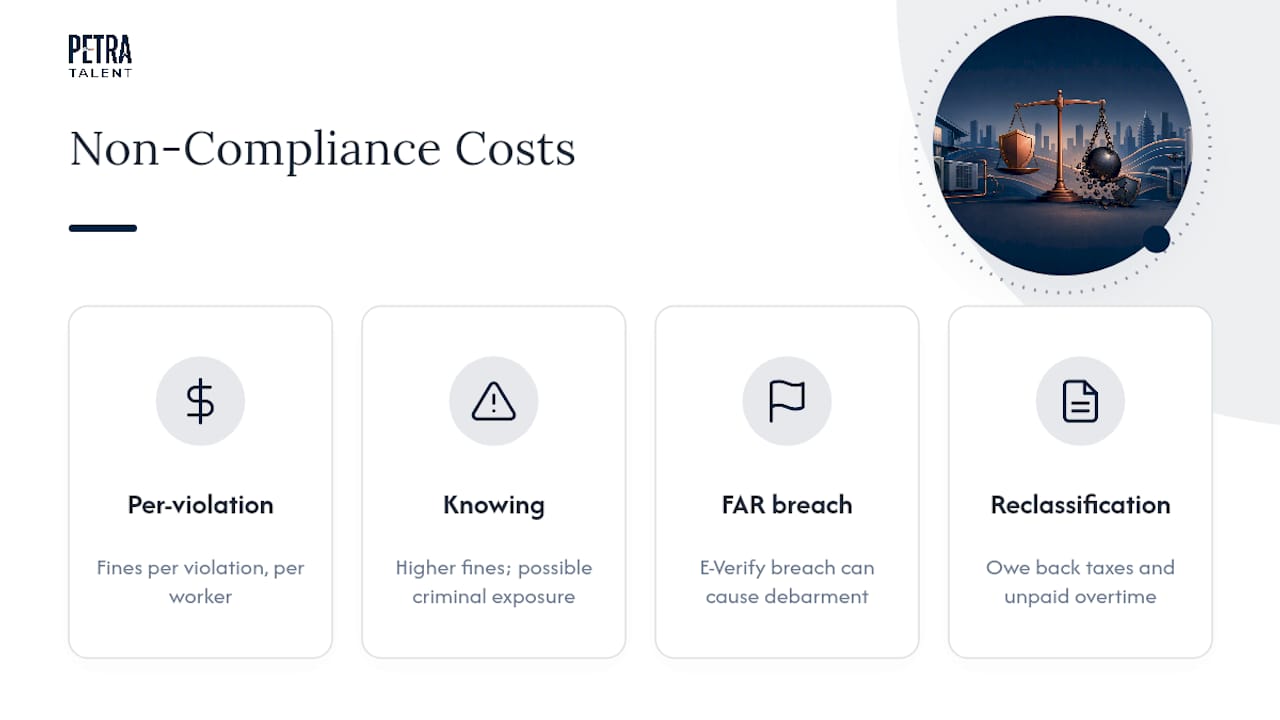
Substantive I-9 violations, missing signatures, uncompleted sections, expired documents accepted as valid, carry civil penalties that increase per violation and per affected worker. A shop running ten trucks with sloppy onboarding can rack up dozens of violations before anyone notices, because every incomplete form is counted separately during a Department of Homeland Security audit.
Knowing violations, meaning you knowingly hired or continued employing someone without authorization, carry steeper penalties and can escalate to criminal exposure for repeat or willful conduct. For a mechanical contractor bidding public work, an E-Verify violation on a FAR-covered contract can also trigger contract debarment, which is far more damaging than any fine. Losing eligibility to bid federal work over a documentation lapse is the kind of mistake that ends up costing more in lost revenue than the actual penalty.
There’s also the misclassification angle. If a “1099 helper” is later reclassified as an employee, retroactively, you may owe back payroll taxes, unpaid overtime, and possibly unemployment insurance contributions, separate from any I-9 exposure. That’s the scenario where thin documentation on a contractor relationship turns an audit into a five-figure problem.
The practical takeaway for trade employers: the risk isn’t usually one dramatic violation. It’s the accumulation of small, avoidable gaps, a missing Section 2 signature here, an E-Verify case created a week late there, across a crew that turns over faster than the paperwork can keep up.
Subcontractors Who Aren’t Your Employees: What You Actually Owe
A lot of contractors assume that because a sub’s crew is working on their job site, they inherit some verification duty for those workers. Usually, that’s not correct.
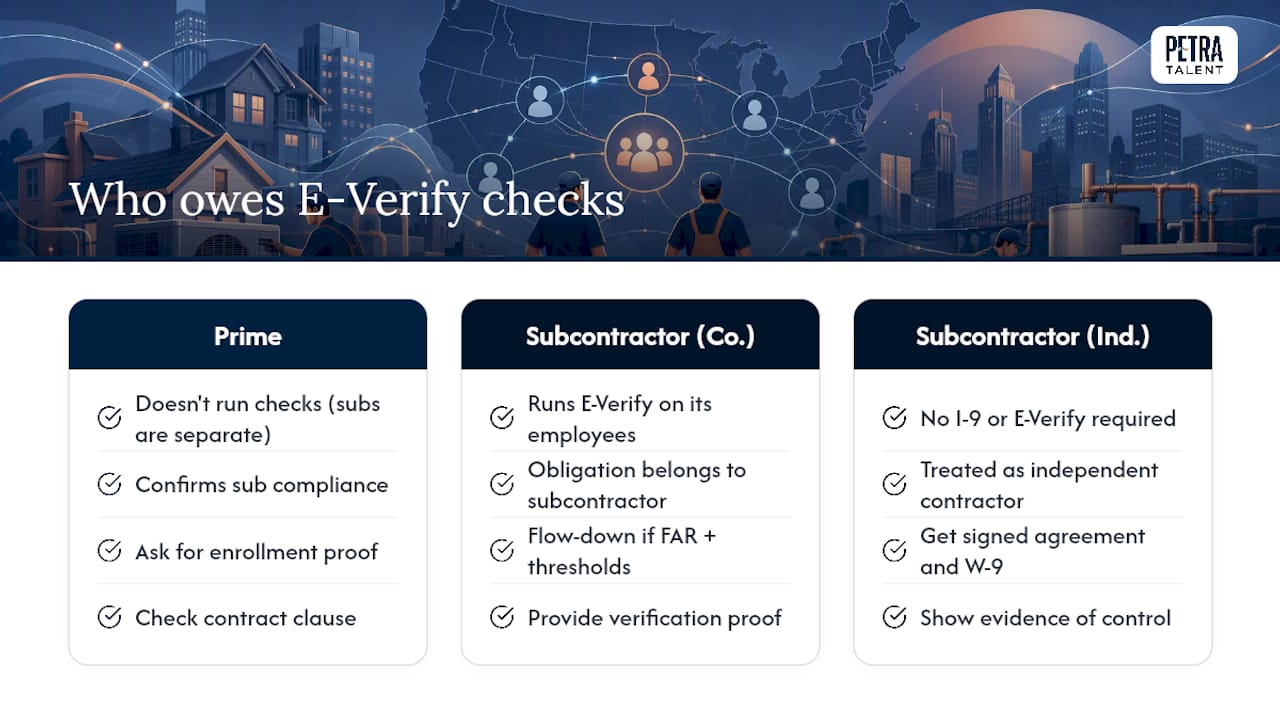
If you’re the prime and your subcontractor is a genuine, separate business with its own employees, you don’t run E-Verify checks on their crew. E-Verify obligations for that subcontractor’s workers belong to the subcontractor, not to you, unless your contract is silent on the issue and something else (like state law or a specific client requirement) says otherwise.
Where it gets real is federal work. If your prime contract carries the FAR E-Verify clause and your subcontract meets the value and performance thresholds, the flow-down obligation lands on the subcontractor directly. Your job as the prime is to confirm they’re actually complying, not to do the verification yourself. Ask for their E-Verify enrollment confirmation before work starts, and request written confirmation that the specific employees assigned to your contract have been verified.
For subcontractors who are individuals rather than companies, without employees of their own, you’re generally back in independent-contractor territory. No I-9, no E-Verify case, just solid documentation: a signed agreement, a W-9, and evidence they control how the work gets done.
The mistake to avoid in either direction: don’t assume flow-down applies just because the word “federal” appears somewhere in the job, and don’t assume it never applies just because you’re used to dealing with private commercial work. Read the actual contract clause every time.
Recent E-Verify Policy Shifts Trade Contractors Should Know
E-Verify’s core mechanics, I-9 first, case creation within three business days, TNC procedures, haven’t changed in ways that alter day-to-day compliance for most HVAC and plumbing shops. What has shifted is enforcement attention and how federal agencies handle contractor flow-down verification on covered projects.
Federal procurement continues to lean harder on E-Verify compliance as a condition of contract eligibility, which means mechanical contractors bidding public infrastructure, base maintenance, or government facility work should expect enrollment and verification proof to be checked earlier in the bid process, not just after award. Subcontractors on those jobs are seeing more proactive requests from primes for enrollment documentation up front, rather than after work has already started.
None of this changes the underlying rule for contractors who stick to private commercial and residential work: if your crews are true employees, I-9 applies; if you’re enrolled in E-Verify, the three-business-day case deadline applies; and independent contractors remain outside both requirements. The shift is really about federal buyers doing more verification of the verification, checking that subs actually did what the flow-down clause required instead of taking a signature on faith.
For contractors who do mix federal and private work, the safest move is treating every new contract, not just the big ones, as a document worth a five-minute read for E-Verify language before crews show up on site.
Why Misclassification, Not Malice, Sinks Most Trade Contractors
The compliance failures that actually cost HVAC and plumbing shops money are rarely dramatic. Nobody sets out to hide undocumented workers. What sinks contractors is sloppier and more common: a helper paid in cash for six months who quietly became a de facto employee, a “subcontractor” who takes daily instructions from the same foreman as the W-2 crew, an E-Verify case created eight days late because the office manager was out sick during a busy week.
The federal flow-down exception gets more attention than it deserves relative to how often it actually applies to a typical residential or light commercial mechanical contractor. Most shops reading this will never touch a FAR-covered contract. The real risk sitting in front of nearly every trade employer is classification drift, treating a worker as a 1099 today who functions exactly like an employee, and discovering that gap only when a disgruntled former worker files an unemployment claim.
Building a hiring process that captures classification decisions in writing, before the first day of work, does more to protect a contracting business than obsessing over E-Verify edge cases most crews will never encounter.
— David
Let Petra Talent Handle the Hiring Paperwork While You Run the Job
Some specialized recruiting agencies serve as an alternative to building your own compliance machinery from scratch. Instead of pulling a service manager off a job to chase down Section 2 signatures or track E-Verify deadlines, contractors who use such agencies may get candidates who arrive pre-vetted, with classification questions already sorted before an offer goes out.

That matters most in the moments this article has walked through: knowing whether a new hire needs an I-9 at all, whether your subcontract carries a FAR flow-down clause, and who on your team actually owns the three-business-day E-Verify deadline. Petra Talent’s HVAC recruiting services and plumbing recruiting services build technical vetting into the placement process itself, so onboarding paperwork isn’t scrambled together after someone’s already on a truck. For leadership hires where classification questions get more complicated, the leadership and management search service applies the same standard.
Placement fees run on a one-time basis, currently 18% per successful hire, detailed on Petra Talent’s pricing page. If your next hire is a technician, project manager, or subcontractor relationship you’d rather not manage alone, that’s the page to start with.
This article is general information, not a substitute for advice from a qualified lawyer. Consult a qualified legal professional about your own circumstances before acting on anything here.
Sources
- Who Must Complete Form I-9 | USCIS M-274 handbook
- E-Verify Quick Reference Guide for Employers
- E-Verify supplemental guide for federal contractors, subcontractors, independent contractors
- Employment Eligibility Verification | USCIS (Form I-9)
FAQ
Does E-Verify apply to independent contractors in HVAC or plumbing?
No. E-Verify and Form I-9 apply to employees hired for wages, not to genuine independent contractors. The exception is a federal-contract flow-down that can require a subcontractor to verify its own employees, not the independent individuals it hires.
How soon must I create an E-Verify case after hiring someone?
You must create the case no later than the third business day after the employee starts work for pay, according to E-Verify’s Quick Reference Guide. Section 2 of Form I-9 must also be completed within that same three-business-day window.
Do subcontractors always have to enroll in E-Verify?
Only if their subcontract carries the FAR E-Verify clause, typically tied to contract value, performance location, and scope, per E-Verify’s federal contractor guidance. Subcontractors on private commercial or residential jobs generally have no E-Verify obligation at all.
How long do I need to keep completed Form I-9s?
Retain each Form I-9 for three years after the date of hire or one year after termination, whichever is later, per USCIS retention rules. Store them separately from general personnel files with restricted access.
Can Petra Talent help reduce I-9 and E-Verify mistakes during hiring?
Petra Talent’s technical vetting process front-loads classification and documentation checks before a candidate ever starts a job, reducing the scramble that causes missed deadlines. Details on service scope are available through Petra Talent’s HVAC recruiting services page.
Recommended
Post a comment
Related Posts

September 20, 2026
Construction Offer Letters for HR: Site Assignments, Certs, Petra Tips
HR ready construction offer letters: copy ready language for site assignments, certs, contingencies, and a…
September 18, 2026
72.5¢ Rate: Take Home Vehicle Policy for Employers and Agencies
Checklist and policy language for employers and agencies: apply the IRS 2026 mileage rate (72.5…

September 17, 2026
Avoid Overtime Back-Pay: Job-to-Job Travel Pay for U.S. Technicians
U.S. employers: learn DOL/WHD travel-pay tests, a blended rate overtime example, state pitfalls, and Petratalent…

September 16, 2026
Chiller Technician Skills Employers Check on Resumes and in Interviews
Employer tested checklist for chiller technicians: refrigeration, electrical and controls, EPA 608, OSHA/NATE, plus resume…