



A take-home vehicle policy lets eligible employees drive assigned vehicles home for business-related commuting while controlling tax exposure, insurance risk, and operating costs. The policy must set objective eligibility rules, apply consistent IRS valuation with real substantiation, and lock in operational controls: insurance verification, driver qualification, and incident reporting. Skip any one of those three, and the program turns into a liability instead of a retention tool.
TL;DR:
- Eligibility should be based on measurable criteria such as callback frequency, equipment needs, and business mileage thresholds, with clear thresholds set by the employer.
- Proper valuation methods, documentation, and substantiation, including mileage logs or telematics, are essential to avoid tax liabilities and IRS penalties.
- A designated program owner must review and approve assignments, with recertification occurring at least annually to ensure continued eligibility and utilization.
- Personal use rules should explicitly distinguish between commuting, incidental personal trips, and business use, with geographic and callback limits clearly defined.
- Vehicle return, insurance coverage, maintenance, incident reporting, and fuel handling procedures must be documented and enforced to prevent liability and operational issues.
Table of Contents
- What Goes Into a Take Home Vehicle Policy Checklist
- How Should Employers Set Take-Home Vehicle Eligibility?
- Is a Take-Home Vehicle Policy Taxable?
- Who Should Approve and Review Take-Home Vehicle Assignments?
- What Personal Use Rules Should the Policy Set?
- How Should Mileage and Telematics Records Be Tracked?
- Does Insurance Cover Take-Home Vehicle Use?
- What Maintenance and Incident Reporting Rules Apply?
- What Take-Home Vehicle Policy Means for Hiring and Onboarding
- How Much Vehicle Use Justifies a Take-Home Assignment?
- What Should the Employee Acknowledgment Form Include?
- How Should Employers Enforce the Policy and Handle Violations?
- What Happens to the Vehicle When an Employee Leaves?
- How Should Fuel Costs Be Handled Under the Policy?
- How Do Sustainability Goals Fit Into Vehicle Choice?
- How Does the Policy Connect to Fleet Management Systems?
- When Does a Take-Home Program Make Sense?
- How Petra Talent Supports Employers Building These Programs
- Sources
- FAQ
What Goes Into a Take Home Vehicle Policy Checklist
Before drafting language, contractors and public agencies benefit from working through a short checklist. It forces every decision that otherwise gets discovered the hard way, usually during an audit or after an accident.
Use this as a working draft framework, not a final document:
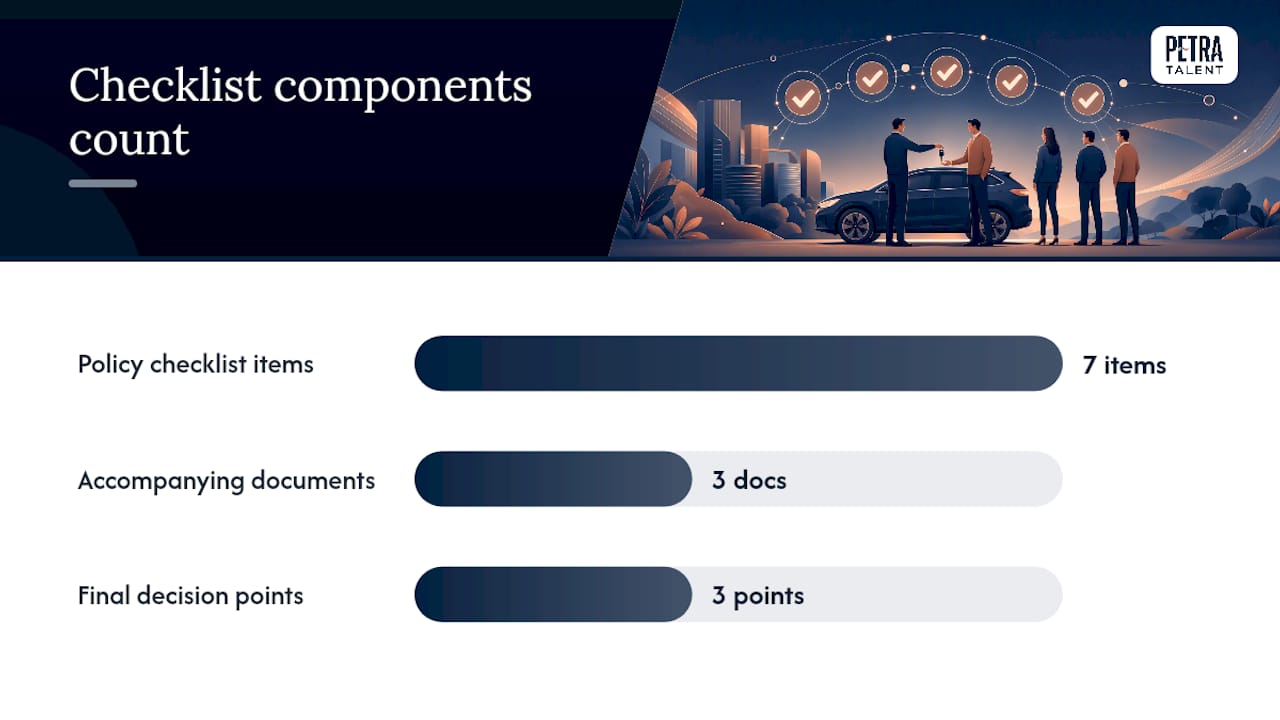
- Eligibility rules: Written, measurable criteria for who qualifies (callback frequency, equipment needs, business mileage thresholds).
- Valuation method: A named IRS method (Commuting Rule, Cents-Per-Mile, or Annual Lease/FMV) tied to specific vehicle and use conditions is required.
- Tracking requirement: A mileage log or telematics system with defined fields and a submission schedule.
- Approval workflow: A single program owner, a documented request form, and a rule against self-approval.
- Insurance verification: Confirmation the commercial auto policy covers take-home use, with endorsements added where gaps exist.
- Security provisions: Overnight parking rules and tool-storage requirements for vehicles carrying equipment.
- Incident reporting: A defined timeline for reporting accidents, damage, or citations.
Three documents should accompany every assignment: an authorization request signed by a supervisor, an employee attestation acknowledging use restrictions, and a mileage log template the employee will actually use. Portland’s HRAR 4.14 guidance builds its entire take-home framework around exhibits like these, precisely because unattached paperwork gets skipped.
Before finalizing anything, resolve three decision points: whether any personal use beyond commuting will be allowed, whether commute distance will be capped geographically, and what happens the first time an employee violates the terms. Vague answers to these three questions are the most common reason take-home programs collapse under audit or legal challenge.
How Should Employers Set Take-Home Vehicle Eligibility?
Eligibility works best when it is measurable, not discretionary. A supervisor’s judgment call, however well intentioned, invites claims of favoritism and creates uneven treatment that HR departments end up defending later.
Three eligibility buckets cover most legitimate use cases:
- Emergency response: Employees who respond to callbacks outside normal hours and need immediate access to a vehicle and equipment.
- Special equipment: Roles where the vehicle carries tools, diagnostic equipment, or parts inventory that can’t reasonably be transferred to a personal vehicle each day.
- Economic benefit: Cases where take-home assignment demonstrably costs less than the alternative, such as pool vehicle staging or per-diem reimbursement.
King County’s take-home policy illustrates how to turn these buckets into numbers. The county’s Fleet Services office ties eligibility to specific thresholds: a minimum count of after-hours callbacks per period, a minimum share of business miles against total miles driven, and a documented equipment necessity test for roles that require it. Setting a number, even a conservative one, gives supervisors a defensible standard instead of a feeling.
Rotating schedules and part-time roles complicate this. A technician on a two-week rotation might clear the callback threshold during on-call weeks and fall well short otherwise. The cleanest fix is to average utilization across the full rotation cycle rather than measuring any single week in isolation. Temporary authorizations, such as a 90-day trial assignment during a seasonal surge, should carry an explicit expiration date and a required review before renewal.
Pro Tip: Build a short “equipment necessity test” into the authorization form. Ask whether the tools or inventory could reasonably fit in a personal vehicle and be secured overnight. If the honest answer is yes, the case for take-home assignment on equipment grounds gets much weaker, and reviewers should say so in writing.
At approval, collect two records minimum: an authorization request identifying the eligibility bucket and supporting metric, and a signed attestation acknowledging the personal-use rules and reporting obligations. The state auditor’s best-practice guide recommends exactly this pairing as the minimum documentation standard for defensible programs.
Is a Take-Home Vehicle Policy Taxable?
Yes, in most cases. Personal use of an employer-provided vehicle, including ordinary commuting, is a taxable fringe benefit under IRS rules unless it falls under a narrow exception. The real question for employers isn’t whether it’s taxable. It’s which valuation method applies and whether the paperwork supports it.
Three IRS methods cover nearly every take-home scenario:
- Commuting Rule: Values daily commuting use at a flat $1.50 per one-way trip ($3.00 round trip), available only when the employer requires the vehicle for legitimate business reasons and restricts personal use to commuting.
- Cents-Per-Mile Rule: Values personal miles at the IRS standard rate, but only applies when the vehicle’s fair market value at the time it’s first made available doesn’t exceed the IRS threshold for that year.
- Annual Lease Value/FMV Rule: Uses IRS lease value tables based on the vehicle’s fair market value, typically applied to higher-value vehicles or when other methods don’t fit the use pattern.
2026 figure to know: The IRS set the 2026 business standard mileage rate at 72.5 cents per mile, up 0.25 cents from the prior year. That rate matters directly if a fleet vehicle qualifies for Cents-Per-Mile valuation, since the vehicle’s FMV at assignment must fall under the IRS threshold before this method is even available.
Employers can’t simply pick whichever method produces the smallest taxable number. The vehicle’s value and use pattern determine eligibility for Cents-Per-Mile and Commuting Rule treatment, and the policy should name the applicable method explicitly rather than leaving it to payroll’s discretion at year-end.
Substantiation is where most programs actually fail. Without a mileage log or telematics record showing business versus personal miles, the IRS defaults to treating the full fair market value of use as a taxable benefit, which can push far more income onto an employee’s W-2 than the actual personal use justified. Require logs monthly, not annually, and have payroll reconcile logged miles against the chosen valuation method each pay period rather than scrambling at year-end.
Policy language should state plainly that failure to submit required logs may result in full FMV valuation being applied retroactively. That single sentence, uncomfortable as it sounds, is what protects both the employer’s accountable plan status and the employee from an unpleasant tax surprise.
Who Should Approve and Review Take-Home Vehicle Assignments?
Every defensible program needs one accountable owner, not a committee. The state auditor’s guide recommends centralizing administration under a single fleet coordinator role specifically because split ownership is how eligibility criteria drift and documentation gets lost between departments.
- Department supervisors submit requests. The immediate supervisor identifies a candidate, documents which eligibility bucket applies, and attaches supporting data (callback logs, equipment inventory, mileage estimates).
- The fleet coordinator reviews and approves. No employee, including the fleet coordinator, approves their own assignment. That single rule prevents the most common self-dealing complaint auditors flag.
- HR confirms driver qualification. Before final sign-off, HR verifies a current motor vehicle record check and confirms the employee meets any licensing requirements for the vehicle class.
- The employee signs the attestation. This document restates the personal-use rules, the tracking requirement, and the consequences of noncompliance.
- The program owner schedules recertification. Most government exemplars, including King County’s, recertify assignments annually; higher-turnover trades roles may warrant a semiannual review instead.
Recertification isn’t a formality. It’s the point where utilization data gets checked against the original eligibility threshold. An employee who cleared the callback minimum at approval but has fallen well below it for two consecutive quarters should trigger an automatic review, not wait for the annual cycle to catch it.
Retention matters too. Keep mileage logs, attestation forms, and authorization records for at least the length of your state’s employment tax audit window, commonly three to four years, and longer if litigation risk exists around a specific incident.
What Personal Use Rules Should the Policy Set?
Commuting, personal use, and business use aren’t interchangeable terms, and a policy that blurs them creates enforcement headaches. Commuting means direct travel between home and the primary work location. Personal use means any other non-business trip, including errands, family transportation, or weekend use. Business use covers everything tied directly to job duties, including callbacks and site visits.
Fleet and HR guidance generally points to three defensible models, and each carries real tradeoffs:
- No personal use beyond required commuting. The strictest option, and the easiest to defend under Commuting Rule valuation, but it requires the most consistent enforcement since any deviation is a clear violation.
- Commuting only, no incidental stops. A middle path that allows the drive home but prohibits detours for errands or family use, still qualifying for Commuting Rule treatment if genuinely enforced.
- Limited personal use with logging. The most flexible option for employers who want to offer take-home as a genuine benefit, but it pushes the vehicle into Cents-Per-Mile or FMV valuation territory and demands rigorous mileage logs.
The Work Truck Network’s guidance on driver policy recommends picking exactly one of these three models and stating it explicitly, rather than leaving personal-use boundaries implied. Ambiguity here is what turns a routine mileage discrepancy into a disputed tax liability.
Geographic limits matter as much as the use model. Set a maximum commute radius from the primary work site, and consider a response-time requirement for emergency-response eligibility, such as arriving on-site within 30 minutes of a callback. Passenger rules deserve their own line: most government policies prohibit non-employee passengers entirely, with limited exceptions for authorized ride-sharing during emergencies. Violations should carry a stated consequence, from a documented warning to loss of take-home privileges, spelled out in the policy rather than decided case by case.
How Should Mileage and Telematics Records Be Tracked?
A mileage log needs specific fields to hold up under review: date, starting and ending odometer readings, business purpose, and a business-versus-personal mileage split for each trip. A log that just totals monthly miles without that breakdown won’t satisfy IRS substantiation requirements no matter how consistently it’s submitted.
Digital tools solve part of this problem. Telematics systems and GPS-based fleet trackers automatically log mileage and route data, removing the guesswork of manual entry. Guides on budget-friendly small fleet tracking note that automated systems consistently produce cleaner substantiation records than handwritten logs, mainly because they eliminate the human tendency to reconstruct a week’s driving from memory on a Friday afternoon.
Telematics comes with its own obligations, though:
- Give employees a written privacy notice explaining what data is collected and how long it’s retained.
- Define a data retention period that matches your recordkeeping policy, not an indefinite default.
- Build a reconciliation process so telematics data and any manually logged trips agree before payroll applies a valuation method.
Pro Tip: Set a monthly submission deadline for logs, not an annual one. Employers who wait until year-end to review mileage records almost always discover gaps they can’t reconstruct, and those gaps default to the least favorable tax treatment.
Submission frequency should match your review cadence: monthly logs, monthly payroll reconciliation, quarterly spot audits. When a log is missing or looks inconsistent with known travel patterns, don’t guess. Document the gap, request written clarification from the employee, and if it can’t be resolved, apply the more conservative valuation method for that period rather than assuming the more favorable one.
Does Insurance Cover Take-Home Vehicle Use?
Check the commercial auto policy before assuming it does. Many commercial fleet policies carry exclusions or reduced coverage for personal use, and a take-home program that permits any personal driving may need an added endorsement to close that gap.
Before assignment, run these checks:
- Confirm with the insurance carrier whether take-home use, including commuting, is covered under the existing commercial policy or requires an endorsement.
- Require a motor vehicle record (MVR) check before authorization, and define disqualifying conditions up front (DUI convictions, license suspension, a pattern of moving violations within a set lookback period).
- Decide who pays for fines, parking tickets, and towing under different scenarios, and state it in the policy rather than resolving it after the first incident.
- Establish a repeat MVR schedule, not just a one-time check at hire.
Negligent entrustment is the liability employers underestimate most. If a company knowingly puts an unqualified or previously disqualified driver behind the wheel and that driver causes harm, the employer can be held directly liable, separate from any coverage the auto policy provides. Periodic MVR rechecks and a clear removal process for drivers who no longer meet standards are the two most effective mitigations, and both belong in the written policy, not just informal practice.
What Maintenance and Incident Reporting Rules Apply?
Operational rules are where day-to-day discipline either holds or falls apart. A policy that nails eligibility and tax treatment but skips maintenance responsibility will still generate disputes the first time a vehicle breaks down on a Saturday.
- Assign maintenance scheduling responsibility clearly. State whether the employee or a central fleet office schedules routine service, and who authorizes repair costs above a set dollar threshold.
- Set overnight security expectations. Vehicles carrying tools or diagnostic equipment should be parked in a secured location, with specific language about garage or locked-lot requirements where feasible.
- Require pre-shift inspections for equipped vehicles. A short checklist covering tire condition, fluid levels, and secured equipment takes minutes and catches problems before they become claims.
- Define the incident reporting timeline. Require any accident, damage, or citation to be reported within a set window, commonly 24 hours, with a named supervisor as the reporting contact.
- Escalate incidents by severity. Minor damage might route through a standard maintenance ticket; any accident involving injury or a police report should escalate immediately to HR and the insurance carrier.
Unsecured tools are an underappreciated risk. Vehicles carrying inventory or diagnostic equipment that sit unlocked overnight generate a disproportionate share of theft claims and insurance disputes, and a simple checklist-based inspection requirement closes most of that gap at almost no cost.
What Take-Home Vehicle Policy Means for Hiring and Onboarding
A take-home vehicle policy isn’t purely a fleet document. It shapes recruiting and onboarding the moment a technician role includes vehicle access as part of the offer. Job descriptions should state eligibility criteria plainly, including the MVR standard and any tool-handling responsibilities, so candidates understand the expectation before an offer is extended.
Onboarding checklists need to protect the employer from day one: a signed attestation, a completed MVR release, and documented vehicle-handling training before keys change hands. Skipping any of these at onboarding is how gaps surface later during an audit or after an incident.
Offering a take-home vehicle also shifts candidate expectations. In competitive trades markets, a well-run take-home program can meaningfully improve retention, but only when eligibility feels fair and consistently applied. Coordination between fleet management, HR, and recruiting is what makes this work. All three groups need access to the same MVR data and eligibility records, and technical vetting processes built for field roles should already account for driver qualification standards before a candidate ever reaches the offer stage.
How Much Vehicle Use Justifies a Take-Home Assignment?
Minimum utilization standards keep the program honest. Without a floor, a vehicle assigned for emergency response might sit unused for months while still costing the employer in depreciation, insurance, and fuel, with no operational justification left to show for it.
Set a minimum threshold tied to the original eligibility bucket. For callback-based eligibility, that might mean a required minimum number of after-hours responses per quarter. For equipment-based eligibility, it might mean a minimum share of logged miles tied to job duties rather than personal errands. King County’s approach ties these thresholds directly to Fleet Services review, so utilization data isn’t just collected, it’s actually acted on.
Commute boundaries need their own limit. A geographic radius from the primary work site, commonly capped at a set number of miles, keeps the commuting benefit proportional to the business need and prevents the program from effectively becoming a long-distance transportation subsidy. Employees who move farther from their assigned work site after receiving a take-home vehicle should trigger a review, not an automatic continuation.
When utilization falls below the threshold for two consecutive review periods, the policy should require either reassignment justification or removal of the vehicle. Building that trigger into the recertification process, rather than leaving it to informal judgment, is what keeps the program defensible when someone eventually asks why a particular employee still has one.
What Should the Employee Acknowledgment Form Include?
Every take-home assignment needs a signed acknowledgment, separate from the authorization request that got the assignment approved. The acknowledgment is the employee’s own confirmation that they understand the rules, not just evidence that a supervisor approved the assignment.
At minimum, the form should restate the applicable personal-use model, the required tracking method and submission schedule, the insurance and driver-qualification requirements, and the consequences of noncompliance. Portland’s HRAR framework treats this attestation as a load-bearing document precisely because it converts a verbal understanding into something enforceable.
The form should also include a specific line confirming the employee understands that failing to submit required logs may result in the vehicle being valued at full fair market value for tax purposes. That sentence protects the employer’s payroll position and gives the employee fair warning before, not after, a tax surprise shows up on a paycheck.
Store signed acknowledgments with the authorization request and mileage logs for that employee, and require a new signature whenever the vehicle, the eligibility basis, or the personal-use model changes. A form signed three years ago under a different use model won’t hold up if the actual practice has since shifted.
How Should Employers Enforce the Policy and Handle Violations?
Enforcement only works when consequences are defined in advance and applied consistently. A policy that lists rules but never states what happens when someone breaks them tends to get enforced unevenly, which is its own liability.
Structure a graduated response: a documented verbal warning for a first minor violation (an unreported errand stop, a late log submission), a written warning with mandatory retraining for a repeat or moderate violation (missing logs for a full period, an unreported minor incident), and suspension or permanent loss of take-home privileges for a serious violation (unauthorized personal use, falsified logs, an unreported accident). Some violations, particularly falsified records or a DUI on the employee’s driving record, warrant immediate removal regardless of prior history.
Whoever administers the program, ideally the same fleet coordinator who handles approvals, should also own enforcement decisions, so violations get judged against the same standard every time. Document every incident and the resulting action in the employee’s authorization file, not just in a general HR note, so recertification reviews have the full history available.
What Happens to the Vehicle When an Employee Leaves?
Termination and resignation both need a defined vehicle-return process, and it should be triggered automatically, not left to whoever remembers to ask for the keys back. Build vehicle recovery into the standard offboarding checklist alongside badge and equipment return.
For a resignation with notice, schedule vehicle return on the final working day, and have the fleet coordinator inspect the vehicle against the pre-assignment condition report before releasing the employee’s final paycheck where state law permits that kind of holdback. For an involuntary termination, especially one with any tension involved, arrange vehicle recovery immediately, ideally before or at the same time the employee is notified, to avoid a vehicle sitting unaccounted for during a difficult conversation.
Either way, run a final mileage log reconciliation and settle any outstanding personal-use valuation before the employee’s final pay is processed. An unresolved mileage gap discovered after someone has already left the company is far harder to correct on a W-2 than one caught during active employment. Keep the signed acknowledgment and final inspection report in the personnel file for the same retention period as other program records.
How Should Fuel Costs Be Handled Under the Policy?
Fuel policy needs its own clear line, separate from mileage tracking. Most take-home programs cover fuel for business use through a company card or direct billing, but personal-use miles, if permitted at all under the chosen use model, should not be subsidized by the employer without being counted as additional taxable value.
State explicitly whether fuel purchases route through a company fuel card, a reimbursement process tied to submitted logs, or a fixed monthly allowance. A fuel card used for personal driving without a corresponding adjustment to taxable valuation creates the same substantiation gap as an unlogged mile, just paid for differently. If reimbursement is the model, tie it to the same mileage log required for tax substantiation rather than running a separate fuel-only tracking system that never reconciles with the valuation records.
Set a reasonable fuel efficiency expectation too, particularly for larger trucks or equipment-heavy vehicles where idling or auxiliary equipment use can inflate consumption well beyond normal driving patterns. A simple monthly fuel-cost review against expected mileage catches both mechanical problems and policy misuse early, before either becomes expensive.
How Do Sustainability Goals Fit Into Vehicle Choice?
Vehicle selection for a take-home fleet carries environmental weight that’s easy to overlook when eligibility and tax rules dominate the drafting process. Fuel efficiency and emissions performance affect both operating cost and public perception, especially for government fleets under public scrutiny.
Where the job allows it, favor hybrid or higher-efficiency models for roles that don’t require heavy-duty towing or specialized equipment mounting. For trades roles that genuinely need full-size trucks or vans, right-sizing the vehicle to the actual equipment load, rather than defaulting to the largest available option, reduces fuel consumption without compromising the job.
Idling policy belongs here too. Extended idling for climate control or auxiliary equipment during callbacks adds up across a fleet, and a simple idling-time guideline in the operational section of the policy can meaningfully reduce fuel spend and emissions without restricting legitimate equipment use. Electric and plug-in hybrid options are increasingly viable for shorter commute radii, and a policy written today should leave room to add them as fleet replacement cycles come up, rather than locking in combustion-only language that needs a full rewrite later.
How Does the Policy Connect to Fleet Management Systems?
A take-home vehicle policy works best when it’s not a standalone document sitting apart from the systems that actually run the fleet. Integrating policy rules directly into fleet management software turns eligibility thresholds, mileage logs, and maintenance schedules into something the system tracks automatically rather than something a coordinator checks manually every quarter.
Most fleet management platforms can flag utilization thresholds, schedule maintenance reminders, and store attestation documents alongside vehicle records, which closes the gap between what the policy says on paper and what actually gets tracked day to day. Telematics data, once reconciled with manual logs as described earlier, should feed directly into the same system that manages maintenance scheduling and insurance renewal dates, so a single dashboard reflects the vehicle’s full compliance picture.
For smaller fleets without a full management platform, even a shared spreadsheet with defined fields, tied to a consistent review cadence, achieves most of the same benefit. The goal is a single source of truth for each vehicle: who’s assigned to it, what eligibility basis justified the assignment, current utilization against the threshold, and the maintenance and insurance status. Fragmented records across departments are exactly what auditors and insurance carriers flag first when a program comes under review.
When Does a Take-Home Program Make Sense?
Take-home programs earn their cost when the signals are clear: frequent after-hours callbacks, equipment that can’t reasonably travel in a personal vehicle, or a documented economic case showing take-home costs less than the alternative. When those signals are weak or inconsistent across a role, a central pool vehicle, a designated staging site, or straight mileage reimbursement usually serves the same operational need at lower risk and cost.
Before committing fleet-wide, pilot the decision with real numbers: cost per mile against reimbursement, average callback frequency for the role, and actual utilization once vehicles are assigned. A pilot that shows a callback-eligible role barely clearing the threshold is a strong signal to reconsider the assignment before it becomes permanent.
— David
How Petra Talent Supports Employers Building These Programs
Take-home vehicle policies don’t operate in isolation from hiring. The eligibility standards, MVR checks, and equipment-handling training built into your policy need to show up in how you screen candidates long before an offer letter mentions vehicle access.
The company specializes in HVAC and plumbing recruiting, focusing on screening candidates for clean driving records, technical credentials, and tool-handling experience for equipment-heavy roles. That’s a meaningfully faster path to a compliant hire than running MVR checks and skills verification after an offer has already gone out. Petra Talent’s technical vetting and workforce solutions build driver and equipment qualification checks directly into the screening process, so onboarding checklist items like MVR release and vehicle-handling training are already confirmed before day one.
For contractors building out service teams where take-home vehicles are part of the offer, Petra Talent’s HVAC recruiting services and plumbing recruiting services source candidates against your specific eligibility criteria from the start. Placement runs on an 18% one-time placement fee, with flexible payment options available. Visit Petra Talent’s pricing page to see current terms, or reach out to discuss a role where driver qualifications and vehicle access are part of the hiring bar.
Sources
- IRS — IRS sets 2026 business standard mileage rate at 72.5 cents per mile, up 0.25 cents
- HRAR 4.14 — Take Home Vehicle Policy guidance (City of Portland)
- Best practices for take-home vehicle programs (State Auditor’s Office, WA)
- How to write a driver/vehicle use policy that holds up — Work Truck Network
FAQ
What Is the $3,000 Rule for Cars?
There is no IRS rule specifically called the “$3,000 rule” for take-home vehicles. Employers likely mean the fair market value threshold that determines eligibility for Cents-Per-Mile valuation, which changes annually and should be confirmed against current IRS guidance before applying that method.
What Are the Pros and Cons of Take-Home Police Cars?
Take-home police vehicles improve emergency response time and officer readiness, and many departments report morale benefits from the assignment. The tradeoffs include higher fleet costs, increased vehicle mileage and depreciation, and added liability exposure if usage rules or driver qualification standards aren’t enforced consistently.
What Is Kaitlyn’s Law?
Kaitlyn’s Law is a California statute addressing child endangerment related to vehicles, not a take-home vehicle fleet regulation. It isn’t part of standard employer take-home vehicle policy frameworks and shouldn’t be confused with fleet-specific compliance rules.
Am I Liable if My Employee Drives My Vehicle Without a License and Something Happens?
Yes, an employer can face significant liability, including negligent entrustment claims, for knowingly allowing an unlicensed or disqualified employee to drive a company vehicle. A pre-assignment MVR check and a documented disqualification process are the primary safeguards against this exposure.
Is a Take-Home Vehicle Policy Taxable for the Employee?
In most cases, yes. Personal use of an employer-provided vehicle, including standard commuting, counts as a taxable fringe benefit unless it qualifies for a specific IRS exception, and the employer must apply a consistent valuation method with proper substantiation.
What’s the Difference Between a Take-Home Vehicle and a Vehicle Allowance?
A take-home vehicle policy assigns a specific company-owned vehicle for business and limited personal use, while a vehicle allowance or mileage reimbursement compensates employees for using their own personal vehicle for work purposes. Employers choose between the two based on cost comparison, equipment needs, and callback frequency for the role.
Recommended
Post a comment
Related Posts

September 20, 2026
Construction Offer Letters for HR: Site Assignments, Certs, Petra Tips
HR ready construction offer letters: copy ready language for site assignments, certs, contingencies, and a…

September 19, 2026
Create E-Verify Cases by Day Three: U.S. HVAC & Plumbing Rules
E-Verify for U.S. HVAC and plumbing contractors: who needs I-9s, the three business day case…

September 17, 2026
Avoid Overtime Back-Pay: Job-to-Job Travel Pay for U.S. Technicians
U.S. employers: learn DOL/WHD travel-pay tests, a blended rate overtime example, state pitfalls, and Petratalent…

September 16, 2026
Chiller Technician Skills Employers Check on Resumes and in Interviews
Employer tested checklist for chiller technicians: refrigeration, electrical and controls, EPA 608, OSHA/NATE, plus resume…