



TL;DR:
- The HVAC labor shortage stems from retirements, rising demand, and increasing job complexity, creating a structural workforce gap. Contractors must invest in proactive recruitment, training, and retention strategies to avoid operational disruptions and rising costs. Policy changes and workforce development efforts are critical but limited in addressing the immediate supply-demand imbalance.
The HVAC labor market tightens because experienced technicians are retiring faster than qualified replacements can enter the field, while demand for HVAC services keeps climbing. The Bureau of Labor Statistics projects 8% employment growth from 2024 to 2034, generating more than 40,100 job openings annually from both growth and replacement demand. That gap is structural, not cyclical. Modern HVAC roles now require digital controls expertise, refrigerant transition knowledge, and system integration skills that most incoming candidates simply do not have. The result is a workforce shortage that compounds every year without deliberate intervention.
- Technician retirements outpace new entrants, creating a persistent supply deficit
- Rising demand from climate factors, new construction, and equipment retrofits adds pressure
- Job complexity has increased sharply, shrinking the qualified candidate pool
- Employment is projected to grow 8% from 2024 to 2034, with 40,100 job openings annually
- The shortage is structural and will not self-correct without proactive workforce investment
Key causes behind the HVAC workforce shortage
The aging workforce is the single largest driver. The Air Conditioning Contractors of America (ACCA) reports that nearly 30% of technicians are over 55, and the average technician age is 55. That concentration of older workers means retirements are not a future concern. They are happening now, at scale.
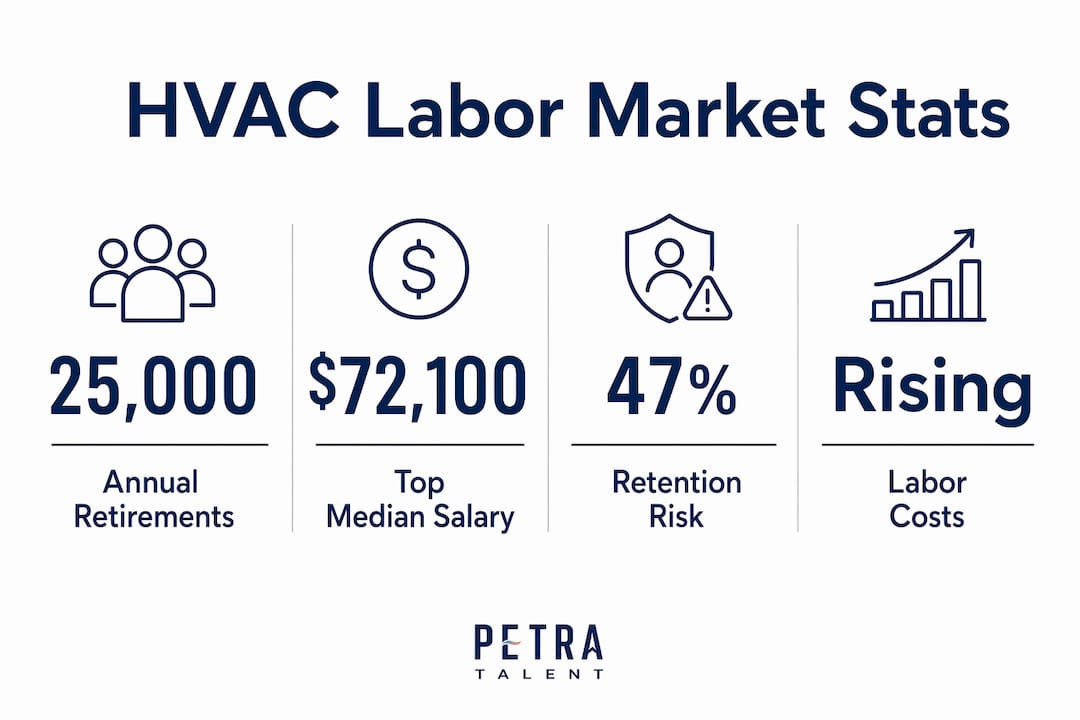
Approximately 25,000 experienced technicians exit the workforce every year through retirement or career changes. The training pipeline replacing them falls short. Vocational education programs were systematically defunded over the past two decades as school counselors directed students toward four-year degrees, and rebuilding that pipeline takes years, not months. A peer-reviewed study published in ASCE’s Journal of Legal Affairs and Dispute Resolution in Engineering and Construction traced the skilled trades shortage directly to this structural failure, compounded by pandemic-era early retirements and reduced immigration.
Technology complexity adds another layer. Modern HVAC roles require understanding digital controls, building automation systems, and integrated energy management, not just mechanical repairs. Heat pumps outsold gas furnaces by 32% in 2024, and technicians trained exclusively on gas systems need retraining before they can service heat pump equipment competently. Economic pressure also drives attrition. Inflation and uncertain career trajectories push workers toward fields with clearer advancement paths, and HVAC has historically done a poor job of communicating its long-term earning potential.
Pro Tip: Track your own workforce age distribution annually. If more than a quarter of your technicians are within ten years of retirement, you have a succession problem that needs a plan today, not when the first resignation letter arrives.
How labor shortages affect HVAC businesses and operations
The operational consequences of the HVAC workforce shortage show up in ways that directly affect revenue and service quality. Longer wait times during peak season are the most visible symptom. When a contractor cannot staff enough trucks, customers wait longer, and some call a competitor. That lost revenue is rarely recovered.

Labor costs are rising in direct response to tight supply. The national median HVAC salary moved from $57,300 in 2023 to $59,810 in 2024, a 4.4% increase against 3.4% inflation over the same period. Contractors competing for a shrinking pool of qualified technicians are bidding wages upward, and that cost pressure flows through to pricing and margins.
The deeper operational risk is knowledge loss. When a senior technician retires, the company loses diagnostic intuition built over decades. That kind of pattern recognition, knowing how a specific system behaves under load or why a recurring fault points to a particular component, cannot be transferred to a new hire in a week. Multiple junior technicians may be needed to replace the effective output of one experienced tech. Burnout among remaining staff compounds the problem, as fewer workers carry heavier workloads, increasing safety risk and quality variability.
Addressing structural challenges in recruitment, training, and retention
Reactive hiring is the default for most contractors, and it consistently underperforms. Posting a job when a technician quits means competing for candidates who are already in demand everywhere else. Strategic workforce planning shifts that posture, building a pipeline before vacancies appear rather than scrambling after them.
In-house training academies are the most effective structural response contractors can control directly. Leading contractors have built AI-powered simulation programs that compress trainee development timelines, reducing dependency on external pipelines that move too slowly. The instructor shortage compounds this challenge. Senior technicians often decline to transition into teaching roles because academic pay is lower and the work structure differs significantly from field work. Contractors who incentivize tech-to-teacher transitions, through compensation supplements or hybrid field-and-teaching schedules, address this bottleneck directly.
Retention requires more than competitive wages. 47% of operational talent say they would leave a job that offers no clear learning and development roadmap. Younger technicians, in particular, prioritize career advancement visibility over base pay alone. Structured apprenticeships, regular skill evaluations, and documented promotion criteria give technicians a reason to stay. Knowledge transfer programs, pairing senior techs with junior staff before retirements occur, preserve institutional knowledge that would otherwise walk out the door.
Pro Tip: Before a senior technician retires, run a structured knowledge capture process: document their diagnostic sequences, system-specific quirks, and customer relationship notes. That institutional knowledge has real dollar value and is often lost simply because no one asked for it in time.
Practical strategies to manage HVAC labor market challenges
Skill testing over resume screening changes who gets hired. A candidate with a strong mechanical aptitude and the right attitude can be trained. A resume that looks good but reflects outdated skills does not solve a staffing problem. Randstad’s analysis of over 150 million U.S. job postings from 2022 to 2026 found that skill testing consistently outperforms resume-based screening for identifying candidates with genuine potential in the trades.

Flexible scheduling is a concrete retention tool. Nearly half of the U.S. operational workforce identifies work-life balance as a decisive factor in accepting a job offer. Compressed workweeks and predictable rotation schedules give technicians stability without requiring remote work options that the trade cannot offer. Contract labor fills urgent gaps while permanent hiring catches up. The Randstad report recommends using expert trades talent on contract payroll to cover peak demand without overextending permanent staff.
Partnerships with vocational schools and community colleges build a longer-term pipeline. Contractors who sponsor apprenticeships, offer site visits, or co-develop curriculum with local programs gain early access to graduates before those candidates enter the open market. Pursuing HVAC certifications for technicians in specialized areas, including heat pump systems and A2L refrigerants, also increases both capability and retention, since certified technicians have a clearer professional identity and advancement path. AI tools can assist with scheduling complexity and lead management, freeing technician time for billable work rather than administrative tasks.
What the HVAC labor market could look like by 2031
The trajectory is clear without a significant change in workforce investment. HVACR Trends projects service labor rates could climb 40–60% above 2025 averages by 2031 if the workforce deficit holds at its current trajectory. That is not a worst-case scenario. It is the baseline if current retirement rates continue and the training pipeline does not accelerate.
The heat pump transition will intensify the skills gap specifically. Heat pump installation requires simultaneous competency in refrigerant handling, electrical systems, and digital controls. Technicians trained on legacy equipment need retraining, and the IRA-driven demand surge for heat pumps arrived faster than training infrastructure could accommodate. The 8% employment growth projection through 2034 means the industry needs more technicians at exactly the moment the existing workforce is aging out fastest. Service delays and premium pricing for urgent calls will become standard in the tightest markets. Contractors who invest in training and retention now will be positioned to capture that premium rather than lose customers to it.
How labor shortages vary by region
Geography shapes the severity of the shortage significantly. Florida and Arizona face compounding pressures: population growth, aggressive new construction, extreme heat, and aging commercial HVAC infrastructure all create demand simultaneously. Rural markets face a different version of the same problem. When a rural contractor loses two senior technicians in the same year, there is often no local candidate pipeline to draw from, and those markets cannot compete on compensation with metro areas.
Illinois carries the highest statewide median HVAC salary at $72,100, driven by Chicago’s unionized commercial market. Union hall wait times are real in that market, and non-union contractors compete against prevailing wages for a shrinking pool. The Midwest and Northeast face a specific equipment problem alongside the workforce problem: large commercial building stock installed in the 1990s is reaching end of service life, and many of the senior technicians who know that legacy equipment are retiring at the same time the replacement projects require them most. Contractors operating in these markets need local sourcing strategies that account for regional wage benchmarks and candidate availability.
How HVAC compares to labor trends in related trades
HVAC is not alone in facing a workforce shortage, but the combination of factors makes it particularly acute. Electricians, plumbers, and pipefitters face similar aging workforce dynamics and vocational training gaps. The peer-reviewed ASCE study noted that construction broadly faces a persistent mismatch between open positions and qualified candidates, driven by the same generational shift away from vocational education.
What distinguishes HVAC is the pace of technology change layered on top of the demographic problem. Electricians face new code requirements and EV charging infrastructure demands, but the core skill set evolves more gradually. HVAC technicians must simultaneously manage refrigerant transitions, heat pump adoption, building automation integration, and digital diagnostics. That rate of change compresses the effective experience of existing technicians and raises the entry bar for new ones faster than most related trades. The common recruitment challenges in HVAC are therefore more layered than in comparable skilled trades, requiring more targeted hiring and vetting approaches.
How policy and regulation shape the HVAC labor market
Regulatory changes are driving demand for technicians with specific technical competencies. The EPA’s AIM Act phasedown of high-GWP refrigerants requires servicing and eventually replacing millions of R-410A systems with A2L-compatible equipment. That retrofit and replacement cycle generates significant technician demand over the next decade, but it also requires retraining for technicians whose certifications do not cover A2L refrigerant handling.
On the supply side, vocational education funding reforms are underway at the state level. California’s apprenticeship funding push for HVAC and the trades is a live example, but education funding reform pays off on a 10–15 year horizon. It will not close the current gap. Federal workforce development programs and apprenticeship tax incentives exist but remain underutilized by smaller contractors who lack the administrative capacity to navigate them. The policy environment creates both demand pressure and a slow-moving supply response, which means contractors cannot wait for policy to solve the problem.
What labor shortages cost consumers
Consumers pay for the HVAC workforce shortage in two ways: higher prices and longer waits. When contractors cannot staff enough technicians, scheduling windows extend, particularly during peak summer and winter demand. In the tightest markets, customers already experience premium pricing for urgent service calls, a pattern that accelerates as the supply-demand imbalance widens.
Equipment replacement costs also rise when labor is scarce. A replacement job that requires a technician with A2L refrigerant certification or heat pump expertise commands a higher rate than a standard swap. Consumers in rural markets face the sharpest impact, since fewer contractors operate in those areas and competition that would otherwise moderate pricing is limited. The broader economic effect is that HVAC service, which is not discretionary for most households, becomes a larger share of household maintenance spending.
How immigration and visa policy affect HVAC workforce availability
Immigration has historically supplied a meaningful share of skilled trade labor in the United States. The ASCE peer-reviewed study identified reduced immigration as one of the compounding factors behind the post-pandemic skilled trades shortage, alongside early retirements and defunded vocational programs. When immigration slows, the pool of workers available to enter the trades contracts, and the HVAC industry feels that contraction alongside construction and other mechanical trades.
Current visa pathways for skilled trades workers are limited. The H-2B visa program covers temporary non-agricultural workers but is capped and heavily oversubscribed. There is no dedicated visa category for skilled HVAC technicians, which means contractors cannot directly recruit internationally trained technicians the way technology companies recruit software engineers. Policy changes that expand skilled trades visa access would increase labor supply, but no such changes are imminent. Contractors should plan workforce strategy around the labor pool that currently exists, not the one that policy might eventually create.
Key Takeaways
The HVAC labor market tightens because retirements, rising demand, and growing job complexity all move in the same direction at the same time, and the training pipeline cannot keep pace without deliberate contractor investment.
| Point | Details |
|---|---|
| Retirements drive the gap | About 25,000 technicians exit the workforce annually, outpacing new entrants every year. |
| Demand keeps rising | BLS projects employment will grow 8% from 2024 to 2034, with 40,100 job openings annually, driven by construction, equipment transitions, and climate factors. |
| Wages are climbing fast | The median HVAC salary rose from $57,300 in 2023 to $59,810 in 2024, a 4.4% increase that outpaces inflation. |
| Retention requires career paths | 47% of operational talent would leave a job with no clear learning and development roadmap. |
| Future costs will escalate | Service labor rates could climb 40–60% above 2025 averages by 2031 if the workforce deficit persists. |
Contractors who understand why the HVAC labor market tightens are better positioned to act before the shortage affects their operations directly. Petratalent specializes in sourcing and vetting skilled HVAC professionals across service, construction, and leadership roles throughout the United States. From direct hire placements to technical vetting and workforce consultation, Petratalent gives mechanical contractors a structured path to better hiring outcomes. For contractors ready to move from reactive to strategic, attracting experienced HVAC workers starts with the right recruitment partner.

Recommended
Related Posts

September 20, 2026
Construction Offer Letters for HR: Site Assignments, Certs, Petra Tips
HR ready construction offer letters: copy ready language for site assignments, certs, contingencies, and a…

September 19, 2026
Create E-Verify Cases by Day Three: U.S. HVAC & Plumbing Rules
E-Verify for U.S. HVAC and plumbing contractors: who needs I-9s, the three business day case…

September 18, 2026
72.5¢ Rate: Take Home Vehicle Policy for Employers and Agencies
Checklist and policy language for employers and agencies: apply the IRS 2026 mileage rate (72.5…

September 17, 2026
Avoid Overtime Back-Pay: Job-to-Job Travel Pay for U.S. Technicians
U.S. employers: learn DOL/WHD travel-pay tests, a blended rate overtime example, state pitfalls, and Petratalent…