




TL;DR:
- Effective candidate sourcing proactively builds a pipeline of qualified tradespeople before roles open, reducing time-to-fill.
- A six-stage process—including intake, market mapping, identification, qualification, outreach, and engagement—ensures successful sourcing for HVAC and plumbing roles.
Understanding how candidate sourcing works is the difference between waiting for applicants and building a pipeline of qualified technicians before a position opens. In HVAC and plumbing recruitment, that distinction matters more than in most industries. 70% of the global workforce are passive candidates who are not actively applying to job boards. That means the best pipe fitters, commercial HVAC technicians, and service leads are already employed. Sourcing is the process that reaches them. This guide breaks down every stage of that process, from intake to engagement, with specific application to trades recruitment.
Table of Contents
- Key Takeaways
- How candidate sourcing works: the 6-stage process
- Choosing the right sourcing channels and tools
- Crafting outreach that trades candidates actually answer
- Building and nurturing talent pipelines for trades roles
- My take on sourcing in the trades
- How Petratalent supports your sourcing efforts
- FAQ
Key Takeaways
| Point | Details |
|---|---|
| Sourcing vs. recruiting | Sourcing proactively identifies candidates before a role is posted, unlike reactive recruiting that waits for applications. |
| Six-stage process | Effective sourcing follows a defined workflow: intake, market mapping, identification, qualification, outreach, and engagement. |
| Channel selection matters | Matching sourcing channels to where trades candidates actually spend time increases qualified response rates. |
| Personalization drives replies | Messages referencing specific details about the candidate or role can raise response rates from 18% to 26%. |
| Pipeline building reduces time to fill | Maintaining warm candidate lists means sourced hires fill roles 15 days faster than average. |
How candidate sourcing works: the 6-stage process
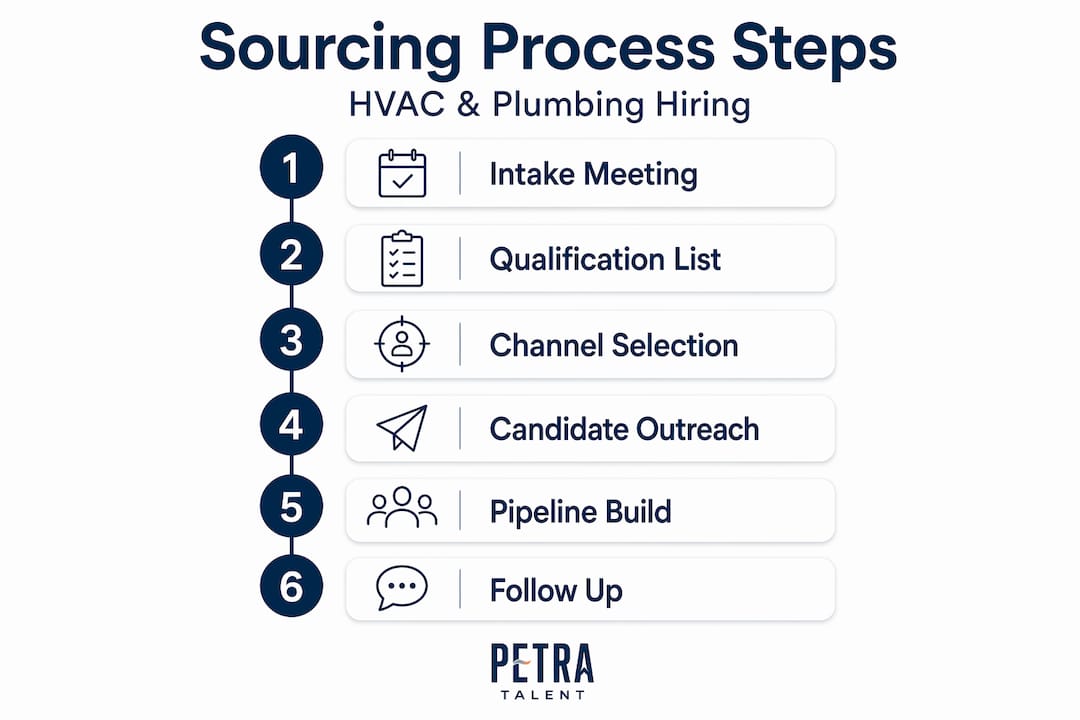
Successful sourcing follows a 6-stage workflow that starts well before the first outreach message is sent and ends only when a qualified candidate sits down for an interview. Here is how each stage applies specifically to HVAC and plumbing roles.
- Intake briefing. This is where sourcing either succeeds or fails before it starts. A structured intake conversation with the hiring manager defines the ideal candidate profile (ICP): required certifications such as EPA 608 or backflow prevention, years of field experience, preferred equipment brands, and compensation expectations. Structured intake conversations produce shortlists accepted 2.4 times more often by hiring managers, which means skipping this step costs time and credibility.
- Market mapping. Recruiters identify which companies employ the target candidate type, what titles they use, and which geographic markets have the highest concentration of qualified workers. For a commercial HVAC contractor in Houston, this might mean mapping large mechanical contractors, property management companies, and facilities management firms within a 50-mile radius.
- Candidate identification. This stage uses Boolean search strings, LinkedIn Recruiter, niche databases, and trade-specific communities to surface individual candidates. Searching for “refrigeration technician EPA 608 certified Texas” in LinkedIn or a trades-specific database pulls a far more relevant list than a generic job board post.
- Qualification. Not every name on that list belongs in the pipeline. Recruiters screen for the non-negotiables: active licenses, relevant experience types (residential versus commercial, service versus construction), and general availability signals such as job changes or recent LinkedIn activity.
- Personalized outreach. Crafting a message that references the candidate’s specific background is what separates a reply from an ignored notification. A note mentioning a technician’s Trane certification and recent work on large commercial systems will outperform a generic “great opportunity” message every time.
- Engagement and scheduling. True sourcing ends only when a qualified candidate is scheduled for an interview, not when the first message is sent. Follow-up, answer facilitation, and coordination through the scheduling stage are all part of the sourcing function.
Pro Tip: Define at least five non-negotiable qualifications and three preferred qualifications before starting any sourcing effort. Hiring managers who can articulate these in the intake meeting produce clearer targets and better results.
Choosing the right sourcing channels and tools
Not all sourcing platforms work equally well for HVAC and plumbing talent. Choosing the right mix is one of the most practical candidate sourcing strategies a recruiter can apply.
| Channel | Best for | Limitation |
|---|---|---|
| LinkedIn Recruiter | Project managers, supervisors, sales roles | Many field techs are inactive or absent |
| Niche trade job boards | Licensed journeymen, apprentices | Primarily active candidates only |
| Trade association directories | Certified professionals, niche specialists | Requires manual outreach effort |
| Employee referrals | All levels, especially field roles | Depends on existing employee network |
| AI sourcing platforms | Passive candidates at scale | Requires human follow-up to convert |
Employee referrals deserve specific attention. Referrals require 18.5 times fewer applications per hire than job boards, making them one of the most efficient channels in trades recruiting. A plumbing contractor whose journeymen know other journeymen is sitting on a sourcing channel that most hiring managers underuse.
AI-powered platforms are changing the identification stage. Semantic AI expands candidate discovery beyond keyword matching, surfacing candidates who list “refrigeration systems” rather than “HVAC” or “drain installation” rather than “plumbing.” That kind of terminology variation is common in trades and often causes strong candidates to go undetected in a manual Boolean search.
Effective candidate sourcing methods in HVAC and plumbing typically combine three to four channels rather than relying on one. Consider this starting mix:
- LinkedIn for supervisory and leadership roles
- Trade association directories and licensing boards for certified specialists
- Employee referral programs with structured incentives
- AI sourcing tools for field technician identification at scale
- Regional trade events and union halls for local talent networking
For attracting experienced HVAC workers, the channel mix matters as much as the message itself.
Crafting outreach that trades candidates actually answer
Generic outreach is one of the biggest failure points in candidate sourcing. Trades professionals are not sitting at desks refreshing their inboxes. Many are on job sites. When a message does reach them, it has a narrow window to create interest.
Personalized messages referencing at least three specific details about the candidate or role increase response rates from 18% to 26%. For a plumbing recruiter, that means mentioning the candidate’s specific license type, the type of work they have done (commercial new construction versus service repair), and something concrete about the opportunity such as a company truck, union benefits, or a specific project type.
Best practices for outreach to HVAC and plumbing candidates include:
- Keep initial messages under 100 words. Long messages rarely get read on mobile.
- Lead with something specific about the candidate’s background, not a generic compliment.
- Name the actual role and location. Vague messages signal low effort.
- Include one clear call to action, such as a 15-minute call or a link to schedule.
- Follow up across multiple touchpoints. Multi-channel outreach with 3 to 5 touchpoints improves engagement, especially for passive candidates who may miss the first contact.
Understanding plumbing trade recruitment specifics helps sharpen both message content and timing. A plumber wrapping up a commercial project is often more receptive to a new opportunity than one in the middle of a multi-month job.
Pro Tip: Send the first message mid-week between Tuesday and Thursday, and time follow-ups for early morning or early evening when trades workers are more likely to check their phones.
Building and nurturing talent pipelines for trades roles
One of the most underused steps in the candidate sourcing process is pipeline management. Most contractors and recruiters source reactively, starting from scratch when a position opens. A maintained pipeline eliminates that delay.

Defining an Ideal Candidate Profile beyond the job description is the starting point for a useful pipeline. Rather than listing only job duties, an ICP for an HVAC service technician might specify EPA 608 certification, three or more years on commercial rooftop units, a clean driving record, and a preference for candidates in commutable distance to a service territory.
Here are four practices that keep a pipeline functional over time:
- Segment candidates by readiness. Separate warm candidates (open to talking now) from passive candidates (happy in their current role but worth nurturing) and future candidates (recently placed or under contract but worth revisiting in six months).
- Schedule regular touchpoints. A quarterly message sharing a relevant industry update, a wage benchmark, or a genuine check-in keeps the recruiter visible without being intrusive. Candidates who feel respected over time are far more likely to respond when an opportunity fits.
- Use your ATS to track pipeline health. Log every interaction, certification update, and availability note in the applicant tracking system. Sourced hires fill roles faster than average precisely because the groundwork is already done.
- Convert nurtured candidates into referrals. A candidate who is not ready to move often knows someone who is. A recruiter who has treated that person well is the one they will refer.
My take on sourcing in the trades
I have worked in skilled trades recruitment long enough to notice what separates contractors who consistently hire well from those who scramble every time a technician gives notice. The difference is almost never the job posting. It is almost always the intake meeting and the pipeline.
The intake meeting gets skipped because it feels like a formality. It is not. It is where a recruiter learns that the hiring manager actually needs someone with chiller experience, not just “commercial HVAC,” and that they are flexible on license type if the candidate has five years on the specific equipment they run. That kind of detail changes the entire sourcing approach.
AI is a powerful multiplier in sourcing but it does not replace a recruiter who can have a real conversation with a skeptical journeyman plumber about why a new employer is worth considering. The tools cut research time. The human connection closes the conversation. Relying too heavily on either one produces the same result: a thin pipeline and a long time to fill.
For recruiters new to HVAC and plumbing, the fastest way to improve is to study common HVAC hiring mistakes and reverse-engineer what went wrong in past searches. Usually it comes down to a vague ICP, a single sourcing channel, or outreach that sounded like it was written for a tech sales role.
— David
How Petratalent supports your sourcing efforts
Petratalent specializes in sourcing and vetting skilled tradespeople for HVAC and plumbing contractors across the United States. The sourcing process at Petratalent covers every stage discussed in this article: structured intake meetings, market mapping, multi-channel candidate identification, technical screening, and pipeline management built around your specific roles and territory.
Whether you need a licensed commercial HVAC technician or a superintendent for a large mechanical project, Petratalent’s sourcing team works with the specificity that trades hiring requires. The same applies to plumbing recruiting services for journeymen, foremen, and project leadership. Explore Petratalent’s full services or reach out directly to discuss your current hiring gaps and get a sourcing strategy built around your workforce needs.
FAQ
What is candidate sourcing?
Candidate sourcing is the proactive process of identifying and engaging qualified candidates before a job is formally posted, rather than waiting for applications to arrive. It focuses heavily on passive candidates who are not actively job searching.
How does candidate sourcing differ from recruiting?
Sourcing identifies and warms up potential candidates, while recruiting moves those candidates through the formal hiring process including interviews and offers. Sourcing feeds the top of the recruiting funnel.
Why does sourcing matter for HVAC and plumbing hiring?
Most skilled tradespeople are already employed and not looking at job boards. Proactive sourcing is the only reliable way to reach this segment and fill specialized roles faster.
How many outreach touchpoints does it take to engage a passive candidate?
Multi-channel outreach with 3 to 5 touchpoints is typically needed to engage passive candidates, particularly trades professionals who are not active on professional networks.
What tools are most effective for sourcing HVAC and plumbing candidates?
A combination of LinkedIn Recruiter, AI-powered sourcing platforms, trade association directories, and structured employee referral programs covers the broadest range of candidate types in the HVAC and plumbing markets.
Recommended
- Blog – PetraTalent
- What industry-specific recruiting means for contractors
- Blog Modern 01 – PetraTalent
- Top 4 gettradejobs.com Alternatives 2026
Related Posts

October 13, 2026
Recruiting Contract Terms: 10 Checks and Ready to Use Clauses
Define fee triggers, candidate ownership, guarantees, and compliance terms. Get a master agreement, short schedule,…

October 12, 2026
Offer Acceptance Rates: Segment Benchmarks, HVAC’s 3–5 Day SLA
See why a 78% to 82% offer acceptance benchmark can mislead, how role and source…

October 11, 2026
Bad Hires Can Cost Construction Firms 30% to 200% of Salary
Bad hires can cost construction firms 30% to 200% of annual salary. Calculate recruiting, rework,…

October 10, 2026
Construction Labor Forecasting for PMs: 7 Steps to Time Hiring
Learn when construction project managers should use WBS or simulation, track labor KPIs, and turn…